




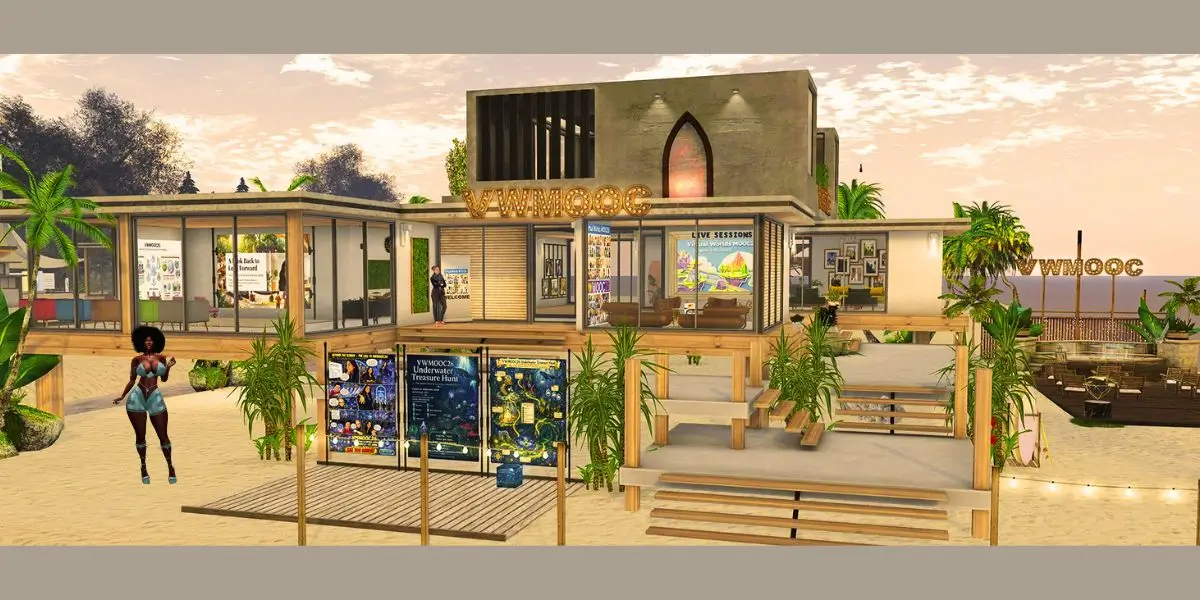
In an era where “online learning” often means staring passively at a grid of Zoom thumbnails, a quiet revolution has been brewing for over a decade. It doesn’t happen on a flat screen; it happens in a three-dimensional, persistent universe where you can fly, build a castle, and discuss quantum physics with an avatar from another continent. We are talking about the intersection of massive open education and virtual reality.
This August, the Virtual Worlds MOOC (VWMOOC26) returns for its 12th annual session, titled “Connecting in Virtual Worlds.” Running from August 2 to August 31, 2026, this free, month-long program is more than a conference—it is a living laboratory exploring how immersive environments, particularly Second Life, enhance education, artificial intelligence, and digital citizenship. But what is a MOOC in a virtual world, and why should educators, futurists, and lifelong learners care? Let’s step inside.
What Exactly is a MOOC, and How Does VWMOOC Break the Mold?
A Massive Open Online Course (MOOC) traditionally offers free, scalable access to educational content, often through pre-recorded lectures and text-based forums. The problem? Dropout rates are notoriously high because the human element is weak. This is where the Virtual Worlds MOOC (VWMOOC) diverges dramatically.
Founded in 2014 by Dr. Nellie Deutsch (known in-world as Nellie Homewood), VWMOOC isn’t a passive video library. It is an experiential layer built on top of the learning management system Moodle. When you join VWMOOC26, you aren’t just logging into a website; you are teleporting into a shared space. You inhabit a body (your avatar) that can gesture, build objects, and physically walk away from a group to have a private sidebar conversation—something impossible in a standard webinar.
By blending the structured curriculum of a MOOC with the spatial immersion of Second Life, the program tackles the isolation crisis of modern digital education. It answers a critical question: Can learning be deep, synchronous, and planetary in scale without feeling lonely? For twelve years, the answer has been a resounding yes.
The 2026 Theme: “Connecting in Virtual Worlds”
The theme for VWMOOC26, “Connecting in Virtual Worlds,” is both literal and aspirational. It comes at a cultural inflection point where the novelty of text-based AI has exploded, yet genuine human presence remains scarce digitally.
The Opening Ceremony: A Doorway to Immersion
The gateway to this month-long experience is the Opening Ceremony on August 2, 2026, at 12:00 PM SLT (Second Life Time/Pacific Time) . Held at the dedicated Academia region in Second Life, this isn’t a log-in screen; it’s a red carpet. Newcomers will witness a gathering of avatars—dragons, robots, business suits, and fantastical creatures—all piloted by real humans passionate about the future of learning.
Because Second Life operates on a persistent simulation, the Academia region isn’t a link you just click on a browser. You need the free Second Life viewer. However, the direct gateway to the event space is accessible via the game’s proprietary URI: http://secondlife.com (which directs you to the viewer download and location map). Once inside, the text-based virtual boredom of traditional webinars melts away, replaced by spatial audio and real-time body language.
Why Second Life Remains the Unrivaled Platform for Immersive Education
With the rise of Meta’s Horizon Worlds and high-end VR headsets, observers might ask: Why is VWMOOC still anchored in Second Life, a platform launched in 2003? The answer lies in accessibility and digital longevity.
Dr. Deutsch, who discovered Second Life in 2007 through a European initiative called MUVEnation, immediately recognized its educational scaffolding. Unlike many newer immersive technologies that require expensive virtual reality equipment, Second Life does not require a headset. This is a democratizing factor. A teacher in a public school with aging computer labs or a retired researcher with a standard laptop can inhabit the same world as a Silicon Valley technologist.
VWMOOC26 leverages this by offering a seamless hybrid model:
The Hub: A companion course on Moodle (hosted at Integrating Technology) for Zoom integration, asynchronous forums, and resources.
The Practice: Live, embodied gatherings in Second Life’s Academia region for tours, role-playing, and collaborative construction.
This dual-platform approach ensures that if you cannot handle the visual demands of the simulated world, you can join the Zoom streams. But the magic, the true connection, happens when you guide your avatar through the digital campus.
Curriculum and Core Topics: AI, Citizenship, and Creative Practice
VWMOOC26 isn’t a tech demo; it is a rigorous academic community organized by leading minds, including Dr. Doris Molero and Dr. Valerie Hill. The sessions explore four critical pillars:
1. Artificial Intelligence as a Collaborative Companion
The hot topic for 2026 is how generative AI intersects with 3D worlds. Sessions will move beyond “cheating fears” and explore how AI bots in Second Life can serve as language tutors or tour guides. Imagine an AI-driven historical character who can debate students inside a reconstructed Colosseum. The conversation explores how AI can be a scaffolding tool within immersive spaces, not a replacement for the human critical thought that virtual worlds nurture.
2. Digital Citizenship in Persistent Worlds
How do you govern a classroom where students can fly or create anonymous objects? Dr. Valerie Hill, a pioneering expert in digital citizenship, leads tracks on behavior, ethics, and the new social contract required when the laws of physics vanish. This is crucial for K-12 educators aiming to teach empathy in a metaverse context.
3. Global Networking and Live Practice
Forget the “peer-reviewed” post in a dead forum thread. Participants will engage in “poster sessions” where you literally walk your avatar up to a 3D model of your research and answer questions in real-time. Networking events are global—a Sunday morning coffee meetup for an educator in Texas is a late-night gala for a researcher in Japan, creating a truly asynchronous melting pot.
4. Micro-Credentials and Gamified Progression
A major draw for the 2026 iteration is the formalization of digital badges and verifiable certificates. By attending Zoom meetings (which verify identity) and completing in-world activities, participants earn stackable credentials. This transforms the free “hobby” of virtual learning into a documented professional development pathway recognized by institutions that demand Continuing Education Units (CEUs).
The Human Face of VWMOOC26: A Legacy of Generosity
To understand why 2026’s “Connecting in Virtual Worlds” feels different, you must understand the ethos of its founder, Dr. Nellie Deutsch. Since 2006, before the MOOC acronym was even coined by Dave Cormier, Deutsch was providing free professional development via Moodle.
Her journey into Second Life began not as a tech enthusiast, but as an educator seeking “presence.” In our spotlight data, she emphasizes that Second Life makes learning exciting without the friction of specialized hardware. Her philosophy—”Focus on your learning goals first, then explore how immersive environments can help learners achieve them”—is the golden rule of educational technology. You don’t need to be a master builder to benefit from VWMOOC; you just need a desire to dismantle the wall between your physical self and your digital potential.
How to Navigate VWMOOC26: A Beginner’s Guide to the Academy in the Cloud
For the uninitiated, jumping into a virtual world in 2026 can feel daunting. Here is your practical roadmap to connecting:
Reserve Your Place: The central hub is the Moodle course:
https://integrating-technology.org/course/view.php?id=13. Enrollment is completely free.Download the Portal: Acquire the Second Life viewer. Create your account (remember, “Resident” surnames are now standard).
Claim Your Avatar Identity: Don’t stay a default gray cloud. Spend an hour customizing. In VWMOOC, your visual expression is part of the communication.
Paste the Coordinates: Use the provided landmark for the Academia region. The environment is often crafted specifically for this event by community volunteers.
Master Spatial Chat: Unlike Zoom, distance matters. Walk close to someone to speak privately; step back to disappear from their audio stream. It’s the most human digital interaction you’ll have all year.
How to Participate and What You Will Gain
Joining VWMOOC26 requires minimal preparation. Interested participants should begin by visiting the program’s Moodle hub to register for the course and access the full schedule of events. From there, creating a free Second Life account allows access to the immersive components of the program, though many sessions are also available via Zoom for those who prefer traditional video conferencing.
The organizers, including Dr. Nelly Deutsch, Dr. Doris Molero, and Dr. Valerie Hill, have structured the program to reward participation meaningfully. Beyond the knowledge and connections gained through attendance, participants earn digital badges that verify their engagement with specific topics. Those who attend live Zoom meetings and actively participate in session activities can earn verifiable certificates documenting their professional development hours.
These credentials matter in an increasingly competitive educational job market. Administrators and hiring committees recognize that educators who proactively develop their digital competencies bring valuable skills to their institutions. Moreover, the network of colleagues cultivated during VWMOOC often becomes a lasting professional resource, with participants continuing to collaborate long after August ends.
Advice for Educators New to Virtual Worlds
For educators intrigued by immersive learning but uncertain where to begin, the VWMOOC community offers a gentle entry point. The most common mistake newcomers make is assuming they must become technical experts before participating. In reality, the most effective approach is to start with curiosity rather than expertise.
Begin by attending the opening ceremony and a few introductory sessions. Observe how experienced educators navigate the environment, ask questions in chat, and allow yourself to be a learner rather than an instructor during your first visits. Visit educational regions within Second Life outside of scheduled events to gain comfort with the interface. Focus on your pedagogical goals first — what do you want your students to understand or be able to do? — and then explore how immersive tools might help achieve those objectives.
Click the image below and come visit us now
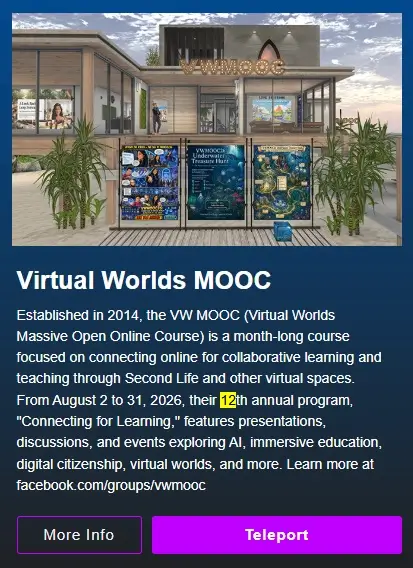
Remember that the VWMOOC community exists precisely because educators recognized the potential of these spaces and chose to support one another in realizing that potential. There is no expectation of prior expertise, only a shared commitment to improving education through innovative means.
VWMOOC on Moodle: https://integrating-technology.org/course/view.php?id=13
VWMOOC YouTube Introduction: https://youtu.be/anNZO8I9-Wo
Integrating Technology: https://integrating-technology.org
LinkedIn: https://www.linkedin.com/in/nelliedeutsch
Facebook group for Virtual Worlds MOOC: https://www.facebook.com/groups/vwmooc
Conclusion
In 2026, the term “metaverse” has been battered by hype cycles and corporate rebrandings. Yet, as the Virtual Worlds MOOC 26 proves, the true metaverse of education has been alive and thriving in Second Life for nearly two decades.
“Connecting in Virtual Worlds” is not just an event; it is a reminder that learning is fundamentally a social, embodied act. It demonstrates that we don’t need billion-dollar headsets to feel “present” with another human being across the globe; we just need a shared space and a shared purpose. Whether you are a librarian seeking to build immersive story-time sets, a linguist exploring AI-driven dialogue, or a curious skeptic, the doors to the Academia region are open.
Step inside. The 12th annual gathering of the world’s most passionate immersive educators awaits—not as a slideshow on your screen, but as a handshake in a world where distance is an illusion. We’ll see you on August 2nd.
Frequently Asked Questions (FAQs)
What is the Virtual Worlds MOOC, and how is it different from Coursera or edX?
The Virtual Worlds MOOC (VWMOOC) is a free, annual online professional development course that combines a Moodle learning management system with live, synchronous meetings in the 3D virtual world of Second Life. Unlike traditional MOOCs that rely on pre-recorded videos, VWMOOC focuses on embodied presence, spatial audio, and real-time avatar interaction to teach immersive education principles.
When does VWMOOC26 “Connecting in Virtual Worlds” start and end?
The 12th annual program takes place throughout August 2026. The opening ceremony is scheduled for August 2, 2026, at 12:00 PM SLT (Pacific Time) , and the event runs through August 31, 2026.
Is VWMOOC26 truly free, and will I earn a certificate?
Yes, registration is 100% free. By actively attending the Zoom-linked sessions and completing in-world activities, participants can earn verifiable digital badges and certificates. These are excellent artifacts for demonstrating continuing professional development.
Do I need a VR headset like an Oculus Quest to join the Second Life events?
Absolutely not. One of the core reasons VWMOOC uses Second Life is its accessibility. You only need a standard desktop or laptop computer (Windows or Mac), a stable internet connection, and the free Second Life viewer software. No VR headset is required.
What is the “Academia region,” and how do I get there?
The Academia region is the primary gathering space for VWMOOC inside Second Life. Once you have installed the free Second Life viewer and created an account, you can teleport there by clicking the specific landmark provided on the VWMOOC Moodle page or by searching for “Academia” in the world map.
How do I register for the VWMOOC26 zoom and Moodle sessions?
Registration is handled through the official Moodle hub hosted on Integrating Technology. You can sign up for free at https://integrating-technology.org/course/view.php?id=13. This site acts as your syllabus, resource vault, and portal for Zoom streaming links.
Who is organizing VWMOOC26, and who is it for?
The MOOC is organized by a collective of global educators, prominently including Dr. Nellie Deutsch, Dr. Doris Molero, and Dr. Valerie Hill. It is designed for K-12 teachers, university professors, instructional designers, librarians, researchers, and lifelong learners interested in the intersection of education and immersive technology.