













Buying cryptocurrency with cash usually comes with a trade-off: convenience at a physical location, but fees that can be difficult to understand.
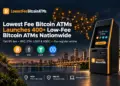
Lowest Fee Bitcoin ATMs is entering the U.S. market with a different pitch. The company announced on October 1, 2026, that it had launched more than 400 cryptocurrency ATMs across the country, offering cash purchases of Bitcoin, Ethereum, USDT and USDC at a stated flat fee of 5%.
The operator says its machines display both the fee and exchange rate before customers confirm a transaction. First-time customers can also pre-register online in approximately two minutes before visiting a machine.
The initial network includes locations in states such as Florida, California, Arizona and Texas, with machines installed in convenience stores, gas stations and shopping centers.
The company describes the launch as the first phase of a broader national rollout. It also says the machines are non-custodial, meaning purchased cryptocurrency is sent directly to the customer’s own wallet rather than being held by the operator.
What Did Lowest Fee Bitcoin ATMs Announce?
Lowest Fee Bitcoin ATMs announced the launch of more than 400 cryptocurrency ATMs across the United States on October 1, 2026.
According to the company’s launch announcement, the network allows customers to:
Buy Bitcoin with cash.
Buy Ethereum with cash.
Buy USDT with cash.
Buy USDC with cash.
Send crypto directly to a personal wallet.
View the transaction fee before confirmation.
View the exchange rate before confirmation.
Pre-register online before visiting a machine.
Use a phone number to access a completed registration.
Complete transactions without a traditional bank account or credit card.
The company says its initial rollout covers several U.S. states and that additional locations will be added in later phases.
Key launch details
The figures above come from the company’s launch materials and should be treated as operator-reported information. Customers should confirm current fees, limits, supported assets and location availability directly on the company’s website before using a machine.
Why Does a 5% Bitcoin ATM Fee Matter?
A stated 5% fee is lower than the 12% to 15% range commonly associated with many U.S. Bitcoin ATMs, according to the company’s comparison. Some operators may charge 20% or more, although the final cost can also depend on exchange-rate markups, network fees and transaction-specific conditions.
A posted percentage fee is only one part of the total price. Buyers should review the complete quote shown on screen before confirming.
What does a 5% fee look like?
If the posted fee is calculated directly on a $1,000 cash purchase:
A 5% fee equals approximately $50.
A 12% fee equals approximately $120.
A 15% fee equals approximately $150.
A 20% fee equals approximately $200.
This comparison excludes exchange-rate differences and other possible charges.
Expert Insight: The most useful comparison is not the advertised fee alone. Compare the final amount of cryptocurrency you receive after the fee, exchange rate, network charge and any applicable limits.
The company says its terminals display the fee and exchange rate before the customer presses the final confirmation button. That transparency can make it easier to compare the transaction with a live market price or another purchase method.
Which Cryptocurrencies Are Available?
The company says customers can purchase four assets with cash:
Bitcoin (BTC): The largest cryptocurrency by market capitalization and the asset most commonly associated with crypto ATMs.
Ethereum (ETH): A blockchain network asset used for transactions and applications built on Ethereum.
Tether (USDT): A dollar-pegged stablecoin issued across multiple blockchain networks.
USD Coin (USDC): A dollar-pegged stablecoin used for transfers, payments and digital-dollar exposure.
Availability may depend on the specific machine, wallet compatibility, network selection and local operating conditions.
Why are stablecoins included?
The company says a growing share of customers use USDT and USDC to send funds to relatives, suppliers and contractors abroad.
Stablecoins are designed to track the value of a reference currency, commonly the U.S. dollar. That can make them useful for digital transfers, but they are not identical to cash held in a bank account.
Users should understand:
Which blockchain network the transaction uses.
Whether the recipient’s wallet supports that network.
Whether network fees apply.
How the recipient can convert the stablecoin locally.
Whether local laws restrict the transaction.
Whether the stablecoin can maintain its intended peg.
A stablecoin transfer can arrive quickly, but speed does not eliminate the need to verify the recipient’s wallet address.
How Does Pre-Registration Work?
Lowest Fee Bitcoin ATMs says first-time customers can complete online pre-registration in approximately two minutes before visiting a machine.
The stated process is:
Open the company’s online registration page.
Enter the required information.
Complete the registration process.
Visit one of the company’s ATM locations.
Enter the registered phone number.
Select the cryptocurrency.
Scan the personal wallet QR code.
Insert cash.
Review the fee and exchange rate.
Confirm the transaction.
The company says customers who pre-register can avoid completing the full onboarding process at the kiosk.
Customers may also register directly at the ATM, although the operator says that process can take longer.
Why online pre-registration matters
Pre-registration could improve the user experience in several ways:
Less time at the machine.
Fewer manual data-entry steps.
Faster access for repeat customers.
A simpler first transaction.
More predictable onboarding.
However, users should review the company’s privacy policy before submitting personal information online. A faster checkout process is useful, but customers should understand what data is collected, how it is stored and how it may be used.
How to Use a Lowest Fee Bitcoin ATM
The exact interface may vary by machine, but the basic process follows a familiar crypto-ATM workflow.
Step 1: Find a location
Use the company’s location directory to identify a nearby machine. The initial rollout includes locations in Florida, California, Arizona, Texas and other states.
Check:
Address.
Store hours.
Supported cryptocurrencies.
Daily limits.
Cash requirements.
Verification tier.
Machine availability.
A listing does not necessarily guarantee that a machine is operational at the exact moment you arrive.
Step 2: Complete verification
Enter your registered phone number or follow the machine’s onboarding instructions.
The company lists two verification tiers:
Tier 1: Phone number only, with a stated daily limit of up to $2,000.
Tier 2: Government ID and Tax ID, with a stated daily limit of up to $50,000.
Verification requirements may vary by transaction amount, location and applicable regulations. Customers should follow the instructions displayed on the machine.
Step 3: Choose an asset
Select BTC, ETH, USDT or USDC.
Before continuing, confirm that the selected cryptocurrency matches the asset and network supported by your wallet. Sending a token through an incompatible network can create a recovery problem.
Step 4: Scan your wallet
The machine may display a QR scanner or ask you to scan the receiving address from your personal wallet.
Check the address carefully. Do not use a wallet address sent by an unknown person or provided during an unsolicited phone call.
Step 5: Insert cash
Insert the amount you want to convert. The machine should display the amount of cryptocurrency, the fee and the exchange rate.
Do not insert cash until you understand the full quote.
Step 6: Review the transaction
Check:
Cryptocurrency type.
Wallet address.
Amount of cash.
Fee.
Exchange rate.
Estimated crypto amount.
Network.
Any additional charge.
Transaction limits.
Step 7: Confirm and keep the receipt
Confirm only when the information is correct. Keep the receipt and transaction details until the cryptocurrency appears in your wallet.
Crypto transactions are generally irreversible. A receipt cannot guarantee recovery if funds are sent to the wrong address.
Pro Tip: Use a small test amount the first time you interact with a new machine or wallet. Confirm that the funds arrive correctly before attempting a larger transaction.
What Does Non-Custodial Mean?
The company says its Bitcoin ATMs are non-custodial, meaning the operator does not hold customer funds after the transaction.
In a non-custodial purchase:
The customer provides cash.
The customer supplies a wallet address.
The operator processes the transaction.
The cryptocurrency is sent to that wallet.
The customer controls the wallet’s private keys.
This differs from a custodial exchange account, where a platform holds assets on behalf of the customer.
Non-custodial does not mean risk-free. The customer remains responsible for:
Choosing the correct wallet address.
Securing the recovery phrase.
Protecting private keys.
Selecting the correct network.
Avoiding phishing links.
Confirming the transaction details.
If someone else controls the wallet or knows its recovery phrase, the customer may not have effective control over the funds.
Bitcoin ATM Fees Versus Other Buying Options
Bitcoin ATMs offer physical access and cash purchasing, but convenience may come at a higher price than some online alternatives.
The right option depends on the customer’s priorities.
A Bitcoin ATM may appeal to someone who:
Wants to use cash.
Does not have a credit card.
Prefers a physical location.
Needs a local purchase option.
Wants to send crypto directly to a personal wallet.
An exchange may be more suitable for someone who:
Wants lower trading costs.
Needs recurring purchases.
Requires advanced order types.
Wants access to account history.
Prefers bank-linked transfers.
The important comparison is not only “Which method is fastest?” It is “What is the total cost and risk for this specific transaction?”
Stablecoin Remittances and Cross-Border Transfers
Lowest Fee Bitcoin ATMs says customers are using USDT and USDC to send dollar-pegged digital assets to relatives, suppliers and contractors abroad.
A typical transaction may look like this:
A sender visits a crypto ATM with cash.
The sender buys USDT or USDC.
The sender enters the recipient’s wallet address.
The stablecoins are sent to the recipient.
The recipient holds, transfers or converts the assets locally.
This process can be faster than a traditional wire transfer, but it creates responsibilities for both sides.
What senders should verify
The recipient’s exact wallet address.
The blockchain network.
The stablecoin type.
The recipient’s ability to cash out.
The transaction fee.
Local legal and tax requirements.
Whether the recipient wants USDT or USDC.
What recipients should understand
Stablecoins are not identical to insured bank deposits.
A dollar peg can fluctuate or face market stress.
Conversion options vary by country.
A wallet address cannot be changed after confirmation.
Network mistakes may be difficult or impossible to reverse.
Expert Insight: Stablecoins can improve transfer speed, but they do not remove currency, custody, compliance or address-verification risk
Remittance Cost Example
The company’s launch material uses a monthly $1,000 remittance example to illustrate the impact of fees.
At a flat 5% fee:
One transaction costs approximately $50.
Twelve monthly transactions cost approximately $600 per year.
At a 12% fee:
One transaction costs approximately $120.
Twelve monthly transactions cost approximately $1,440 per year.
At a 15% fee:
One transaction costs approximately $150.
Twelve monthly transactions cost approximately $1,800 per year.
At a 20% fee:
One transaction costs approximately $200.
Twelve monthly transactions cost approximately $2,400 per year.
These are illustrative calculations based only on the stated percentage fee. They do not include exchange-rate spreads, network fees, taxes, recipient conversion costs or other charges.
For frequent remittance users, fee transparency can directly affect the amount that reaches the recipient.
Safety: Bitcoin ATMs and Scam Warnings
Bitcoin ATMs can be used for legitimate purchases, but scammers also exploit them because crypto payments are difficult to reverse.
The Federal Trade Commission warns that legitimate government agencies, banks and businesses will not unexpectedly tell consumers to withdraw cash and deposit it into a Bitcoin ATM to protect their money or resolve a legal problem.ftc+2
Never use a Bitcoin ATM because someone pressured you
Stop immediately if an unknown caller or message tells you to:
Pay a government fine in Bitcoin.
Avoid arrest by using a crypto ATM.
Protect your bank account by buying crypto.
Fix a computer infection with a kiosk payment.
Send Bitcoin to a “safe” wallet.
Pay a utility bill through a Bitcoin ATM.
Help a relative in an emergency.
Complete a secret government transaction.
These are common social-engineering patterns.
The FTC specifically advises consumers not to believe anyone who says they must use a Bitcoin ATM to protect their money or fix a problem.consumer.ftc
What to do if you suspect a scam
End the call or conversation.
Do not insert cash.
Do not scan an unexpected QR code.
Contact the supposed organization through its official website.
Save messages and phone numbers.
Contact the ATM operator immediately if you already paid.
Report the incident to the appropriate authorities.
Preserve the transaction ID and wallet address.
A legitimate operator may be able to investigate a transaction, but blockchain transfers are generally irreversible and refunds are not guaranteed.
Compliance and Consumer Data
Lowest Fee Bitcoin ATMs states that it is registered with FinCEN as a money services business and that its machines operate in compliance with federal and state regulations. The company also says customer data is encrypted.
Registration and compliance claims should be independently verified by customers and journalists. FinCEN registration does not mean that a government agency endorses a company, guarantees its products or protects customers from losses.
Customers should review:
The company’s legal name.
Terms of service.
Privacy policy.
Registration disclosures.
State availability.
Refund policy.
Transaction limits.
Customer-support information.
Fee disclosures.
The company also states that transactions are non-custodial and irreversible. Those features make wallet-address accuracy and scam awareness especially important.
Launch Promotion
Lowest Fee Bitcoin ATMs says new customers can use the code LOWEST at the machine for 20% off the transaction fee.
If the normal fee is 5%, a 20% discount on the fee would reduce the effective fee to approximately 4% for an eligible transaction.
For a $1,000 purchase:
Standard 5% fee: approximately $50.
Estimated discounted fee: approximately $40.
Estimated savings: approximately $10.
The promotion’s eligibility, duration, location restrictions and terms should be confirmed directly with the operator before use.
Case Study: A First-Time Cash Purchase
Consider a customer who wants to buy $300 of Bitcoin with cash.
Step 1: Pre-register
The customer completes the online registration process and receives confirmation.
Step 2: Find a machine
They use the location directory to identify a nearby ATM and confirm the store is open.
Step 3: Prepare the wallet
The customer opens a personal wallet and displays the receiving QR code.
Step 4: Verify the machine
They check that the ATM branding, website information and support details match the official operator.
Step 5: Begin the transaction
The customer enters the registered phone number and selects Bitcoin.
Step 6: Review the quote
The machine displays the fee, exchange rate and estimated Bitcoin amount.
Step 7: Start with a manageable amount
The customer confirms the wallet address and inserts $300.
Step 8: Keep the receipt
They retain the transaction record until the Bitcoin arrives in the wallet.
Step 9: Secure the wallet
The customer protects the recovery phrase offline and does not share it with the ATM operator or anyone else.
This example illustrates the convenience of a cash kiosk while also showing why transaction verification matters.
What This Launch Means for the Bitcoin ATM Market
The company’s launch signals that competition may be increasing in the U.S. crypto-kiosk sector.
Its positioning focuses on four themes:
More locations.
A lower advertised fee.
Support for multiple assets.
Faster customer onboarding.
The 400-machine rollout gives the company immediate geographic scale rather than a small local test. Its model also targets customers who may be underserved by online exchanges, including cash users and people who want to send stablecoins.
The competitive question will be whether the operator can maintain:
Consistent machine availability.
Transparent pricing.
Reliable transaction settlement.
Strong customer support.
Regulatory compliance.
Secure data handling.
Sustainable operating costs.
Effective scam prevention.
A large ATM network is useful only if customers can find working machines with clear pricing and dependable service.
Frequently Asked Questions
How many Bitcoin ATMs did Lowest Fee Bitcoin ATMs launch?
Lowest Fee Bitcoin ATMs announced the launch of more than 400 cryptocurrency ATMs across the United States on October 1, 2026. The company described the rollout as the first phase of a larger network, with locations in states including Florida, California, Arizona and Texas.
What fee does Lowest Fee Bitcoin ATMs charge?
The company states that its machines charge a flat 5% fee to purchase Bitcoin, Ethereum, USDT or USDC with cash. Customers should also review the displayed exchange rate and any additional network or transaction charges before confirming a purchase.
Can I buy USDT and USDC with cash?
According to the company’s launch announcement, its machines support cash purchases of both USDT and USDC, along with Bitcoin and Ethereum. Customers should verify the supported blockchain network and recipient wallet before confirming a stablecoin transaction.
Are Lowest Fee Bitcoin ATM transactions reversible?
The company describes its transactions as irreversible. Customers should carefully verify the cryptocurrency, network, wallet address, amount, fee and exchange rate before confirming. If a transaction is connected to a scam, contact the operator immediately and preserve all transaction details.
Will a government agency ever ask me to use a Bitcoin ATM?
No legitimate government agency will unexpectedly demand that you pay a fine, avoid arrest or protect your savings by depositing cash into a Bitcoin ATM. The FTC warns that such instructions are scam indicators. End the communication and independently contact the alleged organization
Final Takeaway
Lowest Fee Bitcoin ATMs has launched more than 400 cryptocurrency ATMs across the United States, offering cash purchases of BTC, ETH, USDT and USDC at a stated flat 5% fee.
The company’s main differentiators are:
A nationwide launch footprint.
A lower advertised fee than many traditional crypto ATMs.
Upfront fee and exchange-rate display.
Online pre-registration.
Direct-to-wallet transactions.
Support for stablecoins.
Daily limits based on verification tier.
The launch could appeal to cash users, remittance customers and people who want a physical way to buy crypto without using a bank account or credit card.
But convenience should not replace caution. Compare the final quote, verify the receiving address, protect your wallet and never use a Bitcoin ATM because an unknown caller or message tells you to.
For customers interested in trying the service, the logical next step is to check the official location directory, review the current fee and limits, read the terms, pre-register if appropriate and complete only a transaction that you independently understand.