





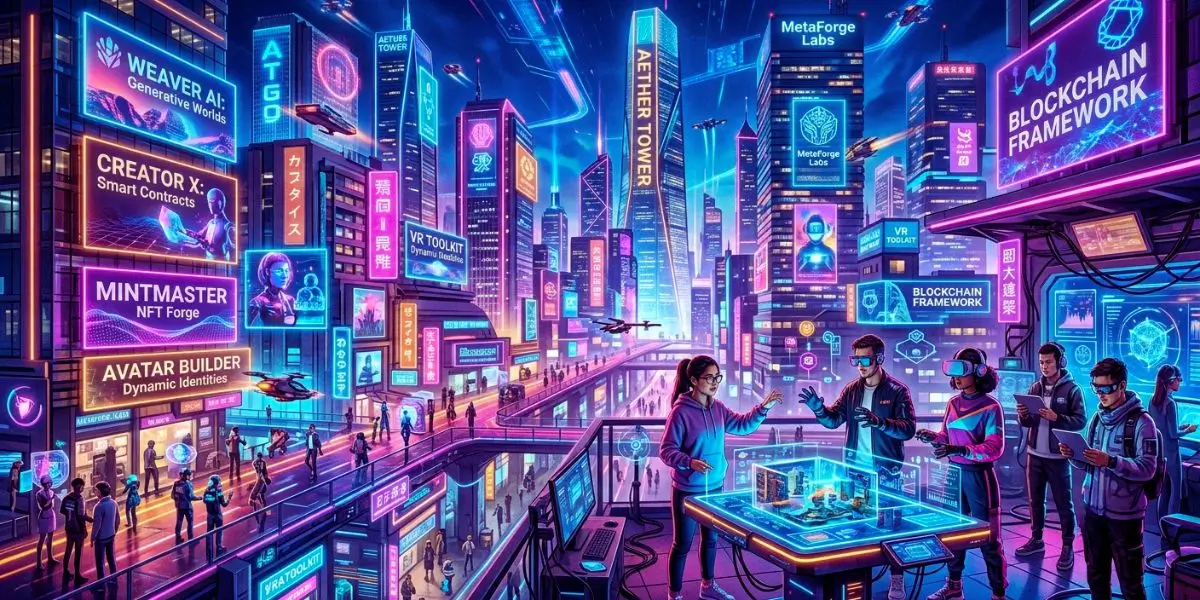
The digital frontier is no longer a flat screen; it is a spatial, persistent, and intelligent universe. By 2026, the convergence of Artificial Intelligence (AI), Web3, and the Metaverse has matured from speculative hype into a tangible creator economy. We have moved past the era of clunky avatars and isolated virtual worlds. Today, the barrier to entry for building immersive experiences has been demolished by a new generation of AI tools.
For creators—whether you are a 3D artist, a game developer, a virtual event producer, or a blockchain architect—the workflow has fundamentally changed. You are no longer just a builder; you are an AI director. This guide dissects the essential AI-powered applications that are non-negotiable for Web3 and Metaverse creators in 2026.
The Symbiosis: Why AI is the Engine of the Open Metaverse
Before diving into the tool stack, it is critical to understand why AI has become the backbone of the creator economy in 2026. Web3 promises decentralization and ownership, but creation historically required centralized, high-cost resources. AI democratizes the “how.”
Generative Interoperability is the key phrase for 2026. Creators need assets that function across multiple metaverse platforms—from Decentraland and The Sandbox to high-fidelity Unreal Engine-based microverses. AI tools have solved the “format fragmentation” problem by automating the optimization of a single 3D model for a mobile AR lens, a VR headset, and a browser-based world simultaneously.
Furthermore, the concept of “LiveOps 3.0” has emerged. Metaverse experiences are no longer static; they must react to blockchain data, user sentiment, and real-world events in real-time. Only AI agents can manage the complexity of dynamically altering weather in a virtual city based on a DAO vote while simultaneously balancing an in-game token economy.
AI-Assisted 3D Content Creation: From Text to Topology
The most painful bottleneck in metaverse development has always been 3D asset creation. In 2026, prompt-to-3D is not just a gimmick; it is production-ready.
Masterpiece X Pro (Generative Mesh & Rigging)
Masterpiece X has evolved beyond rudimentary text-to-mesh. In its 2026 iteration, it understands semantic physics. You can prompt, “A steampunk coffee machine made of brass and glass, with interactive levers, ready for VR hands,” and the AI generates not just the visual mesh but the auto-rigging and collision detection parameters. For Web3 creators, it includes a “Blockchain Attributes” layer where you can visually assign minting traits to specific geometric parts of the object, ensuring rarity traits are visible on-chain by default.
Spline AI (Real-Time Collaborative Surfaces)
Spline has pivoted aggressively into the AI space. It is no longer just a web-based 3D tool; it is a real-time collaborative AI design partner. The “Style Transfer” feature allows you to take a pixelated CryptoPunk and instantly convert it into a high-fidelity, rig-ready VRChat avatar while preserving the original NFT’s color palette and facial proportions. Spline’s integration with web-based wallets means creators can sign transactions to export assets as GLB files directly to IPFS without leaving the browser.
Rodin Diffusion (The Geometry Specialist)
For hard-surface modeling—spaceships, weapons, architectural components—Rodin has become the gold standard. Unlike image-based generators, Rodin operates on native 3D diffusion models. Its 2026 “Multimodal Input” feature allows a creator to upload a photo of a clay sculpture they made in real life, a rough block-out from Blender, and a text description, then blends all three into a clean, quad-optimized topology. For metaverse land developers, this tool is essential for generating high-volume, thematic architecture that fits specific parcel dimensions instantly.
The Autonomous Avatar Economy
Avatars are the identity layer of the Metaverse. In 2026, we are witnessing the rise of the “Intelligent Avatar”—a digital twin that learns, translates, and acts as a proxy for your liquidity and social graph.
Ready Player Me (AI Behavior Studio)
Ready Player Me transcended being a simple avatar creator. Their “AI Behavior Studio” allows you to infuse your cross-game avatar with a personality tree. Using a fine-tuned LLM (Large Language Model) that runs locally on-device, your avatar can now act as an NPC greeter in your virtual gallery. You define its conversational boundaries, brand tone, and knowledge of NFT collections. In 2026, these avatars are soulbound; they carry your reputation credentials across apps using zero-knowledge proofs to verify your identity without doxxing your wallet.
Inworld AI (The Brain Behind the Face)
If Ready Player Me provides the body, Inworld provides the soul. Inworld has shifted from basic chatbots to “Character Relational Models.” These AI agents remember players. If a user visits your metaverse land, leaves, and returns a week later, the Inworld-powered NPC recalls the conversation, the user’s wallet balance, and any pending quests. For Web3, this is transformative for quest systems. “Talk-to-Earn” economies require linguistic validation that only Inworld’s intent-parsing engine can provide, distinguishing between genuine human conversation and bot spam to prevent token farming.
DeepMotion Animate 3D (Full-Body Tracking via Webcam)
The death of expensive mocap suits is here. DeepMotion’s 2026 AI neural network infers full-body 3D rotation (including finger tracking) from a single smartphone camera. The output data can be streamed live as a BVH animation file to any virtual performance stage. For musicians doing concerts in the Metaverse, this means the ability to perform with lifelike movement without a studio. The Web3 integration allows the animation data (the performance) to be recorded on-chain as an IP-protected asset, allowing performers to monetize their movements.
Pro-Code & No-Code Metaverse Logic
You cannot build a world without logic. Smart contracts are the law of the land, and AI is now the legislator.
Cursor IDE for Solidity (AI-First Blockchain Coding)
Cursor, the AI-native code editor, has launched a dedicated profile for Web3 developers. It is deeply integrated with Foundry and Hardhat. Creators can prompt, “Write a gas-optimized ERC-721A staking contract that rewards users with my fungible token based on the length of time they hold the NFT, with a tier multiplier.” Cursor not only writes the code but visualizes the flow chart of the execution logic, flagging potential reentrancy bugs before deployment. For non-technical creators, this is the bridge to deploying custom token gating without paying expensive solidity devs.
Nifty Kit (Drag-and-Drop Dynamic NFTs)
Static PFPs are legacy. Dynamic NFTs that evolve based on real-world data (weather, stock prices, game achievements) are the standard. Nifty Kit’s AI Orchestrator lets you connect oracles (like Chainlink) to visual states. You don’t write the complex callback functions; you define the logic in natural language: “If the user’s wallet holds more than 1 ETH, change the background to gold. If they are in Tokyo and it’s raining, put a hat on the character.” The AI handles the GraphQL queries and SVG compositing on the fly.
Tome (AI-Powered World Building & Pitching)
Tome has found a niche in the Web3 creator economy as the “Lore Builder.” Creators use Tome to input a few keywords about their land project or game, and the AI generates an immersive storyboard, complete with AI-generated concept art, a tokenomics one-pager, and a navigable 3D preview of the pitch deck. It automatically syncs with your Discord to turn the pitch deck into a choose-your-own-adventure style whitepaper for your community.
Marketing, Moderation, and Community Intelligence
Launching a metaverse experience is 10% building and 90% community. AI tools in 2026 have become the admin layer for DAOs and decentralized communities.
Guild.xyz with AI Role Management
Guild.xyz automates access, but their 2026 AI feature analyzes member behavior. It uses machine learning to detect “airdrop hunters” vs. “genuine fans” by analyzing interaction patterns in Discord and on-chain voting consistency. Creators can set dynamic thresholds: “Automatically give the ‘OG’ role to users whose engagement score is above 0.8 and who have voted in the last 3 DAO proposals.” This AI-curated community management ensures that token-gated spaces are filled with aligned participants, not just bot farms.
Midjourney v8 & DALL-E 4 (The Narrative Control)
Visual consistency across a Web3 ecosystem is hard. Midjourney’s “Character Reference” and “World Reference” features allow creators to lock a specific style token. You can train a visual epoch for your entire metaverse. When a community member generates fan art using your shared style token, the AI automatically embeds metadata linking back to the original collection’s smart contract, creating a transparent provenance trail. This solves the “derivative works” attribution crisis that plagued the early 2020s NFT boom.
Synthesia Enterprise (Ambient AI Presenters)
Virtual worlds need guides. Synthesia has moved into real-time streaming avatars. A metaverse art gallery curator can now script an AI docent that stands in the lobby and gives a personalized tour to each visitor. The AI docent reads the visitor’s wallet profile (anonymously via zk-proofs) and highlights the art pieces the visitor can afford or those that match their aesthetic taste, calculated by the visitor’s past minting history.
The Audit & Security Layer
With great creation power comes great responsibility for security. In 2026, AI is both the sword and the shield.
ChainAware (Predictive Fraud Detection)
For Metaverse storefronts, phishing and counterfeit NFTs are rampant. ChainAware’s AI engine operates at the smart contract interaction layer. Before a creator’s asset is transferred, the AI simulates the transaction’s downstream impact. It predicts with 99.2% accuracy (as of Q2 2026) whether a collector is interacting with a malicious proxy contract disguised as a legitimate marketplace. Creators integrate this widget into their custom front-ends to protect their floor prices from sweepers using flash loans.
GPTZero for DAO Governance
Sybil attacks are the death of democracy in the Metaverse. GPTZero has repurposed its AI text detection to identify “GPT-generated proposal spam” and “coordinated voting.” It distinguishes between a human writing a thoughtful DAO proposal and an attacker using an LLM to flood a Snapshot space with 1,000 variations of the same proposal to grind the governance process to a halt.
Infrastructure: The Hidden AI Heroes
You don’t see these tools, but they power the scene.
Stability AI for Real-Time Skyboxes
Forget static cubemaps. Creators now use Stability AI’s real-time API to generate reactive skyboxes. If your metaverse land is in a conflict-themed game, the sky changes from sunrise to a fiery red apocalypse based on the real-time kill ratio in the game, fetched via on-chain game state queries.
ElevenLabs Speech-to-Speech
Voice localization is instant. A creator speaking English can have their voice translated into Japanese, not with subtitles, but with a 3D-spatialized voice clone that respects lip-sync animations, maintaining the original emotional tone. This is breaking down the language barriers that fragmented early Metaverse communities.
The 2026 Creator Workflow: A Day in the Life
To illustrate the synergy, imagine a creator named Ari. In 2026, Ari wakes up with an idea for a “Cyber-Victorian Tea House” in the metaverse.
Ideation: Ari brainstorms the lore in Tome, generating the backstory and visual mood board instantly.
Asset Generation: Ari types the prompt into Masterpiece X Pro, generating the teapots, steam vents, and velvet chairs as modular, mint-ready assets.
Logic: Using Cursor, Ari prompts the AI to write a smart contract where every tea sold triggers a tiny royalty split to the furniture designers (the asset creators) via a standard royalty protocol.
Animation: Ari uses DeepMotion on a smartphone to record a graceful bowing motion for the NPC butler avatar.
Intelligence: Ari loads the butler model into Inworld AI, connecting it to a knowledge base of tea history and a crypto wallet so it can settle tabs.
Deployment & Moderation: Ari deploys the world, uses ChainAware to scan the entry portal for wallet hygiene, and sets Guild.xyz AI to auto-assign “Tea Connoisseur” roles to visitors who interact for more than 10 minutes.
This entire process, which would have taken a team of 10 people 6 months in 2023, takes Ari roughly a week in 2026.
Frequently Asked Questions (FAQs)
Can AI replace 3D artists in Web3?
No. AI tools in 2026 function as “co-pilots.” They handle retopology, LODs (Levels of Detail), and UV unwrapping—the technical chores. However, aesthetic judgment, cultural nuance, and unique style design remain human domain. The most successful Metaverse creators are Art Directors who curate AI outputs, not raw technicians.
Are these AI-generated assets secure to be minted as NFTs?
Yes, transparency is built in. Most advanced 2026 tools embed “Generative Provenance” metadata. This records the prompt, the seed, and the model version used. Platforms like the OpenSea Verisense Engine read this data to verify that an asset isn’t a 1:1 copy of someone else’s prompt. Some protocols allow you to license the “commercial rights” directly with the AI model on-chain via smart contract with the mint, ensuring legal clarity.
What is the best AI tool for creating a low-cost metaverse game?
For no-code, look at Buildbox AI. For a more robust Web3 title, a combination of Spline (for design), Cursor (for smart contracts), and Inworld (for AI NPCs) is the current meta. You no longer need Unity or Unreal expertise for moderately complex experiences.
How does AI handle on-chain data to update the Metaverse?
AI agents, specifically LangChain-integrated bots, listen to “Event Logs” on the blockchain. If a specific event is emitted (e.g., “LandPurchased”), the AI middleware triggers a pipeline: updating the database, changing the visual mesh on the metaverse parcel, and even sending an AI-generated congratulatory message from the Mayor (an AI agent) to the new landowner’s wallet.
Is it expensive to run AI NPCs in my virtual world?
Costs have plummeted due to on-device edge inference. While cloud-based Inworld bots cost per interaction, lightweight dialogue models for common greetings can now run directly on the user’s browser or VR headset chipset. Creators pay only for high-complexity reasoning tasks, making it sustainable for indie builders.
Are all free NFT drops in the metaverse dangerous?
Not every free NFT is a scam, but unsolicited airdrops and random “gift” NFTs are high‑risk by default.coinbase+3
Scammers often send junk NFTs to lure you into clicking a link, visiting a fake site or granting dangerous permissions. As a rule of thumb, treat unexpected NFTs like unknown USB sticks: don’t interact, don’t click, and don’t use them as a reason to connect your main wallet anywhere.
Is it safe to click links shared in Discord, metaverse chats or DMs?
Links shared in public chats and DMs are one of the main entry points for NFT and metaverse scams.
If a link didn’t come from a verified official channel – and you didn’t actively go looking for it – assume it’s hostile until proven otherwise. The safest workflow is to disable DMs from unknown server members, never click “surprise mint” links, and always navigate to official sites manually via trusted directories or bookmarks.
How can I quickly check whether an NFT collection or metaverse project is legit?
Start with three checks: team, platform and history.
Look for fully doxxed creators with a real track record, verify that the collection is listed under the official, verified account on major marketplaces, and inspect whether there’s consistent trading history instead of a sudden spike driven by a handful of wallets. If you can’t find clear information about who is behind the project and how it’s supposed to work, that’s a red flag – not a “hidden gem”.
What should I do if I find a suspicious NFT in my wallet?
If an NFT appeared in your wallet and you don’t recognise it, the safest move is to leave it alone.metamask+3
Don’t list it, don’t sell it, don’t transfer it and definitely don’t follow any instructions attached to it. In many scam patterns, the danger comes from interacting with the NFT – clicking its link or approving actions it requests. Monitor your wallet for unusual activity, review and revoke any strange permissions via trusted tools, and focus on protecting existing assets instead of trying to “profit” from a random drop.
Can I ever safely share my seed phrase or private key with someone who wants to help?
No. There is no legitimate scenario where anyone – support staff, “experts”, friends or platforms – should ask for your seed phrase or private key.rollingstone+5
Those secrets are the ultimate keys to your wallet; sharing them is equivalent to handing over full control of your funds. Real support teams will never ask for them, and any request for screenshots, screen sharing during sensitive actions, or “temporary access” to your wallet is a giant red flag.
Is it possible to recover funds after a rug pull or NFT scam?
In most cases, once funds have been moved out of your wallet in a scam or rug pull, recovery is extremely difficult and often impossible.rollingstone+4
You can and should document everything, revoke permissions, report the fraud to platforms and regulators, and warn the community – but the primary lesson is preventive: only invest what you can afford to lose, stay away from projects you don’t truly understand, and treat every new “opportunity” as guilty until it proves itself trustworthy.
Conclusion
The narrative that the Metaverse is dead is only true for the passive, 2D-screen-based version of 2021. The 2026 Metaverse is a creative layer of the internet, built and expanded by AI. The tools outlined in this guide are not just utilities; they represent a shift in the economics of creation.
We have entered the era of the Sovereign Creator. You no longer need a big studio’s permission, a huge marketing team, or a massive capital injection for rendering farms. The must-have apps of 2026 close the resource gap between the individual and the corporation.
To thrive in this landscape, do not chase every tool. Build your stack intentionally: one for geometry (Masterpiece X), one for logic (Cursor), one for life (Inworld), and one for safety (ChainAware). Master the prompt. Guard your style. And most importantly, use these AI capabilities not to replace human connection, but to scale your unique vision into immersive, decentralized realities that were previously impossible.
The Metaverse is open for business. The tools are ready. The question is: what will you build with your AI co-pilot today?