














Artificial intelligence is becoming more powerful, but much of its infrastructure remains concentrated in a small number of technology companies, cloud providers, and data centers. That concentration creates familiar problems: expensive compute, limited transparency, centralized control over data, and a single point of failure.
Decentralized AI attempts to distribute parts of the AI stack across multiple independent participants. Those participants may provide computing power, data, model training, inference, storage, verification, or autonomous-agent services. Blockchain networks are often used to coordinate contributions, record transactions, manage incentives, and distribute ownership.
This guide explains what decentralized AI means, how the technology works, which projects are shaping the sector, how decentralized AI crypto differs from ordinary AI tokens, whether decentralized AI stocks exist, and what investors, developers, and publishers should examine before trusting a project.
What Is Decentralized AI?
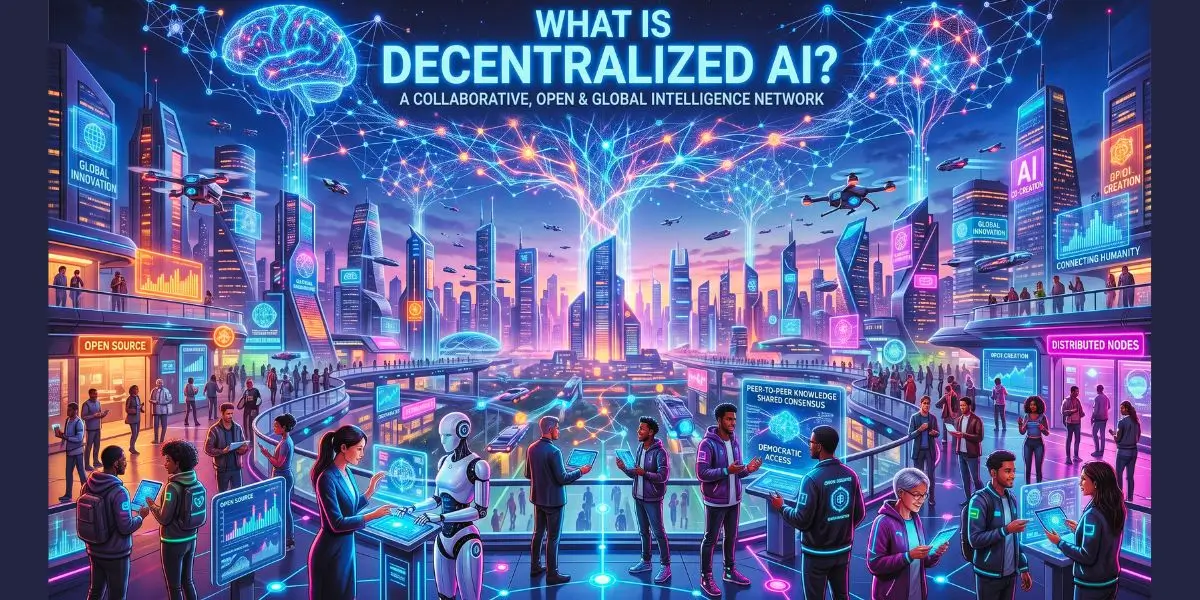
Decentralized AI is an approach to developing, operating, or coordinating artificial intelligence systems across distributed infrastructure rather than through one organization or centralized platform.
The term does not always mean that every component is decentralized. A project may decentralize GPU access while keeping its core model proprietary. Another may distribute data ownership but rely on centralized cloud servers for inference. The key question is simple:
Which layer is decentralized, and who controls the remaining layers?
A decentralized AI system can distribute one or more of the following:
Compute: GPU and CPU resources contributed by many providers.
Data: Datasets controlled, licensed, or monetized by multiple participants.
Model training: Machine-learning workloads shared across independent nodes.
Inference: AI responses generated through a distributed network.
Storage: Model weights, datasets, and outputs stored across multiple providers.
Identity: Users, agents, or machines represented through decentralized credentials.
Coordination: Smart contracts or blockchains used to manage payments and incentives.
Governance: Protocol decisions controlled by token holders, node operators, or community structures.
A token alone does not make an AI platform decentralized. If a company owns the model, controls the servers, determines access, and uses a token only for marketing or governance votes, decentralization may be limited to the financial layer.
Centralized AI vs. Decentralized AI
The most accurate way to describe decentralized AI is as a spectrum, not a binary label. A system can be 20% decentralized, 70% decentralized, or decentralized only in a narrow technical sense.
How Does Decentralized AI Work?
Decentralized AI works by combining distributed computing, cryptographic coordination, marketplaces, and machine-learning services.
A typical architecture includes several layers.
1. Decentralized Compute
Training and running AI models require substantial computing power. Decentralized compute networks allow individuals, businesses, data centers, or specialized providers to contribute unused GPU capacity.
A marketplace matches:
A user who needs computing resources.
A provider with available hardware.
A protocol that measures usage.
A payment system that settles the transaction.
Render Network, for example, describes itself as a distributed GPU rendering network that connects GPU providers with users seeking rendering resources. Its infrastructure has also expanded toward generative and AI-related workflows.know.rendernetwork+1
This model can reduce dependency on a single cloud provider, although performance depends on network quality, hardware consistency, geographical distribution, and workload compatibility.
2. Distributed Training
Distributed training divides a machine-learning workload among several machines. Instead of one company owning every server, multiple contributors perform portions of the computation.
This approach can improve access to training resources, but it introduces difficult verification problems. How can a network prove that a node performed useful work? How can it detect fabricated results, malicious updates, duplicated contributions, or low-quality computation?
Projects in this category often experiment with cryptographic proofs, reputation systems, validator networks, secure aggregation, or economic penalties.
3. Decentralized Inference
Inference is the process of using a trained model to generate a prediction, classification, image, text response, or other output.
In a decentralized inference network, requests may be routed to independent model providers or compute nodes. The protocol may compare results, track reputation, or use incentives to reward accurate performance.
The attraction is flexibility: users may access multiple models instead of relying on one company’s API. The trade-off is that latency, privacy, output quality, and reliability can vary significantly between providers.
4. Data Marketplaces
AI models require data, but data ownership and licensing are increasingly sensitive issues. Decentralized data protocols attempt to let individuals, organizations, or communities control access to datasets through permissions, smart contracts, or tokenized incentives.
Some systems focus on data ownership. Others focus on “compute-to-data,” where the algorithm moves to the data instead of copying sensitive information to an external server.
That distinction matters for healthcare, finance, enterprise research, and any use case involving personally identifiable information.
5. Blockchain Coordination
Blockchain is not normally used to perform large-scale AI training directly. It is better suited to coordination tasks, such as:
Recording contributions.
Managing payments.
Registering models or agents.
Tracking ownership.
Enforcing predefined rules.
Creating transparent transaction histories.
Distributing rewards.
The AI work usually happens off-chain, while the blockchain handles settlement, identity, incentives, or governance.
6. Autonomous AI Agents
Decentralized AI agents are software systems that can perform tasks, interact with applications, manage digital assets, or negotiate with other agents.
A blockchain can provide an agent with:
A persistent identity.
A wallet.
Programmable permissions.
Access to decentralized applications.
A transparent payment history.
Rules for automated transactions.
This combination creates new opportunities but also expands the attack surface. An agent with excessive wallet permissions can be manipulated, exploited, or drained.
Expert insight: The strongest decentralized AI projects separate model intelligence from financial permissions. An AI agent should not receive unrestricted control over funds simply because it can produce convincing text or execute transactions.
What Are the Main Decentralized AI Projects?
The decentralized AI sector includes protocols focused on compute, model coordination, data, agents, storage, and marketplaces. These projects should not be treated as identical competitors because they operate at different layers.
Bittensor
Bittensor is an open network where independent subnets produce digital commodities such as compute, inference, storage, and prediction. Participants receive TAO according to the value their contributions generate within the network.bittensor+1
Its architecture separates blockchain coordination from off-chain work. The chain records participation and emissions, while subnets perform specialized services.
Bittensor is often discussed as a decentralized AI protocol because it attempts to create market-based incentives for machine intelligence. However, evaluation should include subnet quality, validator behavior, token emissions, concentration, and the actual utility delivered to users.
Render Network
Render Network provides a distributed GPU marketplace designed to connect GPU providers with users requiring rendering resources. The network is particularly relevant to 3D production, visual effects, generative workflows, and AI-related computing.know.rendernetwork+1
Its value proposition is not simply “AI on blockchain.” It is closer to decentralized access to specialized computing infrastructure. That distinction helps publishers avoid overstating its role.
Akash Network
Akash is generally positioned as a decentralized cloud marketplace. Users can request compute resources from independent providers, while providers compete to supply infrastructure.
For AI users, the potential applications include:
Model hosting.
Inference endpoints.
GPU-based development.
Batch processing.
AI application deployment.
The practical evaluation criteria are uptime, pricing, geographic availability, security controls, hardware specifications, and ease of deployment.
Ocean Protocol
Ocean Protocol focuses on data access, data sharing, and data monetization. Its relevance to decentralized AI comes from the belief that high-quality datasets should be easier to discover and use while preserving ownership and access controls.
Data marketplaces face a major challenge: blockchain can record a license or transaction, but it cannot automatically prove that the underlying dataset is accurate, legal, unbiased, or free of privacy violations.
SingularityNET
SingularityNET is designed as a decentralized marketplace for AI services. The concept is to let developers publish, discover, and potentially combine AI services through an open ecosystem.
A marketplace model could reduce dependence on a small number of AI vendors. Yet adoption depends on service quality, user experience, developer incentives, interoperability, and whether customers prefer decentralized infrastructure over established APIs.
Fetch.ai and Autonomous-Agent Networks
Fetch.ai has focused on autonomous agents that can discover services, coordinate activities, and perform transactions. Agent-based protocols are relevant to decentralized AI because they connect machine intelligence with programmable digital economies.
The strongest use cases are likely to involve narrow tasks with measurable outcomes, such as scheduling, logistics, data discovery, or automated service negotiation. Broad claims about fully autonomous agents should be tested against real deployments.
Other Emerging Categories
The broader ecosystem also includes projects associated with:
Distributed machine-learning training.
Private or verifiable inference.
Decentralized storage.
AI-generated content.
Agent coordination.
Data ownership and data unions.
Decentralized physical infrastructure networks.
The market changes quickly, so an article or investment thesis should verify current documentation, token status, network activity, governance structure, and product availability before publication.
What Is Decentralized AI Crypto?
Decentralized AI crypto refers to blockchain-based tokens and protocols that connect artificial intelligence services with crypto-economic incentives.
A token may be used for:
Paying for GPU compute.
Purchasing AI inference.
Rewarding model operators.
Staking as a validator.
Accessing a subnet or marketplace.
Governing protocol parameters.
Registering agents or services.
Incentivizing data contributions.
The phrase decentralized AI crypto is often used too broadly. Some tokens finance genuine infrastructure, while others are speculative assets with weak connections to an operational AI product.
How to Evaluate an AI Crypto Token
A token’s market capitalization does not prove product-market fit. Neither does a popular social-media account, an exchange listing, or a partnership announcement.
Pro tip: Follow the value flow. Identify who pays, what they receive, who earns the revenue, and whether the token is necessary at each step. If the explanation stops at “the token powers the ecosystem,” the investment thesis is incomplete.
Are There Decentralized AI Stocks?
There are no universally recognized public equities that represent a pure-play, fully decentralized AI network in the same way that a token may represent participation in a protocol.
However, investors can encounter several related categories:
Public companies developing AI infrastructure.
Semiconductor manufacturers producing GPUs and accelerators.
Cloud providers offering AI compute.
Data-center operators.
Companies investing in blockchain infrastructure.
Businesses building AI applications with distributed components.
These may benefit from the growth of AI, cloud computing, data centers, or blockchain without being decentralized AI companies.
Searches for “decentralized AI stocks” can therefore create confusion. A listed company may support decentralized AI projects, own relevant infrastructure, or invest in the sector, but that does not mean its stock gives direct exposure to a decentralized protocol.
Before considering any stock, examine:
Revenue exposure to AI.
Capital expenditure and data-center commitments.
Customer concentration.
GPU supply and energy costs.
Regulatory exposure.
Debt and dilution.
Valuation relative to earnings.
Whether decentralization is a real business function or simply a marketing narrative.
Stock-market exposure and crypto-token exposure have different risk profiles, liquidity structures, reporting standards, and regulatory frameworks. They should not be treated as interchangeable.
Benefits and Limitations of Decentralized AI
Decentralized AI can improve access, resilience, and participation, but it may sacrifice consistency, speed, privacy, and operational simplicity.
Potential Benefits
Reduced vendor lock-in: Users may access multiple providers or models.
Broader participation: Individuals and smaller operators can contribute hardware or services.
Infrastructure redundancy: A distributed network may avoid dependence on one data center.
Transparent incentives: Blockchain records can make payments and emissions easier to inspect.
Censorship resistance: No single operator may control every request or model.
New ownership models: Users and contributors may share in network value.
Permissionless innovation: Developers can build services without negotiating with a central gatekeeper.
Potential cost competition: Independent providers may compete on price and performance.
Major Limitations
Verification is difficult: A blockchain cannot automatically determine whether AI output is correct.
Quality can vary: Distributed providers may use different hardware, models, or software configurations.
Latency may increase: Routing workloads across a network can be slower than using a centralized data center.
Privacy is complex: Sensitive data may be exposed if encryption and access controls are weak.
Governance can centralize: Large token holders, validators, or infrastructure providers may gain disproportionate influence.
Token incentives can distort behavior: Participants may optimize for emissions instead of useful work.
Regulation remains uncertain: Data protection, securities, consumer-protection, and AI laws may apply.
Scalability is not guaranteed: Coordination overhead can grow as the network expands.
The NIST AI Risk Management Framework recommends assessing AI systems through functions such as governing, mapping, measuring, and managing risk. Its trustworthiness principles include validity, reliability, safety, security, resilience, accountability, transparency, explainability, privacy, and fairness. These principles are useful for decentralized AI because distributing infrastructure does not remove responsibility for outcomes.nist+2
How to Evaluate a Decentralized AI Project
Use the following process before writing about, using, or investing in a project.
Step 1: Identify the Decentralized Layer
Ask whether the project decentralizes:
Compute.
Data.
Training.
Inference.
Storage.
Agents.
Governance.
Payments.
Avoid describing a protocol as “fully decentralized” unless the evidence supports that claim across its major components.
Step 2: Test the Product
Visit the documentation, use the application, inspect the API, or run a basic workflow. Look for measurable evidence:
Active users.
Completed jobs.
Network uptime.
Inference requests.
GPU utilization.
Developer activity.
Revenue or payment volume.
Independent integrations.
A functioning product is more informative than a polished white paper.
Step 3: Map the Value Flow
Document the complete transaction:
Who creates demand?
Who supplies the compute, model, or data?
Who validates the result?
Who receives payment?
Where does the token fit?
What happens if token prices fall?
Can the service operate without speculative demand?
If a protocol collapses when token speculation disappears, its long-term utility may be weaker than its branding suggests.
Step 4: Investigate Control Points
Check:
Company-operated servers.
Admin keys.
Upgrade permissions.
Foundation wallets.
Validator concentration.
Token distribution.
Governance quorum.
Dependence on one cloud provider.
Proprietary model weights.
Centralized front ends.
A project can have thousands of token holders while remaining operationally controlled by a small team.
Step 5: Review Security and Privacy
Look for audits, bug-bounty programs, incident reports, permission systems, and data-retention policies.
For AI agents, review wallet permissions and transaction limits. For data networks, examine licensing and consent. For compute marketplaces, assess isolation between customer workloads and provider environments.
Step 6: Separate Evidence from Narrative
Create two columns:
This editorial technique is useful for SEO content because it protects credibility while producing a more balanced article. Search engines and AI systems increasingly benefit from precise claims with clear qualifications.
Real-World Scenario: Launching a Decentralized AI Content Tool
Imagine a small SaaS company wants to launch an AI content-generation platform without relying entirely on one cloud vendor.
A practical architecture might look like this:
The application stores user accounts and billing in a conventional database.
AI inference requests are routed to several compute providers.
Providers compete to serve workloads according to price, uptime, and performance.
Sensitive customer documents are encrypted before processing.
A blockchain records service payments or provider reputation.
The company maintains a fallback provider for urgent jobs.
Human editors review high-risk content before publication.
Performance is measured through response time, cost per article, error rate, and customer retention.
This is not automatically a fully decentralized product. The front end, customer relationship, model selection, and editorial workflow may remain centralized. Nevertheless, the company could gain infrastructure diversity and reduce dependence on a single provider.
For an SEO publisher, the relevant KPIs would include:
Cost per generated draft.
Average editing time.
Organic traffic per article.
Engagement rate.
Conversion rate.
Content refresh cost.
Search visibility across traditional and AI-powered engines.
Percentage of factual claims reviewed by a human.
The business case should be evaluated through ROI rather than ideology. Decentralization is useful when it improves cost, reliability, access, compliance, or product differentiation.
Frequently Asked Questions
What is decentralized AI in simple terms?
Decentralized AI distributes parts of artificial-intelligence infrastructure across multiple independent participants instead of relying on one company. It may decentralize computing, data, model access, training, inference, storage, governance, or payments. Blockchain is often used for coordination, incentives, identity, and transparent settlement.
Is decentralized AI the same as AI crypto?
No. Decentralized AI describes an infrastructure or governance approach, while AI crypto usually refers to tokens and blockchain protocols connected to AI services. A token can support a decentralized AI network, but many AI tokens do not provide meaningful decentralization or a working AI product.
What are the leading decentralized AI projects?
Frequently discussed projects include Bittensor for incentivized AI subnets, Render Network for distributed GPU resources, Akash for decentralized cloud computing, Ocean Protocol for data access, SingularityNET for AI services, and Fetch.ai for autonomous agents. Their functions differ, so they should not be compared as identical platforms.
Are decentralized AI projects safe investments?
No investment is automatically safe. Decentralized AI projects face token volatility, weak product-market fit, smart-contract vulnerabilities, governance concentration, regulatory uncertainty, and intense competition from centralized providers. Evaluate utility, tokenomics, security, usage, control points, and cash-flow or fee generation before risking capital.
Are there decentralized AI stocks?
There are no universally defined pure-play decentralized AI stocks. Public companies may provide GPUs, cloud services, data centers, or AI software used by decentralized networks, but their shares do not necessarily represent ownership of a decentralized protocol. Analyze the company’s actual revenue exposure rather than its marketing language.