









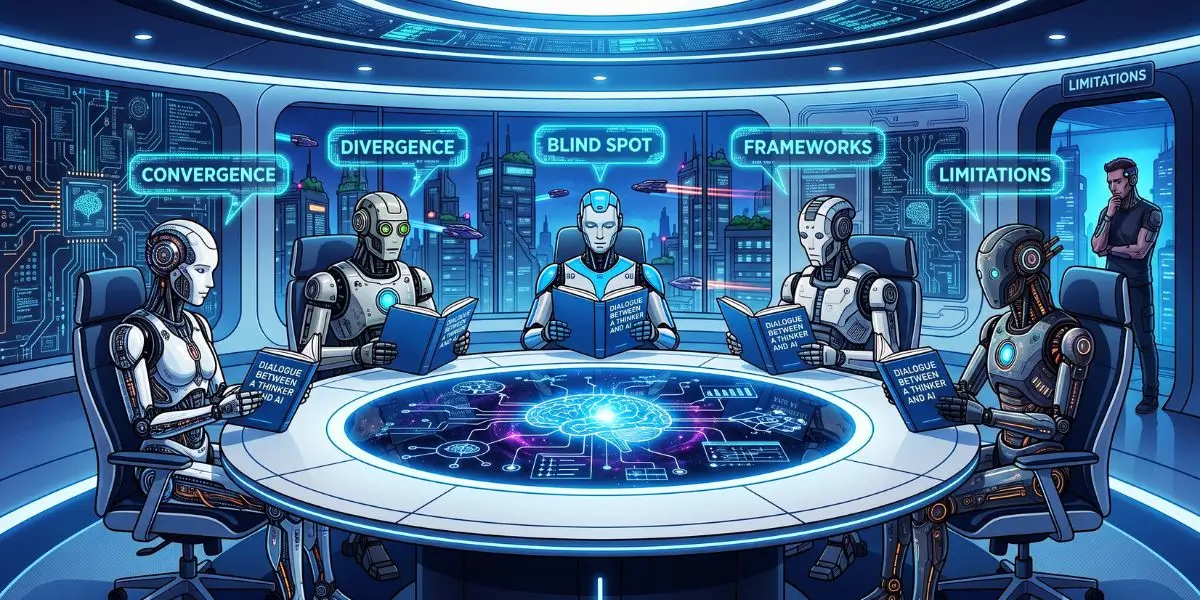
Quick Answer: Artprice (by Artmarket.com) launched a unique meta-reading experiment where five major AI systems—OpenAI/Astra, Perplexity, DeepSeek, Google Gemini, and xAI/Grok—read the same 1,800-page book “Dialogue Between a Thinker and AI” by Thierry Ehrmann. Instead of competing, the AIs then analyze each other’s interpretations, revealing convergences, divergences, and blind spots in how different AI architectures understand complex human thought.
If you’ve ever wondered whether different AI models “think” differently, here’s your answer.
On September 18, 2026, Artprice (the world’s leading art market information company) announced a groundbreaking experiment that turns literary criticism into a comparative laboratory for artificial intelligence.
The setup is simple—but profound:
Give five different AI systems the exact same book to read
Ask each to produce an analysis
Then show each AI the analyses produced by the others
Watch what happens when AI reads… AI reading
This isn’t about ranking which AI is “best.” It’s about understanding why they see different things—and what those differences reveal about how AI architectures process human knowledge.
In this article, you’ll discover:
✅ What book they’re reading (and why it matters)
✅ Which 5 AI models are participating
✅ What “meta-reading” actually means
✅ Early findings from the experiment
✅ How you can read the book yourself (it’s free)
The Book: “Dialogue Between a Thinker and AI”
Before we dive into the experiment, let’s talk about the book itself.
What Is It?
“Dialogue Between a Thinker and AI” is a 1,800-page philosophical work created through hundreds of hours of dialogue between Thierry Ehrmann (founder of Artmarket.com/Artprice) and artificial intelligence.
Key facts:
Author: Thierry Ehrmann (visual artist, philosopher, founder of Artmarket.com since 1997)
Format: Available in print (French & English) + digital (free online)
License: Creative Commons CC BY-NC-ND 4.0 (free to read, non-commercial)
Languages: 14 languages, 123 countries
Creation process: 40 days and nights of continuous dialogue between human and AI
Why This Book?
This isn’t just any book. It’s a “liber mundi” (world-book) designed to be:
Freely accessible (no paywall, no subscription)
Infinitely rich (philosophy, art, science, esotericism, 45 years of humanistic reflection)
Co-created with AI (the very technology now being tested)
From the author:
“This book asks nothing of you. No commercial transaction, no subscription, no algorithmic submission. It extends a simple invitation: to open its freely accessible pages, to journey through it, to draw food for thought, and to make it your own.”
The Experiment: Meta-Reading Explained
What Is “Meta-Reading”?
Traditional literary criticism: Human critic reads book → writes analysis → other humans read analysis.
Meta-reading (this experiment): AI reads book → AI reads AI’s analysis → third AI analyzes that confrontation.
In other words: Commentary becomes corpus. The corpus becomes new material for analysis.
The 5 AI Participants
The Three-Phase Process
Phase 1: Initial Reading
All 5 AIs receive the complete book
Each produces an independent analysis
No access to other AIs’ interpretations
Phase 2: Cross-Reading
Each AI is shown the analyses produced by the others
Example: Gemini reads Grok’s analysis, DeepSeek reads Astra’s critique
Each AI responds to the others’ interpretations
Phase 3: Meta-Analysis
A third system (or human researcher) analyzes the confrontation
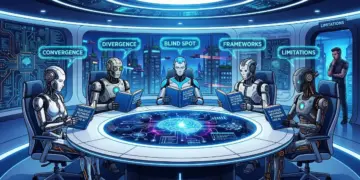
Identifies convergences, divergences, and blind spots
The gaps themselves become data
Why This Experiment Matters
1. It’s Not a Competition
Let’s be clear: This is not about ranking which AI is “best.”
From the experiment page:
“The objective is not to organize a competition between models. It is precisely the opposite. The purpose is to observe their convergences, divergences, and blind spots.”
Why this distinction matters:
Competitions ask: “Which AI is right?”
This experiment asks: “Why don’t they see exactly the same thing?”
The divergences themselves become information.
2. It Reveals AI “Blind Spots”
Different AI architectures have different:
Training data (what they learned from)
Model weights (how they prioritize information)
Safety filters (what they’re programmed to avoid)
Cultural biases (Western vs. Eastern perspectives, etc.)
Example questions the experiment explores:
Which concepts do different AIs spontaneously identify?
Which theses do they consider central vs. peripheral?
Which passages do they connect (or ignore)?
Where do their interpretations fundamentally diverge?
3. It Puts Humans Back in Control
Despite all the AI analysis, humans retain the final say.
From the experiment:
“This experiment does not delegate human judgment. It demands more of it. The human remains the one who compares, doubts, contextualizes, and decides.”
The workflow:
Machine produces readings
Human observes gaps between readings
Human contextualizes, doubts, decides
Early Findings: What We’re Learning
While the experiment is ongoing, some patterns are already emerging:
🔍 Convergences (Where AIs Agree)
All 5 models identify the book’s philosophical core (human-AI dialogue as ontological exploration)
All recognize the Creative Commons licensing as central to the project’s mission
All highlight the 40-day dialogue process as unprecedented in scale
🔍 Divergences (Where AIs Disagree)
Western AIs (OpenAI, Gemini, Grok) emphasize individual agency and creative freedom
DeepSeek (China) places more emphasis on collective knowledge and cultural continuity
Perplexity focuses heavily on citation and source verification
Grok (xAI) brings more irreverent, conversational tone to analysis
🔍 Blind Spots (What Some AIs Miss)
Some models overlook the art historical context (Ehrmann’s 45-year career as visual artist)
Others underemphasize the esoteric/philosophical dimensions in favor of practical takeaways
A few miss the Creative Commons licensing significance entirely
How to Access the Experiment
📖 Read the Book (Free)
The complete book is available online at no cost:
Languages: English, French, + 12 more
Format: Web (free), Print (available on Amazon)
🔬 Follow the Meta-Reading Experiment
Track the AI analyses as they’re published:
Experiment page: https://www.dialoguebetweenathinkerandai.com/en/meta-reading/
Updates: New analyses added as each AI completes its reading
Why This Could Change How We Evaluate AI
Traditional AI Benchmarks (The Old Way)
MMLU, GSM8K, HumanEval: Standardized tests with right/wrong answers
Focus: Accuracy, speed, task completion
Limitation: Doesn’t capture interpretive depth, cultural nuance, or philosophical reasoning
Meta-Reading (The New Way)
Open-ended interpretation: No single “correct” answer
Focus: How different AIs construct meaning from complex human thought
Advantage: Reveals architectural differences, cultural biases, and blind spots
From Thierry Ehrmann:
“For centuries, we have used critics to better understand books. This experiment also proposes the reverse movement: using a book to better understand those who read it.”
What’s Next? The Future of AI Evaluation
Based on this experiment, here’s what we might see in 2027:
🔮 Prediction 1: More “Mirror” Experiments
Expect other organizations to replicate this model with:
Different books (fiction, scientific papers, legal texts)
Different AI models (new releases from Anthropic, Meta, etc.)
Different languages (testing multilingual understanding)
🔮 Prediction 2: AI “Reading Profiles”
Just as we have performance benchmarks today, we might see:
Interpretive style profiles (literal vs. metaphorical, Western vs. Eastern, etc.)
Blind spot databases (what each model systematically misses)
Cultural bias scores (how much training data influences interpretation)
🔮 Prediction 3: Human-AI Co-Analysis
Future workflows might look like:
AI reads complex text → produces analysis
Human reviews AI analysis → identifies gaps
Second AI reviews first AI’s analysis + human feedback
Human makes final judgment
FAQ: Your Questions, Answered
Q: Can I participate in the experiment?
A: Yes! Read the book yourself, then compare your interpretation with the AI analyses. The experiment is designed to be open and participatory.
Q: Is the book really free?
A: Yes. It’s licensed under Creative Commons CC BY-NC-ND 4.0 (free to read, non-commercial use, no derivatives).
Q: Will more AIs be added?
A: The initial corpus includes 5 models, but the experiment is open-ended. Future phases may include additional systems.
Q: What if an AI refuses to analyze the book?
A: Some models have safety filters that might limit certain interpretations. This itself is data about that model’s constraints.
Q: Is this peer-reviewed research?
A: As of September 2026, it’s an independent experiment by Artprice. Academic papers may follow as results are analyzed.
The Bottom Line: Why This Experiment Is Different
In a world of AI benchmarks, leaderboards, and “which model is best” comparisons, this experiment does something radical: It treats AI interpretations as data, not answers.
The key insight:
Different AIs see different things in the same text
Those differences reveal something about the AI (not the book)
Humans remain the ultimate interpreters—but now with more tools to understand AI itself
From the experiment:
“The same work thus becomes a kind of cognitive mirror placed before several artificial-intelligence architectures. This mirror does not ask: ‘Which AI is right?’ It asks: ‘Why don’t they see exactly the same thing?’