










The whistle blows, but it’s not a steam whistle anymore. It’s a silent data push notification to a tablet on the factory floor. The line speed doesn’t just change on a foreman’s hunch today; it changes because a predictive AI manager calculated the exact moment human fatigue peaks against an order deadline. You are standing in the middle of a paradigm shift that isn’t coming—it’s already installed.
For decades, the struggle on the production line was human versus machine, labor versus capital. But we’ve exited the age of simple automation. We’re entering the era of the sentient factory, where the machine isn’t just a tool; it’s a supervisor with a brain. You aren’t fighting a conveyor belt anymore. You’re fighting a statistical probability that knows how long your bathroom break should take.
This isn’t science fiction. It’s the reality of integrating artificial intelligence into the energy sector and manufacturing infrastructure, creating a workplace where the union representative sits across the table from a black-box algorithm. The question isn’t whether you should adapt to Industry 5.0. The question is: how do you negotiate with a boss that processes 10 trillion data points per second and has zero emotional empathy?
Have you ever wondered what happens when a contract clause is triggered not by a human grievance, but by a digital twin that detected a micro-delay in a robotic arm three weeks before it becomes a physical failure?
The Rise of the Predictive AI Manager
We used to talk about “managers” as people with clipboards. Then we had enterprise resource planning software. Now, we have managers that don’t just report what went wrong, but predict what will go wrong. This is the core of the clash between workers vs. digital twins. A digital twin is no longer just a 3D CAD model collecting dust on a server; it is a living, breathing, real-time simulation of the physical production floor.
What Are Digital Twins in Manufacturing and the Use of Models?
Digital twins in manufacturing are virtual replicas of physical assets, processes, or systems. You need to understand the use of models here: we aren’t just talking about a static picture. A true digital twin uses IoT sensors to mirror the state of a physical machine in real-time. If a robotic welder in Detroit heats up to 312 degrees, the digital twin simulates that exact temperature, analyzes the degradation rate of the welding tip, and forecasts the exact minute it will fail.
But it goes deeper. The use of models extends to human activity. The AI models human behavior—your speed, your precision, your attendance patterns—and syncs it with the machine data. This creates a unified “productivity forecast.” When you integrate predictive AI, the system stops being a passive mirror and becomes an active supervisor. It can autonomously adjust the energy load, re-route a palletizer, or flag a worker for re-training without a human clicking a button.
Who Is the Father of Digital Twins?
To understand the authority we are giving these systems, you have to know where the concept came from. If you search for “who is the father of digital twins,” you’ll typically find Dr. Michael Grieves cited. He introduced the concept in 2002 at the University of Michigan for product lifecycle management. However, the practical application came earlier. Who invented the very first digital? While Grieves conceptualized the terminology for manufacturing, NASA was actually the pioneer. In the 1960s, NASA created “living models” of space capsules. They didn’t call them digital twins, but during the Apollo 13 disaster, it was the physical and virtual mirroring systems on the ground that allowed engineers to simulate solutions in real time. That was the spiritual birth of the twin.
Knowing that the concept was born from a life-or-death crisis in space puts its application on your factory floor into stark perspective. It’s designed for survival, not just efficiency.
What Exactly is a Digital Twin in Workforce Management?
We often think of a digital twin as a carbon copy of a machine or a product. But leading-edge facilities are now creating digital twins of their entire operational workflow, including the human elements.
This virtual replica simulates the factory floor in real-time. It’s a sandbox where the AI can test scenarios. What happens if we speed up Line A by 2%? Will Worker B suffer a repetitive strain injury that costs us $50,000 in insurance claims? The digital twin knows the answer before the physical world acts. When we talk about workers vs. digital twins, we aren’t talking about robots replacing limbs; we are talking about virtual simulations optimizing human output in ways that traditional union negotiations simply haven’t caught up with yet.
When the Union Faces the Algorithm: A New Bargaining Table
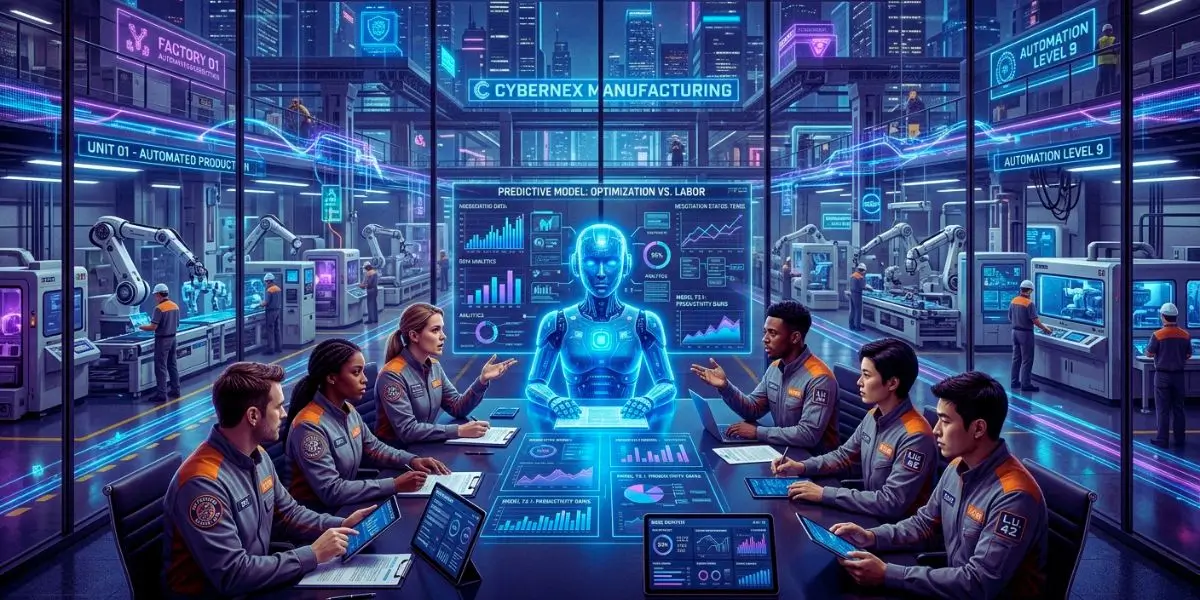
Historically, a union representative would sit across from a plant manager and argue about the physical toll of a 12-hour shift. The plant manager would rely on anecdotal evidence or lagging indicators. Today, the scenario is radically different. The table is now occupied by data scientists, lawyers, and a looming question: Do we trust the AI’s definition of “fair”?
The friction arises when the predictive AI manager makes decisions based on a metric the union hasn’t agreed to. For example, the AI might predict that a micro-break of 45 seconds should be moved from 10:00 AM to 9:45 AM to align perfectly with a machine’s cooling cycle. The worker sees this as micromanagement. The AI sees it as a necessary adjustment to increase Overall Equipment Effectiveness by 1.2%.
This is the moment we see the first factory union negotiation that isn’t about money, but about data interpretation. The union must now audit the algorithm. Have you ever wondered what happens when an algorithm violates a collective bargaining agreement without meaning to? The liability is a gray zone, and pushing for transparency in algorithmic decision-making is the new frontier of labor rights.
Predictive Scheduling vs. Human Autonomy
One of the biggest points of contention in factory AI management negotiations is predictive scheduling. Advanced systems can now forecast order volumes with astonishing accuracy weeks in advance. The AI knows exactly how many workers are needed, down to the minute.
However, this clashes violently with the human need for stability. A predictive AI manager might call a worker in for a 3-hour shift on a Tuesday based on a demand spike it predicted from social media sentiment analysis, then send them home. In a traditional union negotiations setup, this triggers guaranteed minimum pay clauses. The AI doesn’t “care” about clauses; it cares about inputs that affect the cost-per-unit metric. This is where a digital twin becomes a vital tool for resolution, simulating the long-term turnover cost of disgruntled employees versus the immediate savings of flexible labor.
Understanding the Conflict: Labor Logic vs. Predictive Logic
The tension in the first factory where the union has to negotiate with a predictive AI manager comes down to two conflicting decision-making architectures. A union steward acts on visibility, contract language, and human dignity. A predictive AI acts on energy efficiency, asset longevity, and output volume.
What Is the Problem with Digital Twins?
You might be asking, what is the problem with digital twins? If the technology is so perfect, why is there friction? The primary problem isn’t accuracy; it’s the metric of success.
A digital twin optimized solely for energy efficiency might decide to slow down a conveyor during peak electricity pricing hours. To the AI, that’s a brilliant financial hedge. To the worker on that line, that means a compressed window of frantic, high-speed work later to make up for the downtime, increasing physical strain and risk of injury.
What is the problem with digital twins? It’s the opacity. The AI calculates that a 2% speed increase will cause a 0.5% rise in repetitive strain injuries but a 4% gain in output. It ‘votes’ for the speed increase. The union doesn’t even know the calculation existed. You cannot grieve a statistical inference. That’s the negotiation gap. You are fighting a ghost that thinks in spreadsheets.
Integrating Artificial Intelligence into the Energy Sector and Production Lines
We cannot talk about the modern factory floor without a deep dive into sustainability, because the manager AI cares deeply about power. Integrating artificial intelligence into the energy sector isn’t just about solar panels; it’s about the manufacturing floor’s consumption.
Currently, a systematic review of industrial practices shows a massive shift. We are seeing an analysis of digital twin applications in energy efficiency a systematic review that reveals facilities using AI-driven twins save between 15% to 30% on energy costs. This happens because the AI predicts peak loads and autonomously shuts down “non-critical” sub-systems. Imagine you are a maintenance worker taking a coffee break in a bay that the AI just decided to power down to save $17. The lights go off. That’s a psychological power play.
Energy Transition: A Comprehensive Review
The industrial revolution 4.0 is dead; we are now in the energy transition. Integrating artificial intelligence in energy transition a comprehensive review reveals that factories are becoming micro-grids. Your factory isn’t just consuming energy; it’s trading it. When the digital twin sees that the grid price is high, it might sell stored battery power back to the grid instead of running the assembly line.
This decision, driven by integrating artificial intelligence in energy transition, creates a direct clash with job security. A line shut down for energy arbitrage is a line where workers aren’t earning incentive bonuses. The AI has a fiduciary duty to the balance sheet, not to the take-home pay of the staff. How do you negotiate for a human bonus when the AI can show the Board of Directors a chart proving idling the plant was the most profitable decision of the day?
The Negotiation Table: How Do You Bargain with Data?
In the first factory where the union has to negotiate with a predictive AI manager, the collective bargaining agreement (CBA) needs a drastic rewrite. You can’t yell at a server rack.
You need Algorithmic Transparency written into the contract. Before an AI can change a “work practice,” the union must receive a “plain English” impact report. You can’t negotiate a speed-up if you don’t know the AI’s definition of a “safety threshold.”
How Do Digital Twins Contribute to Predictive Maintenance in Manufacturing?
Let’s look at a specific battleground: maintenance. How do digital twins contribute to predictive maintenance in manufacturing? They shift the workflow from “run-to-failure” to “just-in-time.”
In a traditional union shop, if a bearing goes bad, a skilled tradesperson is called for an emergency repair—often meaning overtime, specific pay rates, and a certain number of minimum hours charged. The predictive AI manager hates this. The digital twin detects the bearing’s ultrasonic signature changing three months in advance.
Instead of a costly emergency repair, the AI schedules the replacement during routine downtime, potentially eliminating the need for an expensive specialist on overtime. The union sees the loss of a high-paying grievance shift. The AI sees the elimination of waste. How do digital twins contribute to predictive maintenance in manufacturing? They become the arbitrator of who works when, and if you’re not bilingual in data, you lose that arbitration every single time.
The European Strategy: Web 4.0 and Virtual Worlds
This isn’t happening in a regulatory vacuum. The European Union is proactively building a framework for exactly this scenario.
What Is the EU Strategy on Web 4.0 and Virtual Worlds?
You need to pay attention to Brussels. What is the EU strategy on Web 4.0 and virtual worlds? The EU’s strategy centers on a human-centric digital future, moving beyond Web3’s blockchain hype to a tangible, immersive industrial internet.
Their strategy specifically addresses the use of virtual worlds and digital twins in industrial contexts. The EU is pushing for “Industry 5.0,” which is distinctly different from the 4.0 we mentioned earlier. While 4.0 was about efficiency and automation, 5.0 is about resilience, sustainability, and human-centricity.
If you are a worker facing a predictive AI manager, the EU strategy on Web 4.0 is your safety net. It demands that virtual worlds (like factory digital twins) must not be designed to trick, exploit, or dehumanize. It means if a union sits down to negotiate, the EU legal framework is slowly tilting toward requiring the AI to have an “off-switch” governed by human dignity, not just operational uptime. If you’re operating in a global market, the EU’s standards will likely dictate the software design for factories worldwide.
How to Win as a Human in a Predictive AI Factory
You don’t defeat a predictive AI manager by ignoring it. You beat it by leveraging its own nature. A predictive model is risk-averse. It hates unforeseen friction. Here is your checklist to survive and thrive in a factory run by a digital twin:
Become the Data Exception: The AI is trained on normal distributions. If you strictly follow the standard operating procedure (SOP) to the letter, and the SOP is inefficient, the line slows down. The AI will flag the SOP, not you. Use the rules to fix the rules.
Demand the “Human Factor” Variable: Ensure the union contract quantifies human contribution. The AI tracks “gross throughput.” You need to track “complex problem-solving interventions.” Did you stop the line to fix a quality issue the camera missed? Log it. That’s a data point the AI must ingest.
Learn the System: You don’t need to code. But you do need to understand integrating artificial intelligence into the energy sector enough to know why the machine is slowing down. If the lights dim, is it a broken transformer or an AI selling power to the grid? One is a repair job; the other is a work stoppage you can challenge.
Have you experienced a situation where a “smart system” made a call that felt completely illogical on the ground floor? How did you override it?
Negotiating with Code: The “Workers vs. Digital Twins” Framework
To navigate this, forward-thinking unions are adopting a “Counter-Algorithm” strategy. They aren’t just arguing against the AI; they are building their own models to challenge the management’s findings, effectively turning the predictive AI manager into the subject of a technological audit.
Step 1: The Algorithmic Transparency Audit
Before any negotiation begins, the union must demand a complete transparency audit of the predictive AI manager. This isn’t just about seeing the code—which is often a black box—but about understanding the weight of the inputs.
Critical Check: Is the model prioritizing energy savings over worker fatigue?
Validation: A third-party auditor can run the historical data to see if the AI has exhibited bias, such as penalizing specific demographic groups for productivity metrics, which would be a severe violation leading into first factory union negotiation breakdowns.
Step 2: Simulating the “Human Cost” in the Digital Twin
This is the counter-punch. If management presents a digital twin that maximizes output, the union must present a modified digital twin that includes true “human cost” variables.
Most corporate digital twins are purely mechanical. They model torque, heat, and speed. They don’t model cortisol levels, divorce rates among high-stress shift workers, or the economic ripple effect of layoffs on a small town.
By injecting these “compassion variables” into the simulation, the union forces the algorithm to calculate the long-term destruction of human capital, not just the short-term gain in output. Can you imagine a factory where the AI’s key performance indicator isn’t just units per hour, but sustained family healthcare costs? That’s the long-term play.
Step 3: Agreed-Upon Data Boundaries
The union negotiations must establish hard boundaries for the predictive AI manager. For instance, a common clause in these new contracts is the prohibition of “granular human state assessment.” This means the AI cannot use computer vision to detect an employee’s micro-expressions to predict insubordination or emotional distress. It can track the machine, but it cannot psychoanalyze the worker through a digital twin interface without explicit, revocable consent.
Why the “First Factory Union Negotiation” Is a Blueprint for Every Industry
You might think this is isolated to heavy manufacturing. It’s not. This specific case of workers vs. digital twins is a preview of the knowledge work sector. If you work in a contact center, a logistics hub, or even a hospital, a version of this negotiation is coming to your profession.
We are entering the era of the Answer Engine Optimization for human capital. Just as modern marketing has shifted from guessing what people want to predicting it, modern management has shifted from supervising work to pre-empting it. An predictive AI manager doesn’t wait for a project to go over budget; it simply locks the digital purchase order based on a predictive risk score.
This shift demands a new kind of literacy. You don’t need to be a coder, but you need to understand how a digital twin can be used as a weapon, or a tool, against your own work-life balance. The “first factory” scenario marks the transition from industrial relations to algorithmic relations. The machine is no longer just the means of production; it is the mediator of it.
Optimizing for the Future: How to Prepare Your Team for Algorithmic Management
If you are a plant manager, a union steward, or a tech integrator, you cannot just treat this as a standard ERP upgrade. Adopting a predictive AI manager requires a change management process that prioritizes psychological safety.
Start with “Co-Bot” Simulations
Don’t let the AI give orders right away. Run a 90-day “silent simulation.” Let the digital twin make recommendations in a shadow mode. Allow the workers to compare their human intuition against the AI’s predictions. You will often find that the predictive AI manager is technically correct about the physical breakdown of a bearing, but the human mechanic is correct about the urgency of that breakdown based on a client relationship. Fusing these two data points leads to true optimization.
Negotiate the “Override” Protocol
In every first factory union negotiation involving AI, the “human override” is the central trophy. The algorithm can recommend scheduling changes, but at what threshold does a human manager automatically veto it? Is it a 10% increase in safety risk? A 5% drop in team sentiment?
The digital twin for negotiation must map out these thresholds. If you can’t override the machine without a five-person committee signing off, you’ve lost the war for your factory floor. You’ve essentially handed the keys to a system that has zero accountability but absolute authority—a recipe for disaster in high-stakes manufacturing environments.
The Hidden Risk: When Digital Twins Drift from Reality
Every AI expert warns about “model drift.” A digital twin of a factory is a beautiful, intricate mirror. But it’s a mirror that can slowly warp without anyone noticing. Over weeks, the simulated friction coefficient of a conveyor belt in the twin might differ from the actual, degraded belt in reality.
When the predictive AI manager starts making labor decisions based on a false reality—believing the line is faster than it is—it pushes workers to meet impossible standards. This isn’t malice; it’s a synchronization error. The union negotiations of the future will need an “Accuracy of Virtual Representation” clause. If the digital twin deviates from physical truth by a defined margin, all AI-derived performance ratings become null and void. Are your current performance reviews based on physical reality, or a polished, glitchy simulation? It’s a question that keeps factory stewards up at night.
Real-World Case Study: The Semiconductor Pressure Cooker
Consider a high-precision semiconductor plant (a setting often kept confidential due to trade secrets) which recently faced a stand-off labeled internally as the ultimate test of workers vs. digital twins. The predictive AI manager identified that the “human error rate” in cleanroom suits spiked not due to incompetence, but due to dehydration because workers skipped water breaks to meet the AI’s timed targets. The AI saw the errors; it didn’t see the biological cause.
The resolution required a first factory union negotiation mediated by a team of data ethicists. They agreed to tweak the digital twin to include a “biological constraint” variable. The AI could no longer schedule a task flow that statistically resulted in operators going more than three hours without a hydration pause. The result? The AI optimized the schedule around the water breaks. Downtime decreased. Yield stabilized. The AI didn’t “lose.” It simply gained a better, more humane dataset. This proves that a predictive AI manager is only as good as the constraints a strong negotiation places upon it.
The New Language of Leadership: Blending Grit with Code
To survive this transition, the modern factory leader must be bilingual. You must speak the language of torque and tension, but also the language of standard deviation and algorithmic bias. When your team pushes back on a predictive AI manager, they aren’t necessarily resisting technology; they are resisting the removal of nuance.
The union negotiations table is no longer a place of pure emotion and economics; it is a technical debate about data hygiene. If the union can prove the management’s digital twin is using faulty sensor data, the union wins the argument immediately. This forces facility owners to maintain their virtual infrastructure as meticulously as their physical machinery.
Navigating the Transition: A Quick Wins Checklist
If your facility is looking at this technology, here are the non-negotiables:
Human-in-the-Loop Monitoring: Never allow a predictive AI manager to execute a disciplinary action without a human verification step.
Dual-Input Digital Twin: Ensure your digital twin dashboard displays both “Engineering Metrics” and “Human Experience Metrics” side-by-side.
Algorithmic Literacy Training: Train every union representative on how to read a confusion matrix. You cannot negotiate a digital twin if you don’t know what a false positive is.
Sandbox Scenarios: Before go-live, run the most extreme “disaster” scenarios in the simulation to find the ethical breaking points of the AI.
The Proof: Studies and Real-World Applications
We aren’t basing this on gut feelings. The analysis of digital twin applications in energy efficiency a systematic review provides hard evidence. A comprehensive study published in Applied Energy highlights that digital twins integrated with AI reduced peak energy consumption in automotive plants by 22%. However, the same study warned of “operator cognitive dissonance”—a fancy term for workers feeling they are fighting the building’s brain.
Furthermore, the work on integrating artificial intelligence in energy transition a comprehensive review, often cited by the Journal of Cleaner Production, proves that AI-driven energy markets can stabilize grids. But for a factory worker, a “stabilized grid” might feel like a chaotic shift schedule. The study validates that without “socio-technical feedback loops” (meaning, actually listening to the people doing the work), the energy savings collapse because workers find manual workarounds to the AI.
These aren’t just academic theories. In a large logistics hub in Rotterdam, a predictive AI manager took over the dispatch of autonomous ground vehicles. The union didn’t block the tech; they negotiated for the AI to factor in “rest density”—ensuring robots didn’t cluster human breaks into impossible windows. That’s the future of negotiation.
Conclusion
The first factory where the union has to negotiate with a predictive AI manager won’t be a sci-fi set. It will look like any other factory, but the sound will be different. It will be the quiet of a perfectly balanced system, punctuated by the tension of humans trying to find their place in a loop that feels no pain.
You cannot stop digital twins from managing predictive maintenance. You cannot stop AI from controlling the energy transition. But you can demand that the system’s logic includes one unquantifiable variable: human dignity. If you don’t learn the language of the algorithm, your voice in the negotiation becomes white noise.
The whistle is silent now. It’s your move.
Are you ready to audit your own workplace for “shadow AI” decision-making that’s already happening without human approval?
Frequently Asked Questions
What is a predictive AI manager in a factory context?
A predictive AI manager is an autonomous software system that uses machine learning and real-time sensor data to forecast operational bottlenecks, schedule maintenance, and allocate human labor tasks without direct human supervision. It aims to optimize workflow before problems occur.
How does a digital twin affect union negotiations?
A digital twin provides a real-time virtual simulation of the factory floor. During union negotiations, this tool can be used by management to justify staffing levels or by unions to demonstrate the physical strain on workers. It shifts negotiations from opinions to data-driven arguments.
What was the “first factory union negotiation” regarding AI?
While specific company names are often sealed under NDAs, the “first” landmark union negotiations revolved around predictive scheduling. The union argued that the predictive AI manager had to respect guaranteed minimum hour contracts, even if the algorithm predicted sporadic demand.
How can workers compete against digital twins in the long run?
Workers must lean into the uniquely human elements that a predictive AI manager cannot replicate: ethical judgment, complex dexterity improvisation, and interpersonal conflict resolution. The strategy is not to beat the machine at math, but to become the essential human gatekeeper of the machine’s decisions.
Is the predictive AI manager responsible for safety incidents?
This is a major legal gray area. If a predictive AI manager overrides a worker’s safety stop, liability is complex. Future union negotiations are pushing for a “Joint Liability Framework,” where the AI developer shares legal responsibility with the factory owner for incidents caused by algorithmic override.
What is the difference between a digital twin and regular monitoring software?
Standard monitoring software displays what is happening. A digital twin uses that data to predict what will happen and tests hypothetical changes in a risk-free virtual space. It is interactive and predictive, not just reactive.
Can a union refuse to negotiate with a predictive AI?
A union cannot physically sit across from an algorithm. However, unions can refuse to accept the output of a predictive AI manager as a valid basis for disciplinary action or contract changes. This forces management to translate the AI’s logic into verifiable, human-explainable facts during every first factory union negotiation.
How do digital twins contribute to predictive maintenance in manufacturing?
Digital twins contribute by continuously analyzing sensor data from physical machinery. They simulate wear and tear to predict exactly when a component will fail. This allows the predictive AI manager to schedule repairs during planned downtime, avoiding catastrophic breakdowns and eliminating overtime costs, which fundamentally changes how labor maintenance agreements are structured.
What are digital twins in manufacturing and the use of models?
In manufacturing, digital twins are high-fidelity virtual replicas of the physical factory floor. The use of models involves running “what-if” simulations—testing a speed increase on the virtual line to see if it causes a robot collision or worker injury before it happens in reality. It turns the factory into a sandbox for optimization.
What is the problem with digital twins?
The main problem with digital twins in a labor context is their singular focus on metrics like OEE (Overall Equipment Effectiveness) and energy costs. They often lack contextual awareness of human factors like fatigue, morale, or the implicit knowledge of a veteran worker. The AI’s “perfect plan” can become an inhumane schedule if human variability is treated only as an error margin.
Who is the father of digital twins?
While NASA pioneered the practical concept during the Apollo program, Dr. Michael Grieves is academically recognized as the father of digital twins. He introduced the concept and the specific terminology at a Society of Manufacturing Engineers conference in 2002, defining the three-part system: physical product, virtual product, and the data connections between them.
Who invented the very first digital?
The concept of the “digital” as an information layer evolved over time, but concerning physical simulation, NASA’s John Vickers is often credited alongside Michael Grieves. However, in computer science history, the “very first digital” electronic computing concepts are attributed to pioneers like John Atanasoff and Clifford Berry (ABC Computer) or Alan Turing’s universal machine theory, which defined the digital logic that makes modern twins possible.
Disclaimer: This article discusses emerging technologies and labor relations. The scenarios described are based on current technological capabilities and trends identified in industrial research. They are not financial or legal advice. Consult with a qualified labor attorney and technical consultant before implementing AI-driven management systems.