

















Let’s be honest for a second. You’ve seen it. That moment when you’re relying on an AI to draft a critical client email, analyze a data set, or generate a piece of code, and it confidently spits out something that is not just wrong—it’s catastrophically off the mark. We call them “hallucinations,” but in the trenches of digital marketing and software development, I call them what they really are: business liabilities.
If your conversion funnel is leaking money because a generative model gave a customer bad advice, or if your content team just published a factually incorrect blog post drafted by Claude, you aren’t just dealing with a bug. You are dealing with a digital reputation crisis that impacts your engagement metrics and customer lifetime value immediately.
The problem isn’t just that these failures happen; it’s that up until now, there hasn’t been a unified, high-velocity feedback loop to ensure these models actually learn from their catastrophic mistakes. That is exactly why we need to talk about FLARE-AI. This isn’t just another tech tool; it is the future of content quality control and intelligent response optimization.
Why “Ignore and Hope” Is No Longer a Content Strategy
For years, the marketing world focused purely on traditional search optimization. We obsessed over keyword density and backlinks. But 2025 introduced a new beast: the AI-powered overview. If Google’s AI pulls a wrong answer from a large language model into its search generative experience, the reader doesn’t blame the machine; they blame the source. Your authority score drops silently, and your engagement tanks.
Have you noticed how generative engines like Perplexity or ChatGPT sometimes fabricate statistics or invent product features? That isn’t just a minor glitch. When an AI hallucinates about a “30% discount” you never offered, that’s a customer service nightmare waiting to explode. It erodes the trustworthiness that modern algorithms prioritize.
So, what do you do? Do you keep throwing manpower at manually fact-checking every single AI output? Or do you leverage a system designed specifically for flaw reporting for ChatGPT, Claude, Gemini? The smart money is on the latter.
Defining the Core Problem: The Hallucination Tax
I like to call it the “Hallucination Tax.” Every time an AI generates low-quality output, you pay with your time, your team’s morale, and your conversion rates. Think about it: if you are using a model to power a chatbot on a high-traffic landing page, and it starts giving wrong answers about your return policy, your bounce rate skyrockets. You’re bleeding potential leads.
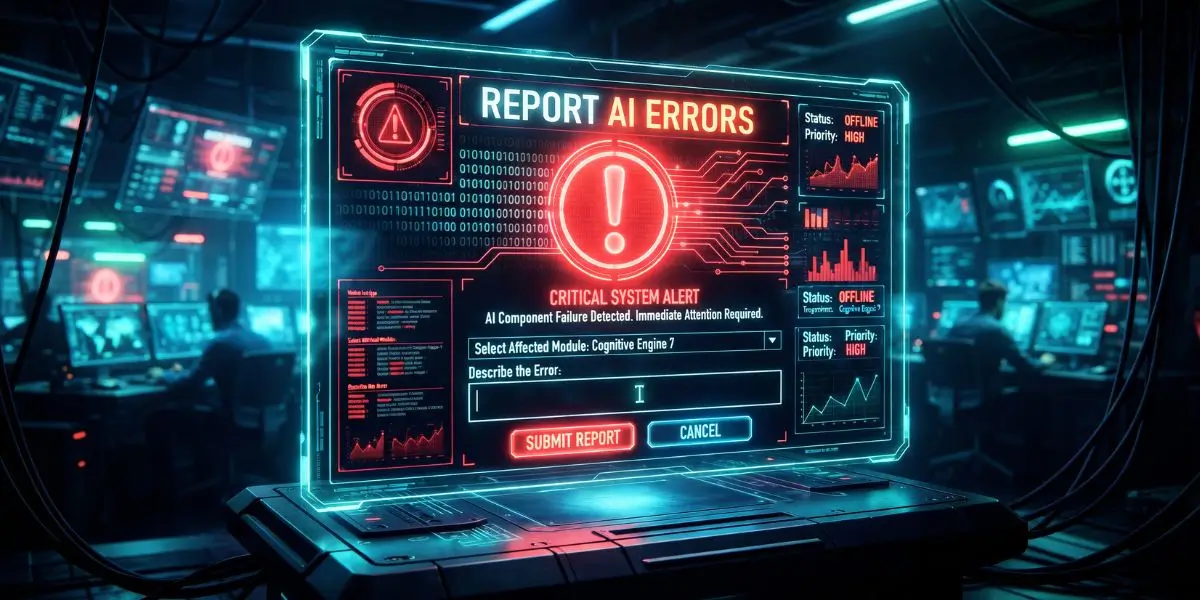
Reporting AI errors & damage is no longer a niche activity for developers. It’s a core business function. You need a streamlined channel, or a report AI channel, to catch these errors before they fracture your brand’s narrative.
FLARE-AI: The Dedicated Report AI Channel for High-Performance Teams
What is FLARE-AI? It is a specialized framework and platform designed to automate the AI incident reporting lifecycle. Instead of silently seething when Claude misinterprets a command or Gemini creates a biased image caption, you log the AI flaw documentation directly into a feedback engine.
This isn’t just a complaint box. It acts as your proprietary report AI errors & damage system. It turns chaotic user feedback into structured data that helps you fine-tune your prompts, guardrails, and even your choice of model. This is how you achieve real, measurable prompt performance optimization.
Structured data for structured minds: When you report an error through a formal AI flaw reporting tool, you aren’t just saying “this is wrong.” You are categorizing the nature of the failure—was it a logic gap, a copyright violation, or a factual inaccuracy? This data is pure gold for generative engine optimization. By understanding how models fail, we can construct content that AI overviews can parse without warping the truth.
How Generative Engine Optimization Relies on Flawless Data
We can’t talk about generative engine optimization without talking about failure. This practice involves designing content so that AI-powered search engines digest, cite, and summarize it correctly. But if the underlying model is flawed, your perfect strategy is built on quicksand.
A successful generative engine optimization approach requires that we close the loop. We feed the machine, and if the machine chews up our data and spits out nonsense, we need a mechanism to hit the emergency stop. Flaw reporting for ChatGPT, Claude, Gemini via FLARE-AI allows you to send that strong corrective signal.
Are you currently tracking how often your brand is misrepresented by AI snapshots? If not, you are flying blind.
The Anatomy of a Perfect AI Flaw Report
To master AI flaw documentation, you must treat a hallucination like a critical software bug. “It didn’t work” is useless. “The model failed to distinguish between American and British legal definitions in a compliance document” is actionable. FLARE-AI ingests this granular data to help you spot patterns.
Here is the non-negotiable AI bug reporting checklist for your team:
The Prompt Snapshot: Never report an error without the exact input.
The Expected Output: Clearly define what success should have looked like.
The Damage Assessment: Did this error stop a transaction? Did it expose legal liability? Categorize the severity.
The Model Specifics: Was it GPT-4o? Claude 3.5? Gemini 1.5? Different models hallucinate differently.
The Correction: Provide the ground truth. This helps in fine-tuning custom GPTs or internal knowledge bases.
By standardizing AI incident reporting, you train your team to become a proactive moderation squad rather than reactive firefighters.
Why This Matters More Than Traditional Search Optimization Right Now
There is a massive shift happening. The classic blue link is dying a slow death. In 2025, users ask questions, and AI generates the answer. If your brand’s information is ingested by a model that lacks proper context, the AI will stitch a Frankenstein version of your reality.
This is where intelligent response design intersects with AI flaw reporting. You optimize an answer, but you must also defend that answer. If Google’s AI overviews claim your software doesn’t have a feature it actually has, you need to report that error not just to Google, but into a system that cross-references these model failures.
FLARE-AI provides the report AI channel to defend your market position. It’s the difference between letting a rumor spread and issuing a definitive, citable correction that the next scrape of the model picks up.
The “Experience” Factor: Show, Don’t Just Tell
Modern algorithms prioritize content that demonstrates tangible, real-world involvement. In the context of AI safety, that means showing your audience you are actively wrestling with these tools, not just writing theory.
When you publish your process of reporting AI errors & damage, you are marketing your transparency. You are telling the digital ecosystem, “We don’t just generate spam; we curate, we correct, and we perfect.” This builds a defensive moat around your site’s authority. It shows you have the hands-on knowledge to handle the wild west of generative content.
The Business Impact: From Bug Report to Revenue
Let’s talk about the funnel. How does AI flaw reporting increase revenue?
Customer Support Cost Reduction: If your internal support bot is trained on corrected data via FLARE-AI, it stops giving customers the runaround. Resolution time drops.
Legal Safety: In regulated industries, AI giving wrong compliance advice can result in fines. Report AI errors early to stop this liability in its tracks. (Disclaimer: This does not constitute legal advice; always consult with a legal professional regarding AI usage in regulated sectors.)
Brand Equity: When a user sees an AI hallucinate about your brand on a public forum, and you immediately chime in with “Thanks for flagging this, logged via FLARE-AI, correction submitted!”, you look like a polished, high-tech authority.
Every piece of AI flaw documentation you collect becomes a training asset. You can literally build a proprietary “failure library” to run adversarial tests against new model releases. When OpenAI releases a new model or Anthropic updates Claude, you run your library against it to see if they fixed the old issues or created new ones. That’s power.
Quick Wins: How to Start Reporting AI Errors Today
Ready to stop the bleeding? Here is your immediate action plan:
Set up a monitoring dashboard: Don’t just trust the model; verify outputs randomly.
Create a “Kill Switch” prompt: Program a meta-prompt that tells your AI, “If you are unsure about a factual statement regarding this topic, respond ONLY with ‘Please check the official FLARE-AI log’ instead of guessing.”
Log every failure: Even the small ones. That quirky misinterpretation today is tomorrow’s viral tweet mocking your brand.
Future-Proofing Your Stack with AI Flaw Documentation
We are heading toward a world of autonomous AI agents. Imagine an agent booking flights for you. If it hallucinates a flight time, you miss the flight. The cost of a mistake shifts from “minor embarrassment” to “logistical nightmare.”
To prepare for this, your report AI errors & damage system must be automated. FLARE-AI isn’t just a manual log; it’s designed to integrate with agentic workflows. If an agent encounters a logic paradox, it should be able to file a self-report, triggering a human review. This is how we prevent runaway AI agents from damaging user trust.
Are you confident that your current tech stack can detect when an AI agent lies to you? Most businesses can’t.
The Ultimate “Avoid the Hallucination Trap” Checklist
Before we wrap up, print this out. Stick it on your wall.
Source Attribution: Is my prompt forcing the AI to cite specific sources, not just pretend it knows?
Temperature Check: Have I lowered the “creativity” setting for factual tasks to avoid wild guesses?
Containment: Am I isolating the AI from making irreversible decisions (like sending emails) without human sign-off?
The FLARE Protocol: Do I have a one-click method to report AI errors when they inevitably happen?
Frequently Asked Questions
What exactly constitutes “AI damage” worth reporting?
AI damage isn’t just a server crash. It includes reputational harm (hallucinated negative reviews), financial loss (incorrect billing calculations), and user churn caused by poor chatbot interactions. If the error causes you to lose time or money, it is AI damage worth documenting.
How does FLARE-AI differ from just giving a thumbs-down to ChatGPT?
The native feedback buttons (thumbs up/down) are “black boxes.” You don’t get a record, you can’t track if the issue was fixed, and you can’t prove to your compliance officer that you addressed the hallucination. FLARE-AI acts as a report AI channel that gives you an audit trail and ownership of your feedback data, which is essential for AI flaw documentation.
Can reporting errors actually fix the underlying model like Claude or Gemini?
Currently, reporting an error doesn’t instantly re-train the public model, but it signals the developers to apply guardrails. More importantly for you, a robust report AI errors & damage system allows you to refine your own prompts, retrieval-augmented generation (RAG) pipelines, and fine-tuned models to stop encountering that specific error.
Why is flaw reporting critical for generative engine optimization?
Generative engine optimization works by structuring data so AI can process it cleanly. If the AI is full of flaws, it will misrepresent your structured data. AI flaw reporting provides the “correction data” that helps ensure your generative engine optimization efforts are reflected accurately in the final answer delivered to the user.
How often should I be auditing my AI outputs for flaws?
For high-stakes content (customer-facing, legal, financial), you should have a daily spot-check. For lower-stakes creative work, a weekly review of the AI flaw documentation log is sufficient to identify systemic issues in your prompt pipeline.
Conclusion
You can’t afford to treat AI like a perfect oracle. Treat it like a brilliant, but occasionally reckless, junior employee. You need a performance improvement plan for your machines, and that plan is called AI flaw documentation.
Don’t let a hallucination tank your session duration or ruin your hard-won authority. It’s time to take control of the narrative. Start using a dedicated report AI channel to refine, correct, and perfect your AI-driven workflows.
Have you experienced a catastrophic AI failure that cost you a conversion? Drop a comment below and let’s workshop how a strong AI incident reporting framework could have saved the day. And if you found this guide useful, share it with your ops team—because in the world of AI, silence isn’t golden; it’s a liability.