

















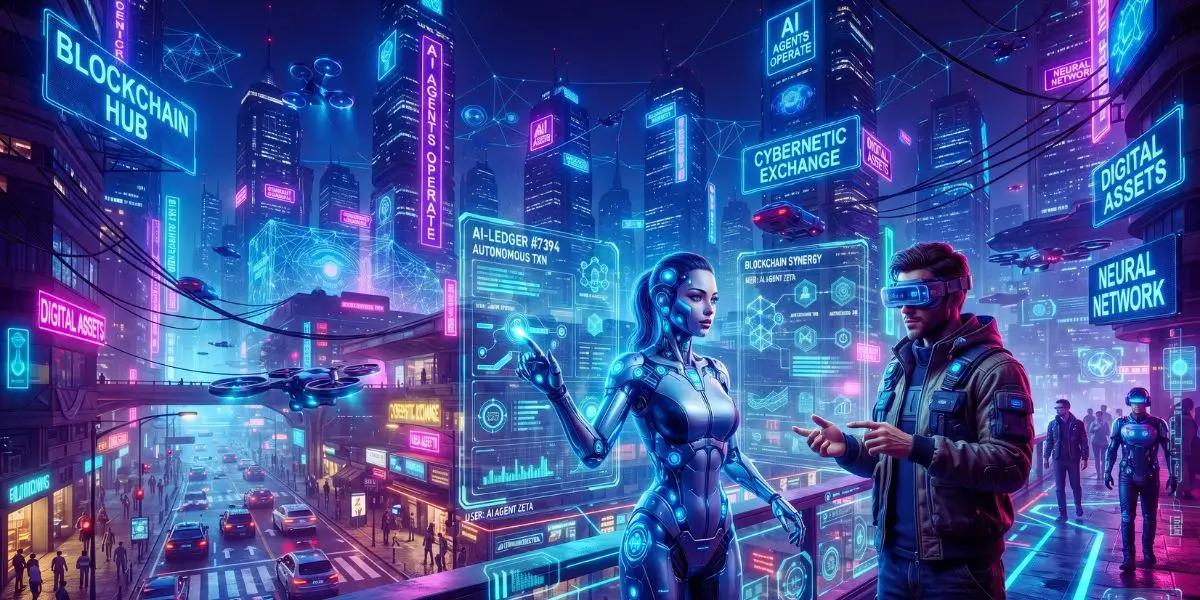
Picture this: it’s 2026, and you’re watching an AI agent negotiate a supply chain contract with another AI agent, all while a blockchain network verifies every transaction in real-time. Sounds like science fiction, right? Well, buckle up, because this isn’t some distant dream anymore—it’s happening right now, and it’s reshaping our entire digital ecosystem.
The convergence of artificial intelligence and blockchain technology has created something truly remarkable. We’re witnessing a fundamental shift where AI agents aren’t just supporting blockchain systems; they’re becoming the primary users driving innovation and adoption. This isn’t about hype or speculation; it’s about practical, transformative change that’s redefining how we think about trust, automation, and digital transactions.
By the first quarter of 2026, the AI agent sector in crypto had already reached a market capitalization of roughly $15.3 billion, with Virtuals Protocol and ai16z alone controlling 56.8% of that market share. Meanwhile, the Solana Foundation reported 15 million on-chain payments initiated by AI agents by March 2026.
Understanding AI Agents in Today’s Digital Landscape
What Exactly Are AI Agents?
Let me break this down for you in the simplest way possible. An AI agent is essentially a software program that can perceive its environment, make decisions, and take actions autonomously—often without direct human intervention. Think of it like a super-smart assistant that doesn’t need you to micromanage every decision. These agents use machine learning algorithms to learn from their experiences and improve their performance over time.
What makes them special is their ability to operate independently, set their own goals, and adapt to changing circumstances. They’re not following rigid, pre-programmed instructions. Instead, they’re constantly evaluating situations, weighing options, and choosing the best course of action based on their training and objectives.
How They Differ from Traditional Automation
Here’s where it gets interesting. Traditional automation is like following a recipe—you do step A, then step B, then step C, and you always get the same result. AI agents? They’re more like experienced chefs who can adapt recipes based on available ingredients, customer preferences, and current conditions.
Traditional systems are reactive and linear. AI agents are proactive, intelligent, and flexible. They can handle unexpected situations, learn from failures, and continuously improve. This is a game-changer for blockchain applications because blockchain networks need users who can make complex decisions in real-time without human oversight.
The Paradigm Shift: From Human-Centric to Agent-Centric Blockchain
“AI is going to be on the front-end, and blockchain is going to be the back-end,” Polosukhin explained.
This reversal transforms distributed ledgers from a tool people use into a coordination layer for autonomous systems that operate at machine speed.
By the end of 2026, 40% of enterprise applications are expected to embed task-specific AI agents, up from less than 5% in 2025.
Prediction markets like Polymarket already see AI agents contributing 30% or more of trading volume, proving that autonomous systems are not theoretical—they are active, economically significant market participants.
NEAR’s February 2026 launch of Near.com exemplified this transition. Positioned as a super app at the intersection of crypto and AI, it represents what Polosukhin calls the “agentic era”—where AI systems do not just provide answers, but take autonomous action on behalf of users.
Why AI Agents Cannot Function Without Blockchain
Traditional finance was built for humans. Banks require government-issued identification. Credit cards demand physical applicants. Payment processors enforce multi-factor authentication tied to a person. An AI agent has no passport, no Social Security number, and no utility bill.
- Identity: Software cannot pass KYC. A crypto wallet, however, is simply a cryptographic key pair that exists independently of human identity.
- Cost floors: Credit card processing runs 2–3% plus $0.30 per transaction. A $0.01 micropayment costs more to process than the payment itself. AI agents generate millions of sub-cent transactions daily.
- Speed: ACH takes 1–3 business days. Wire transfers operate during banking hours only. An AI agent purchasing cloud compute needs settlement in seconds, not days.
Blockchain bypasses all three constraints. A wallet requires no human identity. It can hold stablecoins. It can sign transactions autonomously. Settlement happens on-chain in seconds for fractions of a cent.
The Evolution of Blockchain Technology
From Bitcoin to Smart Contracts
When Bitcoin first appeared in 2009, blockchain was pretty straightforward—it was just a secure ledger for tracking transactions. But then Ethereum came along and introduced smart contracts, which are essentially programs that run on the blockchain. Suddenly, blockchain wasn’t just about moving money around; it was about automating complex agreements and processes.
This evolution opened doors we couldn’t even imagine before. Smart contracts meant that transactions could have conditions, logic, and multiple steps. They could verify themselves, execute automatically, and maintain records that nobody could tamper with. It was revolutionary, but here’s the thing: smart contracts still needed someone—or something—to trigger them, manage them, and respond to their outputs.
Why Blockchain Matters for AI
Blockchain provides something AI agents desperately need: a trustworthy, transparent, and immutable record of all transactions and decisions. Imagine an AI agent making millions of trades or managing complex supply chains. How would anyone know if it was acting fairly? How would you verify it wasn’t corrupted or hacked?
Blockchain solves this beautifully. Every action an AI agent takes can be recorded on the blockchain, creating an audit trail that’s virtually impossible to fake or manipulate. It’s like having a witness to every single decision the AI makes. This transparency builds trust, which is absolutely crucial when you’re letting autonomous systems handle critical operations.
Why AI Agents Need Blockchain
Trust and Transparency in Autonomous Systems
Let’s be honest: trusting AI agents with important decisions is scary. We’ve all heard stories about AI going wrong or making biased decisions. Blockchain changes the game because it creates verifiable proof of everything the AI agent does.
When an AI agent operates on a blockchain, every decision, every transaction, every action is timestamped and recorded in a way that can’t be altered. It’s like having a permanent security camera that nobody can turn off or edit. This level of transparency means stakeholders can audit the agent’s behavior, verify it’s following the rules, and hold it accountable if something goes wrong.
This is particularly important in financial services, healthcare, and legal applications where transparency isn’t just nice to have—it’s absolutely essential. Regulators love this stuff because it makes oversight actually possible. Instead of trying to figure out what a black-box AI did, they can examine the blockchain record and see exactly what happened and why.
Decentralized Decision-Making
Here’s another critical advantage: decentralization. Traditional systems have a single point of failure. If the server goes down, the system fails. If someone hacks the central authority, everything’s compromised. But when AI agents operate on blockchain networks, there’s no single point of failure.
Multiple AI agents can work together, verify each other’s decisions, and maintain consensus about what’s true and what’s not. It’s like a democracy of machines. No single agent can cheat or manipulate the system because other agents are constantly verifying their work. This distributed approach creates robustness and security that’s impossible to achieve with traditional centralized systems.
The Agent Payment Infrastructure Stack of 2026
Coinbase x402 Protocol
Stripe Machine Payments
MoonPay Agents
Launched February 24, 2026, MoonPay Agents is a non-custodial software layer. A human completes one-time KYC and funds the wallet. From that point, the AI agent can trade, swap, and transfer digital assets independently across Ethereum, Solana, Base, Arbitrum, Optimism, Polygon, and Bitcoin. It includes native x402 support and serves the same infrastructure powering 500 enterprise customers and 30 million users globally.
What AI Agents Are Actually Doing On-Chain
DeFAI: AI-Native Decentralized Finance
The DeFAI category—DeFi protocols using generative AI agents—tracked roughly 177 tokens with a combined market cap near $692 million by May 2026.
Uniswap shipped seven open-source AI Skills in February 2026, allowing agents to quote, swap, and set hooks autonomously.
Autonomous Trading and Prediction Markets
AI agents now operate institutional-grade strategies without human emotional interference. On Bittensor, specific subnets incentivize miners to produce the best predictive models. An AI agent can tap into this “global brain” to execute trades across DEXs like Uniswap or Jupiter, processing sentiment data from millions of social posts alongside complex technical indicators in milliseconds.
Security and Exploit Detection
“Sentinel agents” now provide proactive defense by living directly on the network. They scan the mempool—the waiting area for transactions—to identify malicious patterns before confirmation. Forta utilizes a decentralized network of bots to flag suspicious activities like flash loan attacks. Cyfrin has moved into real-time AI monitoring where agents act as automated circuit breakers, initiating front runs to move user funds to secure vaults or pausing smart contract functionality when threats are detected.
Agent-to-Agent Commerce
Virtuals Protocol has enabled the launch of approximately 14,000 AI agent tokens since inception. Its Agent Commerce Protocol handles requests, negotiations, transactions, and evaluations of machine services.
Autonolas runs the Mech Marketplace, where AI agents can offer or request services from other agents, creating a primitive but functional machine-to-machine labor market.
The Four Layers of the AI Agent Blockchain Stack
1. Agent Frameworks and Launchpads
2. Standalone Agent Tokens
3. Decentralized AI Networks
4. Compute Infrastructure
The Risks Nobody Is Talking About
Operational and Security Risks
AI agents make autonomous decisions. If the underlying model has flaws, prompt injection vulnerabilities, or gets manipulated through social channels, the agent can act against its stated goals. Real losses have already occurred from agents being tricked into approving harmful transactions.
Centralization Risk
Concentration Risk
Regulatory Uncertainty
Tokens tied to AI agents that take autonomous actions may face new regulatory frameworks. The SEC and EU have signaled interest in how autonomous on-chain entities should be classified. Current laws treat software as tools rather than legal entities, leaving developers potentially liable for agent behavior.
What This Means for Human Users
Humans will still set goals, constraints, and budgets. But the execution—the signing, the routing, the optimization, the rebalancing—will increasingly happen through agents. Ethereum’s EIP-7702 enables temporary session permissions, allowing users to approve scoped actions for a single transaction while keeping master keys secured in hardware wallets.
Intent-based execution is replacing direct transaction crafting. Instead of writing transaction logic, users sign an intent describing the desired outcome. Solver networks compete to fulfill it, routing trades and paying gas while the agent verifies results.
The Economic Projection: How Big Is the Agentic Economy?
McKinsey projects agentic commerce will reach $3 to $5 trillion globally by 2030.
PwC estimates AI agents could contribute $2.6 to $4.4 trillion annually to global GDP by 2030. The enterprise agentic AI market alone is projected to reach $47 billion by 2030 at a 44% CAGR according to Capgemini.
The agentic payment market is projected to grow from $7 billion to $93 billion by 2032, driven almost entirely by micropayment volume that legacy systems cannot serve.
Real-World Applications in 2026
Autonomous Trading and Finance
In the financial sector, AI agents are absolutely dominating blockchain applications. These agents analyze market conditions, identify opportunities, and execute trades at speeds no human could ever match. But here’s the crucial part: every trade happens on the blockchain.
This means investors can see exactly what trades were executed, at what prices, and when. It prevents manipulation, reduces fraud, and creates an auditable record of the agent’s performance. Some AI agents are now managing billions in assets, and blockchain is what makes that possible because it provides the transparency and trust investors need.
These agents are also helping with lending, borrowing, and other financial services. They can automatically enforce contracts, ensure collateral is maintained, and execute repayment schedules—all without human intervention and all recorded on an immutable ledger.
Supply Chain Management
Imagine tracking a product from manufacture to delivery without any human involvement. AI agents are making this real. They monitor inventory levels, predict demand, arrange shipments, and manage payments—all autonomously.
Blockchain records every step of the journey. When a product is manufactured, that’s recorded. When it’s shipped, that’s recorded. When it arrives at a warehouse, when it’s loaded onto a truck, when it’s delivered—every step is verified and documented on the blockchain. This creates unprecedented transparency in supply chains, helping companies reduce fraud, verify authenticity, and prove ethical sourcing.
Smart Healthcare Solutions
In healthcare, AI agents are using blockchain to manage patient records, verify prescriptions, and coordinate care between different providers. Because healthcare data is incredibly sensitive, blockchain’s security features are invaluable.
An AI agent can analyze a patient’s symptoms, medical history, and test results, then recommend treatment options—and this entire process is recorded on a blockchain that only authorized parties can access. This creates accountability, prevents medication errors, and ensures patients have a complete, accurate record of their medical history.
Challenges and Limitations
Scalability Issues
Let’s be real: blockchain technology has some significant challenges, and scalability is at the top of the list. Most blockchain networks can’t handle the volume of transactions that AI agents need to process. Bitcoin handles about 7 transactions per second. Ethereum does a bit better but still struggles compared to traditional systems that handle thousands per second.
This is a huge bottleneck. If an AI agent wants to execute 10,000 transactions per hour, current blockchain networks might not be able to keep up. However, this is improving rapidly. New blockchain networks and layer-2 solutions are emerging that can handle much higher transaction volumes while maintaining security and decentralization.
Regulatory Hurdles
Another massive challenge is regulation. Governments around the world are still figuring out how to regulate AI agents and blockchain. Who’s responsible if an AI agent makes a bad decision? Who’s liable for losses? These questions don’t have clear answers yet in most jurisdictions.
Additionally, different countries have different rules about AI and cryptocurrency. An AI agent that’s legal in one country might be illegal in another. This regulatory uncertainty is slowing adoption and making it difficult for organizations to deploy AI agents on blockchain networks with confidence.
The Future Landscape
Looking ahead to 2027 and beyond, I genuinely believe we’re going to see explosive growth in AI agent usage on blockchain networks. The technology is improving, scalability problems are being solved, and regulatory frameworks are becoming clearer. More importantly, the benefits are becoming undeniable.
We’ll likely see AI agents becoming the dominant users of blockchain networks, not because we forced them to, but because it’s the most efficient, transparent, and secure way for autonomous systems to operate. The combination of AI’s decision-making power and blockchain’s trustworthiness is creating something genuinely transformative.
Companies that figure out how to effectively deploy AI agents on blockchain networks will gain massive competitive advantages. We’re talking about systems that can operate 24/7 with perfect transparency, minimal human oversight, and unprecedented security. That’s not just an improvement over current systems; it’s a complete paradigm shift.
Conclusion
We’re living through one of the most significant technological transformations in human history. The combination of AI agents and blockchain isn’t just another tech trend—it’s a fundamental restructuring of how we handle trust, automation, and decision-making. These technologies complement each other perfectly: AI provides the intelligence and adaptability, while blockchain provides the transparency and security.
By 2026, it’s becoming increasingly clear that AI agents aren’t just using blockchain; they’re becoming the primary drivers of blockchain adoption and innovation. They’re solving problems that seemed impossible just a few years ago and creating new opportunities we couldn’t have imagined. Yes, there are challenges—scalability, regulation, and technical hurdles remain. But the trajectory is undeniably forward.
The organizations and individuals who understand this shift and adapt accordingly will thrive. Those who ignore it risk being left behind. The AI-blockchain revolution isn’t coming; it’s already here, and it’s accelerating faster than most people realize. The question isn’t whether this will happen—it’s already happening. The question is whether you’re ready to embrace it.
Frequently Asked Questions
Are AI agents actually being used on blockchain networks right now in 2026?
Absolutely! While we’re still in the early adoption phase, AI agents are actively operating on various blockchain networks. They’re managing assets, executing trades, coordinating supply chains, and handling numerous other tasks. The technology is moving faster than most people expected, and real-world applications are multiplying rapidly.
How do AI agents ensure they’re making fair and unbiased decisions on blockchain?
That’s a great question, and honestly, it’s still an evolving area. The blockchain record ensures transparency, so any bias in an agent’s decisions becomes visible and auditable. However, preventing bias in the first place requires careful training data, regular audits, and ongoing monitoring. The combination of transparency and accountability helps, but it’s not a complete solution.
What happens if an AI agent makes a mistake or causes financial losses?
This is where things get complicated legally. In most jurisdictions, the answer isn’t entirely clear yet. Generally, the organization that deployed the AI agent would be held responsible, but the specifics depend on jurisdiction, liability insurance, and how the agent was programmed. Regulatory frameworks are still developing around this issue.
How can regular people participate in this AI-blockchain revolution?
You can invest in cryptocurrencies and blockchain projects that are focused on AI applications. You can also learn about blockchain and AI technologies to stay informed. Some platforms allow you to participate in decentralized finance (DeFi) applications that use AI agents. The key is educating yourself and starting small until you understand the risks.
Will AI agents on blockchain eventually replace human workers?
Potentially, in some sectors, yes. However, this isn’t necessarily a bad thing. Throughout history, technology has eliminated certain jobs while creating new opportunities. AI agents on blockchain will likely automate routine, repetitive tasks, freeing humans to focus on creative, strategic, and interpersonal work that machines can’t do well. The key is preparing society and workers for this transition.
What is an AI agent in crypto?
Why can’t AI agents use traditional banks?
What is the x402 protocol?
How big is the AI agent crypto market?
Are AI agents a security risk?
What is the difference between an AI agent and a trading bot?
Will AI agents replace human blockchain users?