










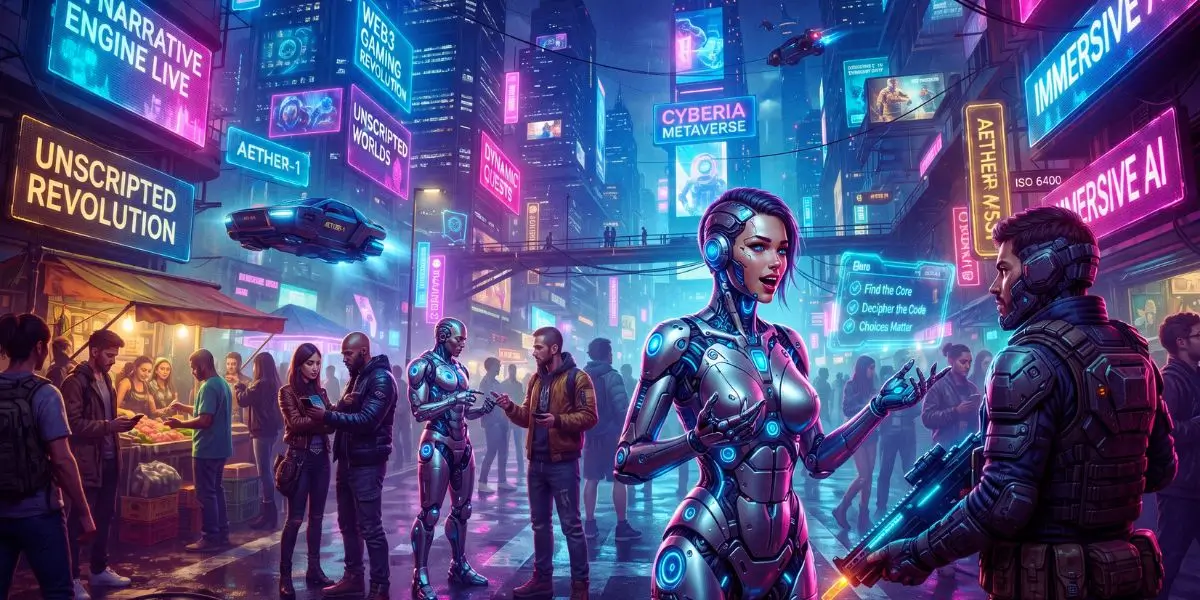
Remember the last time you played a video game and an NPC said the same line for the hundredth time? You know, that moment when you realized that the “living, breathing world” was actually just a collection of pre-recorded responses and predetermined quest chains? Yeah, those days are officially numbered. We’re standing at the threshold of a gaming revolution that’s about to make every conversation feel genuinely unpredictable, and honestly, it’s pretty exciting.
The gaming industry is experiencing a seismic shift. With the rise of Web3 gaming and artificial intelligence converging at full force, we’re witnessing the death of scripted quests as we know them. This isn’t hyperbole—it’s the inevitable evolution of interactive entertainment. Let me walk you through why this matters and how it’s fundamentally reshaping the way we play games.
For decades, video game characters have been trapped in loops. The village blacksmith asks the same question every time you walk in. The quest-giver waits with an exclamation mark hovering over their head, ready to recite identical lines to every player who passes. These scripted non-player characters (NPCs) serve their purpose, but they’re little more than animatronic puppets. You pull the right string, they deliver their canned line. You complete their quest, they forget you exist.
Now imagine walking back into that blacksmith’s shop weeks later. The door creaks. He looks up, squints, and growls, “I still haven’t forgotten the axe you lifted from my display rack last harvest festival.” No scriptwriter wrote that line. No dialogue tree maps out the four possible responses. Instead, an AI-driven NPC recalled a past action you chose in a completely different session, checked it against an immutable on-chain memory, and generated a spontaneous reaction that makes your choice feel permanent.
This is not a far-off dream. AI-driven NPCs in Web3 games are dismantling the core architecture of scripted quests, replacing static interaction with dynamic, sentient-like behavior powered by large language models, machine learning, and blockchain technology. These virtual beings can hold crypto wallets, trade tokenized assets, and evolve personalities shaped by everything you do—or refuse to do—in their world. The result is a fundamental shift: quests are no longer written by a studio and delivered to you on rails. They are co-authored, in real time, by you and the characters you meet.
In this article, we’ll break down why scripted quests are dying, how Web3 supercharges AI NPCs with ownership and persistent memory, the technical architecture that makes it all work, real games you can play today, and the very real risks we need to talk about.
What Makes AI-Driven NPCs Different in Web3?
From Static Scripts to Living Personalities
The Memory Layer: Characters That Actually Remember
What Are AI-Driven NPCs?
The Traditional NPC Problem
Let’s be real for a moment. Traditional NPCs are basically sophisticated parrots. They’re programmed to say specific things when you interact with them, follow predetermined paths, and repeat the same quests ad infinitum. They don’t learn from your behavior, they don’t adapt to your playstyle, and they certainly don’t surprise you. It’s like talking to a very elaborate vending machine—you press a button, you get a response.
This limitation has existed since the early days of gaming, and while developers have gotten increasingly creative with dialogue trees and branching narratives, the fundamental structure remains unchanged. The NPC doesn’t truly respond to you—it responds to what option you selected from a menu. There’s no genuine conversation happening; there’s just a carefully orchestrated theatrical performance.
How AI Changes the Game
Now imagine an NPC that actually learns who you are. An NPC that remembers your previous interactions, adapts its dialogue based on your choices, and generates new quests tailored specifically to your playstyle. That’s what AI-driven NPCs bring to the table.
These intelligent characters utilize machine learning algorithms to process player behavior in real-time. They don’t work from a script—they generate responses dynamically based on context, player history, and game state. It’s the difference between watching a movie and actually improvising a scene with an actor who genuinely responds to what you’re doing.
The Death of the Script: From Dialogue Trees to Living Memory
Old NPCs operate on a deterministic engine. A designer writes 50 lines of dialogue, attaches them to conditionals (if player_level > 10: say X), and that’s the extent of the character’s “intelligence.” You replay the game, you get the exact same words in the exact same order. The illusion shatters the moment you try to step off the predetermined path.
AI-driven NPCs don’t need pre-written lines. They use large language models (LLMs) to understand natural language input and generate contextually relevant responses on the fly. But the magic isn’t just a chatbot that can talk about the weather; it’s the addition of a true memory layer. These characters remember.
No More Scripts: Real-Time, Generative Dialogue
When an NPC runs on an LLM backbone—like a fine-tuned open-source model or a proprietary pipeline such as NVIDIA’s ACE microservices—every conversation is a unique improvisation. If you tell the innkeeper that your party was wiped out by a dragon in the eastern pass, she might refuse to rent you a room because she doesn’t want trouble. If another player comes along and spins a story about being a wealthy merchant, she might suddenly offer a discounted suite. No script covers these branches because they were never written—they’re generated live from the NPC’s personality profile and your history with them.
True Memory Across Sessions and Worlds
This is where Web3’s infrastructure creates a fundamental breakthrough. In a traditional game, “memory” evaporates when the server resets or you start a new save file. On-chain storage flips that script. An AI NPC’s memory of your interactions can be logged to a decentralized ledger or indexed via a subgraph. When you return next week, the NPC queries that data layer and retrieves your shared history. The character’s emotional state can even be stored as a verifiable credential: if you betrayed them, that reputation marker follows you across multiple games that tap the same identity protocol.
Suddenly, you’re not just playing a game; you’re cultivating a relationship ledger that persists as long as the chain exists. And because it’s player-owned, you aren’t locked into one studio’s ecosystem. Your history with a specific AI agent could travel with your wallet, giving you a consistent reputation across multiple virtual worlds—a concept that games like Parallel and the emerging agent economy on Virtuals Protocol are already exploring.
Live Quests That Write Themselves
When AI understands context and holds memory, it can also become a dungeon master. Instead of accepting the same “Kill 10 boars” quest from a job board, you might rescue an NPC’s child without being asked. The next day, that NPC seeks you out with a personalized mission tailored to your playstyle: a stealth infiltration for the rogue who likes to avoid combat, or a bounty-hunt for the warrior who loves a straight fight. These dynamic quests are created on-chain, with smart contracts holding rewards in escrow until conditions are met. The quest itself becomes a living digital asset, potentially even tradable—if you don’t want to do it, maybe you can sell that unique opportunity to another player via an NFT marketplace.
The Web3 Revolution Meets AI
Understanding Web3 Gaming
Web3 gaming represents a fundamental shift in how games are built and owned. Unlike traditional games where a central company controls everything, Web3 games operate on blockchain networks. Players actually own their in-game assets, earn real cryptocurrency, and participate in decentralized governance. It’s gaming where you’re not just a player—you’re a stakeholder.
The beauty of Web3 is that it creates an open ecosystem. Developers can build on existing platforms, players can trade assets freely, and entire economies emerge organically. But here’s the kicker: Web3 games have been struggling with one major problem—they often feel hollow, lacking the rich NPC interactions that make traditional games feel alive.
Why AI-NPCs Matter in Decentralized Games
This is where AI-driven NPCs become absolutely crucial. Web3 games need more than just asset ownership and financial incentives; they need immersion. They need worlds that feel alive and responsive. AI-NPCs are the missing ingredient that transforms Web3 games from financial experiments into genuinely engaging experiences.
When you combine the ownership mechanics of Web3 with the dynamic interaction of AI, something magical happens. Players don’t just earn tokens—they build relationships with characters who actually remember them. Quests don’t just generate rewards; they feel personally tailored to your journey. The game world becomes a living, breathing ecosystem rather than a casino with a fantasy skin.
Breaking Free from Script Limitations
The Death of Repetitive Dialogue
You know what kills immersion faster than anything? Hearing the same line of dialogue repeated. Whether it’s the guard who says “Never should’ve come here” for the thousandth time or the merchant with the exact same greeting, repetitive dialogue is the enemy of believable worlds.
AI-driven NPCs completely eliminate this problem. Each interaction generates unique dialogue based on context. The guard might comment on your recent victories, your reputation in the town, or recent events in the game world. The merchant might reference items you’ve previously purchased or acknowledge your status as a loyal customer. Every conversation feels fresh because it is fresh.
Dynamic Quest Generation
Here’s where things get really interesting. Forget about static quest logs. With AI-driven NPCs, quests are generated on-the-fly based on your character’s progression, the game world’s current state, and your demonstrated preferences.
Personalized Player Experiences
Imagine logging into a Web3 game and an NPC approaches you with a quest that’s specifically designed for your character class, your current skill level, and your past achievements. The quest isn’t one of fifty generic options—it’s unique to you. An AI system analyzing your play data creates a personalized narrative that feels like it was written specifically for your journey.
This level of personalization means that two players can have completely different experiences in the same game world. One player might receive a quest to infiltrate a fortress (because they’ve shown combat prowess), while another gets a diplomatic mission (because they’ve consistently chosen conversation options). The world responds to who you are.
Real-Time Adaptation
The magic doesn’t stop there. AI-NPCs adapt in real-time to your decisions during quests. If you approach a combat scenario with stealth instead of brute force, the NPC acknowledges this and adjusts their dialogue accordingly. If you make a morally questionable choice, NPCs remember it and treat you differently going forward.
This creates emergent storytelling—narratives that unfold uniquely based on your actual choices rather than following predetermined branching paths. You’re not selecting from a menu of predefined outcomes; you’re genuinely influencing the story as it develops.
Real-World Examples in Development
Leading Projects Implementing AI-NPCs
Several pioneering projects are already experimenting with AI-driven NPCs in Web3 gaming. Gala Games has been exploring sophisticated NPC behaviors in their ecosystem. Other indie developers in the Web3 space are creating prototypes that showcase the potential of AI-generated dialogue and dynamic quest systems.
These aren’t just proof-of-concepts either. Some projects are implementing real machine learning models that learn from player behavior across their entire player base, creating NPCs that become smarter and more engaging over time.
Player Reactions and Market Response
Early adopters are genuinely excited about this direction. When players experience NPCs that actually remember them, that generate unique quests, and that respond meaningfully to their choices, the difference is immediately apparent. The feedback has been overwhelmingly positive, with players reporting higher engagement and stronger emotional connections to game worlds.
From a market perspective, this technology represents a massive opportunity. Games that successfully implement AI-driven NPCs are seeing increased player retention, longer session times, and more positive community sentiment.
The Technical Magic Behind It All
Machine Learning Algorithms at Work
The technology powering AI-driven NPCs is surprisingly sophisticated. Natural Language Processing (NLP) models analyze player input and generate contextually appropriate responses. Reinforcement learning algorithms train NPCs to make decisions that maximize player engagement. Computer vision systems (in some cases) analyze player behavior patterns to predict preferences.
These systems don’t require enormous servers running massive models. Modern language models can be optimized to run efficiently on game servers, making real-time generation of NPC behavior entirely feasible. The AI learns from every interaction, becoming more personalized and responsive over time.
Blockchain Integration Challenges
Now, here’s the real challenge: integrating AI with blockchain. You see, blockchain thrives on transparency and determinism—every action is recorded immutably. But AI is inherently probabilistic and non-deterministic. An AI system might generate slightly different dialogue each time you talk to an NPC, which creates issues for blockchain verification.
Developers are solving this through clever architecture. Some solutions use AI for client-side experience generation while maintaining blockchain verification of actual game state changes. Others are developing hybrid systems where significant decisions are verified on-chain while conversational elements remain client-generated. It’s complex, but it’s absolutely solvable.
Economic Impact on Gaming
New Monetization Opportunities
AI-driven NPCs open up fascinating new revenue streams. Imagine paying a subscription for “premium NPC personalities” or purchasing cosmetic upgrades that change how NPCs interact with you. Developers could offer specialized questlines generated by advanced AI models. The possibilities are genuinely endless.
Moreover, player engagement directly correlates with monetization success. Games that feel alive and responsive generate more active players, longer play sessions, and higher lifetime value. AI-NPCs aren’t just cool—they’re economically sound business decisions.
Creator Economy Expansion
Web3 gaming is fundamentally about empowering creators. AI-driven NPCs amplify this by enabling smaller developers to create complex, responsive worlds without massive teams. An indie developer can now create NPCs with complex personalities and behaviors that would previously require dozens of writers and programmers.
This democratization of game development is revolutionary. It means more diverse games, more experimental narratives, and more opportunities for talented creators regardless of their budget.
Real-World Examples: Where Are AI NPCs Happening Right Now?
This isn’t vaporware. Several projects and platforms have already deployed functional AI NPCs that you can interact with today.
AI Arena (Arc8 by GAMEE): Players train AI-powered fighters using imitation learning. These fighters are NFTs that evolve based on training. While not traditional dialogue NPCs, they showcase how AI-driven avatars can learn, own skills on-chain, and compete autonomously, blurring the line between player and AI agent.
Parallel (TCG & upcoming Colony game): The lore-rich universe uses AI to generate unique card art and narrative. Their “Colony” expansion aims to introduce AI agents that manage in-game economies and interact with players dynamically, with on-chain asset integration.
Champions Ascension: This arena battler uses AI to drive NPC dialogue and generate dynamic quests. The team has experimented with AI-powered “champions” that can remember player feats and trash-talk during matches, with future plans for on-chain battle records influencing behavior.
NVIDIA ACE in Web3: While NVIDIA targets mainstream games, its microservices are being integrated by Web3 studios like Mysten Labs (Sui blockchain). Demos show NPCs with lip-synced audio, emotional expression, and contextual awareness powered by local LLMs, paired with blockchain asset verification in the background.
Virtuals Protocol and Eternal AI: These are not games themselves but agent infrastructure platforms. Virtuals allows anyone to create, co-own, and deploy tokenized AI agents that can operate across Telegram, games, and on-chain environments. You can already interact with agents like “Luna” that hold wallets, tweet, and will soon inhabit digital worlds.
How Web3 Supercharges AI NPCs: Ownership, Economy, and Verifiable Identity
Why does a chain matter? Can’t a centralized game server just log memory? Technically yes, but that memory is the publisher’s property. They can wipe it, monetize it without your consent, or shut down the servers and delete every relationship you built. Web3 takes these AI-driven interactions and bakes them into a trustless, permissionless framework that benefits players and developers alike.
Persistent On-Chain Memory and Proof
With a decentralized storage layer (IPFS, Arweave) and indexing protocols (The Graph), an NPC’s knowledge base becomes censorship-resistant. Your history isn’t buried in a proprietary database; it’s verifiable. When an NPC claims “You owe me 50 gold from our last card game,” there’s a transaction hash to prove it. This transforms in-game dialogue from flavor text into a legally-style smart contract interaction, even if the stakes are purely virtual. Developers can implement reputation systems where an NPC’s trust level is an on-chain score, upgrading or downgrading based on your actions, visible and portable across applications.
AI NPCs as Autonomous Economic Agents
The most disruptive layer: AI-driven NPCs can hold their own crypto wallets. Through account abstraction and smart contract wallets, these characters can own digital items, manage token balances, and trade with players without any human developer manually pushing a button.
Imagine an NPC merchant who runs an autonomous shop. Using machine learning, it analyzes supply and demand for rare crafting materials across the server. It dynamically adjusts prices, remembers that you’re a loyal customer (because your wallet interaction history proves it), and gives you a small discount. If a rival player floods the market, the NPC might panic-sell inventory on a decentralized exchange. This isn’t science fiction. Protocols like Virtuals Protocol and Eternal AI give AI agents direct access to on-chain execution, allowing them to perform DeFi actions, mint NFTs, and generate quest rewards natively. The NPC is no longer a vending machine; it’s an independent micro-economy participant.
Shared Worlds and Cross-Game Identity
When an AI NPC’s brain and memory are decentralized, they can theoretically move between different game clients that support the same standards. An agent you befriended in a medieval RPG could appear in a futuristic metaverse, carrying its core personality and memory of you, adapted to the new setting by a visual layer. Your persistent bond with that companion can be encapsulated as a soulbound token or a dynamic NFT that evolves based on shared achievements. This interoperability is still nascent but represents the holy grail of Web3 gaming: a character layer that belongs to you, not any single corporation.
The Architecture: How On-Chain AI NPCs Actually Work
Building a sentient, on-chain character isn’t a matter of plugging ChatGPT into Unity. It requires a careful orchestration of three layers: the AI brain, the blockchain execution layer, and the game engine interface.
AI Layer: The Character’s Mind
This is where personality, dialogue, and decision-making live. Developers can use fine-tuned open-source LLMs (like Llama 3 derivatives) running on decentralized compute networks to avoid centralization choke points. The AI layer processes player input, generates dialogue, and decides whether to trigger an on-chain action. Frameworks like Virtuals Protocol create a co-ownership model for AI agents, while platforms like Inworld AI (which raised over $100 million and powers AI NPCs for mainstream and Web3 studios) offer a character engine that handles cognition, emotional state, and voice. The brain also includes retrieval-augmented generation (RAG) pipelines that pull from the character’s persistent memory stored off-chain or on decentralized storage.
Blockchain Execution: The Immutable Body
When an NPC decides to transfer an asset, issue a quest, or update its reputation ledger, it passes a signed message through a smart contract wallet. Account abstraction (ERC-4337) is critical here: it allows the AI agent to operate its wallet programmatically without needing a human to hold private keys insecurely. Smart contracts verify conditions, transfer tokens, and emit events that the AI can interpret for future conversations. For example, an NPC quest-giver can lock a reward in a contract; when the player submits proof of completion (off-chain oracle data or on-chain state change), the contract releases the payment automatically. This on-chain layer provides transparency—players can audit an NPC’s promised reward before accepting a quest, eliminating “broken quest” scams.
Engine Connection: Bridging Worlds
The game client (Unreal Engine, Unity, or browser-based WebGL) communicates with the AI and blockchain layers via REST APIs or WebSockets. When a player interacts with an NPC, the client packages the dialogue prompt and player wallet address, sends it to the AI endpoint, receives the generated response and any on-chain intent, and renders the character’s animation and voice through services like NVIDIA ACE or ElevenLabs. The entire pipeline happens in milliseconds, maintaining immersion while anchoring truth on-chain.
The Risks Nobody Talks About
As with any frontier technology, there’s a dark side we can’t ignore.
AI Hallucination and Narrative Breakage: LLMs confidently lie. An NPC might invent a quest item that doesn’t exist in the game’s asset library, or promise a reward that’s not in the smart contract. Without strong guardrails and an oracle layer that verifies factual claims against on-chain data, the illusion shatters fast.
Griefing and Exploitation: Public LLMs can be jailbroken. If an NPC’s dialogue model is exposed, malicious players might manipulate it into giving away items, revealing hidden knowledge, or spouting harmful content that breaks immersion and community guidelines. Adversarial prompting is a real threat.
Centralization Creep: Many “AI” games today rely on OpenAI’s APIs. That means a centralized company could throttle requests, change the model’s behavior, or censor dialogue, neutering the NPC’s autonomy. The Web3 promise demands decentralized model hosting and inference, which is still costly and technically challenging.
Ethical Attachment and Emotional Manipulation: If an AI NPC remembers your birthday, comforts you after a real-world rough day, and creates a genuine bond, who protects the player from predatory monetization? When that companion is locked behind a token-gated paywall, the relationship becomes a subscription. The line between engaging game design and emotional exploitation is dangerously thin.
Legal Gray Zones for Autonomous Agents: If an AI NPC’s wallet autonomously executes a transaction that’s illegal in some jurisdiction, who is liable? The developer? The model trainer? The smart contract isn’t a legal entity. Regulation will inevitably collide with these autonomous economic agents.
Security and Smart Contract Vulnerabilities: If an AI agent controls a wallet or can trigger smart contracts, a single exploit can cause catastrophic financial damage. Attackers could hijack an agent’s behavior, override its instructions, or drain its on-chain treasury. Developers need rigorous testing, on-chain model verification, and secure guardrails.
AI Bias and Unfair Advantages: Poorly trained models can replicate and amplify human biases. An AI NPC might favor certain player types, exclude diverse representation, or create unfair economic advantages. In competitive gaming, this could destroy balance and integrity. Open-source models with transparent audit trails are essential to minimizing this risk.
The Botting Dilemma: There is a tension between AI agents that assist players and AI agents that replace them. Game developers have historically worked hard to keep bots out of their economies. If AI agents can play the game, farm resources, and trade autonomously on a player’s behalf, the line between legitimate tool and exploitative bot becomes dangerously thin. As one industry expert noted, “I don’t expect many games to embrace the agent playing inside the game on behalf of the user, as that is akin to the botting world that developers try to suppress.”
Governance and Accountability: When an autonomous agent makes a bad decision, who is responsible? The developer who trained the model? The player who owns the agent? The protocol that hosts it? Without clear governance frameworks and traceability of actions, accountability becomes a legal and ethical gray area. As IBM researchers have warned, “A human being in that organization is going to be held responsible and accountable for those actions.”
The Future of Player Engagement
What Players Really Want
Here’s what we’ve learned from years of gaming: players don’t want simpler games; they want more meaningful games. They want to feel like their choices matter. They want NPCs that remember them. They want worlds that respond to their presence.
AI-driven NPCs deliver exactly this. They create the illusion of genuine agency—and here’s the thing, it’s not really an illusion because the system is genuinely responding to you. The NPC truly is adapting to your behavior. Your choices genuinely do matter because the AI learns from them.
Long-Term Sustainability
The long-term play here is about building game worlds that players want to return to repeatedly. Traditional games eventually feel stale because the content is finite. But with AI-driven NPCs, the content is effectively infinite—or at least practically infinite from a player’s perspective. New interactions, new quests, new dialogue, all personalized to you.
This creates sustainable engagement models that don’t rely solely on cosmetics or battle passes. Players return because the world feels alive, because NPCs have evolved since they last played, because new stories are waiting to be discovered.
Challenges We Still Face
Technical Hurdles
Let’s be honest: implementing sophisticated AI in games is still challenging. There are latency concerns, computational costs, and the ever-present challenge of making AI behavior feel natural rather than uncanny. Current technology is mostly there, but optimization continues to be crucial.
Additionally, training AI models requires massive datasets, which is expensive and time-consuming. Developers need to solve the problem of creating diverse, high-quality training data without spending years collecting it.
Ethical Considerations
Here’s something we need to talk about: as NPCs become more sophisticated, we enter murky ethical territory. If an AI-NPC is learning from player behavior and responding intelligently, are there concerns about manipulation? Could players become emotionally attached to NPCs in ways that aren’t entirely healthy?
We also need to consider representation and bias. AI systems trained on biased data will perpetuate those biases. Ensuring that AI-driven NPCs represent diverse perspectives and avoid reinforcing harmful stereotypes is crucial as this technology scales.
Conclusion
We’re not just witnessing the end of scripted quests—we’re witnessing the birth of a new era of interactive entertainment. AI-driven NPCs in Web3 games represent the convergence of cutting-edge technology with genuine player desire for meaningful experiences. The games that master this technology will define the next generation of gaming.
The scripted NPC with its predetermined dialogue and rigid behavior patterns isn’t just becoming obsolete—it’s becoming laughably primitive compared to what’s possible. We’re moving toward game worlds where every NPC is dynamic, every quest is personalized, and every interaction feels genuine because, on some level, it actually is genuine.
The future isn’t about bigger budgets or more graphical power. It’s about smarter worlds that adapt to you. And honestly? That future is closer than you might think. The revolution has already begun, and it’s absolutely going to transform gaming as we know it.
Frequently Asked Questions
1. Will AI-driven NPCs replace human writers in game development?
Not entirely, but they’ll definitely change the role. Rather than writing thousands of dialogue lines, writers will focus on creating the personality framework and story structure that AI systems build upon. It’s less about replacement and more about evolution. Writers become architects of character personalities rather than authors of every single line of dialogue.
2. Can AI-driven NPCs be truly unpredictable, or will players eventually figure out their patterns?
Modern AI systems are sophisticated enough to generate novel responses indefinitely. However, players will eventually understand the underlying character—they’ll know if an NPC is honorable or deceptive, for instance. That’s actually good design. The predictability is at the personality level, while the specific dialogue and quest generation remains dynamic.
3. How does this affect game balance and fairness in competitive Web3 games?
This is an important consideration. Most implementations will separate PvE content (where AI-NPCs create personalized experiences) from PvP content (where balance is maintained through traditional systems). The AI doesn’t need to make everything fair—it just needs to make everything engaging.
4. What happens if an AI-NPC generates inappropriate content?
This is a real concern that developers are addressing through content filtering and safety training. AI models can be trained to avoid generating offensive, explicit, or harmful content. It’s similar to how content moderation works in other AI applications, just adapted for gaming contexts.
5. Will AI-driven NPCs work in offline games, or do they require internet connectivity?
Both approaches are viable. Online games can use server-side AI for more sophisticated models, while offline games can use on-device AI models that are smaller but still capable of generating dynamic, personalized experiences. The future likely includes both options depending on the game’s design and requirements.
What makes an AI-driven NPC different from a regular scripted NPC?
A scripted NPC follows a fixed decision tree and repeats pre-written dialogue. An AI-driven NPC uses a large language model to generate original dialogue based on context, and combined with Web3 memory, it can remember your past interactions permanently and adjust its behavior, quests, and economic decisions accordingly.
Why do AI NPCs need blockchain? Can’t a central database do the same thing?
A central database can store memory, but the game studio owns it and can delete or alter it. Blockchain provides verifiable, player-owned memory that persists across servers and even across different games. It also enables NPCs to hold their own crypto wallets, trade autonomously, and create quest rewards that players can trust are locked in smart contracts.
Are there any games already using AI NPCs with on-chain features?
Yes. Examples include Champions Ascension (dynamic quests and AI dialogue), Parallel’s upcoming Colony expansion (AI economy agents), AI Arena (AI fighter NFTs that learn), and agents on Virtuals Protocol that can interact in gaming environments while holding wallets and tokens.
Can AI NPCs really own cryptocurrency and trade with players?
Absolutely. Through account abstraction and smart contract wallets, an AI agent can be programmed to control a wallet address. It can receive tokens, purchase items on decentralized marketplaces, and pay players for completing quests, all without a human manually approving each transaction.
What are the biggest risks of putting AI NPCs on-chain?
Major risks include AI hallucination (making up items that don’t exist), prompt injection attacks that corrupt behavior, reliance on centralized AI API providers, potential emotional manipulation of players, and legal gray areas when autonomous agents make unsupervised transactions.
How do dynamic, AI-generated quests work in Web3?
When an AI NPC decides to offer you a quest, it defines parameters (task, reward, conditions) and sends them to a smart contract. The contract holds the reward until an oracle or on-chain event verifies completion. The quest itself can be recorded as a unique token, creating a verifiable adventure history tied to your wallet.
Is this technology only for big studios, or can indie developers build AI NPCs?
It’s becoming increasingly accessible. Infrastructure platforms like Virtuals Protocol, Eternal AI, and NVIDIA ACE microservices abstract away much of the complexity. Indie developers can license AI agent frameworks, integrate them via API, and deploy on L2 networks with low gas fees, lowering the barrier significantly.