





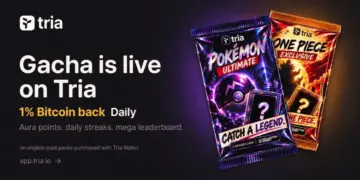









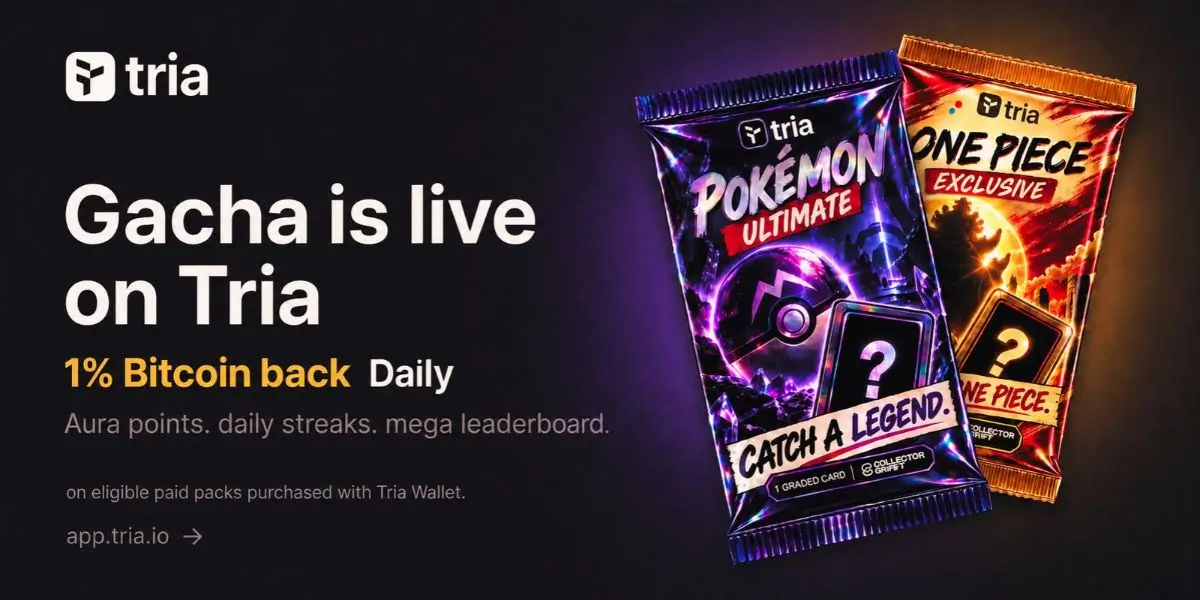
The pack opens. A flash of animation, a pause, then the reveal: a graded Pokémon card you did not choose—and cannot fully predict. That moment is the entire appeal of gacha collecting: part hobby, part game, part marketplace. Tria has now built that experience into a crypto finance app, letting users buy physical Pokémon and One Piece cards while earning Bitcoin back on eligible purchases.
Tria Gacha is a public feature inside the Tria mobile app that combines digital pack openings with real, graded Pokémon and One Piece trading cards. Eligible paid pack purchases earn 1% back in Bitcoin with no stated reward cap, while Aura points, daily streak multipliers, and a monthly leaderboard add game-like incentives.
This guide explains how Tria Gacha works, what packs are available, how the Bitcoin and Aura rewards are calculated, what the leaderboard offers, and the risks collectors should understand before spending.
What Is Tria Gacha?
Tria Gacha is Tria’s onchain take on surprise-driven collectibles. Users purchase digital packs through Tria Wallet, receive a randomized reveal, and then decide whether to keep the underlying physical card, sell it back through the app, or request physical delivery where supported.
The feature follows an initial waitlisted rollout and became publicly available on November 4, 2026. Tria describes itself as a self-custodial neofinance platform with more than 600,000 users; its broader app combines crypto asset management, payments, trading, and rewards.
Unlike a conventional online card store, Gacha does not sell a specific card at checkout. Instead, the buyer purchases a pack and the app determines the revealed collectible. That makes the experience closer to blind-box collecting than traditional e-commerce.
What “onchain” means here
“Onchain” does not necessarily mean the Pokémon or One Piece cards themselves become blockchain tokens. In this launch, it refers to the purchase, rewards, tracking, and account activity being integrated into Tria’s crypto-native app and wallet infrastructure. The revealed items are described as real graded physical trading cards, not digital-only collectibles.
Why Tria Launched Gacha
Tria launched Gacha because trading cards were already a meaningful spending category among its users, but buying them through existing platforms could involve restricted payment methods, complicated checkout flows, and failed transactions. Gacha moves that purchase activity directly into Tria Wallet.
“Collecting is already part of how our community spends, and Gacha has become a culture built around the excitement of the reveal,” said Vijit Katta, co-founder and CEO of Tria. “We’re bringing that culture onchain, combining real graded cards with Bitcoin rewards and the ability to keep, sell or ship what you pull, all through the same app people use to manage their money.”
For Tria, the strategic logic is clear: collectibles create frequent, emotionally engaging spending moments. Bitcoin rewards turn those moments into a reason to use Tria Wallet rather than a conventional card marketplace.
Available Card Packs and Pricing
The public launch adds $500 Pokémon packs and $50 and $500 One Piece packs to Tria’s existing Gacha lineup. Pack availability and stock are displayed in the Tria app, and purchases are made through Tria Wallet.
| Pack type | Listed price | What the buyer receives | Reward potential |
|---|---|---|---|
| Pokémon pack | $500 | A randomized reveal of a real graded Pokémon trading card | 1% Bitcoin back on eligible paid purchases, subject to Tria’s terms |
| One Piece pack | $50 | A randomized reveal of a real graded One Piece trading card | 1% Bitcoin back on eligible paid purchases, subject to Tria’s terms |
| One Piece pack | $500 | A randomized reveal of a real graded One Piece trading card | 1% Bitcoin back on eligible paid purchases, subject to Tria’s terms |
The pricing structure creates two distinct buyer profiles. The $50 One Piece pack lowers the entry barrier for casual collectors, while the $500 Pokémon and One Piece packs target higher-spending enthusiasts seeking rarer pull potential.
How a Gacha purchase works
Open the Tria mobile app in a supported market.
Navigate to Gacha and review available packs and stock.
Select a Pokémon or One Piece pack.
Pay through Tria Wallet.
Complete the digital reveal.
Choose whether to keep, sell back, or request physical delivery where supported.
Bitcoin Rewards: How the 1% Back Works
Eligible paid Gacha pack purchases earn 1% back in Bitcoin, and Tria states that there is no limit on total rewards. Bitcoin rewards are distributed automatically, beginning November 6, with daily payouts thereafter.
For example, a $500 eligible pack purchase would generate $5 worth of Bitcoin back at the 1% rate, assuming the purchase qualifies and Tria’s reward terms are met. A $50 pack would generate $0.50 in Bitcoin back.
Key reward rules
Reward rate: 1% back in Bitcoin on eligible paid pack purchases.
Reward cap: Uncapped, according to Tria’s launch announcement.
Payout timing: Automatic daily payouts begin November 6.
Reward basis: Eligible paid purchases; refunds can affect leaderboard standings.
Streak multipliers: These increase Aura earnings only, not Bitcoin rewards.
Expert insight: Treat the Bitcoin back as a loyalty incentive, not a guaranteed return on the card. A 1% rebate does not offset a poor pull if the revealed collectible is worth materially less than the pack price.
Aura Points and Streak Multipliers
Every qualifying paid pack earns Aura points, Tria’s participation reward for Gacha activity. Aura points have no cash value and cannot currently be redeemed, so they function as an engagement and status layer rather than direct spendable value.
Daily streaks can increase Aura earnings:
| Consecutive qualifying purchase days | Aura multiplier |
|---|---|
| Days 1–6 | Standard Aura earning rate |
| Day 7 onward | 1.5× Aura earnings |
| Day 14 onward | 2× Aura earnings |
Streak multipliers apply only to Aura earnings, not to Bitcoin rewards.
What Aura points can and cannot do
Aura points reward participation, streak consistency, and leaderboard activity. They do not currently have cash value and cannot be redeemed, which means collectors should not treat them as a financial return.
Monthly Gacha Leaderboard
Tria launched a monthly Gacha leaderboard alongside the public rollout. The inaugural competition runs from November 4 through December 1 at 12:00 AM UTC.
Leaderboard standings are determined by eligible paid pack spending, less refunds. Users can track live rankings in the app throughout the campaign.
Leaderboard timeline
| Milestone | Date or timing |
|---|---|
| Public Gacha launch | November 4, 2026 |
| Inaugural leaderboard begins | November 4, 2026 |
| Competition ends | December 1, 2026, at 12:00 AM UTC |
| Prize reveal | November 20, 2026 |
| Final rankings confirmed | Within 48 hours after the campaign ends |
| Prize distribution | Within seven days after final rankings |
Competition prizes had not been disclosed at launch; Tria says they will be revealed on November 20.
Keep, Sell, or Ship: What Happens After a Pull
After a pack reveal, Tria gives collectors three main outcomes:
Keep the collectible: Retain the revealed graded card as part of a collection.
Sell it back through the app: Use Tria’s in-app sellback option, subject to the platform’s terms and available liquidity.
Request physical delivery: Have the physical card shipped where delivery is supported, subject to availability and shipping fees.
This flexibility matters because physical collectibles create a logistics problem: the buyer may want the card, but may not want to pay shipping immediately or manage delivery for every pull. Tria’s model separates the digital reveal from the physical fulfillment decision.
A Practical Case Study: Two Collectors, Two Strategies
Consider two users entering the inaugural leaderboard period.
Maya, a casual One Piece fan, buys one $50 pack. She earns $0.50 in Bitcoin back if the purchase qualifies and receives Aura points. She keeps the revealed card because it completes a display shelf at home. Her strategy is entertainment-first: she spends only what she would comfortably spend on a hobby purchase.
Daniel, a competitive collector, buys several $500 Pokémon packs over consecutive days. His eligible spending generates 1% Bitcoin back, and his streak increases his Aura multiplier after day seven and again after day 14. He tracks the leaderboard, but he also understands that refunds reduce eligible leaderboard spending and that randomized pulls can be worth more or less than what he paid.
The difference is not simply budget. Maya optimizes for enjoyment and a low-cost entry point. Daniel optimizes for rewards, streaks, and leaderboard position—but accepts greater variance and financial exposure.
Pro tip: Set a fixed monthly collectibles budget before opening packs. Gacha mechanics are designed to make the next reveal tempting; a preset limit turns the feature into controlled entertainment rather than impulse spending.
Risks, Costs, and Consumer Considerations
Tria explicitly states that pack contents are randomized and that the value of a revealed card may be lower or higher than the purchase price. Physical delivery is subject to availability and shipping fees. Aura points have no cash value and cannot currently be redeemed.
That disclosure is important. A Gacha pack is not a guaranteed investment, a guaranteed rare-card purchase, or a savings product. The buyer is paying for a randomized collectible experience, with the revealed card’s resale value determined by market demand, grading, condition, rarity, and timing.
Questions to ask before buying
What is my maximum spending limit for this month?
Do I want the physical card shipped, or am I comfortable with the in-app keep or sell-back options?
Have I reviewed shipping fees and delivery availability for my market?
Am I buying because I want the card, or because I am chasing a leaderboard position?
Would I still be comfortable with the purchase if the revealed card is worth less than the pack price?
How Tria Gacha Fits Into the Broader Platform
Tria positions itself as a self-custodial neofinance platform that combines digital asset management, payments, trading, and rewards in one app. Its mobile listing describes support for crypto spending through a Visa card, buying and holding digital assets, earning on idle balances, and rewards across spending, trading, and referrals.
Gacha extends that model from financial activity into consumer collectibles. Instead of asking users to leave the app to buy cards, Tria keeps the transaction, rewards, and post-purchase decisions inside one interface.
This is part of a broader trend: financial apps are adding lifestyle spending categories to increase engagement. For Tria, Gacha may drive wallet usage, repeat purchases, and daily app visits; for collectors, it may reduce checkout friction while adding Bitcoin-based loyalty rewards.
Actionable Steps for First-Time Tria Gacha Users
Confirm availability. Open the Tria mobile app and verify that Gacha is available in your supported market.
Review pack stock and pricing. Check whether the $50 One Piece, $500 One Piece, or $500 Pokémon packs are currently in stock.
Fund or prepare Tria Wallet. Ensure your wallet balance and payment setup support the pack purchase.
Read the current terms. Confirm eligibility rules, refund treatment, delivery fees, and regional restrictions before buying.
Start with a lower-cost pack if unsure. The $50 One Piece pack offers a smaller initial exposure than the $500 options.
Track rewards in the dashboard. Monitor Bitcoin rewards, Aura points, streak progress, and leaderboard standing in the unified rewards dashboard.
Decide the card outcome deliberately. Choose keep, sell back, or physical delivery based on your collection goals—not solely on the excitement of the reveal.
Record your spending. Keep a simple log of pack purchases, Bitcoin rewards, shipping costs, and any resale proceeds to understand your true net cost.
Who Should Consider Tria Gacha?
Tria Gacha is most suitable for collectors who already enjoy Pokémon or One Piece trading cards, want a digital reveal experience, and are comfortable using a crypto wallet for purchases. It may also appeal to Tria users who value Bitcoin rewards and want collectible spending consolidated with their broader financial activity.
It is less suitable for someone seeking a predictable return, a guaranteed rare card, or a low-risk investment. Randomized pack contents, possible shipping fees, and the fact that Aura points cannot currently be redeemed all make careful budgeting important.
Next Steps for Collectors
Tria Gacha turns a familiar collector ritual—the pack opening—into a wallet-native experience with real graded cards, Bitcoin rewards, and a competitive monthly leaderboard. The strongest approach is to treat it as entertainment with optional resale upside: set a budget, understand the randomized nature of pulls, track rewards, and decide in advance whether you want to keep, sell, or ship each card.
If you want to participate in the inaugural campaign, open the Tria app, review the available Pokémon and One Piece packs, and confirm the reward and delivery terms for your market before making your first purchase.
For more information, visit app.tria.so.
About Tria
Tria is a self-custodial neofinance platform serving more than 600,000 users, bringing together digital asset management, payments, trading and rewards in a single app. Built for crypto-native users, Tria enables people to manage and spend their assets while retaining control of their fund
FAQs
What is Tria Gacha?
Tria Gacha is a public feature in the Tria mobile app that lets users buy digital packs and reveal real graded Pokémon or One Piece trading cards. Users can keep, sell back, or request delivery of the physical card where supported.
How much Bitcoin back does Tria Gacha pay?
Eligible paid Gacha pack purchases earn 1% back in Bitcoin. Tria says the reward is uncapped and distributed automatically through daily payouts beginning November 6, 2026.
What Pokémon and One Piece packs are available?
The public launch includes $500 Pokémon packs, plus $50 and $500 One Piece packs. Pack availability, stock, and current pricing are shown in the Tria app.
How does the Tria Gacha leaderboard work?
The inaugural leaderboard runs from November 4 through December 1, 2026, at 12:00 AM UTC. Rankings are based on eligible paid pack spending minus refunds, with prizes revealed on November 20.
Are Tria Gacha cards a good investment?
Not necessarily. Pack contents are randomized, and Tria states that a revealed card may be worth more or less than its purchase price. Collectors should treat Gacha as a hobby purchase with uncertain resale value, not a guaranteed investment.
Do Aura points have cash value?
No. Aura points reward qualifying Gacha participation and can be increased through daily streak multipliers, but Tria says they have no cash value and cannot currently be redeemed.
Recent Posts
- Signal Week (formerly Paris Blockchain Week) Returns to Paris in July 2027
- Why Some Crypto Tokens Have Millions of Holders but Little Liquidity
- Nitro Report Finds Browser Game Domains More Than Doubled as Monthly Player Sessions Grew 77.5%
- Tria Gacha Explained: Real Pokémon and One Piece Cards, Onchain Bitcoin Rewards
- How to use AI without Exposing Your Private Keys