
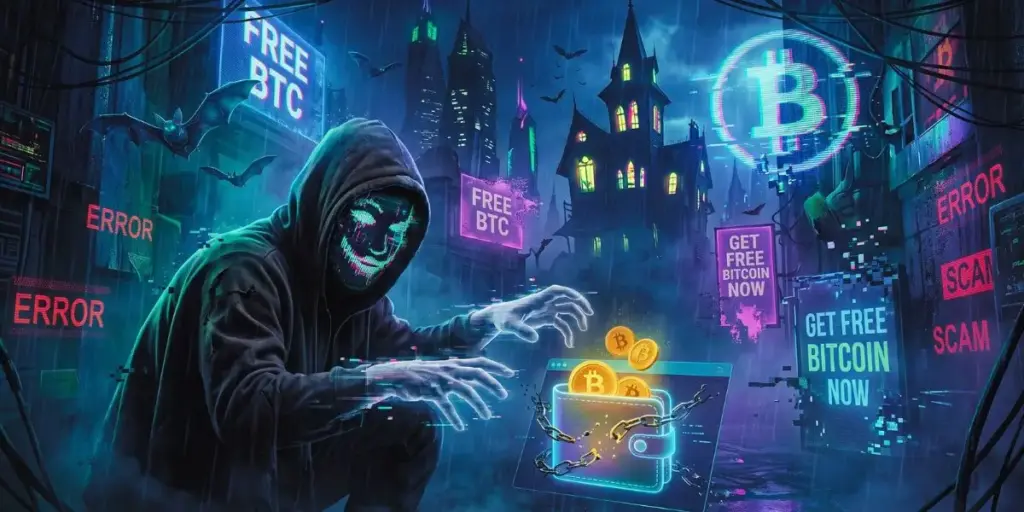

A Halloween post promises free Bitcoin. The account looks familiar. The design looks professional. The offer feels urgent: send 0.05 BTC and receive 0.5 BTC back “before midnight.”
It sounds too good to be true because it is.
Fake Bitcoin giveaways are one of the oldest and most persistent crypto scams. They appear on X, YouTube, Instagram, Telegram, fake livestreams, phishing emails, and sponsored ads. Around Halloween, scammers add seasonal urgency—limited-time rewards, spooky themed promotions, and “claim before the offer disappears” pressure—to make the fraud feel more believable.
The rule is simple: no legitimate Bitcoin giveaway asks you to send Bitcoin first to receive more Bitcoin.
This article explains how these scams work, why they spread during Halloween, and how to protect your crypto wallet.
What Is a Bitcoin Giveaway Scam?
A Bitcoin giveaway scam promises free BTC, then tricks the victim into sending cryptocurrency, revealing credentials, or approving a malicious wallet transaction. The scammer keeps the funds or gains control over the victim’s wallet.
These scams often impersonate well-known crypto companies, celebrities, exchanges, or public figures. The attacker may use a fake verified-style account, a copied profile image, a convincing website, or a manipulated livestream to create trust.
The Basic Promise
The scam usually follows one of these patterns:
-
“Send 0.1 BTC and receive 1 BTC back.”
-
“Celebrate Halloween with a 10x Bitcoin giveaway.”
-
“Send BTC to verify your wallet and claim your reward.”
-
“Connect your wallet to claim your Halloween airdrop.”
-
“Only 50 spots left—claim free BTC before midnight.”
None of these offers are legitimate.
Bitcoin.org states plainly that fraudulent giveaways ask users to send Bitcoin to a specific address with the promise of receiving more back. The Bitcoin is never returned.
Why Do Scammers Use Halloween?
Scammers use Halloween because seasonal themes create urgency, curiosity, and a reason for people to click. Fake giveaways, limited-time offers, and themed promotions give attackers a plausible excuse to contact users unexpectedly.
Bitdefender documented Halloween-themed scam campaigns that used fake sponsored ads promising crypto users “Halloween gifts,” including free premium subscriptions and other incentives.
The holiday gives fraudsters three advantages:
-
Emotional distraction: People are browsing costumes, parties, deals, and entertainment.
-
Urgency: “Limited-time Halloween reward” makes victims act before thinking.
-
Trust cues: Familiar holiday imagery can make a scam look more playful and less suspicious.
But the underlying scam is the same as it is during any other month: promise something free, create urgency, and take advantage of haste.
How Fake Bitcoin Giveaways Work
Fake Bitcoin giveaways work in two main ways: direct-transfer scams and wallet-drainer scams. In both cases, the victim loses control of funds or wallet permissions.
1. Direct-Transfer Scams
This is the classic “send crypto to receive more crypto” scam.
The scammer posts a message claiming that a celebrity, exchange, or crypto company is running a giveaway. The victim is told to send Bitcoin to a specific address. In return, they are promised a larger amount of BTC.
The Bitcoin never comes back.
Example
A fake account impersonating a well-known crypto company posts:
“Halloween Giveaway! Send 0.05 BTC to this address and receive 0.5 BTC back. Limited to the first 100 participants.”
There is no giveaway. There is no reward. There is only a scammer receiving Bitcoin.
2. Wallet-Drainer Scams
This version is more technical.
Instead of asking you to send Bitcoin directly, the scam sends you to a fake website that asks you to connect your wallet. Once connected, the site asks you to sign a transaction or grant a permission. That signature can allow the attacker to move assets from your wallet.
Bitcoin.org warns that fake websites can prompt users to connect a wallet and sign a transaction, giving the attacker permission to transfer assets out of the wallet.
Direct Scam vs. Wallet Drainer
| Feature | Direct-transfer scam | Wallet-drainer scam |
|---|---|---|
| What victim does | Sends BTC to an address | Connects wallet and signs a transaction |
| What attacker receives | The BTC sent | Permission to move approved assets |
| Main lure | “Send 0.1 BTC, get 1 BTC back” | “Claim your Halloween airdrop” |
| Main risk | Direct loss of sent funds | Loss of wallet assets or permissions |
| Common platforms | X, YouTube, Telegram, fake livestreams | Fake websites, phishing links, malicious QR codes |
| Key defense | Never send crypto to receive more | Never sign unknown transactions |
Why Do People Fall for Bitcoin Giveaway Scams?
People fall for these scams because they combine urgency, familiar branding, and the hope of easy money. Scammers do not need sophisticated technology when they can exploit attention, fear of missing out, and trust in a recognizable name.
Common Manipulation Tactics
-
Impersonation: Fake accounts use celebrity photos, company logos, or copied usernames.
-
Fake urgency: “Only 20 minutes left” pushes people to act before verifying.
-
Social proof: Fake comments, bots, and manipulated engagement make the post look popular.
-
Small first request: Asking for a small amount lowers the victim’s guard.
-
Professional design: A polished landing page does not mean a legitimate project.
-
Authority borrowing: Scammers use the names of exchanges, wallet providers, or public figures.
-
Seasonal framing: Halloween gives the scam a themed excuse to appear suddenly.
MoonPay notes that fake giveaway and airdrop scams often impersonate celebrities, crypto companies, exchanges, or public figures to convince users to send cryptocurrency.
Red Flags: How to Spot a Fake Bitcoin Giveaway
The clearest red flag is any offer that requires you to send Bitcoin first to receive more Bitcoin. That is not a giveaway. It is a transfer to a scammer.
10 Bitcoin Scam Red Flags
-
You must send crypto to claim a reward.
-
The offer promises to double or multiply your Bitcoin.
-
The account contacts you unexpectedly.
-
The profile is new, copied, or slightly misspelled.
-
The link does not match the official domain.
-
The site asks you to connect your wallet immediately.
-
The transaction request is vague or difficult to understand.
-
Someone asks for your seed phrase or private key.
-
The offer creates extreme urgency.
-
The “giveaway” comes through a DM, comment, or unsolicited message.
Chainalysis describes giveaway scams as offers that promise to multiply cryptocurrency sent to an address, with the scammer keeping the funds.
How to Protect Your Bitcoin
Protecting your Bitcoin starts with one rule: never send crypto to receive more crypto. After that, use strong account security, verify official sources, and be cautious with wallet connections.
Bitcoin Security Checklist
-
Never send BTC to claim a reward.
-
Never share your seed phrase or private key.
-
Verify official websites by typing the domain manually.
-
Check the full URL, not just the logo or design.
-
Enable multi-factor authentication on exchange accounts.
-
Use a hardware wallet for significant holdings.
-
Keep your recovery phrase offline.
-
Do not connect your main wallet to unknown sites.
-
Review every transaction before signing.
-
Be skeptical of Halloween airdrops, giveaways, and urgent DMs.
Binance’s security guidance recommends verifying contacts through official channels, never sharing seed phrases or private keys, and treating guaranteed-return opportunities as scams.
What Should You Do If You Already Sent Bitcoin?
If you already sent Bitcoin to a scammer, act quickly—but understand that Bitcoin transactions are generally irreversible. Your priority is to prevent further losses and preserve evidence.
Immediate Steps
-
Stop all contact with the scammer.
-
Take screenshots of the profile, messages, website, and transaction.
-
Copy the transaction ID, or TXID.
-
Check where the funds were sent. Use a block explorer to record the destination address.
-
Report the scam to the platform where you saw it.
-
Report it to your exchange or wallet provider if relevant.
-
Secure your remaining accounts. Change passwords and enable MFA.
-
Move remaining funds to a secure wallet if you believe your wallet was compromised.
-
Report the incident to relevant authorities or consumer-protection agencies in your country.
-
Warn others. Public reports can help prevent additional victims.
Do not pay a “recovery agent” who contacts you after the scam promising to retrieve your Bitcoin for an upfront fee. Recovery scams are a common second wave of fraud.
Why Halloween Makes Crypto Scams Worse
Halloween makes crypto scams worse because it increases online activity, promotional noise, and willingness to click on themed offers. Attackers use the season to disguise malicious links as giveaways, events, rewards, or limited-time promotions.
Bitdefender documented Halloween scam campaigns that used fake sponsored ads and malicious pages to target crypto users. The seasonal angle does not change the technology behind the scam; it changes the emotional trigger.
A scary costume is harmless. A scary-looking crypto offer that asks for your wallet access is not.
Case Study: How a Small Mistake Becomes a Big Loss
Imagine a user sees a post from an account that appears to belong to a well-known crypto exchange.
The post says:
“Halloween Giveaway: Send 0.02 BTC and receive 0.2 BTC back. Offer ends in 30 minutes.”
The user checks the profile. It has a familiar logo, a large follower count, and comments from other accounts saying they received Bitcoin.
The user sends 0.02 BTC.
Nothing returns.
The account disappears or blocks them. The Bitcoin is gone.
Now imagine a second version. The user clicks a link to “claim” a Halloween airdrop. The website asks them to connect their wallet and sign a transaction. The user does not read the request carefully. The signature grants permission for the attacker to transfer assets.
In both cases, the user lost money. In the second case, the loss could be much larger.
Are Bitcoin Giveaways Ever Real?
Some legitimate promotions exist, but they do not require you to send Bitcoin first, share your seed phrase, or sign an unexplained transaction. A real giveaway may ask you to follow an account, complete a task, or register through an official website—but it should never require an upfront crypto payment.
If a promotion says “send BTC to receive more BTC,” it is a scam.
If a promotion says “connect your wallet to claim free BTC,” verify the domain, the contract, and the transaction request before doing anything.
If a promotion asks for your seed phrase, it is always a scam.
FAQs
Are Bitcoin giveaway scams real?
Yes. Bitcoin giveaway scams are a common form of crypto fraud. They promise free or multiplied Bitcoin but require victims to send crypto first, connect a wallet, or sign a malicious transaction.
Can a Bitcoin giveaway steal my entire wallet?
It can, if the scam tricks you into signing a malicious transaction or granting dangerous wallet permissions. Simply seeing a scam post does not compromise your wallet, but connecting and signing on a fake site can.
How do I know if a Bitcoin giveaway is fake?
If it asks you to send Bitcoin first, promises guaranteed returns, contacts you unexpectedly, or requests your seed phrase, it is fake. Legitimate giveaways do not require an upfront crypto payment.
What should I do if I sent Bitcoin to a scammer?
Save screenshots and the transaction ID, stop contact with the scammer, secure your remaining accounts, report the incident to the relevant platform, and move any remaining funds if you believe your wallet was compromised. Bitcoin transactions are generally irreversible.
Are Halloween crypto airdrops safe?
Not automatically. Halloween-themed airdrops can be legitimate, but scammers use seasonal urgency to promote fake links and wallet-draining pages. Verify the official domain and never sign an unfamiliar transaction.
Next Steps
Halloween Bitcoin scams rely on one simple weakness: the desire to get something for nothing. The scammers do not need to hack your wallet if they can convince you to send funds or approve a malicious transaction.
Remember the rule that protects you from almost every version of this scam:
If someone asks you to send Bitcoin to receive more Bitcoin, it is a scam.
Verify official domains, protect your seed phrase, use hardware storage for meaningful amounts, and never sign a transaction you do not understand.