
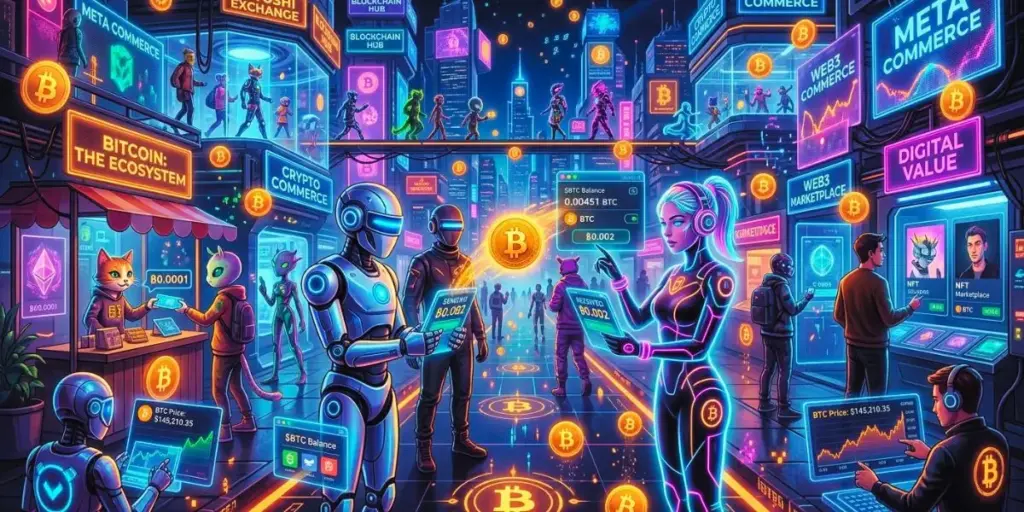

Imagine logging into a VR workspace, buying a digital coffee from an AI barista, and paying with a fraction of a Bitcoin. That might sound like science fiction, but the infrastructure is already here.
So, can Bitcoin be used inside the metaverse? Yes. It mainly happens through Layer 2 solutions like the Lightning Network for microtransactions, or through Wrapped Bitcoin (WBTC) for smart-contract interactions on compatible blockchains.
Base-layer Bitcoin wasn’t built for the high-frequency, low-latency transactions that immersive 3D worlds need. But the broader Bitcoin ecosystem has adapted. This guide breaks down how it works, where it’s already being used, and how you can actually use Bitcoin in virtual economies today.
What Does “Using Bitcoin in the Metaverse” Actually Mean?
Using Bitcoin in the metaverse means employing BTC as a medium of exchange, store of value or settlement layer within virtual environments. It does not always mean every in‑game action is paid in BTC; often it’s used alongside platform tokens.
Common interpretations:
-
Direct payments for goods and services.
-
Store of value for earnings from play‑to‑earn or creator activity.
-
Settlement currency in NFT marketplaces.
-
Cross‑platform value transfer between different virtual worlds.
The key is that Bitcoin adds a shared monetary layer, not a replacement for every in‑world token.
How Bitcoin Payments Work in Virtual Worlds
Bitcoin payments in the metaverse work through wallets, payment gateways and sometimes Lightning for faster, cheaper transactions. The flow is similar to e‑commerce, but with crypto rails instead of cards or PayPal.
Typical flow:
-
User connects a crypto wallet to the platform.
-
User selects an item or experience priced in BTC or converted from BTC.
-
Payment is signed and broadcast to the network (or via Lightning).
-
Merchant or platform confirms and delivers the digital good.
For small, frequent payments, Lightning can significantly reduce fees and confirmation times.
What Can You Buy With Bitcoin in the Metaverse?
You can buy a range of digital goods and services with Bitcoin in the metaverse, depending on the platform.
Not every platform accepts BTC directly; many use their own tokens, so you may need to swap or bridge.
Wallets: Your Gateway to Bitcoin in the Metaverse
Wallets are the main interface between you, your Bitcoin and the metaverse. In 2026, metaverse wallets increasingly support multi‑chain assets, NFTs and in‑world commerce.
What to look for in a wallet:
-
BTC support (ideally with Lightning).
-
Multi‑chain support for ETH, SOL, etc.
-
NFT storage and display.
-
Security features: seed phrase control, 2FA, hardware wallet integration.
-
dApp and metaverse integrations.
Pro tip: For frequent small payments, use a Lightning‑enabled wallet; for long‑term holdings, consider a hardware wallet.
Bitcoin and NFTs: Ownership in Virtual Worlds
Bitcoin can support NFT‑based ownership by acting as the monetary layer for buying, selling and settling digital collectibles. While most NFTs are minted on other chains, BTC can still be used to price or settle those transactions.
How it works:
-
NFTs represent ownership of virtual items (land, avatars, art).
-
BTC can be used as a pricing and settlement currency in marketplaces.
-
Wallets link the user to both their NFTs and their BTC balance.
-
Smart contracts and oracles can automate transfers when conditions are met.
This creates a clearer link between money, ownership and usage rights.
Where Bitcoin Is Already Being Used
People are already spending Bitcoin in virtual environments to buy digital real estate, acquire NFT wearables, pay for in-game services, and tip creators. This isn’t theoretical anymore.
Here’s how major platforms handle Bitcoin integration today:
| Metaverse Platform | Primary Blockchain | Bitcoin Integration Method | Best Use Case |
|---|---|---|---|
| Decentraland | Polygon / Ethereum | Wrapped Bitcoin (WBTC) via third-party gateways | Buying virtual land (LAND) and premium wearables |
| The Sandbox | Polygon / Ethereum | WBTC and direct BTC via payment processors like MoonPay | Buying ASSETS and joining land auctions |
| Somnium Space | Ethereum / Solana | Lightning Network integrations and wrapped tokens | Paying for VR experiences and avatar customization |
| Voxels (Cryptovoxels) | Ethereum | Direct crypto payments via wallet connections | Acquiring parcels and building 3D voxel structures |
| Bitcoin-native games | Bitcoin (L1/L2) | Ordinals, BRC-20, and Lightning Network | Web3 gaming, micro-tipping, and instant in-game rewards |
The Real Technical Hurdles
The main things holding back native, base-layer Bitcoin in the metaverse are slow throughput, high fees during congestion, and no native smart-contract functionality.
When a game needs instant feedback, waiting 10 minutes for a block confirmation destroys immersion. If you buy a digital sword, you want to equip it now—not after the next block.
And during busy periods, Bitcoin fees can spike hard. Paying $15 in network fees to buy a $2 virtual item makes no sense.
That’s why Layer 2 solutions and sidechains aren’t optional. They’re necessary for scaling Bitcoin into immersive digital environments.
Streaming Payments: The Killer Use Case
The Lightning Network enables something called streaming payments—money that flows continuously by the second instead of in lump sums.
Picture a live virtual concert in the metaverse. Instead of paying $20 upfront, your Lightning-enabled wallet streams 10 satoshis per second to the artist while the show runs. Leave early, and the stream stops.
This “money as a stream” model, powered by tools like Lightning Address and LNURL, fits the real-time nature of metaverse interactions perfectly. It shifts the model from “paying for access” to “paying for exact consumption.”
That’s a much more efficient virtual economy.
How to Buy Virtual Assets Using Bitcoin: Step by Step
Ready to make your first metaverse purchase with BTC? Here’s a practical guide using Wrapped Bitcoin on a platform like Decentraland or The Sandbox.
Step 1: Secure Your Base Bitcoin
Buy Bitcoin on a reputable exchange like Coinbase, Kraken, or Binance. Then transfer it to a self-custody hardware wallet like Ledger or Trezor so you control your private keys.
Step 2: Bridge to a Smart-Contract Network
Most metaverse marketplaces run on Ethereum or Polygon, so you’ll need WBTC.
-
Use a decentralized bridge like Thorchain, or a centralized exchange’s bridging service.
-
Send your native BTC to the bridge address.
-
Receive WBTC on Ethereum or Polygon in your Web3 wallet, such as MetaMask.
Step 3: Connect Your Web3 Wallet to the Metaverse
Go to the official marketplace of your chosen metaverse platform. Click “Connect Wallet” and select MetaMask. Make sure your wallet is set to the correct network—usually Polygon for lower gas fees.
Step 4: Execute the Smart Contract Transaction
Find the asset you want to buy—a plot of land, an NFT wearable, etc. Click “Purchase.” Your wallet will ask you to approve the WBTC spend. Confirm the transaction and pay the small gas fee, usually in MATIC or ETH.
Once the block confirms—often under 5 seconds on Polygon—the asset transfers to your wallet and shows up in your metaverse inventory.
Step 5: Manage Your Digital Inventory
Always verify your new asset on a blockchain explorer like Polygonscan or Etherscan by pasting in your wallet address. That confirms the smart contract executed correctly and the NFT is safely in your custody.
Real‑World Examples and Case Study
Real‑world examples show how Bitcoin and crypto are already being used in virtual economies, even if adoption is still uneven.
Case Study: Buying a Virtual Item With BTC
-
User connects a Bitcoin‑enabled wallet to a metaverse marketplace.
-
User selects a wearable priced at 0.001 BTC.
-
Payment is made via Lightning for low fees.
-
Item is transferred to the user’s wallet as an NFT.
This flow is already possible on platforms that support BTC or BTC‑bridged payments.
Other Use Cases
-
Tips and donations to creators in virtual events.
-
Play‑to‑earn rewards partially paid in BTC.
-
Cross‑border payments for global user bases.
-
Virtual real estate purchases settled in BTC.
Limitations and What Bitcoin Cannot Do Alone
Bitcoin is not a perfect fit for every metaverse use case; it has real limitations in speed, cost and platform support.
Key limitations:
-
Platform support: not all metaverses accept BTC directly.
-
Fees and speed: base‑layer BTC can be slow and costly for microtransactions.
-
Volatility: pricing goods in BTC can be risky for users and merchants.
-
UX complexity: managing keys and wallets is still hard for non‑crypto users.
-
Regulatory uncertainty: rules vary by jurisdiction.
Bitcoin improves the rails, but it doesn’t automatically fix UX, governance or business model issues.
Using Bitcoin in a Metaverse Today
You can start using Bitcoin in the metaverse with a few practical steps.
Choose a Supported Platform
Pick a metaverse or marketplace that explicitly supports BTC or BTC‑bridged payments.
Set Up a Compatible Wallet
Install a wallet that supports BTC (ideally Lightning) and the chain used by the platform.
Fund Your Wallet
Buy BTC on an exchange and transfer it to your wallet, or use a Lightning‑enabled service.
Make a Small Test Purchase
Buy a low‑cost item or tip a creator to test the flow.
Track Costs and Experience
Note fees, confirmation times and any UX friction. Adjust your approach before scaling.
Expert insight: Start with small amounts and test the full loop (buy, receive, use, withdraw) before committing larger funds.
Case Study: Micro-Tipping in a VR Social Hub
To see the power of native Bitcoin through Lightning, picture a VR social hub like Somnium Space.
A virtual tour guide is leading a 3D walkthrough of ancient Rome. Thirty users are attending. At the end, the guide shares a Lightning Address like guide@walletofsatoshi.com.
Using a VR-integrated Lightning wallet, all 30 attendees instantly tip the guide 5,000 satoshis each.
-
Total time: Under 2 seconds for all 30 transactions
-
Total fees: Less than a fraction of a cent combined
-
Settlement: Final and irreversible
If this happened on the base Bitcoin layer, the guide would wait 10 to 30 minutes for confirmations, and the cumulative fees would likely exceed the tips themselves.
That’s the case for Layer 2. It’s what makes Bitcoin a viable everyday currency for the metaverse.
Future Outlook: Bitcoin Layer 2s and the Virtual Economy
The intersection of Bitcoin and the metaverse is moving fast. Emerging Bitcoin Layer 2 networks like Stacks and Rootstock are bringing full smart-contract capabilities directly to Bitcoin.
These networks let developers build dApps, decentralized exchanges, and metaverse environments that settle directly to the Bitcoin blockchain for maximum security.
As institutional adoption grows through spot ETFs, demand for using BTC as collateral and currency in high-fidelity virtual worlds will only accelerate. The metaverse needs a pristine, decentralized reserve asset. Bitcoin is built for that role.
Moving Forward: Securing Your Virtual Footprint
Bitcoin’s role in the metaverse has moved from speculative concept to functional reality. Whether you’re using Lightning for frictionless microtransactions in VR social hubs or Wrapped Bitcoin to buy digital real estate on Polygon, the infrastructure is live.
Your next step is choosing your integration method:
-
If you want high-frequency gaming and social tipping, download a Lightning-compatible wallet like Phoenix or Muun.
-
If you’re investing in virtual real estate and NFT collections, set up a hardware wallet and get familiar with bridging protocols.
The virtual economy is expanding. Bitcoin remains its most resilient foundation.
Conclusion
Bitcoin can be used inside the metaverse, mainly as a payment, settlement and store‑of‑value layer, while native tokens handle many in‑world functions. Its usefulness depends on wallet support, platform integration and user experience, and it works best as a complement rather than a replacement.
Next steps:
-
Test a small BTC payment in a supported metaverse.
-
Compare fees and speed between on‑chain and Lightning.
-
Monitor which platforms expand BTC support over time.
If you want, I can help you choose the best wallet and platform combo for your specific use case.
FAQs
Can I use Bitcoin to buy things in the metaverse?
Yes. On platforms that support it, you can use Bitcoin to buy virtual items, access experiences, or settle NFT purchases. Many platforms still prefer native tokens, so check payment options first.
Do I need a special wallet to use Bitcoin in the metaverse?
In most cases, yes. You’ll need a crypto wallet that supports BTC and, ideally, multi‑chain assets and NFTs. Metaverse wallets are designed to store, manage and transfer virtual assets securely.
Is Bitcoin widely accepted in all metaverses?
No. Acceptance varies by platform. Many metaverses use their own tokens (like MANA or SAND), and BTC may need to be swapped or bridged.
Can Bitcoin be used for NFTs in the metaverse?
Bitcoin can be used to price and settle NFT purchases, even if the NFT itself lives on another chain. Wallets and marketplaces can link BTC payments to NFT ownership and transfers.
What are the main risks of using Bitcoin in the metaverse?
Key risks include volatility, fees, scalability limits, user experience challenges and uneven platform adoption. Lightning and other layers can reduce some of these issues but don’t eliminate them.