
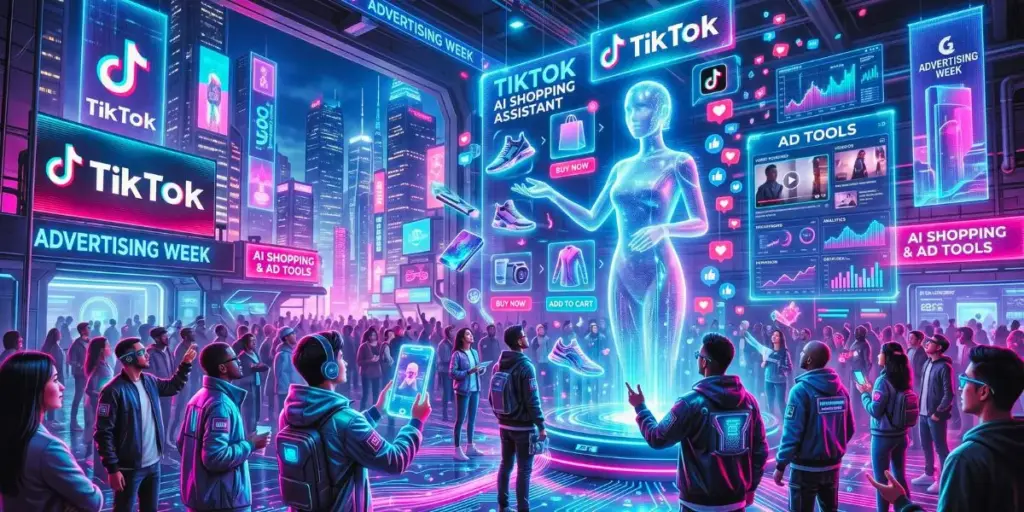

TikTok’s advertising model is expanding beyond the familiar in-feed video. At Advertising Week New York 2026, the platform introduced AI-powered tools that connect discovery, shopping, lead generation, search advertising, campaign automation, and off-platform reach.
The announcements matter because TikTok is positioning AI across multiple stages of the customer journey. A user may discover a product in a video, ask an AI assistant for information, complete a purchase through a faster checkout experience, or interact with a brand through an automated lead workflow.
TikTok’s official newsroom materials describe tools including Shopping Assistant, Buy Direct, Agentic Leads, TikTok for Business MCP, Smart+ Search Ads, and expanded TikTok Ad Network capabilities.newsroom.
This article explains what TikTok announced, how each tool fits into the advertising ecosystem, what advertisers should measure, and where the implementation challenges remain.
What did TikTok announce at Advertising Week?
TikTok announced AI-powered shopping, lead-generation, search advertising, campaign-management, and off-platform advertising updates at Advertising Week New York 2026.
The major areas include:
-
AI-assisted product discovery.
-
A Shopping Assistant for conversational commerce.
-
Buy Direct checkout experiences.
-
Agentic Leads for lead capture and qualification.
-
Smart+ automation for search advertising.
-
TikTok for Business MCP for AI-connected campaign workflows.
-
TikTok Ad Network expansion beyond the TikTok app.
-
New opportunities to connect discovery with measurable business outcomes.
The announcements are significant because they combine consumer-facing AI with advertiser-facing automation. TikTok is not presenting AI only as a tool for generating creative; it is also using it to influence how people discover, evaluate, and purchase products.
What is TikTok Shopping Assistant?
TikTok Shopping Assistant is a conversational AI experience designed to help users discover products and receive shopping guidance.
A traditional product journey may require a user to:
-
Watch a video.
-
Search for the product.
-
Open a product page.
-
Compare alternatives.
-
Ask questions elsewhere.
-
Return to purchase.
A shopping assistant could compress some of those steps by helping users ask questions inside the TikTok environment.
Potential use cases include:
-
Finding products that match a need.
-
Comparing product characteristics.
-
Answering basic product questions.
-
Recommending related items.
-
Guiding the user toward checkout.
-
Helping brands surface relevant inventory.
The quality of such a system depends on product data. If descriptions, prices, availability, shipping information, or variations are inaccurate, the AI experience may create confusion instead of reducing it.
Expert insight: Conversational commerce is only as reliable as the catalog behind it. Better AI cannot fully compensate for incomplete product feeds, inconsistent inventory, or vague product descriptions.
What is Buy Direct?
Buy Direct is a TikTok shopping experience intended to make it easier for users to purchase directly from brands.
The strategic idea is simple: reduce the distance between product discovery and transaction. When users encounter products in short-form content, additional checkout steps can create friction. A direct or faster purchase path may improve the chance that interest becomes action.
Advertisers should examine:
-
Where the checkout takes place.
-
Which payment methods are available.
-
How customer data is handled.
-
Which party manages fulfillment.
-
How returns and refunds work.
-
How conversion attribution is calculated.
-
Whether the experience is available in the advertiser’s market.
A faster checkout does not automatically create demand. It helps most when the content generates genuine interest and the product page answers practical questions clearly.
What is Agentic Leads?
Agentic Leads is an AI-powered lead-generation tool designed to help businesses capture, qualify, and convert prospects through guided conversations.
Lead-generation advertising often faces a quality problem. A campaign may produce many form submissions, but only a fraction may have the budget, urgency, location, or intent required for a real sales conversation.
An AI agent can potentially ask qualifying questions before passing the lead to a sales team.
Possible qualification signals include:
-
Product category.
-
Purchase timeframe.
-
Budget range.
-
Service location.
-
Preferred contact method.
-
Specific business need.
-
Consent to follow-up.
The process needs careful design. A lead should not be labeled “high intent” merely because a person clicked several times. Qualification criteria should match the actual sales process.
Human handoff matters
AI should know when to transfer a conversation to a human. A handoff may be appropriate when:
-
The customer asks a complex question.
-
The subject involves sensitive personal information.
-
The user expresses frustration.
-
A refund or complaint requires judgment.
-
The product is regulated.
-
The agent lacks enough information.
-
A sales representative must provide a formal quote.
The best lead-generation system is not the one that avoids human involvement. It is the one that routes human involvement to the conversations where it creates the most value.
What is TikTok for Business MCP?
TikTok for Business MCP is an integration based on the open Model Context Protocol. It allows developers to build AI agents and tools that interact with the TikTok Ads ecosystem.
TikTok says the MCP can support advertising workflows such as:
-
Planning campaigns.
-
Creating campaigns.
-
Launching campaigns.
-
Managing campaigns.
-
Connecting AI tools to TikTok Ads.
-
Reducing manual steps in campaign operations.
TikTok’s newsroom materials also identify availability through several AI platforms and registries, including Claude, Kimi, Manus, Perplexity, Replit, Snowflake, Tencent WorkBuddy, and the IAB Tech Lab Agent Registry.
This does not mean that every advertiser can immediately perform every task through every platform. Access, permissions, client support, account configuration, and regional availability still matter.
How does Smart+ support Search Ads?
TikTok is expanding automation through Smart+ for search advertising campaigns.
The described Search Ads Campaign capability can automate elements such as:
-
Keyword use.
-
Creative selection.
-
Campaign delivery.
-
Matching ads to user searches.
-
Performance optimization.
Search advertising differs from feed advertising because the user’s query expresses a more direct information or product need. That can create a stronger intent signal, but it also places pressure on keyword relevance and landing-page quality.
Advertisers should monitor:
-
Search terms.
-
Keyword-to-creative alignment.
-
Query quality.
-
Negative or excluded themes.
-
Conversion quality.
-
Brand-safety concerns.
-
Incremental value compared with organic discovery.
Automation should not become an excuse to stop reviewing search behavior. Search reports remain valuable because they show how users describe their needs in their own words.
What is the TikTok Ad Network?
The TikTok Ad Network extends TikTok advertising beyond the company’s own app into third-party applications and digital environments.
The expansion allows advertisers to consider TikTok campaign reach across a wider placement ecosystem. Reports describe the U.S. rollout as covering a large number of third-party apps, while TikTok’s own materials frame the network as an opportunity to extend campaign reach beyond the core platform.newsroom.tiktok+1
This creates both opportunity and complexity.
Advertisers should ask:
-
Where exactly will ads appear?
-
What placement controls exist?
-
How is inventory quality evaluated?
-
Can brands exclude categories or applications?
-
How are impressions and conversions measured?
-
Does performance differ from TikTok in-feed placements?
-
What reporting is available at the app or placement level?
Off-platform reach can increase scale, but scale without transparency may weaken brand-safety and incrementality analysis.
How do TikTok’s AI tools fit together?
TikTok’s announcements can be organized into three layers:
This structure helps advertisers understand that the tools do not all solve the same problem. A shopping assistant supports consumer discovery. Agentic Leads supports qualification. MCP supports campaign operations. The Ad Network supports distribution beyond TikTok.
What benefits could advertisers gain?
TikTok’s AI advertising tools could help brands:
-
Reduce friction between discovery and purchase.
-
Improve product recommendation experiences.
-
Qualify leads before sales follow-up.
-
Automate search advertising workflows.
-
Connect existing AI agents to campaign operations.
-
Extend campaign reach to third-party apps.
-
Generate more measurable customer journeys.
The most suitable use case depends on the business model.
E-commerce brands
E-commerce brands may focus on Shopping Assistant, Buy Direct, catalog quality, product feeds, and checkout measurement.
Lead-generation businesses
Service companies may focus on Agentic Leads, qualification questions, human handoffs, and lead-to-sale rates.
Performance advertisers
Performance teams may focus on Smart+, search intent, conversion quality, and campaign automation.
Agencies and technical teams
Agencies and developers may focus on Business MCP, repeatable workflows, permissions, logging, and multi-account operations.
What risks should advertisers consider?
The main risks include inaccurate product information, weak lead qualification, over-automated campaign decisions, poor placement transparency, privacy concerns, and unclear attribution.
A shopping assistant that recommends an unavailable product creates a poor experience. An agent that qualifies leads too aggressively may reject valuable prospects. An automated search campaign may spend against irrelevant queries if guardrails are weak.
Teams should establish:
-
Catalog update procedures.
-
Product and pricing validation.
-
Consent and privacy controls.
-
Escalation rules.
-
Search-term review schedules.
-
Placement exclusions.
-
Budget limits.
-
Human approval for major changes.
-
Clear definitions of qualified leads and purchases.
Pro tip: Build a measurement map before enabling automation. Document which event represents discovery, consideration, qualification, checkout, purchase, and repeat value
A practical implementation plan
Step 1: Choose one business outcome
Select a primary outcome: online sales, qualified leads, app activity, or reach. Do not launch every tool simultaneously.
Step 2: Audit your product or lead data
For commerce, verify product names, prices, inventory, shipping, images, and variants. For lead generation, verify qualification rules, service areas, contact permissions, and response times.
Step 3: Test the customer experience
Use real questions a customer might ask. Check whether the assistant gives accurate answers, understands follow-up questions, and transfers difficult conversations correctly.
Step 4: Define AI permissions
Specify which campaign actions can be automated. Keep activation, large budget changes, sensitive targeting, and regulated claims behind human approval.
Step 5: Run a controlled pilot
Use a limited budget, defined geography, small product set, or narrow lead segment. Compare the AI-assisted workflow with an existing campaign process.
Step 6: Measure quality, not only volume
Track:
-
Revenue.
-
Conversion rate.
-
Qualified-lead rate.
-
Cost per qualified lead.
-
Refunds.
-
Customer satisfaction.
-
Search-term relevance.
-
Placement quality.
-
Human escalation rate.
Step 7: Expand only after validation
If the pilot improves outcomes without creating unacceptable errors, expand gradually. Document what changed and which safeguards remain necessary.
A real-world scenario
A regional furniture retailer wants to generate sales from TikTok product videos. Previously, viewers had to leave the app, search the retailer’s website, find the product, check delivery availability, and complete checkout.
The retailer could test a connected workflow:
-
Publish short-form videos for a selected product collection.
-
Ensure product feeds contain accurate dimensions, prices, images, and stock.
-
Let the Shopping Assistant answer basic product questions.
-
Use Buy Direct where available.
-
Track product views, assistant interactions, checkout starts, purchases, and returns.
-
Review questions that the AI could not answer.
-
Improve product descriptions and training data based on real customer conversations.
The retailer should not judge success only by clicks. If purchases rise but refunds also increase because dimensions were misunderstood, the AI experience needs improvement.
Final takeaways and next steps
TikTok’s Advertising Week announcements show a broad AI strategy that connects discovery, commerce, lead qualification, search advertising, campaign management, and off-platform distribution. The company’s official materials identify tools such as Shopping Assistant, Agentic Leads, Business MCP, Smart+ Search Ads, and TikTok Ad Network expansion.
The recommended next step is to choose the narrowest useful pilot. Start with a clean product catalog, a defined lead workflow, or a controlled search campaign. Establish human handoffs, monitor data quality, and measure business outcomes rather than assuming that more automation means better performance.
FAQs
What AI tools did TikTok announce at Advertising Week 2026?
TikTok announced AI-powered tools for shopping, lead generation, search advertising, campaign management, and off-platform reach. The products and capabilities discussed include Shopping Assistant, Buy Direct, Agentic Leads, TikTok for Business MCP, Smart+ Search Ads, and TikTok Ad Network expansion.newsroom.tiktok+1
What is TikTok Shopping Assistant?
TikTok Shopping Assistant is a conversational AI shopping experience designed to help users discover products, ask questions, receive recommendations, and move toward purchase. Its usefulness depends on accurate product data, current inventory, clear pricing, and reliable checkout information.
What is TikTok for Business MCP?
TikTok for Business MCP is a Model Context Protocol integration that lets developers build AI agents and tools connected to the TikTok Ads ecosystem. It can support campaign planning, launching, and management with fewer manual steps, subject to permissions and availability.
What is Agentic Leads on TikTok?
Agentic Leads is an AI-powered lead-generation capability designed to capture, qualify, and convert prospects through guided conversations. Advertisers should define qualification rules, consent requirements, escalation conditions, and human handoffs before relying on automated lead workflows.
Does TikTok Ad Network show ads outside TikTok?
TikTok Ad Network is designed to extend TikTok campaign reach to third-party applications and digital environments. Advertisers should confirm market availability, placement controls, reporting, brand-safety options, and attribution rules before treating off-platform inventory as equivalent to TikTok in-feed placements.