





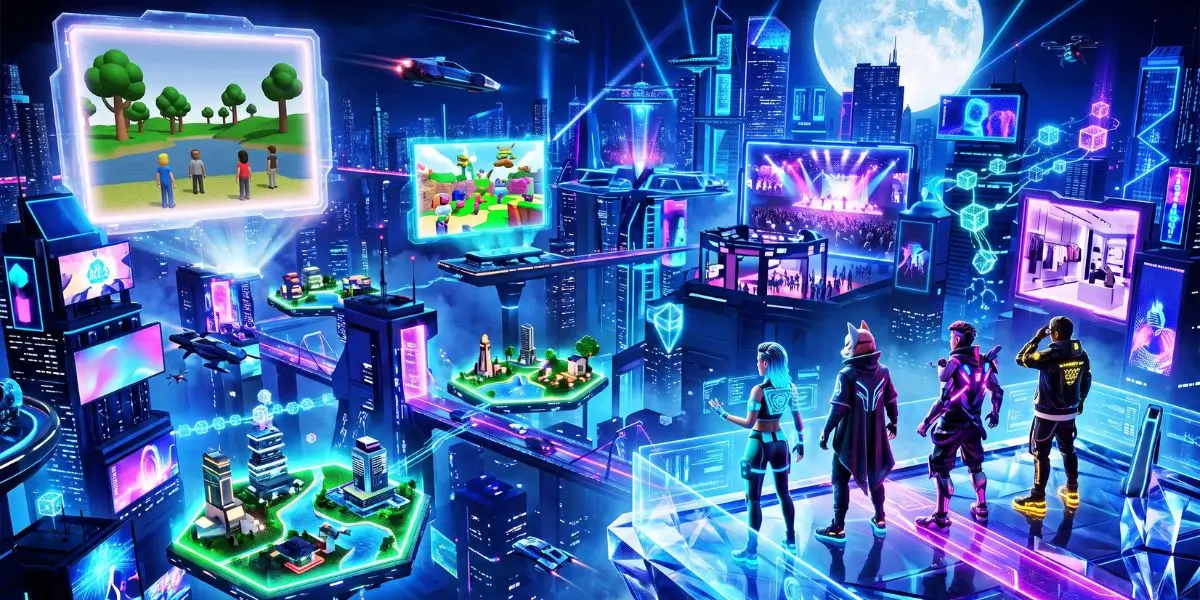
The metaverse is one of the most fascinating—and misunderstood—ideas in modern technology. Some people imagine it as a single virtual reality world where everyone will work, socialize, shop, and play through digital avatars. Others associate it exclusively with VR headsets, cryptocurrency, NFTs, or futuristic digital cities.
The reality is more complex.
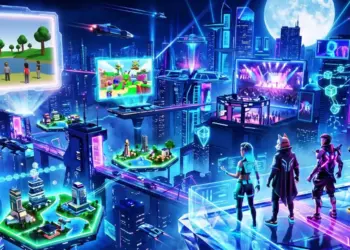
The metaverse is not one single website, application, game, or company. It is a broad ecosystem of persistent digital environments where people can interact, create, communicate, play, work, attend events, customize avatars, buy virtual goods, and build communities.
These environments may include virtual worlds, multiplayer games, augmented reality applications, social platforms, digital-twin systems, creator economies, blockchain-based marketplaces, and AI-powered spaces. Some can be accessed through a virtual reality headset, while others work through a computer, smartphone, game console, or web browser.
There is also no universally accepted definition of the metaverse. Most descriptions include several common features:
Persistent digital environments.
Real-time interaction.
Avatar-based identity.
User-generated content.
Virtual economies.
Social communities.
Immersive 3D experiences.
Digital ownership.
Interoperability between platforms.
The metaverse did not suddenly appear when technology companies began promoting it. Its foundations were built over decades through online communities, multiplayer games, chat rooms, virtual reality experiments, digital economies, and user-created worlds.
A Brief History of the Metaverse
The word “metaverse” became widely known after Neal Stephenson used it in his 1992 science-fiction novel Snow Crash. In the book, the metaverse is a vast virtual reality environment where people interact through avatars.
Although the concept was fictional, it influenced developers, designers, and technology companies. Over time, early online communities and 3D platforms began offering real-world versions of shared digital spaces.
Before the current metaverse trend, platforms such as Active Worlds and There experimented with online environments where users could create identities, communicate with one another, and explore shared spaces.
Then came a much more ambitious platform.
Second Life Was a Metaverse Pioneer
Linden Lab launched Second Life in 2003, long before Facebook became Meta and before the word “metaverse” became a mainstream marketing term.
Second Life was not structured like a conventional video game. It did not focus on missions, levels, or a single victory condition. Instead, it provided a persistent 3D world where residents could build their own experiences.
Users could:
Create detailed avatars.
Design clothing and accessories.
Build homes, stores, galleries, and communities.
Buy, rent, and develop virtual land.
Attend concerts, classes, and conferences.
Create animations and interactive objects.
Open virtual businesses.
Sell digital products and services.
Meet people from around the world.
Participate in a real-money virtual economy.
Linden Lab describes Second Life as a pioneering user-created virtual world. The company has reported more than 73 million accounts created since launch, around 750,000 monthly active users at the time of its 20th-anniversary announcement, more than 1.6 million daily in-world transactions, nearly two billion user creations, and a virtual economy valued at approximately $650 million.
These figures are company-reported and should be understood in that context. Nevertheless, they demonstrate why Second Life deserves recognition as one of the earliest large-scale metaverse platforms.
Second Life introduced ideas that later became central to Web3 and the metaverse:
Avatar-based identity.
Virtual property.
Digital fashion.
User-generated environments.
Creator monetization.
In-world currencies.
Virtual communities.
Online events.
Digital entrepreneurship.
Long before NFTs became popular, Second Life residents were buying virtual clothing, renting digital land, attending events, and building businesses inside a persistent online world.
1. The Metaverse Is Not One Single Place
There is no single official “Metaverse” website where everyone logs in.
Instead, the metaverse is an ecosystem of independent or partially connected platforms. These may include:
Social virtual worlds.
Multiplayer games.
Virtual reality platforms.
Augmented reality applications.
Digital-twin environments.
Online marketplaces.
Virtual workplaces.
Educational simulations.
Creator platforms.
Blockchain-based worlds.
Roblox, Fortnite, Minecraft, Second Life, VRChat, Decentraland, and The Sandbox all offer different interpretations of metaverse-like experiences.
Some focus on social interaction. Others emphasize games, digital property, live entertainment, user-generated content, or creator monetization.
2. The Metaverse Does Not Require a VR Headset
Virtual reality can make a digital environment feel more immersive, but it is not required to access every metaverse platform.
Many virtual worlds can be experienced through:
Desktop computers.
Laptops.
Smartphones.
Tablets.
Game consoles.
Web browsers.
Augmented-reality devices.
VR headsets.
Roblox, Fortnite, Minecraft, and Second Life can all be accessed without specialized VR hardware.
This accessibility is important for mass adoption. Requiring an expensive headset would limit the audience, while cross-platform access allows more people to participate.
3. Second Life Was Creating Digital Economies Before NFTs
Second Life allowed users to create and sell digital goods long before blockchain-based NFTs became popular.
Residents have historically sold:
Clothing.
Hair.
Skins.
Furniture.
Homes.
Vehicles.
Animations.
Buildings.
Land rentals.
Photography.
Design services.
Event tickets.
The platform’s Linden Dollar economy allowed residents to buy and sell virtual goods and services. Linden Lab described a marketplace with millions of virtual items and a thriving creator economy.
Second Life did not use NFTs to establish digital ownership. Its assets existed within the platform’s own ecosystem. However, it demonstrated that people could assign real social and financial value to objects that exist only in a virtual world.
4. Roblox Is More Than a Video Game
Roblox is often called a gaming platform, but it is also a massive user-generated content ecosystem.
Users can create and publish their own experiences through Roblox Studio. These experiences may function as:
Games.
Social hangouts.
Role-playing environments.
Obstacle courses.
Fashion spaces.
Concert venues.
Educational worlds.
Virtual stores.
Interactive advertisements.
Community hubs.
Roblox reported that creators earned more than $1.5 billion through its Developer Exchange program in 2025, surpassing the previous year’s reported total of $923 million.
That creator economy shows how virtual platforms can evolve beyond entertainment into digital labor markets.
5. Roblox Creators Are Building Real Businesses
Roblox developers can earn money from:
Virtual items.
Game passes.
In-game purchases.
Premium subscriptions.
Branded experiences.
Advertising.
Creator commissions.
Custom development.
Digital accessories.
The platform has created opportunities for programmers, artists, designers, animators, community managers, marketers, and entrepreneurs.
A successful Roblox experience can become a small business with its own audience, revenue streams, brand partnerships, and development team.
6. Fortnite Hosted a Concert With 12.3 Million Concurrent Players
In April 2020, Fortnite hosted Travis Scott’s “Astronomical” in-game concert.
More than 12.3 million players reportedly attended the first live showing simultaneously, according to Epic Games.
The event demonstrated that a virtual world could function as a global entertainment venue. Users did not simply watch a standard video. They entered a shared digital space, controlled avatars, experienced synchronized effects, and participated in an event with millions of other people.
Fortnite later reportedly attracted 14.3 million concurrent players for its “Remix: The Finale” event in 2024.
7. Virtual Concerts Can Function Like Digital Theme Parks
A metaverse concert can include much more than a digital stage.
Players may experience:
Giant performer avatars.
Flying sequences.
Changing landscapes.
Teleportation.
Interactive visual effects.
Digital merchandise.
Synchronized animations.
Branded environments.
Social activities before and after the show.
This transforms entertainment from passive viewing into an interactive journey.
For brands and marketers, virtual events can also create measurable engagement opportunities, including event attendance, repeat visits, digital merchandise sales, lead generation, and social sharing.
8. Minecraft Is a Metaverse-Like Platform
Minecraft is not always marketed as a metaverse, but it contains many metaverse-style elements.
Players can:
Build persistent environments.
Collaborate with other users.
Create communities.
Explore shared worlds.
Design games inside the game.
Use custom servers.
Attend events.
Create educational spaces.
Develop virtual economies.
Minecraft’s greatest strength is user creativity. Players are not limited to consuming a predefined world; they build much of the world themselves.
9. VRChat Is Built Around Social Presence
VRChat is a social virtual-world platform where users meet in worlds created by the community.
It is known for:
Customizable avatars.
User-created environments.
Voice communication.
Virtual events.
Performances.
Role-playing communities.
Dance groups.
Virtual photography.
Social gatherings.
Educational meetings.
One of VRChat’s defining characteristics is avatar freedom. Users can appear as humans, animals, robots, fantasy characters, abstract designs, or entirely original creations.
For many users, the avatar is not merely a costume. It becomes a form of social identity.
10. Avatars Can Become Digital Identities
An avatar can represent much more than appearance.
Users may use avatars to explore:
Gender expression.
Fashion.
Cultural identity.
Fantasy identities.
Personal branding.
Disability representation.
Social confidence.
Creative storytelling.
Professional presence.
In a virtual world, people can choose how they want to be represented instead of relying only on physical appearance.
Some users maintain one consistent avatar, while others use different avatars in different communities.
11. Decentraland Uses Blockchain-Based Virtual Land
Decentraland is a blockchain-based virtual world built around digital land and virtual assets.
In the platform, parcels of virtual land are represented as NFTs. Users can buy, sell, develop, or use these parcels for:
Games.
Galleries.
Stores.
Events.
Advertising.
Social spaces.
Branded experiences.
Educational projects.
The blockchain records ownership and transfers, while users decide what to build on the land.okx
Decentraland became influential because it connected virtual property with blockchain-based ownership rather than keeping every asset inside a centralized database.
12. The Sandbox Lets Users Build and Monetize Experiences
The Sandbox is a user-generated virtual world where creators can build games, environments, characters, and digital assets.
Its ecosystem includes:
VoxEdit for creating voxel-based assets.
Game Maker for interactive experiences.
LAND for virtual property.
SAND as a platform token.
Digital assets represented through blockchain technology.
The Sandbox white paper describes LAND as blockchain-backed virtual parcels that creators can use to publish content and experiences.
The platform has also reported large-scale participation in its Alpha Seasons, with more than 144,000 players participating during 2025.
13. Virtual Land Is Not the Same as Physical Land
Buying virtual land does not give someone real-world property rights.
A virtual land NFT represents ownership or control inside a particular platform. Its value depends on:
Platform popularity.
User activity.
Location.
Utility.
Brand partnerships.
Scarcity.
Marketplace liquidity.
Community interest.
Platform stability.
If a virtual world loses users or changes its rules, the value of its land may decline dramatically.
Virtual real estate can be useful for building experiences, but it is not automatically a safe investment.
14. NFTs and the Metaverse Are Connected—but Not Identical
NFTs can represent:
Avatars.
Clothing.
Land.
Art.
Vehicles.
Game items.
Event tickets.
Membership passes.
Collectibles.
However, not every virtual world uses NFTs. Many platforms operate with centralized inventories, internal currencies, and company-controlled databases.
The key difference concerns ownership and transferability. A centralized digital item may exist only within one platform, while an NFT can potentially be transferred between wallets and marketplaces.
In practice, interoperability remains limited. Most virtual goods cannot move freely between unrelated worlds.
15. The Open Metaverse Has Not Fully Arrived
The idea of an open metaverse suggests that users could move between platforms while keeping the same:
Avatar.
Identity.
Clothing.
Friends list.
Reputation.
Virtual goods.
Currency.
Personal data.
That vision remains difficult to implement.
Different platforms use incompatible:
File formats.
Avatar systems.
Graphics engines.
Identity standards.
Moderation policies.
Economies.
Security systems.
Marketplace rules.
Interoperability requires technical standards and cooperation between competing companies. Current platforms usually keep their assets and identities inside separate ecosystems.
16. Virtual Reality Is Only One Layer of the Metaverse
The metaverse includes far more than VR headsets.
It combines technologies such as:
3D graphics.
Artificial intelligence.
Cloud computing.
Spatial audio.
Motion tracking.
High-speed networks.
Game engines.
Digital identity.
Blockchain.
Augmented reality.
Mixed reality.
Creator tools.
A person chatting through an avatar on a laptop may already be participating in a metaverse-like experience.
17. Artificial Intelligence Is Becoming a Core Metaverse Technology
AI can make virtual worlds more dynamic and personalized.
Possible applications include:
Conversational non-player characters.
AI-powered virtual assistants.
Automated world-building.
Personalized quests.
Real-time translation.
Automatic avatar animation.
AI-generated clothing.
Smart moderation.
Personalized education.
Procedural environment creation.
Generative AI may allow creators to describe a world in natural language and produce a rough environment without manually designing every object.
However, AI also introduces risks involving:
Deepfakes.
Impersonation.
Privacy.
Copyright.
Synthetic misinformation.
Voice cloning.
Automated manipulation.
18. Virtual Worlds Can Be Used for Education
Metaverse environments can support:
Medical simulations.
Industrial training.
Emergency response.
Engineering visualization.
Architecture.
Language learning.
Historical reconstruction.
Workplace training.
Customer-service education.
Laboratory simulations.
A virtual simulation can allow people to practice scenarios that are dangerous, expensive, or impossible to reproduce physically.
The strongest educational applications use immersion to solve a specific learning problem. Simply placing a classroom in a 3D environment does not automatically improve education.
19. Digital Twins Connect Virtual Worlds to Physical Systems
A digital twin is a virtual representation of a real-world object, building, machine, city, or process.
Organizations can use digital twins to:
Monitor equipment.
Simulate traffic.
Test construction plans.
Optimize energy consumption.
Train employees.
Predict maintenance problems.
Visualize urban development.
Improve logistics.
The industrial metaverse focuses less on avatars and entertainment and more on linking real-world data with interactive 3D models.
20. Businesses Can Build Virtual Stores and Showrooms
Brands can use virtual worlds to create:
Digital showrooms.
Product launches.
Fashion stores.
Interactive advertisements.
Branded games.
Customer communities.
Virtual events.
Product demonstrations.
Customer-support environments.
A virtual campaign can increase engagement by allowing customers to explore, interact, and share a branded experience.
However, impressive graphics alone do not guarantee ROI. Businesses should measure:
Engagement time.
Repeat visits.
Event attendance.
Digital product sales.
Lead generation.
Conversion rates.
Customer retention.
Brand sentiment.
21. Virtual Fashion Is a Major Part of the Metaverse
Users buy digital clothing because avatars are social identities.
Virtual fashion can include:
Shirts.
Jackets.
Dresses.
Shoes.
Jewelry.
Hair.
Makeup.
Wings.
Helmets.
Animated accessories.
Full-body avatars.
In Second Life, Roblox, and VRChat, creators can build businesses around avatar customization and digital fashion.
Virtual fashion also allows designers to create products without manufacturing physical inventory. The main challenges become design quality, discoverability, cultural relevance, scarcity, and community demand.
22. Virtual Worlds Have Their Own Economies
Virtual economies may use:
Platform currencies.
Loyalty points.
In-game tokens.
Blockchain assets.
Creator rewards.
Marketplace credits.
These currencies can help users buy digital goods and services. Some can be exchanged for real-world money, while others remain restricted to the platform.
Virtual economies also create risks, including:
Inflation.
Price volatility.
Market manipulation.
Account theft.
Fraud.
Conversion fees.
Regulatory uncertainty.
Users should understand whether a digital asset is transferable, withdrawable, and legally recognized.
23. The Metaverse Can Create Real Digital Jobs
Virtual worlds create demand for:
3D artists.
Game developers.
Scripters.
Animators.
Avatar designers.
Fashion creators.
Event producers.
Community managers.
Digital marketers.
Virtual photographers.
AI world-builders.
Moderators.
The creator economy can be especially powerful because users are not limited to working for the platform itself. They can sell products and services directly to other users.
24. Virtual Events Can Reach Global Audiences
A physical venue has limited capacity. A virtual event can potentially attract participants from many countries simultaneously.
Virtual events may include:
Concerts.
Conferences.
Fashion shows.
Product launches.
Art exhibitions.
Gaming tournaments.
Educational sessions.
Community festivals.
Business networking events.
Fortnite’s music events demonstrated how games can become global entertainment platforms.engadget
The challenge is giving users a reason to participate. A virtual event that merely reproduces a traditional livestream inside a 3D environment may not create lasting engagement.
25. Social Presence Can Matter More Than Graphics
A visually impressive virtual world can fail if users do not feel connected to other people.
Communities return to virtual worlds because of:
Friendship.
Shared rituals.
Events.
Identity.
Belonging.
Creative collaboration.
Emotional support.
Discovery.
Recognition.
Second Life and VRChat show that community can be more important than graphical realism.
A simple environment with strong social interaction may produce more engagement than an expensive world with no active community.
26. Virtual Worlds Have Serious Moderation Challenges
Large digital communities face problems involving:
Harassment.
Bullying.
Hate speech.
Fraud.
Sexual exploitation.
Child safety.
Identity theft.
Impersonation.
Account theft.
Non-consensual recording.
Manipulative monetization.
Moderation becomes more difficult when users interact through voice, movement, private spaces, custom avatars, and user-generated content.
Platforms need a combination of:
Automated detection.
Human moderators.
Reporting systems.
Age-appropriate design.
Privacy controls.
Identity protection.
Clear community rules.
Rapid enforcement.
No moderation system is perfect, especially in enormous user-generated environments.
27. Metaverse Privacy Risks Can Be More Detailed Than Social Media Risks
Depending on the device and platform, virtual worlds may collect:
Voice recordings.
Facial movements.
Eye movements.
Hand gestures.
Body motion.
Location.
Device data.
Social connections.
Time spent in specific spaces.
Behavioral patterns.
Biometric information.
This data could reveal personal preferences, physical conditions, emotional reactions, and behavioral habits.
Users should review permissions carefully, limit unnecessary data collection, and understand how recordings and behavioral information are stored.
28. Digital Identity May Become More Important Than Physical Appearance
In a virtual world, people may be recognized by:
Their avatar.
Their display name.
Their reputation.
Their creative work.
Their clothing.
Their community memberships.
Their voice.
Their history of interactions.
This creates a new form of personal branding. A creator may become known primarily through an identity that exists across virtual platforms.
For influencers, artists, musicians, marketers, and entrepreneurs, the avatar can become an extension of the brand.
29. Virtual Worlds Can Support Remote Collaboration
Immersive environments can provide spaces for:
Meetings.
Product design.
Training.
Brainstorming.
Presentations.
Simulations.
Team-building.
3D visualization.
A virtual workspace is especially useful when teams need to examine three-dimensional objects, facilities, machinery, buildings, or designs.
However, not every meeting requires a virtual reality environment. The best use cases are those where spatial interaction provides an actual advantage over video calls.
30. The Metaverse Can Improve Accessibility—but Also Create Barriers
Virtual worlds may help people participate in experiences that are difficult to access physically.
Potential benefits include:
Remote participation.
Flexible identity.
Customizable environments.
Assistive interfaces.
Virtual events without travel.
Social interaction for people with mobility limitations.
Adjustable sensory settings.
But users may also face:
Expensive hardware.
Motion sickness.
Poor controller design.
Inaccessible interfaces.
Lack of captions.
Difficult voice communication.
High-speed internet requirements.
Limited support for assistive technology.
Accessibility must be considered during product design, not added as an afterthought.
31. Virtual Property Can Be Used for Advertising
Virtual land can function as digital real estate for:
Branded billboards.
Product displays.
Interactive games.
Event venues.
Virtual stores.
Community hubs.
Sponsored experiences.
However, a virtual location only has significant marketing value if users actually visit it.
A smaller location in an active community may be more valuable than a large parcel in an abandoned world.
32. The Metaverse Is Closely Connected to the Creator Economy
Creators can produce:
Games.
Digital wearables.
Avatars.
Buildings.
Animations.
Music.
Educational environments.
Events.
Scripts.
AI characters.
Virtual campaigns.
Platforms that offer powerful creation tools can grow quickly because users generate much of the content.
The challenge is ensuring that creators receive fair compensation, retain appropriate rights, and can reach their target audiences.
33. Virtual Assets Can Have Value Without Being Expensive
A digital asset can be valuable because it:
Expresses identity.
Unlocks access.
Creates social status.
Improves gameplay.
Provides utility.
Connects users to a community.
Marks participation in an event.
Supports a creator.
Enables customization.
A free avatar item may have more emotional value than an expensive NFT.
For businesses, utility and community engagement are often stronger long-term drivers than artificial scarcity.
34. Interoperable Avatars Remain a Major Challenge
In theory, a person could own one avatar and use it across multiple virtual worlds.
In practice, that avatar would need to work with different:
Body structures.
Animation systems.
Clothing standards.
Graphics engines.
Physics systems.
Identity rules.
Moderation systems.
Marketplace policies.
A jacket designed for one avatar may not fit another. A digital accessory may be technically incompatible with another world.
A truly open avatar ecosystem requires technical standards, industry cooperation, and secure identity systems.
35. The Metaverse Market Forecasts Vary Widely
Market research firms publish very different estimates for the future size of the metaverse.
One 2026 report estimated that the market was worth approximately $139.1 billion in 2025 and projected it could reach more than $3.7 trillion by 2033. Another forecast estimated a 2025 market size of approximately $156.07 billion and projected a compound annual growth rate above 46% through 2034.grandviewresearch+1
These estimates should not be treated as guarantees. Different researchers include different categories, such as:
Virtual reality hardware.
Augmented reality.
Gaming.
Digital assets.
Industrial software.
Virtual events.
Advertising.
Enterprise collaboration.
Creator economies.
The exact forecast matters less than the broader trend: virtual-world technology continues to attract investment, experimentation, and user attention.
36. The Metaverse Is Moving Beyond the “One Giant World” Narrative
Early metaverse marketing imagined one universal world where people would work, shop, socialize, and play.
The market has developed in a more fragmented direction.
Users spend time across specialized ecosystems:
Roblox for user-created experiences.
Fortnite for entertainment and events.
Second Life for virtual commerce and social creativity.
VRChat for avatar-based communities.
Minecraft for building and collaboration.
Decentraland for blockchain-based spaces.
The Sandbox for creator-owned experiences.
Enterprise platforms for training and work.
This fragmented model may be more realistic than the idea of one platform replacing the entire internet.
37. AI May Make Virtual World Creation Much Faster
Creating a detailed virtual world traditionally requires designers, programmers, artists, animators, writers, and sound engineers.
AI tools may accelerate the process by generating:
Buildings.
Landscapes.
Characters.
Dialogue.
Missions.
Textures.
Animations.
Music.
Lighting.
Storylines.
Interactive objects.
This could allow smaller teams and individual creators to develop ambitious virtual experiences.
The challenge will be maintaining originality, quality, safety, and copyright compliance. A world built quickly is not necessarily a world people will want to visit repeatedly.
38. The Metaverse Can Support Digital Twins and Industrial Innovation
Companies can use virtual environments to test factories, warehouses, machines, vehicles, and city systems before changing the physical world.
Potential benefits include:
Lower testing costs.
Faster product design.
Safer training.
Better predictive maintenance.
Improved energy efficiency.
Reduced downtime.
More effective collaboration.
This industrial approach may ultimately produce more practical business value than speculative virtual real estate.
39. Virtual Worlds Are Becoming More Mobile and Accessible
The future of virtual worlds will likely involve multiple devices rather than one dominant interface.
Users may move between:
Smartphones.
PCs.
Consoles.
Browsers.
AR glasses.
VR headsets.
Mixed-reality devices.
One person may attend a virtual event through a headset, while another joins via a mobile phone.
Shared experiences do not always require identical hardware.
40. The Metaverse Is Still Being Built
The metaverse is not a finished product. It is an ongoing transition in how people use the internet.
It is developing through:
Virtual worlds.
AI characters.
Spatial computing.
Augmented reality.
Digital twins.
Blockchain assets.
Creator economies.
Social avatars.
Virtual events.
Immersive education.
Remote collaboration.
Some predictions will fail. Some platforms will disappear. Others may become important parts of online culture.
The metaverse will probably not arrive as one dramatic event. It will develop gradually through the tools, communities, games, marketplaces, and digital identities that people choose to use every day.
The Hidden History of the Virtual World
1. The Term Was Coined in a Dystopian Sci-Fi Novel
2. The First “Metaverse” Was Built in the 1980s
3. The Digital “Avatar” Was Invented for This Exact Concept
Mind-Bending Technological Realities
4. You Will Soon Be Able to “Feel” the Digital World
5. Brain-Computer Interfaces Are the Ultimate Endgame
6. The Metaverse Doesn’t Actually Require a VR Headset
The Wild Economy of the 3D Internet
7. Virtual Real Estate is a Multi-Billion Dollar Market
8. Digital Fashion is Outperforming Physical Retail in Some Metrics
9. “Virtual Architect” is a Rapidly Growing Profession
Bizarre and Surprising Social Impacts
10. The “Proteus Effect” Changes Your Real-World Behavior
11. People Are Getting Legally Married in the Metaverse
12. Virtual Reality is Being Used for Exposure Therapy
The Future: What’s Next for Spatial Computing?
13. AI Will Populate the Metaverse with Infinite NPCs
14. The Metaverse Will Eventually Merge with the Physical World
Frequently Asked Questions
What is the metaverse in simple terms?
The metaverse is a collection of persistent digital environments where people interact through avatars, create content, socialize, play, work, attend events, and participate in virtual economies.
Is the metaverse one single platform?
No. The metaverse is an ecosystem of different platforms and technologies. Roblox, Fortnite, Second Life, VRChat, Decentraland, Minecraft, and The Sandbox offer different types of metaverse-like experiences.
When did the metaverse begin?
The idea of the metaverse became widely known after Neal Stephenson used the term in his 1992 novel Snow Crash. Real-world virtual environments developed through online communities, games, 3D platforms, and virtual worlds during the 1990s and early 2000s.
Was Second Life the first metaverse?
Second Life was not necessarily the first virtual world, but it is widely regarded as one of the pioneering large-scale metaverse platforms. Linden Lab launched it in 2003, and it introduced customizable avatars, user-generated content, virtual land, social communities, digital commerce, and a creator economy.
Why is Second Life considered a metaverse pioneer?
Second Life allowed users to create avatars, build virtual environments, buy and rent digital land, sell virtual goods, attend events, and form communities inside a persistent 3D world. It offered many features now associated with the metaverse before the current metaverse trend began.
Is Roblox a metaverse?
Roblox can be considered a metaverse-like platform because it combines avatars, user-generated 3D experiences, social interaction, digital goods, and a creator economy.
Is Fortnite a metaverse?
Fortnite includes many metaverse-style features, such as live events, virtual concerts, avatars, social spaces, digital items, and branded interactive experiences. Its Travis Scott concert attracted more than 12.3 million concurrent players during its first showing.
Is VRChat a metaverse?
VRChat is a social virtual-world platform where users interact through customizable avatars in user-created environments. It is commonly considered a metaverse-like platform because of its social presence, persistent communities, and creator-generated spaces.
Do you need virtual reality to enter the metaverse?
No. Many platforms can be accessed through a computer, smartphone, tablet, console, or browser. A VR headset can create greater immersion, but it is not required for every virtual world.
What is the connection between NFTs and the metaverse?
NFTs can represent virtual land, avatars, clothing, collectibles, event tickets, and other digital goods. However, not every metaverse platform uses NFTs, and many virtual assets remain controlled through centralized systems.
Can people make money in the metaverse?
Yes. People can earn money by creating games, virtual clothing, avatars, environments, animations, scripts, events, digital services, and branded experiences. Roblox reported that creators earned more than $1.5 billion through its Developer Exchange program in 2025.
Is virtual land a good investment?
Virtual land is speculative and can lose value. Its usefulness and price depend on platform activity, location, community demand, utility, liquidity, and the long-term survival of the virtual world.
Will all virtual worlds eventually connect?
That is uncertain. Interoperability remains difficult because platforms use different identity systems, asset formats, economies, technical standards, and moderation policies.
How does AI affect the metaverse?
AI can generate environments, animate avatars, create conversational characters, personalize experiences, translate conversations, improve moderation, and make virtual-world development faster.
What are the risks of the metaverse?
Major risks include privacy loss, biometric data collection, harassment, fraud, identity theft, deepfakes, child safety concerns, addiction, account theft, manipulative monetization, and speculative digital assets.
Is the metaverse still relevant?
Yes, but the market is evolving. The biggest opportunities may come from practical uses such as gaming, creator economies, virtual events, education, industrial training, digital twins, AI-powered characters, and remote collaboration rather than one universal virtual world.
Conclusion
The metaverse is much more than virtual reality headsets, cryptocurrency, NFTs, or futuristic digital cities.
It is the result of decades of experimentation with online identity, 3D environments, multiplayer games, virtual communities, digital economies, user-generated content, immersive events, and virtual commerce.
Second Life deserves a special place in that history. Launched in 2003, it gave residents the ability to create avatars, build environments, own or rent virtual land, design digital clothing, attend events, operate businesses, and participate in a virtual economy long before metaverse became a mainstream technology term.
Roblox expanded the creator economy. Fortnite transformed games into global entertainment venues. Minecraft demonstrated the power of user-built worlds. VRChat made social presence and avatar identity central to virtual interaction. Decentraland and The Sandbox explored blockchain-based ownership and virtual land. Artificial intelligence is now adding a new layer by helping create environments, characters, stories, and personalized experiences.
The future of the metaverse may not be one giant digital universe. It may be a network of specialized virtual worlds, each designed for different purposes:
Gaming.
Social interaction.
Education.
Entertainment.
Commerce.
Remote collaboration.
Digital fashion.
Industrial training.
Creative expression.
Community building.
The platforms that succeed will likely offer more than impressive graphics. They will need strong communities, useful creator tools, accessible interfaces, effective safety systems, responsible monetization, and experiences that people genuinely want to revisit.
The metaverse is not finished—and that is precisely what makes it so interesting. Its future will be shaped not only by major technology companies, but also by creators, designers, developers, marketers, artists, entrepreneurs, and everyday users who continue to build new digital worlds.