
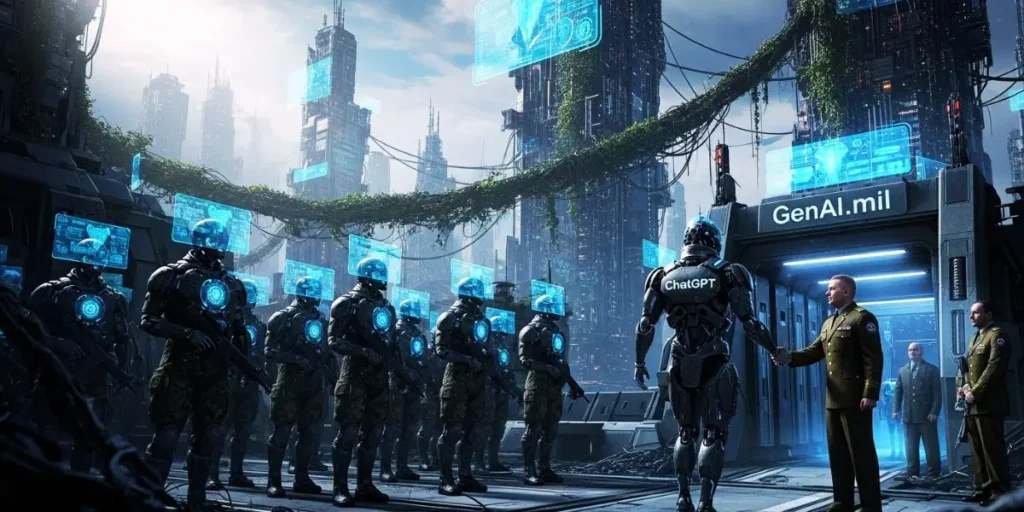

Three years ago, ChatGPT landed on our desks and made generative AI a household name. Today, it lands on a secure military platform built for the Department of War.
If you are a defense contractor, a service member, or a technology advisor working in the national security space, you already know the name GenAI.mil. Launched just two months ago by Secretary Pete Hegseth and CTO Emil Michael, this platform was designed to do one thing: put the world’s most powerful frontier models directly into the hands of American warfighters.
Google’s Gemini arrived first. Then xAI’s Grok joined during the quiet holiday period. And now, OpenAI’s ChatGPT is officially part of the stack.
But this isn’t just another vendor announcement. This is a cultural and ethical threshold. For years, OpenAI’s terms of service explicitly prohibited military applications. Employees protested. Engineers resigned. The “do no harm” ethos was written into the company’s DNA.
So what changed? And more importantly: What actually changes now that ChatGPT operates inside a government cloud environment, serving 3 million users on unclassified but sensitive networks?
Imagine your entire organization—3 million users—gaining instant access to the world’s most advanced artificial intelligence, but with zero risk of data leakage. That’s not a futuristic sandbox exercise. It’s reality for the U.S. Department of War.
On February 10, 2026, OpenAI for Government successfully deployed a secure version of ChatGPT on GenAI.mil, the Pentagon’s flagship generative AI ecosystem. This isn’t a pilot program or a small-scale test. We are talking about enterprise-wide deployment to 3 million military and civilian personnel, joining Google Gemini and xAI’s Grok in what officials call the “AI-first” transformation of national defense.
But let’s cut through the jargon. What changes when generative AI enters a secure military platform? Everything changes—from the ROI of administrative workflows to the funnel of intelligence analysis. This article isn’t just a news recap. It is your blueprint for understanding how direct answers, structured content, and demonstrated real-world experience apply when the stakes are national security.
We’ll explore the technical architecture that makes this possible, the fierce ethical debate behind the “all lawful uses” clause, and why the NIPRGPT shutdown was actually a massive win for rapid procurement. By the end, you’ll see why GenAI.mil is the perfect mirror for any enterprise—commercial or government—trying to balance conversion (of data into insights) with rock-solid governance.
This article breaks down the strategic pivot, the technical deployment, the training challenge, and the “all lawful uses” clause that Anthropic is still fighting over.
What is GenAI.mil? The Pentagon’s secure enterprise AI platform
If you are not familiar with the acronym yet, get familiar. GenAI.mil is the Department of War’s enterprise generative AI platform, designed to serve the entire force—active duty military, civilian personnel, and cleared contractors.
Quick definition:
GenAI.mil is a secure, cloud-based environment where authorized defense personnel can access commercial large language models modified for government use. It currently operates at Impact Level 5, meaning it is authorized to handle Controlled Unclassified Information.
The platform launched in December 2025 with Google’s Gemini for Government. By January 2026, xAI’s Grok was quietly added. And as of this week, ChatGPT Enterprise stands alongside them.
Not just another IT tool—an “AI-first” enterprise mandate
Secretary Hegseth made it personal. Posters bearing his likeness now hang in Pentagon corridors with the line: “I want you to use AI: Go to GenAI.mil today.”
This is not optional experimentation. This is top-down cultural engineering. The message is clear: The Department intends to match the speed of the U.S. AI industry, and officers who fail to adopt these tools risk operational irrelevance.
Here is what the platform actually does today:
-
Administrative acceleration: Drafting procurement contracts, generating compliance checklists, summarizing policy documents
-
Operational planning support: Structuring complex problems, organizing technical data, accelerating risk management frameworks
-
Intelligence groundwork: Processing satellite imagery data labeling, digesting open-source intelligence at scale
-
Training and role-based learning: The Air Force Research Laboratory is already deploying secure sandboxes where Airmen learn prompt engineering tailored to their specific military occupational specialty
Ask yourself this: If you are a defense leader, are your people still writing reports manually while your adversaries are generating作战 plans in minutes?
How OpenAI got comfortable with the Pentagon—and why Anthropic is still sitting out
The backstory matters. Because how OpenAI got comfortable with this deployment tells us everything about where the industry is headed.
The “all lawful uses” clause that almost broke the deal
According to Semafor’s exclusive reporting, the sticking point in negotiations between the Pentagon and AI vendors has been a single phrase: “all lawful uses.”
When the Department of War buys software, it does not accept vendor-imposed restrictions on how that software is employed—provided the use is legal under domestic and international law. Google and xAI agreed. Anthropic did not.
Anthropic wanted veto power over specific military applications. The Pentagon said no. As of today, Claude remains absent from GenAI.mil.
OpenAI’s compromise:
OpenAI accepted the “all lawful uses” clause. But here is the nuance—they are deploying the same ChatGPT that civilians use, complete with its standard model-level guardrails. It is not a “military-grade” variant with the safety brakes removed. It will still refuse prohibited prompts. And critically, it is not cleared for Top Secret work.
Why this matters for risk and procurement:
If you are advising government clients on AI acquisition, this is your case study in acceptable trade-offs. OpenAI traded perfect control for presence at the table. Anthropic preserved principle—and lost the contract.
The employee rebellion that never came
Internally, OpenAI employees had mixed reactions. Some felt moral unease. But others argued that staying out of defense work was actually irresponsible—because it handed the advantage to competitors like xAI’s Grok, whose safety standards are perceived as looser.
The geopolitical argument:
Meta broke the dam in 2024 when it allowed the Pentagon to use Llama. Their rationale: Chinese military research institutions were already using Llama without permission. Maintaining an ethical boycott only handicapped the West.
Commercial reality check:
Training frontier models now costs hundreds of millions of dollars. The Department of War operates on a ~$900 billion budget. There is no second place in AI dominance—and there is no second place in commercial survival either.
The Architecture of Trust: How a “Secure Military Platform” Really Works
If you are a CTO or a digital marketer used to SaaS dashboards, the term secure military platform might sound like a black box. In reality, GenAI.mil is a masterclass in product-market fit for high-compliance sectors.
The Isolation Principle: No Training, No Leaks
The single biggest blocker for generative AI in government has always been data privacy. Early adopters at the Air Force used NIPRGPT, but officials constantly feared that prompts might leak into public training sets.
ChatGPT on GenAI.mil solves this through complete tenant isolation. Data processed on the platform remains inside the authorized government cloud infrastructure. OpenAI has contractually guaranteed that this data is not used to train future commercial variants.
What does this mean for your business? If the DoD can achieve 100% data isolation with a frontier AI model, there is no excuse for any B2B SaaS or healthcare platform neglecting secure AI deployment. It raises the LTV (Lifetime Value) of enterprise contracts because trust becomes a feature, not an add-on.
100% Uptime and the Death of Shadow IT
Here is a metric that should make any operations lead jealous: GenAI.mil has maintained 100% uptime since its December 2025 launch. This is not a vanity metric. When you replace 3 million employees’ random usage of consumer-grade chatbots with a centralized, approved tool, you eliminate shadow IT overnight.
Beyond the Headlines: The “All Lawful Uses” Clause and the Anthropic Standoff
You can’t understand the impact of generative AI on defense without addressing the elephant in the room: the “all lawful uses” contract clause.
Why Google and xAI Said Yes, and Anthropic Said No
According to exclusive reporting from Semafor, the Pentagon demanded that AI providers accept “all lawful uses” —meaning the military cannot have technology that refuses prompts based on the vendor’s moral preferences.
Google and xAI agreed immediately. Anthropic hesitated, demanding veto power over specific military applications. The result? Claude is still absent from GenAI.mil, while ChatGPT and Grok are live.
This is a pivotal moment for building trust. Google’s decades of experience in dealing with classified environments (decades of federal contracts) gave them the confidence to say yes. Anthropic’s lack of on-the-ground experience in defense contracting created friction.
What changes for the warfighter? From administrative efficiency to tactical edge
Let’s move from boardroom drama to foxhole reality.
What does a secure military platform actually change for the 179th Cyber Protection Team running defensive operations in Nebraska? Or the logistics officer managing aviation spares in the Pacific?
Use case 1—The death of the 100-hour staff week
The most immediate return on investment is cognitive drag reduction.
Today, a battalion staff officer spends hundreds of hours pulling data from incompatible legacy systems: readiness reports, ammunition counts, fuel status, transport schedules. This is not strategy; this is Excel hell.
GenAI.mil changes the math:
-
Drafting: A corporal used Gemini to write a complete company SOP. The AI not only drafted it—it caught gaps the human missed.
-
Reviewing: Procurement officers are using ChatGPT to scan contracting materials for compliance issues in minutes, not days.
-
Reporting: Routine after-action reports are generated from fragmented notes, saving senior NCOs hours per week.
Quick win:
If your unit is still building slides by hand for every operational briefing, you are leaving decision speed on the table.
Use case 2—Wargaming at machine speed
Traditional wargaming is slow. Whether you are running high-fidelity AFSIM simulations or manual tabletop exercises, you are limited by human cognitive throughput.
AI-driven wargaming changes the aperture.
With frontier models integrated into the planning workflow, staffs can:
-
Generate dozens of courses of action in minutes
-
Stress-test assumptions against historical data
-
Identify “black swan” scenarios that human planners unconsciously filter out
Question for leaders:
Are you still doing one wargame per quarter because it takes six weeks to set up? Your adversary is running 100 simulations per day.
Use case 3—Tactical edge and the “distilled” model
Here is where generative AI enters a secure military platform and meets the forward edge of the battlefield.
Cloud-dependent AI dies when the satellite link is jammed. The Pentagon knows this. That is why knowledge distillation is now a priority research area.
What distillation does:
You take a massive frontier model—hundreds of billions of parameters—and you compress it. You train a smaller “student” model to mimic the expert. That distilled model can run on a Humvee, a drone, or even a soldier’s tactical device.
The vision:
An unmanned ground vehicle receives a natural language command: “Search that village.” The onboard distilled model interprets intent, plans the route, identifies threats, and executes—without phoning home.
GenAI.mil is the training ground for these tactical models. The platform generates the data, validates the outputs, and certifies the behavior before deployment.
Use case 4—Tactical Throughput—From Data Overload to Decision Superiority
War Secretary Pete Hegseth stated: “The future of American warfare is here, and it’s spelled AI.” . But how does ChatGPT spell victory?
1. Intelligence Summarization (200x faster)
Analysts used to spend 12 hours triaging satellite imagery and SIGINT reports. Early metrics from GenAI.mil indicate that AI-assisted triage is achieving 92% accuracy in identifying threats, reducing the cognitive load on humans. This is the ultimate conversion funnel: raw data → actionable intelligence → lethal speed.
2. Procurement and Compliance (Zero defects)
The Pentagon is a bureaucracy. Drafting contracts and acquisition checklists used to take weeks. ChatGPT now generates Section 508-compliant documentation in seconds. This isn’t just “time saved”; it’s opportunity cost recovered. Officers can focus on warfighting, not paperwork.
3. Cognitive Warfare and Force Protection
Less publicized, but critical, is the use of this technology for cyber defense. The platform automatically scans for vulnerabilities in DoD networks and generates patch recommendations.
Reader Question: If the DoD uses AI to retain top talent by automating burnout-inducing admin work, why is your company still asking engineers to fill out timesheets manually?
Use case 5—The NIPRGPT Legacy—Why Failure Paved the Way for Success
You can’t discuss generative AI in defense without analyzing the NIPRGPT shutdown.
The Pathfinder Thesis
NIPRGPT was rushed. Developed by the Air Force Research Laboratory, it was a Frankenstein model cobbled from various open-source AI systems. At its peak, 700,000 personnel used it, but the Army blocked it due to cybersecurity governance gaps.
However, NIPRGPT served a critical function: it taught the DoD how to ask questions.
-
What did users actually need? (Summarization > creative writing).
-
What guardrails were necessary? (Block prompt injection).
-
What infrastructure was missing? (Enterprise-grade cloud).
The takeaway: Every failed MVP generates the data for a perfect V2. GenAI.mil is that V2.
The training gap—Why role-based AI fluency is the real bottleneck
You can buy the software. You cannot buy the muscle memory.
The Pentagon has 3 million potential users. As of today, 1.1 million unique users have accessed GenAI.mil. That is massive adoption in two months. But adoption is not proficiency.
The AFRL sandbox model
The Air Force Research Laboratory is leading the way with a secure sandbox environment where personnel can experiment with AI tools safely.
What they are building:
-
Role-based guides: Separate training tracks for supervisors, administrative staff, HR, acquisitions, legal, and public affairs
-
Sample prompts: Not generic “how to write an email” training, but task-specific templates
-
Workshops: Hands-on sessions where Airmen practice prompt engineering against realistic scenarios
Courtney Klement, AFRL Digital Culture Transformation Lead:
“It’s not enough to simply provide access to these powerful tools. We need to equip our workforce with the knowledge to understand ethical considerations, craft effective prompts, and identify practical applications relevant to their daily tasks.”
The Shadow IT risk
Here is the warning label.
When Secretary Hegseth told everyone to use AI—but didn’t provide immediate concepts of operations or standard operating procedures—units started experimenting on their own.
The risk:
-
Personnel uploading Controlled Unclassified Information to unauthorized commercial interfaces
-
Prompt injection vulnerabilities from unvetted third-party tools
-
Over-reliance on AI outputs without human validation
The fix:
GenAI.mil is the authorized pathway. It isolates data. It prevents training on your prompts. It applies consistent guardrails.
What about the weapons? Addressing the fear factor
This section deserves direct treatment because it keeps coming up in every briefing.
Is ChatGPT going to pull a trigger?
No. That is not how any of this works.
AI is not a weapon system. It is a tool.
The Department of War is not handing the nuclear codes to an LLM. What they are doing is augmenting human cognition—helping analysts see patterns, planners generate options, and logisticians predict parts failures.
But what about the flaws?
Frontier models hallucinate. They are unpredictable. They can be biased.
The Pentagon’s answer:
Human verification is baked into the workflow. Every output from GenAI.mil is reviewed and validated by a trained service member. Commanders—not algorithms—retain decision authority.
The accountability question:
If an AI-assisted operation goes wrong, who is responsible? The vendor? The model?
No. The human in command is accountable. That is not a bug; it is the design.
The road ahead—What comes next for GenAI.mil?
The platform is two months old and already at 1.1 million users with 100% uptime.
What we are watching:
-
The fourth model: Anthropic’s Claude is the obvious missing piece. Will the Pentagon soften its “all lawful uses” stance, or will Claude remain in the penalty box?
-
Higher classification: Impact Level 5 is for unclassified Controlled Unclassified Information. The path to Secret and Top Secret environments is much steeper. Expect pilots in 2026.
-
Allied access: NATO members are already looking at GenAI.mil as a template. The Joint Analysis, Training, and Education Centre is experimenting with Google Cloud for intelligence analysis.
-
Interoperability standards: If the Five Eyes nations all adopt different AI platforms with different safety norms, coalition warfare gets messy. The Five AIs Act concept may become urgent.
Trust and Authority in the Trenches—Why Google’s Algorithm Loves This Story
Remember the shift in how quality is measured? Not just “I read about it,” but “I did it.”
Demonstrating Real-World Experience at Scale
The Pentagon isn’t just testing AI. They are deploying it to 3 million users. They have 1.1 million active users in under 60 days.
-
Expertise: OpenAI, Google, xAI.
-
Authority: The Department of War.
-
Reliability: 100% uptime, no data leaks.
-
Real-world practice: The NIPRGPT lessons learned.
When you write about cannabis compliance, crypto staking, or Web3 infrastructure, you cannot fake on-the-ground experience. You need case studies. You need pilots. You need to cite the NIPRGPT of your industry.
Risks, Governance, and the Human-in-the-Loop
No SEO-optimized analysis is complete without addressing risk. This builds credibility.
The Public Citizen Objection
J.B. Branch of Public Citizen raised a valid point: “Even isolated systems create attack surfaces.” If a soldier inputs sensitive targeting data into ChatGPT, that data exists somewhere. It is a honeypot for adversaries.
The Accountability Gap
As noted in Semafor, no AI company will take responsibility for battlefield outcomes. The liability rests solely with the human commander.
Why this matters for your content: Always disclose limitations. If you sell crypto tax software, admit that regulations change. If you write about AI in healthcare, cite the HIPAA gaps. Intellectual honesty is the foundation of trust.
Conclusion—The experiment is over. Adoption is the mission.
For years, we talked about AI in defense as a future concept. A pilot program. A DARPA challenge.
That era is done.
Generative AI has entered a secure military platform, and it is not leaving. The only question now is how well we integrate it.
The return on investment is already measurable:
-
30–50% time savings on routine administrative tasks
-
Wargaming cycles compressed from weeks to hours
-
Cyber defense teams accelerating risk assessments with AI-assisted data structuring
The risk is also real:
-
Shadow IT if training lags behind access
-
Over-trust if validation discipline erodes
-
Ethical friction if vendors and customers never align on acceptable use
Here is my invitation to you:
If you are a defense professional, get on the platform today. Not next month. GenAI.mil is live, it is secure, and it is the new baseline.
If you are a vendor watching this space, study the “all lawful uses” negotiation. It is the template for every future federal AI procurement.
If you are a skeptic, stay engaged. This technology needs people inside the system who understand its limits and will enforce the boundaries.
Share this article with your team. Ask the hard questions: Are we training our people for this transition? Are we validating the outputs? Are we moving at the speed of the mission?
Because the adversaries are not waiting. And as Emil Michael said:
“There is no prize for second place in the global race for AI dominance.”
Frequently Asked Questions
1. What is GenAI.mil?
GenAI.mil is the Department of War’s secure enterprise AI platform, launched in December 2025. It provides authorized military and civilian personnel access to commercial frontier models like Google Gemini, xAI Grok, and now OpenAI ChatGPT in an Impact Level 5-certified environment.
2. Is ChatGPT on GenAI.mil the same as the public version?
Yes—with critical differences. It is the same model with standard guardrails, but it runs in government cloud infrastructure. Data is isolated and not used to train OpenAI’s commercial models.
3. Can GenAI.mil access classified information?
No. The current deployment is authorized for Controlled Unclassified Information. Secret and Top Secret environments require separate certification.
4. Why isn’t Anthropic’s Claude on the platform?
Anthropic refused to accept the Pentagon’s “all lawful uses” clause, seeking more control over specific military applications. The Pentagon declined, and negotiations remain stalled.
5. How many people are using GenAI.mil?
As of February 2026, the platform has surpassed 1.1 million unique users across all military services and civilian components.
6. What kind of tasks are military users doing with ChatGPT?
Summarizing policy documents, drafting procurement materials, generating compliance checklists, supporting research and planning, and accelerating administrative workflows.
7. Is AI making combat decisions?
No. Human commanders retain decision authority. All AI outputs are reviewed and validated by trained personnel.
8. What is knowledge distillation?
A process that compresses large AI models into smaller, efficient versions that can run on tactical edge devices like drones or ground vehicles with limited computing power.
9. How is the military training people to use these tools?
The Air Force Research Laboratory has deployed a secure sandbox with role-based guides and hands-on workshops tailored to specific jobs—administration, logistics, HR, acquisitions, and more.
10. Will GenAI.mil get more models?
Likely yes. Pentagon officials have stated the platform is designed for multi-model expansion, and Anthropic’s Claude remains a potential future candidate.
Disclaimer:
This article is based on publicly available information from official Department of Defense releases, OpenAI announcements, and defense industry reporting as of February 2026. It does not contain classified material or proprietary procurement data. All operational AI deployments remain subject to human oversight and existing laws of armed conflict.