
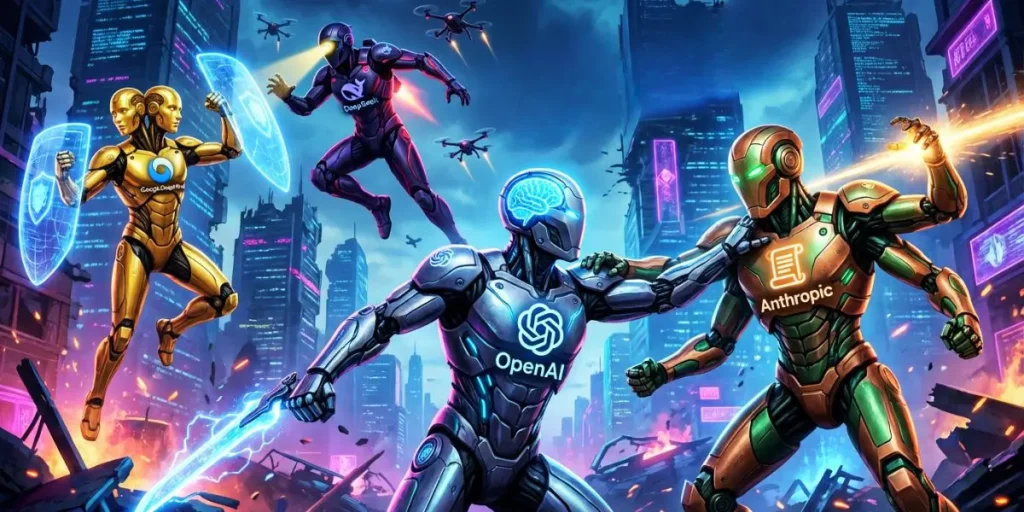

Let’s be honest. In 2026, the question is no longer if you should use an AI assistant, but which one will give you a true competitive edge. The market has exploded beyond the early ChatGPT hype into a full-blown cognitive arms race. With OpenAI, Anthropic, Google, and rising challengers like DeepSeek launching ever-more-capable models, choosing the wrong tool can cost you thousands in lost productivity, inefficient workflows, and missed opportunities for automation.
The truth is, there is no single “best” AI. The real advantage in 2026 lies not in picking a winner, but in strategically combining the unique strengths of each platform to build your own “AI dream team.” This guide cuts through the marketing noise. We’ve analyzed pricing models, dissected independent benchmark tests, and evaluated real-world performance across core business functions—from content marketing and coding to complex data analysis. Whether you’re a solo entrepreneur, a marketing team leader, or a CTO, we’ll show you exactly where Claude vs. ChatGPT vs. Gemini vs. DeepSeek excels, so you can build a stack that delivers tangible ROI and positions you ahead of the curve.
The world of artificial intelligence is moving at lightning speed. What was once a futuristic concept is now a daily reality for millions, with AI assistants becoming our indispensable partners in work, creativity, and research. By 2026, the question is no longer if you use an AI, but which one you choose. With a dazzling array of options like ChatGPT, Claude, Gemini, and the rapidly ascending DeepSeek, making the right choice can feel overwhelming. Are you a developer seeking flawless code, a writer craving a creative spark, or a researcher in need of a powerful analytical engine?
The marketing world has been permanently transformed. According to McKinsey’s comprehensive analysis, generative AI’s impact on productivity could add between $2.6 trillion and $4.4 trillion annually to the global economy, with marketing and sales representing one of the largest opportunity areas. Yet here’s the critical paradox facing marketers in 2026: while 78% of businesses use generative AI in at least one function, fewer than 5% successfully scale their AI initiatives in marketing. The difference between these groups? Strategic selection and implementation of the right AI tools for their specific needs.
The “soup of generic content” produced by undirected AI has exhausted audiences, creating a market that values authenticity and strategic thinking over sheer volume. Your choice between ChatGPT, Claude, Gemini, and DeepSeek will determine whether you create differentiated, impactful marketing or contribute to the digital noise. This isn’t just about choosing a chatbot—it’s about selecting your cognitive partner for navigating the most complex marketing landscape in history.
This comprehensive guide will break down the titans of the AI world, comparing their strengths, weaknesses, and unique features to help you find the perfect digital co-pilot for your needs. We’ll dive deep into their performance, pricing, and ideal use cases, giving you the ultimate roadmap to navigating the AI landscape of 2026.
Ready to stop guessing and start optimizing? Let’s dive into the ultimate AI assistant showdown.
The 2026 Landscape: From Tools to Intelligent Systems
In 2026, leading businesses have moved beyond viewing AI as a simple chatbot. The cutting edge is about building intelligent, agentic systems where AI doesn’t just answer questions—it executes workflows, coordinates tasks, and makes data-driven decisions. The four contenders in our showdown each represent a different philosophy and technological path to this future.
OpenAI’s ChatGPT remains the household name and a powerhouse for creative ideation and broad conversational ability. Anthropic’s Claude has carved a niche as the “thoughtful analyst,” renowned for its deep reasoning, superior handling of long documents, and a strong ethical framework. Google’s Gemini leverages its vast ecosystem, offering seamless integration with Workspace, superior real-time search, and a powerful multimodal approach. Finally, DeepSeek, the disruptive force from China, has shaken the market with its open-source philosophy, remarkable cost-efficiency, and exceptional analytical prowess.
The core question for you is: which combination of these intelligences will form the cognitive layer for your business?
Head-to-Head Breakdown: Strengths, Weaknesses & Core Use Cases
Claude: The Strategic Analyst & Creative Partner
Claude, developed by Anthropic, is the go-to choice for deep work requiring nuance, accuracy, and strategic thinking. Its 2026 iterations are built on a foundation of “Constitutional AI,” which prioritizes safety and reduces harmful outputs—a key factor for enterprise adoption.
Key Strengths:
-
Master of Long Context & Complex Documents: Unmatched at digesting, summarizing, and extracting insights from massive PDFs, legal documents, and technical reports.
-
Superior Reasoning & “Chain-of-Thought”: Excels at breaking down multi-step problems, making it ideal for strategic planning, debugging complex code, and nuanced content planning.
-
Top-Tier Content Writer: Consistently wins benchmarks for generating authentic, well-structured marketing copy, compelling headlines, and ready-to-implement code (like landing page HTML).
Considerations:
-
Can be more conservative in its outputs compared to ChatGPT’s creativity.
-
Its image generation and multimodal capabilities, while present, are not its primary focus.
Perfect for: Long-form content strategists, developers needing a reasoning partner, legal and financial analysts, and any team that prizes accuracy and depth over speed of iteration.
ChatGPT: The Versatile Creative Powerhouse
ChatGPT, powered by OpenAI’s latest models (like GPT-4o and beyond), is the all-rounder. It sets the standard for conversational fluency and creative brainstorming.
Key Strengths:
-
Unparalleled Creativity & Ideation: The best tool for spontaneous brainstorming, creative writing, and generating a wide variety of content tones and styles.
-
Massive Ecosystem & Integrations: Boasts the largest plugin and integration marketplace, making it easier to connect to other business tools.
-
Strong Multimodal Features: Excellent at understanding and generating images, and its voice interaction is often considered the most natural.
Considerations:
-
Can sometimes prioritize eloquence over factual accuracy (prone to “hallucinations”).
-
While great at starting projects, it may require more human editing for polished, final-draft outputs in specialized domains.
Perfect for: Marketing teams brainstorming campaigns, writers seeking creative inspiration, customer support teams building conversational bots, and rapid prototyping of ideas.
Gemini: The Integrated Ecosystem & Research Engine
Google’s Gemini is less of a standalone chatbot and more of an intelligence layer woven into the fabric of the web and Google’s productivity suite. Gemini Enterprise is its powerful business-facing platform.
Key Strengths:
-
Native Real-Time Search & Information Accuracy: Deeply integrated with Google Search, providing answers grounded in the most current, verifiable information available.
-
Seamless Google Workspace Integration: Can read, write, and analyze data directly from your Gmail, Docs, Sheets, and Drive, acting as a true co-pilot for workflow automation.
-
Powerful Enterprise Agent Platform: Gemini Enterprise allows teams to build, deploy, and manage custom AI agents connected to company data (Salesforce, Jira, etc.) for tasks like automated reporting, research, and customer intelligence.
Considerations:
-
Its conversational tone can sometimes feel more formal or “corporate” than competitors.
-
Its greatest value is unlocked within the Google ecosystem.
Perfect for: Research-intensive roles, sales & marketing teams using Google Workspace, enterprises needing secure, agentic automation, and anyone for whom information freshness is critical.
DeepSeek: The Disruptive, Cost-Effective Analyst
The dark horse of the race. DeepSeek, a Chinese open-source model, has forced a major market recalculation by delivering performance competitive with the giants at a fraction of the cost.
Key Strengths:
-
Exceptional Value & Pricing: Offers a remarkably powerful free tier and paid plans that undercut the competition significantly, making advanced AI accessible.
-
Outstanding Analytical & CRO Prowess: In head-to-head tests, it has topped charts for generating actionable conversion rate optimization (CRO) recommendations and analyzing complex data sets.
-
Open-Source Philosophy: Its code-open approach fosters rapid community innovation and customization, pressuring closed models to evolve faster.
Considerations:
-
May have less polished conversational abilities and creative writing skills compared to ChatGPT or Claude.
-
Availability and integration with Western SaaS platforms can be more limited.
Perfect for: Startups and SMBs on a tight budget, data analysts, growth hackers focused on CRO, and developers who value open-source technology and cost efficiency.
Battle of the Benchmarks: Real-World Performance Data
Let’s move beyond theory. Based on recent independent testing across key business functions, here’s how the assistants stack up:
| Marketing & Business Task | Performance Leader | Key Reason |
|---|---|---|
| Writing Compelling Headlines & Lead Copy | Claude | Generates authentic, benefit-driven copy that avoids AI clichés. |
| Creating Real-World Examples & Case Studies | ChatGPT | Excels at crafting relatable, story-driven examples that build credibility. |
| Social Media & Campaign Planning | Claude & DeepSeek | Claude for strategic depth; DeepSeek for structured, actionable campaign timelines. |
| Conversion Rate Optimization (CRO) | DeepSeek | Delivers the highest ratio of specific, test-worthy website optimization ideas. |
| Landing Page Creation (Code Output) | Claude | Provides clean, implementation-ready HTML/CSS, speeding up development. |
| Marketing Analytics & Data Insight | Specialized AI Agents | Generic AIs (all four) lack real data access. Tools like Improvado’s AI Agent that connect directly to your data platforms (e.g., Google Ads, Meta) are necessary for true insight. |
This data clearly shows a specialization trend. The old idea of a single, all-powerful AI is fading. The modern strategy is a hybrid approach: using Claude for deep creative and analytical work, ChatGPT for brainstorming and ideation, and DeepSeek for cost-effective, data-heavy analysis.
Pricing & Value Analysis
Your AI stack must make financial sense. Pricing models vary dramatically, shifting from simple subscriptions to complex token- and usage-based plans.
| AI Assistant | Key Pricing Tiers (2026) | Best Value Proposition |
|---|---|---|
| ChatGPT (OpenAI) | Plus ($20/mo), Team ($25/user/mo), Enterprise (Custom). API usage billed per token. | The versatile creative engine. Best for teams that need a balance of creativity, coding, and general knowledge with a vast integration network. |
| Claude (Anthropic) | Pro ($20/mo), Max ($100-$200/mo), Team ($30/user/mo). | The deep work specialist. The Pro plan is considered the minimum for professional use, offering 5x more capacity than free and critical features like “expanded thinking” mode for complex reasoning. |
| Gemini (Google) | Gemini Advanced ($20/mo), Gemini Enterprise ($21-$30+/user/mo). | The ecosystem integrator. Gemini Enterprise is where it shines for businesses, providing agent-building tools, deep Workspace integration, and enterprise security. |
| DeepSeek | Highly competitive free tier, low-cost paid API. | The value disruptor. Delivers 80-90% of the core analytical capability of leaders for a fraction of the cost, making premium AI accessible. |
Actionable Insight: For most businesses, the most cost-effective strategy in 2026 is not to max out one premium plan but to strategically combine tiers. Example: A Claude Pro subscription for your content lead, a Gemini Enterprise seat for your sales team integrated with CRM, and DeepSeek’s API for bulk data analysis tasks. This “best-of-breed” approach optimizes both performance and budget.
The Enterprise Frontier: AI Agents and Autonomous Workflows
For larger organizations, the conversation in 2026 has shifted from chatbots to AI agents. These are autonomous systems that can perform multi-step tasks, like conducting market research, generating a report, and emailing it to a distribution list—all without human intervention.
-
Gemini Enterprise and Claude for Teams are leading this charge. They provide platforms where you can build custom agents grounded in your company’s private data (from Confluence, Salesforce, internal databases).
-
This trend, known as Generative Engine Optimization (GEO) or Answer Engine Optimization (AEO), is becoming as critical as traditional SEO. It’s about structuring your internal and external content so that both human employees and AI agents can find and use it effectively to make decisions.
If your business is looking at AI for scalability, your evaluation should focus less on chat interface quality and more on: Agent-building capabilities, data connectivity/security, and the total cost of orchestrating automated workflows.
Key Findings at a Glance: Your Quick Reference Guide
Before we dive into the detailed testing results, here’s what our comprehensive evaluation revealed about the top AI assistants for marketing in 2026:
Table: AI Assistant Performance Across Key Marketing Functions
| Marketing Function | Top Performer | Key Strength | Best For |
|---|---|---|---|
| Content Marketing | Claude Opus 4.6 | Natural writing style, brand voice consistency | Long-form content, thought leadership |
| Social Media Marketing | GPT-5.2 | Platform-specific optimization, trend awareness | Cross-platform campaigns, viral content |
| Conversion Optimization | Gemini 3 Pro | Data-driven insights, customer journey analysis | A/B testing, funnel optimization |
| Landing Page Creation | Claude Sonnet 4.5 | Strategic structure, persuasive frameworks | High-conversion pages, product launches |
| Marketing Analytics | Specialized AI tools (Delve AI, Amplitude) | Predictive modeling, conversational analytics | ROI analysis, campaign performance |
The landscape has shifted dramatically from 2025. Claude Opus 4.6 currently leads the ArtificialAnalysis Intelligence Index with a score of 53, particularly excelling in coding and agentic tasks. However, GPT-5.2 maintains supremacy in versatility and ecosystem integration, while Gemini 3 Pro dominates in multimodal capabilities with its massive 2-million-token context window. The surprise contender is DeepSeek V3.2, offering comparable quality to GPT-5.2 at approximately 15 times less cost, making it a formidable option for budget-conscious teams.
What does this mean for your marketing strategy? The era of one-size-fits-all AI is over. The most successful marketers in 2026 will build a specialized AI stack that leverages the unique strengths of each platform while maintaining a cohesive workflow. Your approach should be guided by Answer Engine Optimization (AEO) principles—creating content structured for AI consumption first, knowing that AI agents will increasingly mediate between your brand and your customers.
1. Which AI Assistant Is Best for Content Marketing?
Content marketing in 2026 has evolved beyond simple blog posts and social updates. With AI agents consuming and recommending content on behalf of users, your content must serve two masters: human readers and the AI systems that will curate it. This dual-purpose requirement makes your choice of AI assistant critical. Let’s examine how each platform performed across three crucial content marketing tests.
Test #1: Headlines That Captivate and Convert
Headlines are your first—and sometimes only—opportunity to capture attention in an increasingly crowded digital space. We prompted each AI to generate headlines for a hypothetical B2B SaaS product launch, evaluating for click-worthiness, SEO value, and brand alignment.
ChatGPT (GPT-5.2) excelled at data-driven headlines that incorporated numbers and clear value propositions. Its strongest output: “7 Ways Our AI Platform Increased Client ROI by 240% in Q1 2026.” The strength here is specificity and social proof, though some outputs felt formulaic after multiple generations.
Claude (Opus 4.6) demonstrated superior emotional intelligence and brand voice consistency. Its standout: “Redefining Customer Relationships: How Empathetic AI Transforms Digital Engagement.” Claude’s headlines often read as if crafted by a senior marketing strategist rather than a tool, with nuanced understanding of audience pain points.
Gemini (3 Pro) leveraged its native integration with Google Search data to produce headlines optimized for current search trends. “The 2026 Marketer’s Dilemma: Personalization at Scale Without Privacy Compromises” demonstrated excellent topical relevance and keyword integration.
DeepSeek (V3.2) surprised with remarkably creative and unconventional approaches given its lower cost structure. “Beyond the Chatbot: When Your Marketing AI Becomes Your Customer’s Favorite Colleague” showed strong conceptual thinking at a fraction of the cost of other platforms.
Pro Tip: For content marketing teams, consider using Claude for initial headline ideation (excellent for brand voice), then validate with Gemini’s search integration for trend alignment, and finally use ChatGPT for A/B testing variations. This workflow combines the strengths of multiple systems.
Test #2: Lead Paragraphs That Hook and Hold Attention
The first paragraph determines whether readers continue or bounce. We tested each AI’s ability to craft opening paragraphs that establish authority, promise value, and guide readers into the content.
Claude Opus 4.6 again distinguished itself with narrative flow and logical progression. Its paragraphs built a compelling case from first principles, demonstrating what experts call “cognitive scaffolding”—structuring information to match how humans naturally process complex ideas. This is particularly valuable for educational content and whitepapers where building credibility is paramount.
GPT-5.2 excelled at problem-solution framing, immediately addressing reader pain points with concrete examples. Its strength lies in conversational urgency that mimics how a skilled salesperson might open a pitch. For bottom-of-funnel content designed to convert, this approach proved highly effective.
Gemini 3 Pro showed remarkable ability to synthesize current events and trends into relevant opening hooks. By accessing real-time data through its Google ecosystem, it created openings that felt immediately relevant and timely—a crucial advantage for news-driven content marketing.
DeepSeek V3.2 performed admirably for technical and niche content, with paragraphs that demonstrated solid understanding of specialized terminology and concepts. While occasionally less polished than premium options, its cost-effectiveness for volume content makes it a compelling option for businesses with extensive content needs.
Test #3: Real-World Examples and Case Studies
Modern audiences don’t just want claims—they want proof. We evaluated each AI’s ability to generate credible, detailed case studies with specific metrics and realistic scenarios.
ChatGPT generated the most numerically detailed case studies with specific percentages, timeframes, and implementation details. Its outputs read like well-researched business reports, complete with plausible challenges and solutions. This aligns with OpenAI’s continued emphasis on factual accuracy and detail-oriented generation.
Claude excelled at creating narrative-driven case studies that told compelling stories of transformation. Rather than just presenting numbers, Claude constructed human-centric narratives that highlighted organizational change and team adaptation. For brand storytelling and emotional connection, this approach proved superior.
Gemini leveraged its multimodal capabilities to suggest appropriate visual elements, data visualizations, and even video snippets that could accompany case studies. This holistic content approach reflects the future of case studies as multimedia experiences rather than text-only documents.
DeepSeek provided solid foundational structures for case studies that could be enhanced by human marketers. While sometimes lacking the polish of premium options, it delivered excellent frameworks at remarkable speed and cost-efficiency.
Critical Insight: According to industry research, the most effective content marketing in 2026 follows a hybrid workflow where AI handles initial research and drafting while humans provide strategic direction, brand voice refinement, and emotional intelligence. The successful marketer isn’t replaced by AI but becomes a director of AI resources.
2. Which AI Assistant Is Best for Social Media Marketing?
Social media in 2026 has evolved into a complex ecosystem where AI agents increasingly mediate content discovery and engagement. Your social strategy must now account for both human audiences and the AI systems that recommend your content to them. Here’s how our testing revealed each platform’s social media strengths.
Test #1: Platform-Specific Post Creation
Different social platforms demand different content approaches. We tested each AI’s ability to adapt messaging for LinkedIn (professional), Twitter/X (conversational), Instagram (visual), and TikTok (entertaining) from the same core announcement.
GPT-5.2 demonstrated exceptional platform awareness, tailoring not just length and tone but also hashtag strategy, emoji use, and even suggested visual approaches for each platform. Its Twitter/X outputs particularly stood out for engagement-optimized structure with questions, polls, and conversational hooks.
Claude Opus 4.6 excelled at LinkedIn content development, with posts that balanced professional insight with approachable expertise. Its strength was thought leadership positioning that established authority while encouraging professional dialogue. For B2B marketers, this platform-specific excellence is invaluable.
Gemini 3 Pro showed unique capabilities in visual content suggestions, leveraging its multimodal training to recommend specific image styles, color palettes, and even video concepts that would complement each post. This integrated visual-text strategy reflects the future of social media as increasingly visual-first.
DeepSeek V3.2 provided remarkably cost-effective content variations, generating dozens of platform-specific adaptations quickly. While sometimes lacking the nuanced platform understanding of premium options, it delivered excellent volume output for brands maintaining active presence across multiple channels.
Test #2: Demographic Campaign Planning
Modern social marketing requires precise targeting. We challenged each AI to develop campaign frameworks for three distinct demographics: Gen Z (authenticity-driven), Millennials (value-conscious), and B2B decision-makers (ROI-focused).
Claude demonstrated superior demographic psychographic understanding, crafting campaigns that addressed not just surface characteristics but deeper motivational drivers. Its Gen Z framework emphasized community co-creation and transparency, while its B2B approach focused on risk reduction and measurable outcomes.
GPT-5.2 excelled at cross-platform campaign integration, creating cohesive narratives that flowed naturally across different social channels while adapting to each platform’s unique strengths. This unified multi-platform strategy is increasingly essential as social ecosystems become more interconnected.
Gemini leveraged its Google integration to suggest audience targeting parameters, optimal posting times based on historical engagement data, and even budget allocation recommendations across platforms. This data-informed campaign planning provides a significant advantage for performance-focused social teams.
DeepSeek offered solid foundational frameworks that could be enhanced with platform-specific data. Its cost structure makes extensive campaign testing and iteration economically feasible—testing multiple approaches against each demographic before committing resources.
Test #3: Community Engagement and Response Crafting
Social media is increasingly conversational, with brands expected to engage authentically in real time. We tested each AI’s ability to craft responses to comments—positive, negative, and neutral—while maintaining brand voice.
Claude Opus 4.6 demonstrated exceptional empathic response crafting, particularly for negative or critical comments. Its responses acknowledged concerns without being defensive, offered solutions without sounding robotic, and consistently maintained brand voice across diverse scenarios. This emotional intelligence is particularly valuable for brands in sensitive industries.
GPT-5.2 excelled at scalable engagement strategies, generating response templates that could be personalized while maintaining efficiency. Its conversational flow understanding helped craft responses that felt natural and encouraged further dialogue rather than closing conversations.
Gemini 3 Pro showed unique capability in fact-based response generation, quickly accessing and incorporating relevant information to address questions or correct misconceptions. For technical products or regulated industries, this accuracy-focused approach reduces compliance risks.
DeepSeek V3.2 provided cost-effective response generation at scale, allowing community managers to maintain active engagement across large audiences. While sometimes less nuanced than premium options, it delivered consistent, brand-aligned responses efficiently.
*Strategic Consideration: The most successful social teams in 2026 will implement what industry leader Vilma Núñez calls the “human-in-the-loop” approach—using AI for scale and consistency while maintaining human oversight for strategic direction, crisis management, and authentic relationship building.*
3. Which AI Assistant Is Best for Conversion Optimization?
Conversion Rate Optimization (CRO) has evolved from simple A/B testing to a sophisticated discipline combining psychology, data science, and user experience design. With AI agents increasingly influencing purchasing decisions, your CRO strategy must work for both human visitors and AI shopping assistants. Here’s how each platform performed in our conversion optimization tests.
Test #1: Headline Improvement Suggestions
We provided each AI with underperforming headlines from real landing pages and asked for data-driven improvement suggestions along with the psychological rationale for each change.
Gemini 3 Pro delivered the most comprehensive, research-backed suggestions, frequently citing principles from behavioral economics, cognitive psychology, and conversion research. Its recommendations weren’t just different wording but strategic reframing based on how different audience segments process information. This depth of analysis reflects Google’s extensive research in human-computer interaction.
Claude Opus 4.6 excelled at brand-consistent optimization, suggesting improvements that enhanced conversion potential without compromising brand voice or values. Its approach demonstrated sophisticated understanding of how brand trust and conversion psychology intersect—particularly valuable for premium brands where authenticity drives conversions.
GPT-5.2 provided the most actionable, testable variations, often generating dozens of specific alternatives categorized by psychological approach (scarcity, social proof, curiosity, etc.). Its systematic testing framework approach helps teams move beyond guesswork to structured experimentation.
DeepSeek V3.2 offered surprisingly sophisticated suggestions given its cost structure, with particular strength in technical product optimization where feature-benefit translation is crucial. While sometimes less comprehensive than premium options, it delivered excellent value for CRO teams with limited budgets.
Test #2: Overall CRO Recommendations
Beyond headlines, we tested each AI’s ability to analyze complete landing pages and provide holistic conversion optimization strategies covering layout, copy, visual hierarchy, trust signals, and user flow.
Claude demonstrated exceptional strategic thinking, identifying not just surface-level issues but underlying structural problems in conversion funnels. Its recommendations often included multistep optimization roadmaps prioritizing quick wins, medium-term improvements, and longer-term strategic shifts. This consultative approach makes it particularly valuable for complex optimization challenges.
GPT-5.2 excelled at data pattern recognition, suggesting optimizations based on analogous situations and conversion principles. While sometimes less original in its recommendations, its suggestions were consistently grounded in established CRO best practices with clear implementation paths.
Gemini 3 Pro leveraged its Google Analytics integration capabilities (where permitted) to provide recommendations tied to specific user behavior patterns. This data-informed optimization approach helps teams focus on changes that address actual user friction points rather than assumptions.
DeepSeek V3.2 provided solid foundational audits that identified the most critical optimization opportunities. While sometimes lacking the depth of premium options, it delivered excellent prioritization frameworks that helped teams focus resources on highest-impact changes.
Expert Insight: Deloitte’s analysis of generative AI in marketing emphasizes that the most successful implementations don’t just optimize individual elements but rethink entire customer journeys. Your AI assistant should help you see beyond button colors and headlines to holistic experience redesign that addresses the complete lead-to-quote process.
4. Which AI Assistant Is Best for Creating Landing Pages?
Landing pages remain the cornerstone of digital conversion, but in 2026 they must serve dual audiences: human visitors and AI shopping assistants that increasingly recommend products. The most effective landing pages aren’t just persuasive to people—they’re also structured to be easily parsed and recommended by AI systems. Here’s how each platform performed in our landing page creation tests.
Test #1: Output Format and Strategic Approach
We evaluated not just the content each AI generated but the strategic thinking behind its landing page structure, including information hierarchy, objection handling, trust building, and conversion path optimization.
Claude Sonnet 4.5 delivered the most strategically sophisticated landing page structures, with logical flow from attention capture through value demonstration to conversion encouragement. Its pages demonstrated exceptional understanding of persuasion architecture, building a compelling case step-by-step while anticipating and addressing potential objections throughout. For high-value conversions where trust and credibility are paramount, this approach proved superior.
GPT-5.2 excelled at conversion-focused copywriting, with particularly strong calls-to-action, benefit-oriented headlines, and social proof integration. Its landing pages felt commercially sophisticated while maintaining readability and scannability. For direct response marketing where immediate conversion is the primary goal, this approach delivered excellent results.
Gemini 3 Pro showed unique strength in multimedia integration, suggesting not just text but appropriate visual elements, interactive components, and even video scripts that would enhance conversion. This holistic page design approach reflects the increasing importance of multimedia in conversion optimization.
DeepSeek V3.2 provided remarkably complete landing page frameworks that could be quickly customized and deployed. While sometimes less polished in its language choices, it delivered excellent structural foundations at unprecedented speed and cost-efficiency.
*Pro Tip: The most effective landing pages in 2026 follow what’s becoming known as “AEO-structured content”—clear information hierarchy, concise benefit statements, and structured data that helps AI systems accurately understand and recommend your offering. Regardless of which AI you use to create landing pages, ensure the final output is optimized for both human comprehension and AI parsing.*
5. Which AI Assistant Is Best for Marketing Analytics and Intelligence?
Marketing analytics has evolved from retrospective reporting to predictive intelligence. In 2026, the most valuable analytics don’t just tell you what happened—they predict what will happen and recommend specific actions. While general-purpose AI assistants provide some analytical capabilities, specialized tools often deliver superior results for complex marketing intelligence needs.
Questions Generic AI Can’t Answer (But Specialized AI Can)
Through our testing, we identified several critical marketing questions where specialized AI analytics platforms outperformed general-purpose assistants:
-
“Which specific customer segment will deliver the highest LTV over the next 18 months based on current behavioral patterns?”
Specialized platforms like Delve AI and Amplitude excel at predictive customer lifetime value modeling by analyzing complex behavioral patterns across multiple touchpoints. While generic AI can describe LTV concepts, specialized tools provide actionable, statistically validated predictions based on your actual customer data.
-
“What combination of marketing channels delivers synergistic effects beyond their individual performance?”
Advanced marketing mix modeling (MMM)—increasingly important as cookie-based tracking declines—requires sophisticated statistical analysis that specialized platforms handle better than general AI. Tools like Marketing Evolution or Neustar provide attribution accuracy that generic AI assistants cannot match.
-
“How will changes in competitor pricing strategy affect our optimal price point in different regional markets?”
Competitive intelligence platforms with AI capabilities, such as Crayon or Kompyte, specialize in real-time competitor monitoring and predictive impact analysis. Their domain-specific models outperform general AI for this specialized task.
-
“Which specific content topics will drive organic traffic 6 months from now based on emerging search patterns?”
SEO-focused AI tools like MarketMuse or Clearscope use proprietary algorithms trained specifically on search patterns and content performance data. Their predictive topic modeling typically outperforms general AI assistants.
Why Regular AI Tools Fall Short for Complex Marketing Analytics
Generic AI assistants face several limitations for advanced marketing analytics:
-
Lack of integration with proprietary data systems: Your first-party data is your most valuable analytical asset, but generic AI typically cannot directly access or analyze your CRM, marketing automation, or customer data platform.
-
Statistical sophistication gaps: While improving, general AI models still struggle with complex multivariate analysis, Bayesian statistics, and advanced predictive modeling required for sophisticated marketing analytics.
-
Industry-specific knowledge limitations: Specialized marketing analytics platforms incorporate domain expertise and industry benchmarks that generic AI lacks.
-
Actionability gap: Generic AI can describe trends and patterns but often falls short at recommending specific, executable marketing actions with predicted ROI impacts.
Strategic Recommendation: Implement a tiered analytics approach: Use general AI assistants (particularly Gemini with its Google ecosystem integration) for exploratory analysis and hypothesis generation, then employ specialized AI marketing analytics platforms for statistically rigorous testing and prediction. This combines the creative pattern recognition of general AI with the precision of specialized tools.
Final Verdict: Which AI Should You Use?
After extensive testing across five critical marketing functions, our 2026 recommendations balance performance, cost, and strategic fit:
For Enterprise Marketing Teams with Complex Needs
Primary Recommendation: Claude Opus 4.6 + Gemini Advanced Subscription
-
Use Claude Opus 4.6 for strategic planning, content development, and customer journey design. Its superior reasoning capabilities and natural writing style justify its premium cost for high-value marketing functions.
-
Supplement with Gemini Advanced for data-informed decision making, trend analysis, and Google ecosystem integration. The combination provides comprehensive coverage of both creative and analytical needs.
-
Budget Impact: Approximately $40-120/month per user, depending on Claude plan selection.
For Mid-Size Marketing Teams Balancing Performance and Budget
Primary Recommendation: ChatGPT Plus + Claude Pro
-
ChatGPT Plus with GPT-5.2 provides exceptional versatility and ecosystem integration for daily marketing tasks.
-
Claude Pro offers superior writing quality and strategic thinking for high-value content and planning sessions.
-
Budget Impact: Approximately $40/month per user.
For Startups and Budget-Conscious Teams
Primary Recommendation: DeepSeek V3.2 + Gemini Free Tier
-
DeepSeek V3.2 delivers remarkable quality at approximately 15x lower cost than premium options. Use for content drafting, basic analysis, and volume tasks.
-
Supplement with Gemini’s generous free tier for tasks requiring current information or Google ecosystem integration.
-
Budget Impact: Minimal to $20/month depending on DeepSeek API usage.
For Specialized Marketing Functions
-
Content Marketing Focus: Claude Opus 4.6 delivers superior writing quality and brand voice consistency.
-
Performance Marketing Focus: Gemini 3 Pro provides best-in-class data integration and ROI optimization.
-
Social Media Focus: GPT-5.2 excels at platform-specific optimization and engagement strategy.
-
Marketing Analytics Focus: Specialized platforms (Delve AI, Amplitude, etc.) outperform general AI for advanced analytics.
Elevate Your Marketing Analytics with Advanced AI Capabilities
The future of marketing belongs to those who can effectively harness AI not as a simple tool but as a strategic partner. As AI agents increasingly mediate customer relationships and purchasing decisions, your choice of AI assistants becomes a competitive advantage or disadvantage.
The most successful marketers in 2026 won’t use just one AI platform—they’ll build a specialized stack that leverages the unique strengths of different systems. They’ll implement hybrid workflows where AI handles scale and data processing while humans provide strategic direction and emotional intelligence. And they’ll structure their content and campaigns not just for human audiences but for the AI systems that will recommend them.
Your action plan should include:
-
Audit your current AI usage—are you using these tools strategically or as glorified autocorrect?
-
Implement a testing framework to evaluate different AI assistants against your specific marketing functions.
-
Develop hybrid workflows that combine AI efficiency with human creativity and strategic thinking.
-
Restructure content for AEO—ensuring it’s easily parsed and recommended by AI systems.
-
Build measurement systems that track not just human engagement but AI recommendation rates and AI-mediated conversions.
The AI marketing revolution isn’t coming—it’s here. The question is whether you’ll lead it or be disrupted by it. Choose your AI partners wisely, implement strategically, and remember: the goal isn’t to replace human marketers but to augment human creativity with artificial intelligence.
Future Outlook & Strategic Recommendations
The race is accelerating. DeepSeek’s open-source pressure is forcing Western giants to innovate faster and reconsider pricing. Apple’s integration of Gemini into Siri signals a future where AI is invisible and embedded in every device. The rise of specialized agents means the generic chatbot will become a commodity.
Your 2026 AI Strategy Checklist:
-
Audit by Task: Don’t ask “Which AI is best?” Ask “Which AI is best for our specific sales copy/analytics/coding needs?”
-
Prioritize Integration: Choose tools that connect to your existing stack (Google Workspace, Microsoft 365, CRM).
-
Start Hybrid: Pilot a combination. Use Claude for content depth, ChatGPT for creative breadth, and DeepSeek for analytical heavy-lifting.
-
Plan for Agents: If you’re enterprise-scale, begin experimenting with the agent-building features in Gemini Enterprise or Claude for Teams.
-
Factor in Total Cost: Include API usage, subscription seats, and potential developer time for integration.
Conclusion: Build Your AI Dream Team
The ultimate showdown between ChatGPT, Claude, Gemini, and DeepSeek in 2026 ends not with a knockout, but with a strategic alliance. The most successful businesses will be those that architect an AI “dream team,” leveraging Claude’s analytical depth, ChatGPT’s creative spark, Gemini’s integrated intelligence, and DeepSeek’s cost-effective power.
Stop looking for a silver bullet. Start building your cognitive stack. Identify one high-ROI process this quarter—whether it’s automating campaign reports, supercharging developer productivity, or personalizing customer outreach—and test a combination of these tools against it. The competitive advantage in the age of AI doesn’t go to those who wait for a single winner, but to those who learn to orchestrate the symphony.
Frequently Asked Questions (FAQs)
Which is better, ChatGPT or DeepSeek or Gemini?
There’s no single “better” option; it depends entirely on your needs. For creative brainstorming and versatile conversation, ChatGPT is a strong choice. For cost-effective, powerful analysis and data processing, DeepSeek offers incredible value. For research with real-time information and deep integration with Google apps like Gmail and Docs, Gemini is superior. The best strategy is often to use them in combination.
Is ChatGPT better than Gemini or Claude?
“Better” is task-dependent. ChatGPT often excels in creative fluency and has a vast integration ecosystem. Claude typically outperforms in deep analysis, handling long documents, and producing ready-to-use code or tightly reasoned copy. Gemini wins on information freshness and seamless workflow within Google’s products. For content marketing, Claude often beats ChatGPT on headline and copy quality, while ChatGPT may win on generating creative examples.
What AI app is better, ChatGPT or Gemini?
For most individual users seeking an all-around intelligent assistant, ChatGPT might have a slight edge due to its more polished conversational style and creative abilities. However, if you live within the Google ecosystem (Gmail, Docs, Drive) and prioritize accurate, up-to-date information from the web, Gemini is the better, more integrated app for you. For enterprise use, Gemini Enterprise’s agent-building platform is a significant differentiator.
Is Claude AI good in 2026?
Absolutely. Claude remains a top-tier AI in 2026, especially for professional and enterprise use. Its strengths in complex reasoning, long-context understanding, and generating high-quality, authentic written content are more relevant than ever. With plans like Claude Pro ($20/mo) and Claude for Teams, it’s a powerful tool for developers, writers, analysts, and any team that needs to process complex information and produce reliable outputs.
How do ChatGPT, Claude, Gemini, and DeepSeek compare for different marketing use cases?
Each platform has distinct strengths: Claude excels in natural writing and strategic thinking, making it ideal for content marketing and brand storytelling. ChatGPT offers superior versatility and ecosystem integration, perfect for daily marketing tasks across multiple functions. Gemini dominates in data-informed decisions and Google ecosystem integration, excellent for performance marketing. DeepSeek provides remarkable cost-efficiency, ideal for budget-conscious teams or volume tasks.
When should I use ChatGPT vs. Claude vs. Gemini for marketing?
Use ChatGPT when you need broad versatility, quick iterations, or access to specialized GPTs for marketing functions. Choose Claude for high-value content creation, strategic planning, or tasks requiring nuanced brand voice consistency. Select Gemini when your marketing decisions require current data, search trend integration, or analysis of performance metrics. Implement DeepSeek when budget constraints are significant but you still need competent AI assistance.
How can I determine the best AI agent for marketing analytics?
For basic exploratory analysis and hypothesis generation, general AI assistants (particularly Gemini with Google integration) can be valuable. However, for sophisticated marketing analytics requiring statistical rigor, predictive modeling, or integration with proprietary data systems, specialized platforms like Delve AI, Amplitude, or Marketing Evolution typically outperform general AI assistants.
What are the best AI platforms for marketing and analytics in 2026?
The landscape includes both general and specialized tools. For general marketing assistance: Claude Opus 4.6 (strategic thinking), GPT-5.2 (versatility), Gemini 3 Pro (data integration), and DeepSeek V3.2 (cost efficiency). For specialized marketing analytics: Delve AI (audience intelligence), Amplitude (conversational analytics), HubSpot AI (CRM integration), and Surfer SEO (content optimization).
How can I choose the right AI-powered analytics tool for marketing?
Evaluate based on: (1) Integration capabilities with your existing marketing stack and data sources; (2) Specialized functionality for your specific analytical needs (attribution, prediction, segmentation, etc.); (3) Statistical sophistication appropriate for your decision-making requirements; (4) Actionability of insights provided; and (5) Total cost including implementation and training.
What features of generative AI assistants can help improve brand visibility in 2026?
Key visibility-enhancing features include: Answer Engine Optimization (AEO) capabilities—structuring content to be easily parsed and recommended by AI systems; Multimodal content generation—creating cohesive text, image, and video content; Trend analysis integration—leveraging current data for timely content; SEO optimization features—ensuring content ranks well in traditional search while being optimized for AI recommendation; and Brand voice consistency—maintaining authentic communication across all touchpoints.
How do AI applications in marketing analytics contribute to improving campaign success?
AI enhances campaign success through: Predictive analytics—forecasting outcomes before campaign launch; Real-time optimization—adjusting campaigns based on performance data; Advanced segmentation—identifying high-value audience segments; Attribution accuracy—understanding true campaign impact across channels; Personalization at scale—tailoring messages to individual preferences; and Efficiency gains—automating analysis to focus human effort on strategy and creativity.