
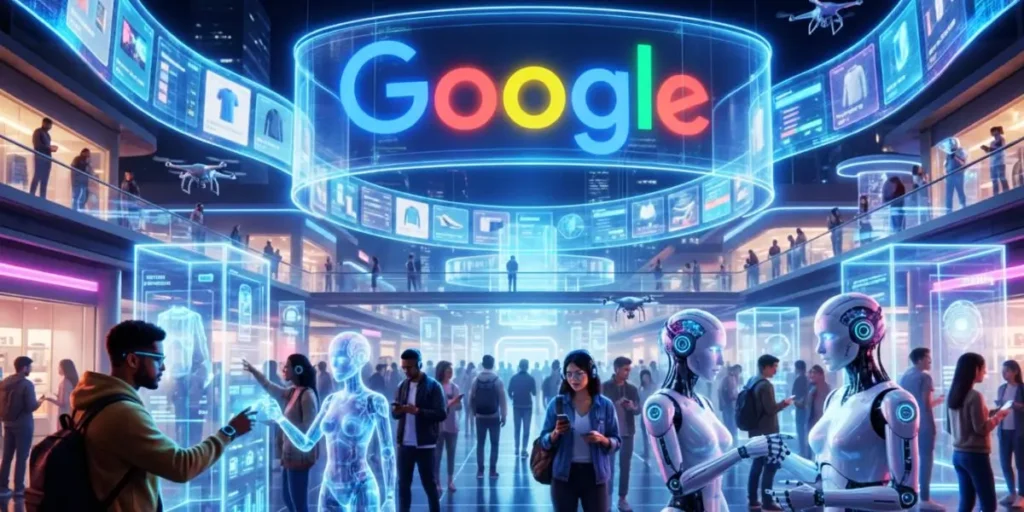

You type a query, get an answer, and buy a product—all without clicking a single link or opening a website. This isn’t science fiction; it’s the reality of Agentic Commerce, and it’s changing everything we know about online retail. Agentic Commerce represents the most profound shift in eCommerce since the birth of the internet, moving from passive browsing to AI-driven automated shopping where artificial intelligence doesn’t just suggest products—it finds, compares, and buys them for you. For business owners and marketers, the landscape is being rewritten. Your website traffic could drop, while a new, AI-first customer journey begins to dominate. In this new world, you’re no longer just competing for clicks; you’re competing to be the most logical, data-rich, and trustworthy option for an AI agent making decisions on your customer’s behalf. This guide will break down Google’s AI transformation of the entire shopping ecosystem and provide the actionable roadmap you need to adapt, survive, and thrive
Imagine a world where your online store doesn’t just wait for customers to click and search. Instead, it proactively guides them, anticipates their unspoken needs, negotiates deals in real-time, and closes sales with the finesse of your best human salesperson. This isn’t a distant sci-fi fantasy. It’s the imminent future of online retail, powered by a seismic shift called Agentic Commerce.
For eCommerce leaders, the pain is real. Sky-high customer acquisition costs, plummeting attention spans, and the relentless pressure to personalize every single interaction are squeezing margins thin. You’ve optimized your funnel, A/B tested your checkout, and boosted your engagement, but what’s the next frontier for ROI?
The answer lies in moving from reactive websites to proactive, intelligent commerce agents. This is the core of Google agentic commerce. Google isn’t just building another algorithm update; it’s architecting a new foundational layer for how buying and selling happens on the internet. In this deep dive, we’ll demystify what is agentic commerce, explore groundbreaking agentic commerce examples, and give you a actionable roadmap to ensure your business isn’t left behind. Ready to see the future of your conversion rate?
What is Agentic Commerce? Beyond Transactions to AI-Driven Relationships
Let’s cut through the jargon. At its simplest, agentic commerce refers to eCommerce ecosystems where autonomous AI software agents act on behalf of buyers and sellers to facilitate, negotiate, and optimize transactions.
Think of it this way: Traditional eCommerce is like a digital catalog. A customer (the principal) must do all the work: search, compare, decide, and checkout. In Agentic Commerce, the customer delegates authority to an AI agent. This agent, armed with the customer’s goals, preferences, and constraints, goes out into the digital marketplace to accomplish the task.
-
For the Buyer: Your agent knows you want “a comfortable running shoe for long distances under $120, available in my size, with a warranty.” It can scour the web, compare prices across retailers (even those using Adyen agentic commerce payment rails), check inventory, read reviews for “comfort,” and negotiate a bundle deal—all without you lifting a finger.
-
For the Seller: Your store is powered by an AI agent that doesn’t just display products. It can dynamically bundle items, offer personalized discounts to high-LTV customers, manage complex post-purchase support, and even collaborate with buyer agents to seal the deal.
This is the fundamental shift: commerce becomes a conversation between intelligent agents, with the human setting the high-level goal.
Agentic Commerce is a new paradigm where an AI agent acts as a proactive, autonomous shopping assistant for the user. It’s far more advanced than a chatbot that simply answers questions. An AI agent is a system that can understand context, reason through complex goals, and execute multi-step actions—like completing a purchase—with minimal human intervention.
Think of it this way: you can tell your agent, “Book me a direct flight to London next week for under $600, no red-eyes.” The agent will then search airlines, check your loyalty memberships, compare prices, and book the ticket, only coming back to you for final approval. In retail, this means an agent could be tasked with finding “a durable laptop for video editing under $1,500 that can be delivered by Friday,” and it will handle the entire research and checkout process.
This shifts the user’s role from researcher and clicker to supervisor and approver. The fundamental question for your business changes from “How do I get a user to click my link?” to “How do I become the undeniable best choice for an AI agent working on my customer’s behalf?”
Google’s 2026 Blueprint: The Five Pillars of Agentic Commerce
In January 2026, Google made a series of interconnected announcements that provide the clearest roadmap yet for how AI-driven automated shopping will become mainstream. These initiatives are designed to work together, creating a seamless, conversational, and agent-friendly shopping ecosystem.
1. Universal Commerce Protocol (UCP): A Common Language for AI
The cornerstone of Google’s vision is the Universal Commerce Protocol (UCP). UCP is an open standard designed to solve a critical bottleneck: if every AI agent needs a unique integration with every retailer, the system can’t scale. UCP creates a “common language” that allows agents, retailers, payment systems, and logistics providers to interoperate seamlessly.
Think of it as a universal plug for commerce. Instead of building a custom outlet for every new device, everyone agrees on a single standard. This protocol covers the entire journey—from product discovery and checkout to post-purchase support—making it far easier for AI agents to access real-time inventory, pricing, and fulfillment data directly from retailers.
2. Native Checkout in AI Mode & Gemini
Google is integrating a direct, frictionless checkout flow within its AI-powered search experiences (AI Mode) and the Gemini app. This means users can complete a purchase without ever leaving the conversational interface.
For retailers, this doesn’t mean the death of their website. It means the website is no longer the only place where conversion happens. For low-friction, routine, or clearly defined purchases, the entire journey—from question to confirmation—can happen in an AI conversation. This dramatically shortens the path to purchase and increases pressure on retailers to have impeccable, machine-readable data to win in these instant, agent-mediated transactions.
3. Business Agent: Your Brand’s AI Sales Rep in Search
The Business Agent is a revolutionary tool that allows buyers to chat directly with a brand’s AI representative within Google Search. It functions like a virtual sales associate, answering detailed product questions, providing recommendations, and guiding users toward a purchase, all in the brand’s unique voice and style.
This transforms product search from a list of blue links into an interactive dialogue that happens on Google’s platform. Retailers will be able to train and customize their Business Agent through the Merchant Center, turning it into a powerful channel for building consideration and trust at the very moment of intent.
4. A “Conversational” Merchant Center: Optimizing for Questions, Not Just Keywords
To fuel the Business Agent and AI shopping experiences, Google is expanding the Merchant Center with dozens of new data attributes. The shift is profound: moving beyond traditional keywords (like “wireless headphones”) to structured data that answers conversational questions.
Retailers will need to provide:
-
FAQs: Answer common customer questions about products.
-
Compatibility Data: “Which accessories work with this device?”
-
Alternative or Substitute Products: “What’s a similar dress under $100?”
-
Detailed Attribute Clarification: “Is this shirt true to size?”
This makes your product feed and catalog the core competitive advantage. A complete, richly structured catalog is what allows the AI to confidently recommend your product over a competitor’s.
5. Direct Offers Pilot: Injecting Value into the AI Conversation
Direct Offers is a new Google Ads pilot that lets advertisers present exclusive offers (discounts, bundles, free shipping) directly within AI Mode when the system detects a user has high purchase intent.
This isn’t just another ad format. It’s a mechanism to integrate promotional value directly into the AI’s decision-making flow. When an agent is comparing three similar products, a compelling Direct Offer can be the deciding factor that tips the scale in your favor. It moves competition from visibility to value proposition at the precise moment of decision.
The Engine Room: Google’s Vision and the Universal Commerce Protocol (UCP)
So, who is building the infrastructure for this agent-to-agent world? Google agentic commerce initiatives are leading the charge. Their vision is to create a seamless, trustworthy, and scalable platform where AI agents can operate.
The cornerstone of this vision is the Universal Commerce Protocol (UCP). You can think of the Agentic commerce UCP as the “HTML for transactions.” Just as HTML gives websites a common language to display content, the UCP aims to give AI agents a standardized language to discover products, inquire about specs, check inventory, negotiate terms, and execute payments.
Why is the UCP a game-changer?
Without a standard protocol, every AI agent would need a custom integration for every single online store—an impossible task. The Google agentic commerce Protocol seeks to solve this. If widely adopted, a buyer’s agent could seamlessly interact with a small boutique’s AI or Amazon’s AI, using the same “grammar” of commerce.
This is where partnerships like Adyen agentic commerce become critical. Adyen, a global payment powerhouse, is integrating its systems to enable these AI-driven, protocol-based transactions, ensuring secure, instant settlement across this new digital bazaar.
Key Players and Powerful Examples: Who’s Making This Real?
This isn’t just theoretical. Major players are already building and deploying agentic commerce examples. Let’s look at a few.
1. Google Gemini Agentic Commerce
Google Gemini, their most advanced AI model, is being fine-tuned to power commerce agents. Imagine integrating a Google Gemini agentic commerce assistant directly into your product pages. Instead of a static FAQ, this AI can answer complex, contextual questions in real-time, guide users through configuration options for a custom PC, and even handle returns by understanding the reason for the return and offering the best resolution instantly.
2. Google Agentic Checkout
Abandoned carts are a trillion-dollar problem. Google agentic checkout envisions an AI that intervenes. If a user leaves a cart full of camping gear, the store’s agent might proactively send a message via their preferred channel: “I notice you’re planning a trip. I can reserve these items for 24 hours. Also, would you like me to check if a lighter sleeping bag from our new line, which ships free, fits your needs?” This hyper-personalized, proactive service is the antithesis of today’s generic “forget something?” email.
3. The OpenAI Factor
While Google builds the protocol, Agentic Commerce OpenAI integrations showcase the model agility. Developers are using OpenAI’s APIs to create specialized buyer agents. For instance, a fashion-styling agent trained on a user’s style, budget, and calendar could attend digital “showrooms” (speaking UCP) to put together a complete wardrobe for an upcoming season.
4. Strategic Insights: McKinsey’s Take
When Agentic commerce McKinsey appears in reports, the world pays attention. McKinsey & Company highlights agentic commerce as a primary vector for the next wave of digital growth. They project that AI-driven commerce agents could influence trillions of dollars in consumer spending by enabling more efficient discovery, personalized pricing, and frictionless fulfillment. Their analysis urges CEOs to view this not as an IT project, but as a fundamental strategic realignment.
The Strategic Impact: Why Agentic Commerce Changes Everything
The shift to Agentic Commerce is not a channel update; it’s a fundamental restructuring of retail economics, marketing, and operations. Its impact can be summarized in four seismic shifts.
1. The Funnel is Reordered: From “Click” to “Decision”
The traditional marketing funnel (search → click → browse website → convert) is collapsing. In an agentic model, the AI handles the “browse and compare” stage internally. The brand’s goal is no longer to generate a click, but to win the algorithmic decision the agent makes before presenting options to the user. This makes structured data, trust signals, and clear value more important than ever.
2. Your Catalog is Now Your Core Competitive Moat
Your product catalog transforms from a back-office operational tool into your primary marketing and sales engine. In a world parsed by AI agents, an incomplete, inconsistent, or poorly structured catalog means you are literally invisible. Catalog governance—normalization, enrichment, and real-time accuracy—becomes a top strategic priority, not an IT task.
3. A New High-Value “Inventory”: The Recommendation + The Offer
The most valuable real estate in AI-driven automated shopping is the AI’s final recommendation. This spot is earned through a combination of product relevance (from your catalog data) and compelling value (from tools like Direct Offers). Winning requires synchronizing merchandising, pricing, promotions, and inventory data to present an unbeatable package to the AI.
4. Measurement & Attribution: The Pressure on First-Party Data
When purchases occur in AI conversations without clicks, last-click attribution models break down. Brands will face increased pressure to rely on first-party data and more sophisticated measurement techniques like marketing mix modeling (MMM) and incrementality testing to understand what’s truly driving demand and sales in this new, fragmented journey.
Implementing Agentic Commerce: A Practical Roadmap for 2026
Adapting to this new reality requires a phased, strategic approach. Here is your actionable roadmap.
Phase 1: Audit & Foundation (Next 90 Days)
-
Catalog Diagnostic: Audit your product feeds for completeness, accuracy, and richness. Do you have data for new Merchant Center attributes?
-
Data Structure Check: Ensure your product information is available in structured, machine-readable formats via APIs.
-
Trust Signal Inventory: Audit your reviews, ratings, return policies, and guarantees. Are they clear, prominent, and positive?
Phase 2: Pilot & Optimize (Next 6 Months)
-
Enrich Your Catalog: Implement systems to add FAQs, compatibility info, and alternative product data to your feeds.
-
Experiment with AI Interfaces: Explore tools like Google’s Business Agent (when available) and ensure your brand is represented.
-
Run an Incrementality Test: Design a test to measure the true business impact of your structured data efforts.
Phase 3: Scale & Integrate (Next 12-18 Months)
-
Integrate with Agentic Platforms: Explore connections with platforms like Stripe for agent-initiated payments or others building in the UCP ecosystem.
-
Build an AI-Aware Content Strategy: Shift content creation to directly answer user intent and provide decision-critical information.
-
Reorganize Teams: Break down silos between SEO, product data, merchandising, and paid media teams to create a unified “agent readiness” strategy.google
The Future Forecast: How Big is the Agentic Commerce Market?
While precise figures are evolving, analysts agree the agentic commerce market is poised for explosive growth. We’re moving from a market measured in millions of dollars in R&D to one that will encompass a significant percentage of all global eCommerce—a multi-trillion dollar sector. Early agentic commerce examples are the proof of concept. As the Google agentic commerce Protocol and similar standards mature, adoption will accelerate across verticals, from retail and travel to B2B procurement.
What’s the forecast for agentic commerce? Mass adoption within 3-5 years, becoming a dominant transactional paradigm by the end of the decade. Businesses that adapt early will build immense competitive moats.
Conclusion: Don’t Build a Storefront, Empower an Agent
The shift to Agentic Commerce is as fundamental as the move from brick-and-mortar to the web. It redefines the very nature of the customer relationship from transactional to relational, mediated by intelligent, persistent AI.
Google, through its Gemini AI and the proposed Universal Commerce Protocol, is laying the tracks. Partners like Adyen are building the payment railcars. Your job is to ensure your business is a compelling destination on this new high-speed network.
Start today. Structure your data, build your authority, and embrace a conversational mindset. The future of eCommerce won’t be won by the biggest website, but by the most helpful, trustworthy, and agentic store.
Ready to future-proof your revenue? Share this article with your team and start a conversation about your first agentic commerce pilot project. Have questions? Drop them in the comments below!
Frequently Asked Questions (FAQs)
What is an example of agentic commerce?
A practical example of agentic commerce is a user telling their AI agent, “Plan and book a weekend camping trip for two within a 200-mile radius, budget $500.” The agent would then autonomously research campsites (checking availability via a UCP), find and reserve rental gear, purchase appropriate food supplies, and book the itinerary—all by negotiating with various retailers’ and services’ AI agents, without further human input.
What is metaverse commerce?
Metaverse commerce involves buying, selling, and advertising goods and services within immersive, persistent virtual worlds (the metaverse). This can include digital assets like avatar clothing or virtual real estate, as well as real-world goods advertised or purchased in a virtual setting. While both are futuristic, agentic commerce focuses on the AI-driven process of commerce, which can operate within the metaverse, on traditional websites, or across both.
What is the forecast for agentic commerce?
The forecast for agentic commerce is exceptionally bullish. Industry analysts from firms like McKinsey predict it will move from niche to mainstream within 3-5 years, influencing a majority of digital transactions by 2030. Growth will be driven by advances in AI, standardization of protocols like UCP, and consumer demand for hyper-personalized, frictionless shopping.
How big is the agentic commerce market?
Pinpointing the exact size of the nascent agentic commerce market is difficult, but its potential is vast. It is projected to grow to encompass a significant portion of the global eCommerce market, which itself is measured in trillions of dollars. As the underlying technology stabilizes and sees widespread adoption, the market value for platforms, tools, and services enabling agentic commerce is expected to be in the hundreds of billions.
What’s the difference between an AI Agent and a chatbot?
A chatbot is a reactive tool that answers questions within a predefined script. An AI Agent is proactive, autonomous, and goal-oriented. It can understand complex requests, reason through steps, and take actions (like making a purchase) on your behalf.
Is Agentic Commerce safe? How do returns work?
Security and trust are paramount. Protocols like UCP are built with established security frameworks. For returns, clear policies are essential. Platforms are emerging that allow AI agents to manage return workflows. The key for retailers is to have extremely clear, machine-readable return and refund policies that an agent can understand and execute.
Will this make my website irrelevant?
No, but its role will change. Your website will remain crucial for brand building, deep exploration, and complex purchases. However, for a growing segment of routine, replenishment, or specification-driven purchases, the conversational AI interface may become the primary conversion point. Your website must be supported by a robust, API-driven backend that feeds data to these AI experiences.
Which retail sectors will be impacted first?
Categories with routine purchases, clear specifications, or high comparison activity will lead the adoption: Grocery and consumables, electronics, beauty and personal care, apparel (especially replenishment), and travel.
How do I measure success in an agentic world?
Shift focus from click-based metrics to business outcome metrics: Gross Merchandise Value (GMV), conversion rate within AI interfaces, share of AI-driven recommendations, and cost-per-acquisition. Invest in first-party data analytics and multi-touch attribution models.
Disclaimer: This article is for informational and educational purposes only. It contains forward-looking statements about emerging technology trends, including AI and commerce protocols. The strategies mentioned are suggestions, not financial or legal advice. The implementation of any AI or commerce technology should be undertaken after thorough due diligence and, where appropriate, consultation with legal and technical professionals. Company and product names (Google, Adyen, OpenAI, McKinsey) are trademarks of their respective owners. The author and publisher have no affiliation with these entities unless explicitly stated. All investment and business decisions carry risk.