
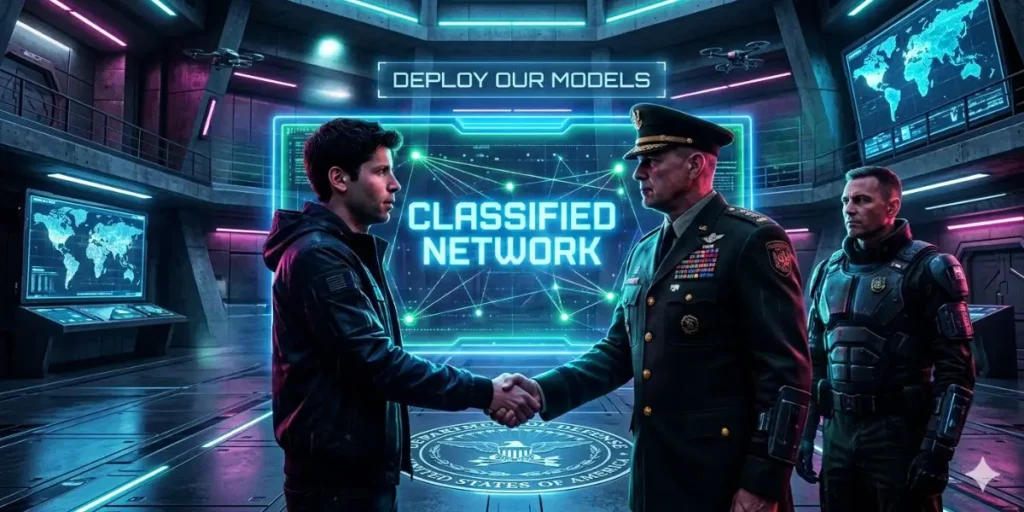

In a move that has sent shockwaves through the tech world and redefined the relationship between Silicon Valley and the military-industrial complex, OpenAI has officially inked a deal with the Pentagon to deploy its advanced artificial intelligence models on classified networks. This announcement, made by CEO Sam Altman late on a Friday, comes just hours after the Trump administration took the unprecedented step of blacklisting rival AI firm Anthropic, labeling it a “supply chain risk.”
The timing is explosive. For years, the concept of major AI labs working directly with the Department of Defense on classified infrastructure was considered a taboo line few were willing to cross. Yet, here we are. This isn’t just a contract; it’s a paradigm shift. It raises immediate, urgent questions about the ethics of autonomous weapons, the potential for mass domestic surveillance, and the very soul of generative AI.
But before we dive into the dystopian possibilities, let’s look at the facts. Why did Anthropic refuse to bend the knee? How did OpenAI negotiate a deal that supposedly keeps its “red lines” intact? And most importantly, what does this mean for you, your data, and the future of warfare?
Whether you’re a tech enthusiast, a concerned citizen, or a professional navigating the digital marketing implications of AI’s rapid evolution, understanding this deal is crucial. The convergence of national security and artificial intelligence is no longer a sci-fi trope; it is today’s headline. Let’s cut through the noise and analyze the fine print.
The Fallout: From Anthropic Blacklist to OpenAI Integration
To understand the seismic nature of this event, we have to look at the 24 hours that shook the AI world. The story begins not with OpenAI, but with its competitor, Anthropic.
Why the Pentagon Turned Away from Anthropic
Anthropic, known for its “Constitutional AI” approach with its Claude model, had been a previous partner for the Pentagon. However, negotiations soured over red lines. Anthropic reportedly insisted on strict guardrails to prevent its technology from being used for autonomous weapons or mass surveillance of U.S. citizens .
The response from the Pentagon, under the newly renamed Department of War, was swift and brutal. Defense Secretary Pete Hegseth designated Anthropic a supply chain risk, immediately barring U.S. military contractors and partners from engaging with the firm . This designation is usually reserved for entities linked to foreign adversaries, making it a stark warning to any tech company that seeks to limit how the military uses their tools.
The Terms of the OpenAI Agreement
In the wake of the blacklist, OpenAI strikes Pentagon deal seemingly by stepping into the breach. But according to statements from Altman and subsequent clarifications from the company, they didn’t just accept the deal Anthropic refused; they negotiated a distinct middle ground.
OpenAI confirmed that their contract with the Pentagon includes specific, layered protections. “Two of our most important safety principles are prohibitions on domestic mass surveillance and human responsibility for the use of force, including for autonomous weapon systems,” Altman stated . Crucially, he noted that the Department of War “agrees with these principles, reflects them in law and policy, and we put them into our agreement.”
This suggests that while Anthropic walked away from the table over these terms, OpenAI managed to secure a deal that contractually enforces three key “red lines”:
-
No Domestic Mass Surveillance: The AI cannot be used to spy on American citizens at scale.
-
Human Responsibility for Lethal Force: Autonomous weapons systems cannot be directed solely by the AI; a human must remain in the loop for decisions involving force.
-
Technical Safeguards: OpenAI is embedding engineers within the Pentagon to build a “safety stack” to ensure the models behave as intended .
This creates a fascinating paradox. Is OpenAI securing the future by embedding ethics into the contract, or are they paving the road to hell with good intentions by finally putting the technology on classified networks? The answer likely lies in how we handle the inevitable byproduct of this AI age: the deepfake.
The Backstory: Why Anthropic Got Blacklisted
To understand the significance of the OpenAI deal, we have to look at the train wreck that happened just 24 hours prior involving Anthropic. This isn’t just a business rivalry; it’s a clash of ideologies regarding AI safety.
The Pentagon, now rebranded by the administration as the “Department of War” (DoW), approached Anthropic with a demand: grant the government unfettered access to its Claude AI models for military applications. Anthropic, which has built its brand on a strict ethical framework, pushed back hard. They insisted on guardrails that would prevent their technology from being used for mass domestic surveillance or controlling autonomous weapons without human oversight.
The administration’s response was swift and brutal. President Trump directed federal agencies to cease using Anthropic’s tech, and Defense Secretary Pete Hegseth designated the company a “supply chain risk”—a label usually reserved for foreign adversaries.
Quick Takeaway: Anthropic took a stand for ethics and lost billions in potential valuation overnight. It was a stark warning to the entire industry: cooperate, or be cut out of the $200 million contracts.
The OpenAI Deal: “Three Red Lines” vs. Reality
Enter OpenAI. In a dramatic pivot, Sam Altman took to X (formerly Twitter) to announce they had reached an agreement with the DoW. But the key question burning in everyone’s mind is: Did OpenAI just sell out the principles that Anthropic went to war for?
According to the official statement released by OpenAI, they didn’t just accept the Pentagon’s terms—they claim to have improved them. The agreement is built around what they call the “three red lines” designed to govern the use of AI in classified environments.
The Three Red Lines Governing AI in Classified Networks
OpenAI published a detailed FAQ to calm the nerves of its user base and the wider tech community. They insist that their deployment model is safer than anything previously offered. Here is how they are structuring the collaboration with the Department of Defense:
1. Prohibition on Mass Domestic Surveillance
The first red line is a big one. The agreement explicitly states that OpenAI’s models cannot be used for mass domestic surveillance of American citizens. They cite strict adherence to the Fourth Amendment and the Posse Comitatus Act.
However, critics are already pointing to the phrase “all lawful purposes” in the contract. What happens if the laws change? OpenAI asserts that even if laws are modified, the contract binds the DoW to the current ethical standards, not future ones. They argue this multi-layered approach—combining technical safeguards with contractual law—creates a stronger cage for the artificial intelligence beast than a simple usage policy.
2. No Autonomous Weapons Systems
Perhaps the most visceral fear surrounding deepfakes and AI is their use in killing machines. OpenAI has drawn a hard line in the sand here: the models will not be used to direct autonomous weapons.
They achieved this through a clever technical restriction: “cloud-only deployment.” By refusing to deploy models on “edge devices” (like drones or smart missiles), OpenAI ensures that there is always a human in the loop. If a weapon loses connection to the cloud, it loses the “brains” of the AI. This forces the military to keep a human finger on the trigger rather than a fully automated algorithm.
3. Preventing High-Stakes Automated Decisions
This third red line is the most complex. It targets the bureaucratic nightmares of the future—things like automated social credit scores or AI judges. The contract aims to prevent the Pentagon from using the model for what they call “high-stakes automated decisions.”
To enforce this, OpenAI is not just handing over the code and walking away. They are embedding “cleared OpenAI personnel” directly into the Pentagon’s workflow. These experts will monitor how the models are being used, ensuring they aren’t repurposed for malicious intent.
Technical Safeguards and Deployment Strategy
How do you actually put a tool as powerful as GPT on a network that holds the nation’s secrets? You don’t just plug it in via Wi-Fi. OpenAI has outlined a specific architecture to maintain control.
-
Cloud-Native Infrastructure: The models live in the cloud, not on local hard drives. This allows OpenAI to maintain the “safety stack” remotely.
-
The Anthropic Factor: OpenAI claims their deal is superior to the one Anthropic rejected because they refused to compromise on the “stack.” They retain the right to update and patch the safety features in real-time.
-
Human Verification: The loop always includes a human. This is critical for maintaining trust and ensuring that generative AI outputs are vetted before any kinetic action is taken.
Pro Tip: For businesses watching this space, the “human in the loop” concept is vital. Whether you’re using AI for content creation or data analysis, never fully take the human out of the approval process. It’s your best defense against reputational damage.
The Industry Reaction: Solidarity, Suspicion, and Cynicism
The tech community is deeply divided. On one hand, you had hundreds of employees from Google DeepMind and OpenAI signing an open letter titled “We Will Not Be Divided,” urging solidarity with Anthropic just days before the OpenAI deal was announced. That letter warned against the DoW’s attempts to pit companies against each other.
On the other hand, market realities are harsh. The Pentagon has budgets that can reach $200 million per contract. For a company burning cash to train massive models, turning down that kind of revenue is tough.
Critics online have been quick to dissect OpenAI’s “three red lines.” Some analysts ran the contract language through other AI models, flagging phrases like “all lawful purposes” as potential loopholes that could be “easily broken.” The cynicism is palpable. Can we really trust a corporation to police the Pentagon? Or will the allure of deeper integration and bigger budgets eventually erode those red lines?
What This Means for the Future of Digital Security
This deal opens a Pandora’s box regarding information security and cyber warfare. If OpenAI is helping the Pentagon, it is inevitable that adversaries will accelerate their own programs. We are entering an AI arms race.
The Threat of Deepfakes in Geopolitical Conflict
While OpenAI is working on defense, the offensive capabilities of AI are terrifying. The original concern in the prompt—deepfakes—remains a critical vulnerability. Nation-states can now generate synthetic media that is indistinguishable from reality.
Consider this scenario: A video surfaces online appearing to show a U.S. general giving orders to withdraw troops. It’s fake, generated by an adversary using generative AI. By the time it’s debunked, the damage to morale and international alliances is done. This deal is, in part, a recognition that the U.S. needs to build walls around its data to prevent its own models from being used to create disinformation against it.
Practical Implications for Businesses and Marketers
You might be thinking, “I run a small business. Why should I care about a Pentagon deal?” Because the technology that filters down from these contracts always hits the commercial sector.
-
Data Sovereignty: If the government is demanding classified networks, expect consumer demands for privacy to increase. Be transparent about where user data goes when you use AI tools.
-
Content Authenticity: As deepfakes become more common, trust becomes the ultimate currency. Brands that can prove their content is human-made or verifiably authentic will win.
-
Navigating the Funnel: At the top of the funnel, you need to grab attention. The OpenAI/Pentagon story is attention-grabbing. Use current events to show your audience that you understand the macro environment affecting their security and privacy.
The Deepfake Dilemma: Why This Deal Is a Double-Edged Sword
When we talk about AI in classified networks, we aren’t just talking about algorithms that process spreadsheets. We are talking about models that can generate synthetic media—deepfakes—at machine speed. The same technology that can help the Pentagon identify threats can also be used to confuse adversaries.
However, the greatest threat to the Pentagon might not be a foreign missile, but a hyper-realistic video of a general surrendering, circulated on social media to demoralize troops. This is the reality of modern information warfare.
The Rise of Audio Deepfakes
While visual deepfakes often get the headlines, the audio component is arguably more dangerous and harder to detect. Recent academic research highlights just how sophisticated the countermeasures need to be. A 2026 study published on arXiv introduced “BreathNet,” a novel detection framework that focuses on the one thing current generators struggle to replicate: human breath .
The research posits that existing detection methods fail to pay attention to “fine-grained information, such as physiological cues.” BreathNet uses a modulation mechanism to amplify temporal representations based on breathing sounds. If an AI-generated voice doesn’t breathe like a human, BreathNet catches it . This is the level of sophistication the Pentagon now has access to through its OpenAI agreement.
Spatiotemporal Detection: Watching the Unseen
Video deepfakes are getting better, but they still leave traces. A comprehensive study published in Discover Applied Sciences (2026) confirms that the most effective way to catch a fake is to combine spatial and temporal analysis .
Think of it this way:
-
Spatial Analysis: Looks at a single frame. Are the eyes reflecting light correctly? Is the skin texture consistent?
-
Temporal Analysis: Looks at the sequence. Does the person blink naturally? Do their micro-expressions match the flow of conversation?
By leveraging pre-trained networks like ResNeXt50 combined with Long Short-Term Memory (LSTM) networks, modern detection tools can spot inconsistencies that the human eye simply misses . The OpenAI Pentagon collaboration likely involves deploying models with this level of scrutiny to protect against “video weaponization.”
The Multimodal Frontier
The gold standard for detection, however, lies in multimodality. A 2025 study published by the NIH (National Institutes of Health) outlines a framework that achieves up to 98.76% accuracy by checking audio-visual synchronization . This framework, using Cross-Modal Graph Attention Networks, looks for subtle mismatches—like the movement of a jaw not perfectly syncing with a phonetic sound.
If an adversary creates a deepfake of a commander giving orders, a multimodal AI can analyze the video and audio streams simultaneously to see if they “agree” with each other. If they don’t, the content is flagged as a threat. This is the front line of defense against deepfakes.
Technical Safeguards: How OpenAI Protects Its Red Lines
Given the nature of classified AI projects, the public is naturally skeptical about those “red lines.” How can we be sure that a model deployed on a secret network isn’t being used to profile citizens or develop autonomous drones?
OpenAI has detailed a “multi-layered approach” to enforce these restrictions .
-
Cloud Deployment: The models are deployed via secure cloud infrastructure that allows for oversight.
-
Human-in-the-Loop: “Cleared OpenAI personnel” are reportedly embedded within the operational loop. This means that before the AI executes a high-stakes action, a human (either from OpenAI or the DoW) must sign off . This directly addresses the fear of “autonomous weapons.”
-
Contractual Termination Clause: In a rare move of transparency, OpenAI stated that any breach of the contract’s ethical terms by the U.S. government could trigger a termination of the agreement . This gives the company a theoretical kill switch if the technology is misused.
This is a massive shift from the “move fast and break things” era of Silicon Valley. Here, the motto is “deploy fast, but build the cage first.”
The Future of Information Warfare: A Forecast
With the OpenAI Pentagon deal signed, we are likely to see a rapid acceleration in specific areas of defense technology. This isn’t just about defense; it’s about dominance.
AI vs. AI: The Automated Battlefield
We are moving toward a future where the primary defender against a deepfake is not a human fact-checker, but another AI. The Pentagon has already awarded contracts for “agentic AI” to identify vulnerabilities in weapons systems . Soon, we will see AI agents actively hunting for deepfake narratives across the global information space, identifying the source, and automatically flagging them for counter-intelligence units.
Have you considered how you would trust a video message from a family member in a war zone if you knew that AI could perfectly replicate their voice and face? This is the psychological reality the Pentagon is preparing for.
The Civilian Spillover
The technology developed to protect classified networks always trickles down. The audio deepfake detection methods being refined for the Pentagon (like BreathNet) will eventually find their way into your bank’s verification systems, your social media platforms, and your news feeds.
In the next 24 months, expect to see browser extensions or operating system-level features that automatically verify the authenticity of streaming media. If OpenAI strikes Pentagon deal to stop deepfakes at the source, the commercial sector will ultimately benefit from the byproduct: a verification layer for the internet.
Conclusion: A Dangerous Precedent or Necessary Evolution?
The OpenAI-Pentagon deal is a landmark moment. It marks the official marriage of Silicon Valley’s brightest minds with the military’s most powerful machines. OpenAI insists they have built a fortress of technical safeguards around their “three red lines.” They have deployed “cleared OpenAI personnel” to watch the watchers.
Yet, the ghost of Anthropic looms large. The message sent by blacklisting a company for standing on principle is clear: adapt or die. As we move forward, the vigilance of the public, the press, and the very engineers who built these models will be the only true guarantee that these red lines remain red.
We want to hear from you. Do you trust OpenAI to police the Pentagon’s use of AI? Or is this the first step toward a mass domestic surveillance state? Share your thoughts in the comments below. If you found this analysis helpful, subscribe to our newsletter for more deep dives into the intersection of technology and society.
Frequently Asked Questions (FAQ)
What is the main purpose of the OpenAI and Pentagon deal?
The primary purpose is to deploy advanced artificial intelligence models onto the Pentagon’s classified networks. This allows the Department of Defense to use AI for data analysis, logistics, and intelligence gathering while operating under specific safety protocols negotiated by OpenAI.
How is OpenAI preventing its AI from being used in autonomous weapons?
OpenAI has implemented a “cloud-only” deployment strategy. By refusing to allow the models to run on “edge devices” (like drones or missiles), they ensure that a human operator is always required to interpret the AI’s data and make the final decision to act, keeping a human in the loop regarding the use of force.
What happened to Anthropic in relation to this deal?
Anthropic refused to give the Pentagon unrestricted access to its models without guardrails against mass domestic surveillance and autonomous weapons. In response, the Trump administration designated Anthropic a “supply chain risk” and ordered federal agencies to stop using their technology, effectively blacklisting them.
What are “deepfakes” and why are they a national security concern?
Deepfakes are hyper-realistic but fake videos, images, or audio generated by AI. They are a national security concern because adversaries can use them to create disinformation, impersonate leaders, incite violence, or manipulate stock markets, eroding public trust in media and government institutions.
Will this agreement lead to mass surveillance of U.S. citizens?
OpenAI claims the contract explicitly prohibits using its technology for mass domestic surveillance, citing laws like the Fourth Amendment. However, civil liberties groups worry that vague language like “all lawful purposes” could eventually allow scope creep, enabling the government to expand surveillance capabilities over time.
What does the OpenAI Pentagon deal actually involve?
The agreement allows for the deployment of OpenAI’s models—the same technology powering ChatGPT—onto the Pentagon’s classified networks. This will be used for national security purposes, including intelligence analysis, operational planning, and potentially cyber defense, all while adhering to agreed-upon safety principles regarding surveillance and autonomous weapons .
Why did the Pentagon ban Anthropic?
The Trump administration and the Department of War designated Anthropic a “supply chain risk” after negotiations stalled. The government reportedly wanted the AI for “all lawful purposes,” while Anthropic insisted on strict contractual guardrails to prevent its use in autonomous weapons and mass surveillance. The administration viewed this as the company dictating military policy .
Will OpenAI’s AI be used to create autonomous weapons?
According to the terms released by OpenAI, no. The contract explicitly prohibits the AI from directing autonomous weapon systems. It maintains the principle of “human responsibility for the use of force,” meaning a human must always make the final decision to deploy lethal force .
How does this relate to deepfakes?
The partnership is a double-edged sword in the fight against deepfakes. On one hand, the AI models can be used to generate synthetic content for training and simulations. On the other hand, the same models are being equipped with technical safeguards to detect deepfakes created by adversaries, protecting the U.S. from information warfare tactics that use fake audio or video .
What happens if the Pentagon violates the agreement?
OpenAI has stated that the contract includes a termination clause. If the U.S. government breaches the terms—for example, by using the AI for unauthorized mass surveillance—OpenAI retains the right to terminate the agreement .
Who is Emil Michael?
Emil Michael is a senior Pentagon official (Under Secretary for Technology) who reposted Sam Altman’s announcement. His involvement signals the high-level importance of this tech integration, as he is in charge of steering technology policy for the Department of War .