
















At 2:14 a.m., an AI coding agent decides that a dependency update is “safe” and pushes it to production. Three hours later, an AI treasury agent misreads a payment instruction and sends funds to the wrong wallet address. No malicious hacker was involved. No employee clicked a suspicious link. The systems simply acted faster than the humans could supervise them.
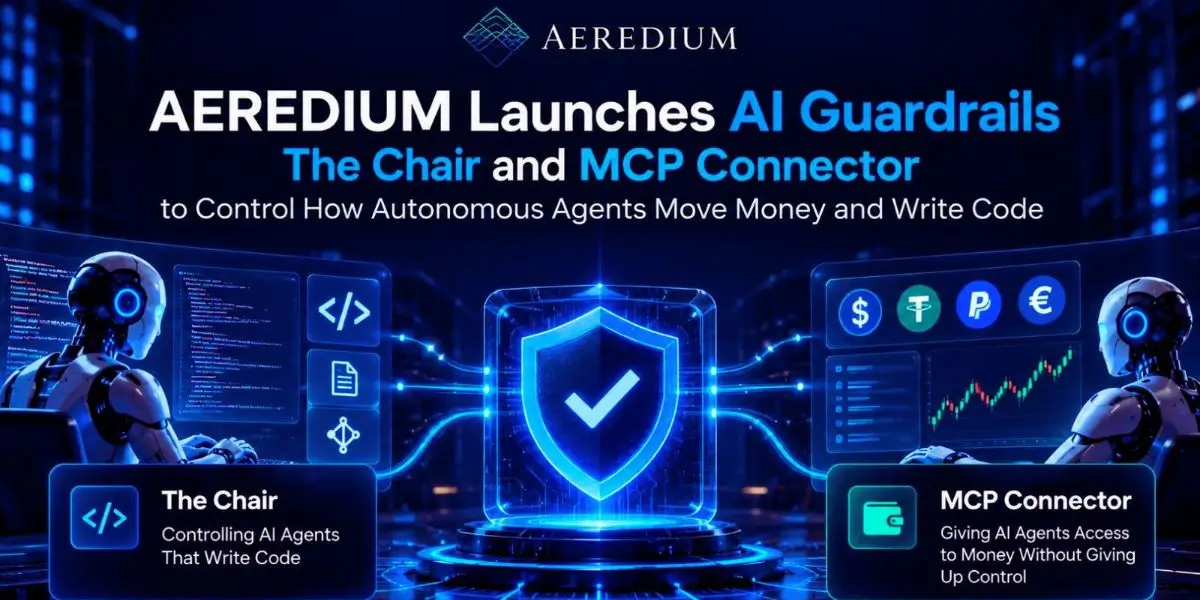
That is the uncomfortable reality of autonomous AI: capability has outrun control. AEREDIUM, a digital asset infrastructure company, has launched two products—The Chair and MCP Connector—designed to put enforceable guardrails between AI agents and the code repositories, payment rails, and trading systems they touch.
This article explains what AEREDIUM’s AI guardrails do, how the policy engine works, who should use each product, and how organizations can adopt agent controls without slowing innovation to a crawl.
What Are AEREDIUM’s AI Guardrails?
AEREDIUM’s AI guardrails are policy-based controls that evaluate an AI agent’s proposed action before it executes. Instead of trusting an agent to “behave,” an organization defines what the agent may do, what it may never do, and which actions require a person’s approval.
The company launched The Chair and MCP Connector through its new aeredium.ai platform on October 13, 2026, with public announcement coverage on October 22, 2026.
Both products use the same core model:
An AI agent proposes an action.
A policy engine checks that action against owner-defined rules.
The system returns one of three outcomes: approved, denied, or held for human review.
Every decision is signed and recorded, creating a verifiable audit trail.
That last point matters. Traditional security logs often show that something happened. A signed decision receipt can show what the agent attempted, which policy applied, and who authorized the action—a more useful record for audits, incident response, and internal accountability.
Expert insight: The biggest governance mistake companies make is giving an agent broad API keys and hoping prompts will keep it in line. Prompts are guidance; policies are enforcement. A guardrail must sit in the execution path, not merely in the system prompt.
Why Autonomous Agents Need Guardrails
AI agents need guardrails because they increasingly perform irreversible actions with real financial, legal, and operational consequences. A chatbot that gives a bad answer is frustrating. An agent that merges broken code, transfers funds, or executes an unauthorized trade creates business risk.
“AI agents are no longer just answering questions. They’re writing code, moving money and making decisions that have real consequences,” said Albert Dadon, CEO and Founder of AEREDIUM. “The challenge isn’t just making these agents more capable, but making sure they operate within the rules we set. With The Chair and MCP Connector, we’re giving organizations a way to put AI to work without giving up control over what it can do.”
The risk surface expands when agents can:
Execute shell commands.
Modify source files.
Merge code or push changes.
Send stablecoins or other digital assets.
Trade on exchanges.
Interact with external APIs and financial counterparties.
AEREDIUM’s approach does not try to make agents less capable. It tries to make their permissions scope-bound, policy-bound, and observable.markets.
The Chair: Guardrails for AI Coding Agents
The Chair is AEREDIUM’s control layer for AI coding agents working inside an organization’s development environment. It sits between the agent and the development system, inspecting each tool call before it runs.
The product evaluates actions such as:
Executing commands.
Modifying files.
Merging code.
Pushing changes.
If a proposed action matches an existing policy, The Chair can approve or deny it automatically. If the action falls outside policy, it is held in a control panel for an authorized human to approve or reject.
How The Chair Works in Practice
Imagine a development team allows an AI coding agent to:
Read repository files.
Create branches.
Run unit tests.
Open pull requests.
But the team does not allow the agent to:
Deploy directly to production.
Modify infrastructure-as-code files.
Push directly to the main branch.
Install unvetted third-party packages.
With The Chair, those rules become executable policy. The agent can complete routine work, but a request to alter production infrastructure is blocked or routed to a senior engineer.
| Agent Action | Policy Outcome | Business Benefit |
|---|---|---|
| Run automated tests | Approved automatically | Faster development cycles |
| Create a feature branch | Approved automatically | Standardized workflow |
| Modify a protected file | Held for review | Prevents accidental or unauthorized changes |
| Push to production | Denied or held | Reduces deployment risk |
| Merge code after review | Approved under policy | Maintains engineering controls |
The Chair supports Claude Code through a dedicated plugin and provides a governed shell for other coding agents, including those from OpenAI. Organizations can configure policies through a questionnaire rather than writing every rule directly in code.
The Chair is available with a 30-day free trial.
Pro tip: Start with “read-only plus test” permissions. Let the coding agent explore the repository and run tests, but require human approval for merges, deployments, dependency changes, and any action touching secrets or infrastructure.
MCP Connector: Guardrails for AI Agents Moving Money
MCP Connector applies AEREDIUM’s policy model to financial transactions, combining a policy engine with a digital asset wallet. It lets AI agents make approved payments or trades while keeping those actions inside limits set by the wallet owner.
Each agent receives its own:
Wallet.
Policy.
Designated owner.
The owner defines the agent’s role, approves its mandate with a passkey, and can halt or delete the agent at any time.
This separation is important. A payment agent does not need trading permissions. A trading agent does not need the ability to send funds to arbitrary external recipients. Splitting authority reduces the blast radius if an agent is compromised, misconfigured, or manipulated by a prompt-injection attack.
Supported Agent Roles
AEREDIUM currently offers two roles:
| Role | What the Agent Can Do | What the Agent Cannot Do |
|---|---|---|
| Payer | Send approved stablecoins—USDC, USDT, PYUSD, and EURC—to owner-approved addresses. | Trade assets or send funds outside approved recipients. |
| Trader | Trade on designated exchanges within its own wallet. | Send funds to external recipients. |
That role separation creates a simple but powerful control principle: an agent receives the narrowest permission needed for its job.
Wallet Security and Supported Chains
MCP Connector uses threshold signatures generated inside secure enclaves. According to AEREDIUM, no complete private key is created, and AEREDIUM does not hold a key to the owner’s funds.
The product currently supports:
Ethereum.
Arbitrum.
Base.
Transaction records are retained for seven years, which aligns the product with the long retention horizons often expected in regulated financial and institutional environments.
MCP Connector is designed for Claude and is open to OpenAI and other AI frameworks.
Expert insight: For financial agents, define controls in three dimensions: who can act, what asset and amount can move, and where funds may go. A policy that says “send up to $5,000 USDC per day to approved vendor wallets” is far safer than “manage treasury payments.”
How AEREDIUM’s Policy Engine Compares
AEREDIUM’s products are not another chatbot safety filter. They are execution-time controls designed for high-risk agent actions.
| Capability | The Chair | MCP Connector |
|---|---|---|
| Primary use case | AI coding agents | AI payment and trading agents |
| Control point | Development environment and tool calls | Digital asset wallet and transactions |
| Main risks addressed | Unauthorized code changes, unsafe commands, direct pushes | Unauthorized payments, excessive trading, fund loss |
| Human review | Control panel for out-of-policy actions | Owner approval, halt, or deletion of agent |
| Audit mechanism | Signed decision receipts | Signed and retained transaction records |
| Key security feature | Policy-governed shell and plugin support | Threshold signatures in secure enclaves |
| Availability | 30-day free trial | Available through AEREDIUM AI platform |
The shared architecture is the differentiator. AEREDIUM extends its existing institutional digital asset security stack—threshold signatures and policy enforcement—into AI-driven software and financial operations.
Why “Approve, Deny, or Hold” Matters
The approve-deny-hold model matters because it gives organizations a practical middle ground between full automation and manual work. Many agent actions are low risk and should proceed without friction. Others are dangerous enough to require a person.
A well-designed policy set might look like this:
Approve automatically: Read documentation, run tests, query public market data, generate draft code.
Hold for review: Merge to main, modify access controls, send more than a defined threshold, contact a new counterparty.
Deny outright: Access production secrets, deploy to production, transfer to unapproved wallets, exceed daily transaction limits.
This structure preserves speed where risk is low and inserts human judgment where mistakes are expensive.
It also creates an auditable decision trail. Every proposed action receives a signed receipt documenting the attempted action, applicable policy, and authorizing party
A 30-Day Implementation Plan
Organizations can adopt AI agent guardrails in 30 days by starting with one workflow, defining policies, piloting controls, and measuring exceptions. The goal is not to block every agent action; it is to make autonomy predictable.
Week 1: Inventory Agent Access
Map every AI agent currently in use or under evaluation.
For each agent, document:
What systems it can access.
What credentials or API keys it uses.
What actions it can perform.
Which actions are irreversible.
Who owns the workflow.
What happens if the agent makes a mistake.
Week 2: Define Policies
Separate permissions into three categories:
Safe by default: Read-only operations, test execution, research, and internal drafts.
Conditional: Merges, payments, external communications, and configuration changes.
Prohibited: Secret access, production deployment, transfers to unapproved recipients, and actions outside the agent’s mandate.
For financial agents, set explicit limits: approved wallets, approved exchanges, asset types, transaction ceilings, daily volume limits, and time-based restrictions.
Week 3: Pilot With Real Workloads
Deploy The Chair for one coding team and MCP Connector for one narrowly scoped payments or trading workflow.
A good first pilot might involve:
A coding agent that can create branches and run tests.
A payer agent that can send small USDC payments to three preapproved vendor wallets.
A trader agent restricted to one exchange and a low maximum position size.
Do not begin with production deployments, large transfers, or broad exchange access.
Week 4: Measure and Refine
Track:
Percentage of actions automatically approved.
Percentage held for human review.
False positives and false negatives.
Time spent reviewing exceptions.
Cost per completed task.
Number of policy violations prevented.
Audit completeness.
If nearly every action is held for review, the policies are too restrictive. If almost everything is auto-approved, the policies may be too permissive. The right balance depends on risk tolerance, regulatory exposure, and the value of speed.
Who Should Consider AEREDIUM?
AEREDIUM’s guardrails are most relevant to organizations deploying agents in software development, digital asset operations, treasury, trading, or payment workflows. The products are especially compelling where an agent’s mistake could cause financial loss, security exposure, or regulatory scrutiny.
Strong fit profiles include:
Software teams using Claude Code, OpenAI coding agents, or other autonomous development tools.
Crypto-native companies managing stablecoin payments.
Treasury and trading teams experimenting with AI-driven execution.
Fintechs and exchanges that need auditable controls.
Enterprises that must demonstrate governance over AI systems.
Security teams seeking to reduce credential abuse and prompt-injection risk.
It may be less necessary for low-risk internal assistants that only summarize documents or answer employee questions. But as those assistants gain access to calendars, email, databases, and payment tools, the same policy-first logic becomes relevant.
Limitations and Considerations
AEREDIUM’s guardrails reduce execution risk, but they do not eliminate the need for strong AI governance. A policy engine can stop an unauthorized transfer, but it cannot replace threat modeling, secure software development, employee training, or regulatory review.
Organizations should still evaluate:
Policy quality: Bad rules create false confidence.
Integration coverage: Unsupported systems may remain outside the control layer.
Key management: Threshold signatures reduce single-key risk but require careful operational design.
Vendor dependence: Teams should understand what happens if the platform is unavailable.
Regulatory fit: Seven-year transaction retention may help, but compliance obligations vary by jurisdiction and business model.
Agent evaluation: Guardrails should complement, not replace, testing for hallucination, prompt injection, and unsafe planning.
The strongest deployments treat AEREDIUM as one layer in a broader control system that includes identity management, least-privilege access, monitoring, incident response, and human accountability.
The Bigger Shift: From AI Access to AI Authority
The larger shift is from managing what AI can access to managing what AI is authorized to do. Access control asks whether a user or system can reach a resource. Authority control asks whether a specific proposed action is permitted under a specific policy at a specific moment.
That distinction will define enterprise AI over the next few years.
AEREDIUM’s launch reflects a broader market need: organizations want to use autonomous agents for coding, payments, trading, and operational work—but they cannot hand over unrestricted credentials to systems that act at machine speed. The Chair and MCP Connector address that gap by making every consequential action pass through a policy checkpoint before execution.
For more information:
- AEREDIUM AI: https://aeredium.ai
- The Chair: https://aeredium.ai/the-chair
- MCP Connector: https://aeredium.ai/connector
Conclusion & Next Steps
AEREDIUM’s The Chair and MCP Connector represent a practical answer to one of AI’s hardest questions: how do you let agents act without letting them act unchecked?
The answer is not to slow agents down everywhere. It is to classify actions by risk, enforce policies at the moment of execution, preserve signed audit trails, and keep humans in control of irreversible decisions.
For engineering leaders, start with coding-agent permissions. For finance and digital asset teams, start with narrowly scoped payment or trading mandates. For security leaders, make agent policy review part of your standard access-governance process.
The next step is simple: identify one AI agent that can write code or move money, list its five riskiest possible actions, and decide today which of those actions should be automatically approved, denied, or held for a human.
FAQs
What is AEREDIUM’s The Chair?
The Chair is an AI guardrail for coding agents. It sits between an AI agent and a development environment, checks tool calls before execution, and approves, denies, or holds actions such as file changes, command execution, merges, and pushes.
What is AEREDIUM’s MCP Connector?
MCP Connector is a policy engine and digital asset wallet for AI agents that make payments or trades. It gives each agent its own wallet, policy, and owner, while restricting transfers and trading to predefined limits.
How does AEREDIUM control AI agent transactions?
Every proposed transaction is evaluated before execution and receives one of three outcomes: approved, denied, or held for human review. Each decision is signed and recorded, creating a verifiable history of agent activity.
Which stablecoins does MCP Connector support?
The Payer role supports USDC, USDT, PYUSD, and EURC, but only to addresses approved by the agent’s owner. The Trader role can trade on designated exchanges but cannot send funds to external recipients.
When did AEREDIUM launch its AI guardrails?
The Chair and MCP Connector launched on October 13, 2026, through AEREDIUM’s new AI platform, with announcement coverage published on October 22, 2026.