












The internet has a trust problem, and nowhere is that more glaring than in the world of sports predictions. Scroll through social media, and you’ll see a graveyard of deleted tweets. You’ll find flashy screenshots of 10-leg parlays that miraculously hit, while the 50 that lost evaporated into the ether. For decades, the sports forecasting industry has been the digital Wild West, where charisma often trumps competence, and self-reported records are a marketing tool rather than a historical document.
But beneath the noise, a seismic shift is happening. The “vibes-based” economy of tipsters is crumbling, replaced by a hard, indisputable ledger of truth. At the center of this transformation is a concept that will define the next decade of decision-making: Algorithmic Trust.
Enter TipMaster, an AI-powered infrastructure platform that isn’t just another service selling picks. It is building the reputation layer for the entire prediction economy. In a market where anyone can post an opinion, the real alpha lies not in a single bet, but in knowing who has been right before, how consistently, and in which context.
This is the story of how verified forecasters, AI decision support, and immutable performance tracking are dismantling the “fake guru” economy and constructing a transparent marketplace where reputation is the ultimate currency.
The Death of the Anonymous Expert
To understand why platforms like TipMaster are necessary, you have to diagnose the core disease plaguing the sports analysis space: Opacity of Performance.
Historically, a betting tipster’s business model relied on the asymmetry of information. They controlled the narrative. A handicapper could claim an 80% win rate simply by ignoring the law of large numbers, cherry-picking date ranges, or outright fabricating results. For the average consumer, there was no public ledger to audit. You were buying a promise wrapped in a sales page.
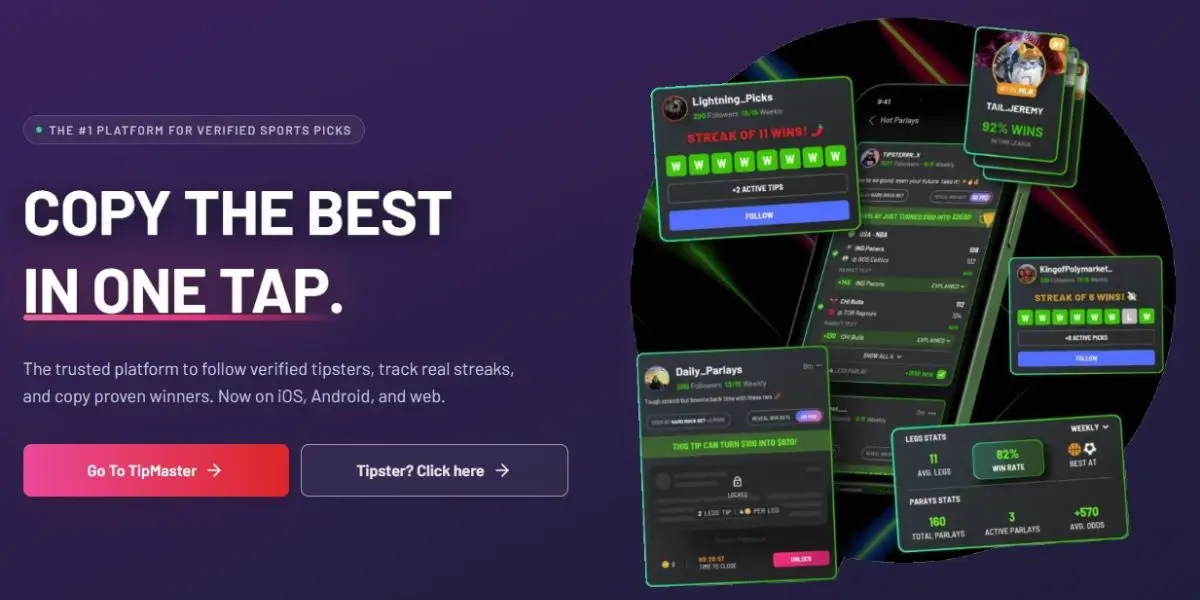
TipMaster’s architectural philosophy flips this model inside out. It operates on a strict “verify, then trust” protocol. The platform currently hosts a dense network of over 4,000 experts posting opinions daily. But unlike a Twitter feed, every single one of those opinions is immediately logged, timestamped, and frozen in a database that cannot be retroactively edited.
This shift represents the AI Reputation Economy, where your past performance is no longer a marketing highlight reel. It is a permanent, public, and unalterable digital fingerprint.
Beyond the Hype: The Anatomy of a Reputation Marketplace
What TipMaster has effectively engineered is a reputation marketplace. It is a distinction that carries massive weight in the modern information ecosystem because today’s leading search algorithms increasingly mirror this exact methodology—rewarding demonstrable expertise and verified trust signals over empty claims.
In the legacy model, users relied on vanity metrics: follower counts, paid Blue Checks, or the aesthetic quality of a Telegram channel. TipMaster replaces these proxy indicators with a deep, multi-dimensional performance matrix. When a user browses experts on the platform, they aren’t just seeing a “win/loss” ratio. They are looking at a high-resolution MRI of an expert’s cognitive biases and strengths.
Users can filter and compare experts by:
Verified History: Is the track record two weeks old, or two years old?
Recent Momentum: Is the expert in a statistically significant hot streak, or are they regressing to the mean?
Contextual Mastery: Does the expert excel in the English Premier League but fail miserably in the NBA? The platform segments performance by sport and league.
Risk Structure: Are their wins coming from safe -200 moneyline favorites, or are they dominating risky plus-money underdog markets?
This granularity turns the user from a passive gambler into a data-driven analyst. You are no longer “tailing” a hero; you are subscribing to a mathematically validated edge. The transparency forces accountability, washing out the noise traders and elevating the experts who possess genuine, repeatable skill.
TipMaster Pro: AI Decision Support, Not Just AI Picks
The conversation around Artificial Intelligence in sports betting has often been reductive. The mainstream narrative is “AI makes picks.” This fantasy suggests a sentient machine printing winning lottery tickets, a concept that frequently leads to disappointment when those generic, black-box picks inevitably lose.
TipMaster’s approach to AI, particularly with its TipMaster Pro suite, is significantly more sophisticated and psychologically astute. They are not building a deus ex machina that tells you who will win. They are building an AI Decision Support System built on real marketplace data.
The distinction is critical. Generic AI pickers scrape public box scores and churn out predictions based on data that the sportsbooks have already baked into the line. TipMaster’s AI analyzes a proprietary data lake: the behavior, history, and market signals of the 4,000+ experts on the platform.
When you analyze a tip using TipMaster Pro, the AI is cross-referencing the suggestion against a complex web of trust signals. It asks:
How does the odds structure of this specific pick correlate with the tipster’s historical profitability?
Is this a betting market where this expert has a proven long-term ROI, or are they venturing outside their lane?
Does the expert’s behavior pattern (timing of the post, deviation from the market line) indicate high conviction, or just volume posting?
This is Augmented Intelligence. It empowers the human user to understand the strength of a prediction before risking capital. It demystifies the “why” behind the tip. In the modern framework of digital authority, this is the ultimate expression of genuine experience—the AI isn’t a novice spewing out theory; it’s a veteran analyst who has observed millions of marketplace transactions and learned the subtle patterns of human forecasting behavior.
The Future: Human Experts vs. AI Agents in a Unified Trust Economy
One of the most profound, borderline sci-fi implications of the TipMaster infrastructure lies in its capacity to standardize the evaluation of both human and artificial intelligence.
We are rapidly entering an era of AI Agent swarms in prediction markets. Soon, autonomous systems powered by Large Language Models (LLMs) will be placing forecasts and trading on information just like humans. This creates a philosophical and practical crisis: how do you trust an agent? How do you trust a robot tipster?
The answer is a standardized performance ledger. TipMaster is building the rails for this future. The platform’s vision is a marketplace where a human expert and an AI-powered agent stand on equal footing, judged by the exact same standard: verified performance over time.
If a rogue developer creates a sports betting agent that claims a 20% ROI, the market will no longer have to take that claim at face value. By plugging into an infrastructure layer like TipMaster, that agent’s live decisions are tracked and audited in real-time. If the agent’s edge decays (as edges often do in efficient markets), the “Agent Reputation Score” drops immediately. Users can pull capital, or switch to a competing agent, instantaneously.
This closes the loop on the Trust Economy for Digital Markets. It strips away the marketing hype from AI products and exposes the raw, naked performance. It’s a Darwinian meritocracy where the best forecaster wins, regardless of whether they have a heartbeat or a GPU.
Why Verified Data is the Ultimate Content Moat
From a content strategy and digital publishing perspective, the methodology TipMaster employs is directly aligned with the principles that govern high-quality information discovery today—specifically around the signal of trust.
The digital landscape has made it clear that content involving financial risk or well-being must come from verified, authoritative sources. The sports betting advice sector sits squarely in that category; bad advice directly harms a user’s financial health.
In the past, affiliate sites relied on “author bios” that vaguely claimed “10 years of experience.” TipMaster, as a data source, provides the hard evidence of that expertise. A bettor featuring their TipMaster verification badge on a blog or social profile offers a signal of trustworthiness that no intelligent filtering system can ignore. It’s the difference between saying you are a professional athlete and posting your official race times.
This is the next evolution of Author Entity optimization. We are moving away from keyword stuffing and toward “Proof Signals.” TipMaster essentially serves as an off-site trust validator for the entire industry, a third-party oracle that verifies the claims made by creators in this space.
The Net Effect on the Betting Consumer
The commoditization of prediction data via platforms like TipMaster shifts the power dynamic back to the consumer. The platform explicitly states it is not a sportsbook; it’s an intelligence layer. It sits above the transactional layer of gambling, serving as the due diligence department that the industry never had.
For the user, the workflow changes from gambling to allocating capital:
Discovery: Find an expert whose verified data matches your risk appetite.
Validation: Use AI tools to check if the current tip aligns with the expert’s proven historical edges.
Execution: Place the bet with your operator of choice, carrying a level of confidence that comes from data, not hope.
This represents the maturation of the sports analysis market. It’s the institutionalization of a retail space.
Conclusion
The sports prediction market is not a game of chance; it is a game of information asymmetry. For too long, that asymmetry has favored the seller of the information over the buyer. The integration of AI verification, expert grading, and public performance repositories is flattening that curve.
TipMaster is not just a tool for finding a winning bet next Sunday. It is a prototype for how we will interface with knowledge workers in the age of AI. Whether you are hiring a financial advisor, a political analyst, or an NFL handicapper, the question will soon no longer be “What are your credentials?” but rather “Show me your immutable performance graph.”
In a digital landscape drowning in deepfakes, anonymous trolling, and viral misinformation, the ability to verify reality is the most valuable asset. The future of forecasting isn’t magic. It’s math. And it’s finally transparent.
Frequently Asked Questions (FAQs)
1. How does TipMaster verify that a tipster’s record is real?
Unlike social media platforms where users can delete losing posts, TipMaster’s system logs a prediction the moment it is posted, freezing the odds available at that exact time. The outcome is automatically graded against those specific frozen odds—the same odds a user would have acted upon. Once a game starts, a tip cannot be edited or deleted, creating an immutable, verified performance history that tracks win rates, streaks, and ROI authentically.
2. Is TipMaster a sportsbook or a betting app?
No. TipMaster is strictly an intelligence layer and marketplace for predictions. It does not facilitate the placing of bets or handle any transactions for gambling. Instead, it helps users make better decisions by providing transparent performance data on thousands of experts, acting as an analytics and due diligence tool.
3. What is the difference between AI picks and TipMaster’s AI decision support?
Generic AI “picks” often use historical sports data to guess outcomes, which is a game of playing catch-up with the sportsbooks’ oddsmakers. TipMaster Pro analyzes the behavior and live performance data of experts on the platform to evaluate the strength and historical context of a prediction. It tells you if a specific tip aligns with a proven edge, rather than just blindly predicting a score.
4. Can AI agents or bots use TipMaster to build reputation?
Absolutely. One of TipMaster’s long-term visions is to serve as a standardized reputation layer for both human experts and autonomous AI agents. By plugging a forecasting algorithm into the platform’s tracking system, developers can provide a public, transparent audit of their AI’s live performance, building trust without relying on marketing hype.
5. What does “AI Trust Infrastructure” mean for the average sports fan?
It means the end of the “fake guru” era. For the average fan, the infrastructure acts as a lie detector. You no longer have to rely on flashy social media personas or self-reported records; you can check a third-party, objective ranking of an expert’s performance by sport, league, and consistency, turning the process of following tips from gambling into an informed, data-driven decision.