
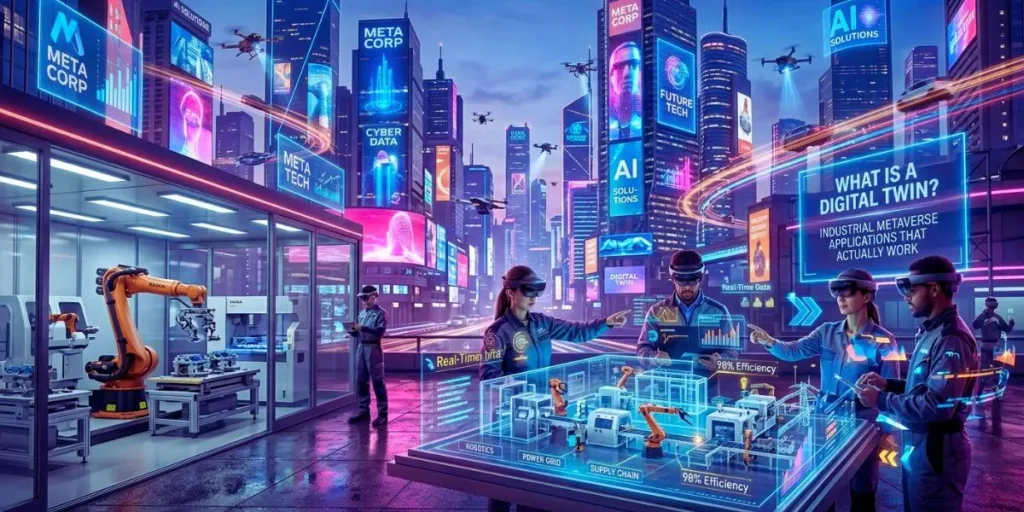

Imagine trying to fix a million-dollar jet engine while it’s 30,000 feet in the air. Or testing a complete factory redesign without stopping production for a single second. That’s the promise of the technology reshaping modern industry. It’s not science fiction; it’s happening right now in warehouses, hospitals, and power plants across the globe.
If you are tired of hearing buzzwords like “metaverse” without seeing tangible business results, you are in the right place. The fluff stops here. We are diving deep into what is a digital twin and why it’s the engine behind industrial metaverse applications that actually work. Forget avatars and virtual land; we are talking about operational uptime, reduced waste, and a serious competitive advantage.
By the time you finish reading, you will understand exactly how these virtual replicas move the needle on business performance, and more importantly, you will see clear pathways to implementing this within your own operational funnel. Are you ready to bridge the gap between physical chaos and digital clarity?
What Is a Digital Twin? The Short Answer for Busy Professionals
Let’s cut through the jargon before we get into the weeds. What is a digital twin? In the simplest terms, it’s a virtual representation of a physical object, process, or system. But it’s not a static 3D model. A true digital twin is connected via a two-way flow of data—sensors on the physical asset stream live information to the digital version, which can then run simulations and send commands back to the real world.
Think of it as the ultimate “undo” button for an industrial machine. You can push a machine to its breaking point in the digital world, learn the limits, and never risk a dollar of real-world revenue. That’s the power we are leveraging when we talk about industrial metaverse applications.
If you search for a complex systems data mirror, you’ll find overly academic definitions. Let’s cut through the noise. What is a digital twin? It isn’t just a static 3D CAD model or a cool animation.
A true digital twin is a dynamic, real-time virtual representation of a physical object, process, or system. Think of it as a bridge. On one side, you have a physical machine pumping oil, spinning a turbine, or moving packages. On the other side, you have its exact digital counterpart, connected by a constant stream of sensor data, mirroring every vibration, temperature spike, and pressure change.
But how is that different from a standard simulation? A standard simulation looks at one hypothetical scenario. A digital twin lives alongside its physical counterpart. If the physical asset gets hot, the digital twin gets hot. If a bearing starts to degrade in the real world, the digital twin immediately shows the impact on performance. It’s the difference between reading a medical textbook and having a real-time vitals monitor for a patient.
Why Standard 3D Models Fail to Drive Business Value
You might have a brilliant 3D visualization of your factory floor. It looks stunning in boardroom presentations. But if that model isn’t connected to live operational data, it’s already obsolete. It’s dead geometry.
To truly optimize your digital twin in manufacturing, the model needs a nervous system. It requires an IoT infrastructure that feeds it data. Otherwise, it’s just a digital paperweight. When we talk about creating a bridge between physical and digital, we mean building a connection that resolves the synchronization gap. You don’t need a bigger screen; you need a faster data pipeline that truly understands the physical nature of the asset.
The Industrial Metaverse Myth: It’s Not What You Think
For years, the “metaverse” was sold to us as a cartoonish world of legless avatars and corporate Zoom rooms. The market yawned. But while the hype cycle crashed on consumer VR, a silent revolution brewed in the industrial sector. The industrial metaverse isn’t about escaping reality; it’s about augmenting it. It’s the convergence of the physical and digital, powered by digital twins.
What is a digital twin in the metaverse? It’s the foundational software layer that gives the metaverse its purpose. Instead of a fantasy world, the metaverse becomes an immersive simulation center where you can walk through your factory floor in Spain while sitting in your office in Chicago. According to Deloitte, this convergence enables “the simulation of complex scenarios, enabling better decision-making and performance optimization.”
Quick Wins: Why Prioritize Digital Twins Now?
Here’s why industry leaders are shifting budgets right now:
-
Reduced Prototyping Costs: Fail fast on a computer screen, not on the assembly line.
-
Predictive Maintenance: Fix a bearing before it seizes, saving hundreds of thousands on emergency shutdowns.
-
Sustainability Compliance: Optimize energy consumption in the virtual world first to reduce your real-world carbon footprint.
Slicing Through the Hype: What Are the 4 Types of Metaverse?
To understand where your business fits, you must segment the market. Asking “what are the 4 types of metaverse?” helps you filter out the noise and focus on assets, not avatars. These types define the spectrum from pure reality to pure digital.
-
Augmented Reality (AR): Digital overlays on the physical world. A field technician seeing a temperature gauge flashing red on a physical pipe through their tablet is a prime example of an industrial metaverse interface.
-
Lifelogging: Capturing and storing everyday experiences and information about objects and people. For business, think of the immutable audit trail of a product’s lifecycle.
-
Mirror Worlds: This is the home of the digital twin. These are virtual replicas of the real world, simulating everything from traffic patterns to factory workflows. This is where operational efficiency and conversion optimization actually happen.
-
Virtual Worlds: The purely digital, persistent environments where users interact via avatars. While useful for training, the immediate business value often pales compared to “Mirror Worlds.”
Most of the enterprise value today is trapped in the “Mirror Worlds” category. If you aren’t mirroring a physical asset that generates revenue, you might be investing in the wrong layer of the stack.
Industrial Digital Twins: Where the Rubber Meets the Virtual Road
Let’s get specific. What are industrial digital twins? Unlike a digital twin of a consumer smartwatch, industrial digital twins are complex network-level models that replicate massive, mission-critical systems. We are talking about entire oil rigs, automotive assembly lines, or national logistics networks.
The key differentiator is scale and the two-way data stream. An industrial digital twin doesn’t just visualize; it orchestrates. It ingests millions of data points per second from IoT sensors to optimize throughput. The conversion rate of raw material to finished product isn’t just tracked here; it’s simulated and improved before a single physical change is made.
The AI Integration Factor
Siloed data is the enemy of efficiency. Modern industrial digital twins are now integrated with large language models to create a new search layer. Instead of clicking through fifteen dashboards to find a pressure anomaly, a senior engineer can simply ask, “Show me every valve at risk of failure in the next 72 hours.” This slashes the latency between insight and action, directly boosting the lifetime value of your capital equipment.
Real-World Industrial Metaverse Applications That Deliver Results
Theory is useless without execution. Let’s look at what are the real world applications of digital twins that are generating massive value right now. These aren’t pilot programs; these are scaling fast.
1. Predictive Maintenance (The Ultimate Save)
Unplanned downtime is the enemy of inventory turnover. Digital twins monitor vibration, temperature, and throughput rates. When the digital model detects an anomaly pattern—say, a specific motor operating 0.5% slower than the digital baseline—it triggers a work order. This prevents a catastrophic line stoppage. Siemens uses this to achieve over 99% reliability on certain train fleets, keeping their promise of frictionless logistics to their customers.
2. Immersive Training and Safety
Why train a chemical plant operator on a live reactor that can explode? The industrial metaverse allows for “High Consequence” scenario training. A worker can accidentally open the wrong valve in a VR headset, see the simulated blast, and learn the lesson viscerally without physical harm. This reduces the learning curve and drastically improves safety KPIs.
3. Factory Layout Reconfiguration
Changing a production line usually requires shutdowns, guesswork, and monumental expense. With an industrial digital twin, you can simulate the flow of workers, robots, and materials virtually. BMW uses these simulations to optimize assembly line ergonomics and logistics before breaking ground, ensuring every square foot maximizes throughput.
4. Supply Chain Stress Testing
When the Suez Canal was blocked, most companies were caught flat-footed. A supply chain digital twin lets you simulate “black swan” events. You can digitally block a trade route and watch how the supply chain reacts, instantly identifying the chokepoints. This allows you to build a logistics funnel that is anti-fragile, not just efficient.
The Architecture: How to Build a Resilient Twin
Creating a successful digital twin strategy isn’t a software purchase; it’s an operational shift. Here is a simplified architecture flow:
-
The Physical Layer: Your assets must be sensored. If you can’t measure it, you can’t twin it.
-
The Connection Layer: A data fabric (usually edge computing) that processes data in real-time to avoid latency.
-
The Digital Layer: The 3D model and simulation physics engine.
-
The Insight Layer: AI analytics that triage the data and recommend actions.
Here’s a checklist to audit your readiness:
-
Do you have a unified data source, or is your data trapped in silos?
-
Can your network handle real-time streaming, or do you rely on batch processing?
-
Is your leadership team ready to trust AI-driven insights over decades of instinct?
Quick Reference: Physical Asset vs. Digital Twin Capability
| Physical World Limitation | Digital Twin Metaverse Solution | Business Impact |
|---|---|---|
| “What if we try running the boiler at 105%?” (High risk) | Run the simulation in 10 minutes, safely. | Zero risk innovation. |
| “We don’t know why batch #7 failed.” | Replay the exact sensor timeline in 3D. | Reduced waste material. |
| “Experts are retiring faster than we can train.” | Capture their logic in AI models layered on the twin. | Preserved institutional IP. |
| “We can’t send an engineer offshore this week.” | Collaborate on the virtual rig from onshore. | Lower travel risk and cost. |
Industrial Metaverse Applications That Deliver Real Operational Value
Let’s get specific. You aren’t here for theory; you’re here to stop wasting budget on solutions that don’t scale. Here are the use cases digital twin technology specialists are deploying right now to drive measurable outcomes.
1. Predictive Maintenance: Fixing the Machine Before It Fails
Unplanned downtime is the single biggest thief of your operational budget. Traditional maintenance relies on a calendar—”change the oil every 90 days.” That’s inefficient. You might be trashing a perfectly good component, or worse, missing a failure that’s accelerating due to unexpected stress.
A virtual representation connected to vibration sensors changes the game entirely. The physics engine inside the twin analyzes the “digital heartbeat” of the asset.
The Operational Payoff:
When the AI detects an anomaly frequency that historically leads to a fracture, it triggers a work order automatically. You don’t fix a machine because the schedule says so; you fix it because the data screams for it. This shifts your maintenance team from reactive to prescriptive, drastically lowering the Total Cost of Ownership (TCO) .
Quick Win Checklist:
-
Identify your “criticality A” assets (machines where failure stops all production).
-
Retrofit with vibration and thermal sensors.
-
Map the data to an anomaly detection model, not just a threshold alarm.
2. Virtual Commissioning: The “Ctrl+Z” for Factory Builds
One of the costliest phases in digital twin in manufacturing is commissioning. This is when you power up a new assembly line for the first time. Usually, this is chaos. Software bugs clash with mechanical limits. Robots crash. Conveyor belts buckle.
With the right integration of spatial computing, you can simulate the entire production line before a single brick is laid. This is a truly compelling industrial metaverse applications strategy. You run the Programmable Logic Controllers (PLCs) against the digital twin to test logic at full speed.
Why This Matters: You can crash virtual robots a thousand times without a penny of real damage. By the time you power on the physical line, 90% of the code glitches are resolved. This condenses months of on-site commissioning into days.
Have you ever had a launch delayed by a software bug that couldn’t be traced until power-up? Virtual commissioning finds those bugs in the design phase, not on the factory floor.
3. Immersive Training: Forging Experience Without Risk
The skills gap in manufacturing is a crisis. You have a retiring workforce with 40 years of tactile experience, and new hires who have mainly learned from YouTube. You can’t afford to let them learn by breaking million-dollar machinery.
A use case focused on digital twin industrial applications creates a “safe sandbox.” Using a high-fidelity trackable model, a trainee can disassemble a turbine blindfolded. The system overlays repair instructions directly onto the physical machine, guided by the spatial mapping of the twin.
Operational Edge: This drastically amplifies employee engagement and retention. Instead of reading a dusty manual, they learn by doing. This builds muscle memory faster than any classroom lecture, directly influencing the quality of work and safety outcomes.
Building Your Bridge: How to Integrate Systems Without the Chaos
You’re likely sold on the value, but worried about the implementation. “How do I connect my 1950s machine to a cloud-based virtual representation?” You don’t necessarily need a brand-new “smart” factory. You need a strategic retrofit approach.
Step 1: Define the Goal, Not the Tool
Start with the pain point, not the shiny sensor. Are you trying to reduce energy waste? Solve a quality defect that only appears on week three of production? Your strategy must be laser-focused on a single, high-value problem. Don’t try to twin the entire plant overnight.
Step 2: Map the Ecosystem
A 3D visualization without context is just art. You need a strong digital thread that traces requirements, design specs, and as-built conditions. This product lifecycle trail is the connective tissue that allows AI to make sense of the raw data streams. It ensures that what you’re seeing has instant recall accuracy to the engineering BOM (Bill of Materials).
Step 3: Federate the Data Sources
Don’t attempt a massive data migration into one lake. It’s too slow. Use integration tools that link your Manufacturing Execution System (MES), your Enterprise Resource Planning (ERP) tool, and your IoT sensors. The power comes from the interplay—seeing how a raw material variance in the ERP affects vibration in the machine via the sensor.
Scaling Through Distribution and Content Authority
A hidden advantage of documenting this integration process is the massive content distribution opportunity. Tech leaders are desperate for grounded documentation. If you write the guide on “How to Retrofit a Legacy CNC Machine to a Digital Twin,” you don’t just build a factory asset; you build a high-authority asset that earns backlinks from engineering forums and software vendors. That loop drives direct, high-intent traffic that converts, directly feeding your funnel with highly qualified leads.
Structuring Data for AI Interfaces and Instant Answers
Let’s talk about the technical documentation itself. If a VP of Operations types a query into a generative search engine, you want your definition pulled as the snippet.
To do this, structure your technical blog posts like a relational database. The art is designing content that is machine-parseable but human-friendly.
If you are explaining how data flows, don’t bury it in a 500-word paragraph. Use a table:
| Data Layer | Source | Refresh Speed | Action Triggered |
|---|---|---|---|
| Physical Asset | IoT Sensors | Real-time (ms) | Alarm generation |
| Edge Node | Gateway aggregation | 1 second | Filtering & buffering |
| Digital Twin | Physics-based model | 15 seconds | Behavioral prediction |
| Enterprise App | ERP/MES | Hourly/batch | Work order dispatch |
This format is instantly scannable for a human. But more importantly, an AI crawler can extrapolate this exact relationship into a clear, cited answer for a user’s question like “How does IoT connect to a digital twin?”
This creates a flywheel effect: your structured content feeds the AI overviews, builds brand authority, and drives users back to your site for the deeper dive.
The Critical Path: Why Physics Demands Governance
Before you rush to implement, we need to discuss a sobering reality. Connecting operational technology (OT) to the cloud creates a bridge that goes both ways. A digital twin that isn’t secured is a remote control system for bad actors.
When we talk about digital engineering in the metaverse context, we must also talk about the security perimeter of the digital model. If your virtual representation has a direct line to the physical PLC, you must treat that connection with the same severity as a physical lock on the machine cage.
The “Human-in-the-Loop” Mandate
AI can predict a rupture, but should it be allowed to shut down a public utility circuit automatically? Probably not yet. Establishing a high-trust environment means designing workflows where the system recommends, but a human approves.
This directly impacts your LTV (Life Time Value) of the software. If a system causes a false positive shutdown, trust evaporates. Operators will switch it to manual mode, and your expensive solution becomes shelfware. To maintain trust, your algorithm must always show its work, citing the specific sensor frequencies that led to a conclusion. This transparency builds the experience-based credibility that fosters long-term user commitment and safety.
Implementation Blueprint: Your 90-Day Quick Wins Strategy
You don’t need a five-year digital transformation plan. You need momentum. Here is how to move the needle in the next quarter.
-
Week 1-4: Asset Selection & Pain Discovery. Pick one bottleneck machine. Map its failure history. Calculate the exact hourly cost of its downtime. If you can’t define the financial impact in a single sentence, the project lacks a North Star for measuring conversion from cost-center to profit-saver.
-
Week 5-8: The Connectivity Sprint. Implement minimal viable sensors (vibration, current, temperature). Develop the mesh or edge topology. The goal isn’t a perfect digital replica yet; it’s establishing a reliable, low-latency data pipe from the physical asset to a dashboard.
-
Week 9-12: Twin Creation & Scenario Testing. Upload the engineering geometry. Feed the live data against the physics model. Run a “hindcast”—feed it old data to see if the twin accurately predicted the last failure it didn’t know about. If it correctly identifies the past failure signature, you’ve validated the model.
Are you tracking the distinct behavior of individual machines, or just looking at fleet averages? Averages hide outliers. A digital twin is personalization for industry; it cares about the specific fingerprint of a single physical asset.
Frequently Asked Questions
What exactly is a digital twin in simple terms?
Think of it as a real-time “living” computer model of a physical object. Unlike a static blueprint, a digital twin is connected to sensors on the real object, so it actually shows what’s happening right now—vibrations, heat, speed—and can predict what will happen next based on physics and AI.
How is an industrial metaverse application different from a consumer metaverse?
A consumer metaverse focuses on social avatars and virtual entertainment. Industrial metaverse applications focus on operational technology. They use spatial computing and real-time IoT data to fix machines, prevent blackouts, and train workers, not to play games or hold virtual concerts.
Do I need to buy a brand-new smart factory to use a digital twin?
Absolutely not. You can start with a strategic retrofit. By adding external sensors to your most critical legacy machine, you can build a virtual representation of that specific asset without replacing the entire machine. This bridges the gap between old infrastructure and modern AI.
Is a 3D model the same as a digital twin?
No. This is a crucial distinction. A 3D model is static geometry; it just looks like the part. A digital twin contains the 3D model but is hyper-scaled with live data, physics-based behavioral simulation, and two-way connectivity that a simple static rendering cannot offer.
What is the first step in adopting this technology?
Don’t start with the technology; start with the pain. Inventory your critical assets and quantify the cost of downtime per hour. Select the machine where a 5% improvement in prediction would yield the highest financial return, and build your first use case there.
Can AI really predict machine failure accurately?
Yes, but it requires a physics-aware approach. Standard AI just looks for patterns in numbers. A digital twin combines AI with the laws of thermodynamics and mechanical stress. It doesn’t just guess; it deduces the failure mode by asking, “Based on how this metal fatigues, what is likely to snap?”
What are the real world applications of digital twins?
The most impactful real-world applications center on high-value assets. This includes predictive maintenance for manufacturing lines, remote collaboration in hazardous environments like mines, supply chain stress testing to avoid bottlenecks, and building performance optimization to meet net-zero carbon goals.
What is a digital twin in metaverse?
It’s the bridge between atoms and bits. While the “metaverse” is the immersive 3D environment, the digital twin is the data-rich, AI-driven engine inside that space. It’s the dynamic software model that keeps the metaverse grounded in physical reality, ensuring the simulation reflects the actual state of your machinery.
What is a digital twin in metaverse? (Re-iterated for clarity)
To put it bluntly: the metaverse is the visualization room; the digital twin is the brain inside the skull. Without the twin, the industrial metaverse is just an empty, pretty room. With it, it becomes a mission-critical command center.
What are the 4 types of metaverse?
As outlined, the categorizations are Augmented Reality (overlays), Lifelogging (records), Mirror Worlds (digital twins), and Virtual Worlds (pure digital). For industry, Mirror Worlds deliver the highest immediate business value by allowing us to optimize our physical operations virtually first.
What are industrial digital twins?
They are complex, system-level virtual models connecting heavy machinery, entire factories, or logistics fleets to IoT data streams. Unlike simple product twins, industrial digital twins manage the chaos of dynamic, heavy-load, high-consequence environments where downtime costs millions per hour.
How does a digital twin drive better business performance?
It shifts the operational model from reactive to prescriptive. Rather than fixing a machine after it breaks (reactive), you replace a part based on its actual condition (predictive), then finally, the digital twin tells you precisely what will happen if you change the operating speed (prescriptive). This maximizes the throughput of your entire operational engine.
Can small and medium-sized businesses afford digital twin technology?
The cost barrier has collapsed. With cloud-based solutions and “as-a-service” models, a mid-sized logistics provider can develop a modest digital twin of a critical conveyor system without the multi-million-dollar price tag of legacy on-premise solutions. Start with a single, problematic asset to prove the model, then scale.
Conclusion
We’ve uncovered the reality behind what is a digital twin, and it’s far more impactful than the consumer metaverse hype. These industrial metaverse applications represent a paradigm shift in risk management, talent retention, and physical efficiency. The ability to fail fast in a simulation while your competitors guess blindly in the real world is the ultimate competitive advantage.
The question isn’t whether you can afford to implement a digital twin strategy; it’s whether you can afford the waste and lag that comes from flying blind.
Are you ready to stop reacting to breakdowns and start orchestrating perfection? Let’s shift from physical chaos to digital clarity.
Have you started simulating your operations yet, or are you still hoping for the best? Share your biggest operational bottleneck in the comments below.
Disclaimer: This article provides general information on industrial technology trends. It does not constitute technical or investment advice. Implementation of digital twin technology should involve consultation with certified systems integrators and cybersecurity professionals to ensure specific operational safety and data integrity.