
















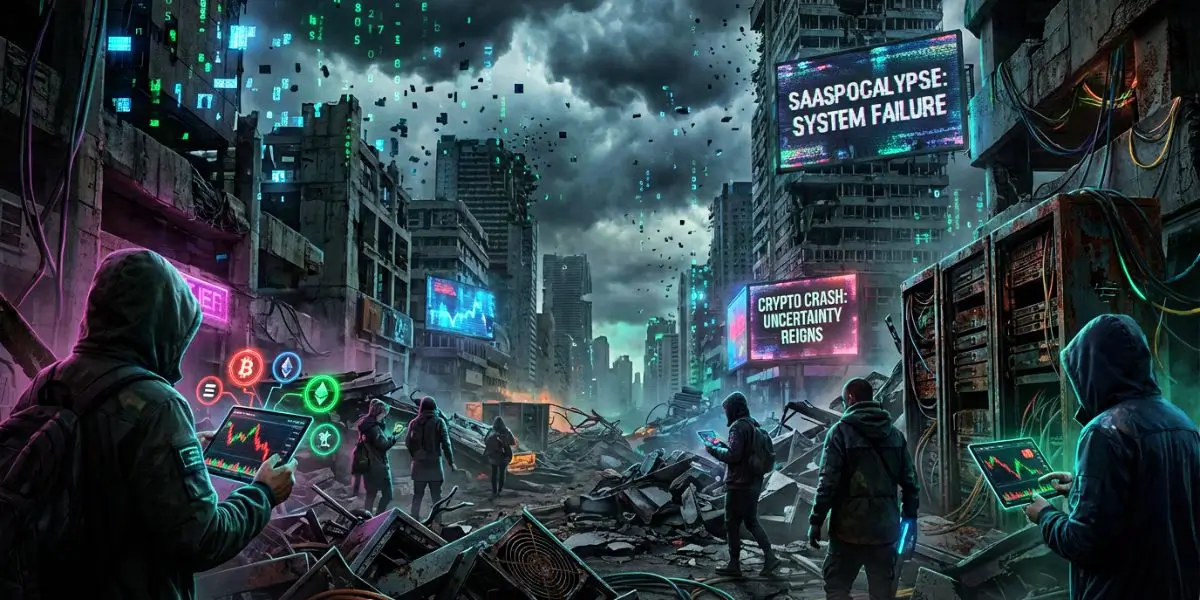
The term hit the financial wires on a chilly February morning in 2026, and within hours, $300 billion in market value had evaporated. It wasn’t an interest rate hike or a geopolitical crisis that caused the carnage; it was a product launch. Anthropic, the AI powerhouse, unveiled Claude Cowork, an AI agent capable of automating complex professional workflows—reviewing contracts, triaging NDAs, and ensuring compliance—tasks that have long been the cash cow of legacy software giants like Thomson Reuters and LexisNexis. The market reaction was swift and brutal, coining a new term that every tech investor is now talking about: the SaaSpocalypse.
But if you are holding Bitcoin (BTC) , Ethereum (ETH) , or any crypto assets, you might be wondering: Why should a software sell-off on Wall Street matter to me? The answer lies in the shifting tectonic plates of global capital. We are witnessing a “Great Rotation” where money is fleeing the old world of per-seat software licenses and rushing toward the new frontier of autonomous systems. This article will dissect the SaaSpocalypse, exploring its roots in the rise of AI agents, and crucially, how this structural disruption is reshaping the cryptocurrency market. We will look at why Bitcoin (BTC) is suddenly correlating with tech stocks, and where the real opportunities lie in decentralized AI and crypto AI protocols.
What exactly is the “SaaSpocalypse”?
In plain English, the SaaSpocalypse is the sudden, massive sell-off in software stocks triggered by the fear that AI agents will replace the need for human-priced software subscriptions. Think of it as the “Apocalypse of SaaS.” The spark that lit the fuse was Anthropic’s launch of “Claude Cowork”—an AI powerful enough to automate complex legal and business workflows that previously required a whole team of people and a stack of expensive tools. When the market realized an AI could replace five software seats (and the salaries behind them), panic set in. Investors dumped SaaS stocks, wiping out a staggering $300 billion in market value almost overnight.
Now, you might be thinking: “I don’t own stock in a legal software company, why should I care?” Here’s the thing: if you hold cryptocurrencies, trade on DeFi platforms, or just keep an eye on the economy, this matters to you. Historically, crypto and tech stocks have moved in lockstep. They are twin engines in the “risk-on” portfolio. When the SaaSpocalypse hit the Nasdaq, those shockwaves traveled fast, knocking Bitcoin off its feet and sending a chill through the entire digital asset space.
But here is the million-dollar question every trader is asking right now: Is this just the beginning of a broader tech meltdown that drags crypto down with it? Or is the SaaSpocalypse actually the catalyst for a “Great Rotation”—a massive shift of capital out of old, centralized software and into the decentralized, autonomous future that crypto was built for? Let’s break down what’s really happening and how you can navigate the chaos.
Deconstructing the SaaS Apocalypse: Why Did Markets Crash?
To understand how this impacts your crypto portfolio, we first have to look at the wreckage in the stock market. The SaaSpocalypse isn’t just a fancy term; it represents a structural shift in how we value software.
The “Claude Cowork” Effect
Before February 2026, the consensus was that AI would augment software. Companies like Microsoft pitched “Copilot” as an add-on to existing tools. Anthropic changed the game with “Clowork.” Instead of helping you use a tool, Claude Cowork became the worker.
Specifically, its legal plugin demonstrated the ability to automate contract review, NDA triage, and compliance tracking—tasks previously locked behind high-priced subscriptions to LexisNexis or Westlaw . When the market saw a single AI handle multi-step workflows across different applications, the “visibility premium” of traditional software licenses evaporated.
The Death of the Per-Seat Model
At the heart of the SaaSpocalypse is the destruction of the “per-seat” pricing model. If a company used to buy 100 licenses for a graphic design tool, but an AI agent can now generate those graphics based on a single prompt, the company only needs one license for the AI.
This has massive implications for metrics like Customer Acquisition Cost (CAC) and Lifetime Value (LTV). SaaS companies spent decades building moats based on user habit and interface complexity. AI agents bypass the interface entirely. They don’t need a pretty dashboard; they need an API. This is why stocks like LegalZoom plummeted nearly 20% overnight—their entire business model relies on humans needing help, not machines doing the work .
The Perfect Storm: How AI Agents Triggered the SaaSpocalypse
To understand the SaaSpocalypse, we have to look at the fundamental business model of the software industry. For decades, the SaaS model (Software-as-a-Service) has been the gold standard. Companies like Salesforce, Workday, and Adobe built trillion-dollar empires by charging businesses a monthly fee for every single employee—or “seat”—that used their software. It was a beautiful, recurring revenue stream. But the model had a hidden vulnerability: it assumed that humans would always be the ones doing the clicking.
The End of the “Per-Seat” License
Enter Claude Cowork. Unlike a simple chatbot that suggests responses, an AI agent acts. It doesn’t just tell you how to review a contract; it reads the contract, cross-references it with legal databases, flags risky clauses, and drafts a summary—all without a human opening a single document. This is the core of the SaaSpocalypse fear.
Why pay for ten licenses to a legal research tool when one subscription to an AI agent can do the work of a ten-person team? The software valuation logic that Wall Street relied on for years has been flipped on its head. Investors are no longer valuing companies based on user growth; they are discounting them based on the risk of user obsolescence. The Nasdaq Composite felt this pain immediately, suffering some of its worst sessions since 2022 . Can you see the shift? The value is moving from the tool to the doer.
From “Tools” to “Workers”
This transition is more profound than simply buying different stocks. It represents a shift in how we define labor and output. For years, the tech industry sold “enablement.” Now, it is selling “outcomes.” When an AI agent can manage an entire sales pipeline or handle first-line legal advice, the traditional barriers to entry for starting a business crumble. This directly impacts the programmable money thesis of cryptocurrencies, because if software development costs drop to near zero, the entire economic structure of the internet changes.
The Crypto Connection: Risk-On, Risk-Off, and the Great Rotation
So, how does a software crash impact the price of your crypto assets? The relationship is a tale of two phases: immediate panic and structural realignment. Initially, the market behaves as a giant risk blender.
The Correlation Conundrum: Why Bitcoin (BTC) Sold Off
When the SaaSpocalypse headlines hit, they didn’t just scare software investors; they spooked everyone in the “risk-on” asset class. In early February 2026, the selling was indiscriminate. Bitcoin (BTC) , which had been trading in a range, suddenly dropped sharply alongside the tech-heavy indices .
Why? Because in the eyes of macro investors, both SaaS stocks and crypto assets are high-beta plays on future growth. When a structural threat emerges (like AI replacing software), portfolio managers often de-risk by selling their most volatile holdings first. Data showed a massive outflow from the S&P 500 Software and Services Index, and Bitcoin (BTC) was caught in the crossfire . This highlights a crucial point: cryptocurrency is no longer an island; it is deeply integrated into the global financial system’s risk management flows.
Capital Rotation: The Shift Toward AI Infrastructure
However, the initial panic selling often obscures the underlying capital rotation. The money leaving traditional software isn’t disappearing; it’s being redeployed. The primary beneficiary has been the physical layer of AI—companies like Nvidia. But the secondary, and perhaps more exciting, beneficiary is the decentralized layer.
Investors are waking up to the fact that if the future is autonomous AI agents, they need a backend that isn’t controlled by a single entity like Anthropic or Google. This is where decentralized AI comes into play. Instead of flowing into centralized, permissioned clouds, capital is beginning to trickle into protocols that offer permissionless compute, verifiable data, and agent-to-agent settlement layers.
Think of it this way: Claude Cowork might be the application you see, but the infrastructure it runs on—or the infrastructure that competing, open-source agents will run on—could very well be crypto AI driven. This is the pivot that sophisticated investors are watching closely.
Decentralized AI: The Silver Lining of the SaaSpocalypse
While the SaaSpocalypse paints a grim picture for legacy tech, it serves as a massive validation for the core principles of Web3: decentralization, transparency, and permissionless innovation. The crisis of centralized software is the coming-out party for decentralized AI.
The Case for Permissionless Agents
Anthropic’s Claude is a powerful, but ultimately centralized, service. The company can change its terms, censor certain queries, or shut down access at any time. In a world where businesses run on AI agents, relying on a single corporate gateway becomes a massive single point of failure.
This is the opening for crypto AI. Imagine a future where AI agents are not corporate employees but independent economic actors living on a blockchain. These agents could access decentralized compute power from a global network of GPUs (far cheaper than Amazon Web Services), retrieve uncensorable data from decentralized storage, and settle payments in programmable money like Ethereum (ETH) . This isn’t science fiction; protocols are already building the rails for this “Agentic Era.” The SaaSpocalypse accelerates the need for a permissionless alternative.
Crypto as the Settlement Layer for AI
If AI agents are going to book our flights, file our taxes, and manage our supply chains, they will need to transact. They will need to pay for APIs, compute time, and data access. They cannot log into a bank account and ask for a credit card. They need programmable money—native digital assets that allow for machine-to-machine payments.
This is where cryptocurrencies like Ethereum (ETH) become indispensable. The crypto asset acts as the native fuel for the autonomous economy. The SaaSpocalypse effectively eliminates the middleman (the expensive SaaS platform) and connects the user directly to the AI agent, with the blockchain serving as the trustless bookkeeper and settlement layer.
Tokenization and the Future of Software Value
The SaaSpocalypse forces us to ask a hard question: If software development costs are collapsing, how will companies capture value? The old answer was “through proprietary code and user lock-in.” The new answer, increasingly, is “through tokenization and network ownership.”
From Subscription Fees to Protocol Ownership
The SaaS model was about renting software. The AI agent model might be about owning a piece of the network. Instead of paying a monthly fee to a centralized corporation, users might pay for compute time in a native token, or even contribute their own unused GPU power to a network in exchange for tokens.
This shifts the value proposition. You are no longer a customer; you are a participant. This model aligns incentives far better than the old licensing model. As the SaaSpocalypse erodes trust in centralized, rent-seeking software structures, the crypto ethos of shared ownership and decentralized infrastructure becomes more attractive.
Infrastructure Plays: GPU Markets and Data Protocols
The immediate winners in this rotation are likely to be the picks-and-shovels of the AI gold rush, but in a decentralized format. We are seeing the rise of:
Decentralized GPU Marketplaces: Allowing projects to rent processing power at a fraction of the cost of centralized clouds.
Data Provenance Protocols: Using blockchain to track and verify the data used to train AI models, ensuring transparency and combating the “black box” problem.
Verifiable Compute Networks: Using cryptography (like zero-knowledge proofs) to prove that an AI agent performed its calculations correctly.
These crypto AI projects are the direct hedge against the SaaSpocalypse. They are not the incumbents being disrupted; they are the infrastructure enabling the disruptors.
The Crypto Connection: Contagion or Decoupling?
So, how does a software sell-off in New York affect the price of Bitcoin or the liquidity on Uniswap? The connection is more profound than most retail investors realize.
The “Risk-On” Correlation
Immediately following the Anthropic news, the Nasdaq Composite slid nearly 1.5%. But it wasn’t just tech stocks bleeding. Bitcoin, which had been trading in a range, broke down sharply, falling nearly 7% in tandem .
Analysts point to a structural reality: in the eyes of macro investors, Bitcoin and Ethereum are currently viewed as “programmable money” and are grouped with tech stocks as “risk-on” assets . When a shock like the SaaSpocalypse hits, portfolio managers engage in risk-off flows. They sell the winners (or in this case, the sectors facing structural threat) to cover margins or reduce overall portfolio volatility.
As one market strategist noted, the positive 40-day correlation between Bitcoin and the Nasdaq remains persistent. The SaaSpocalypse triggered a “get me out” moment for software, and crypto was caught in the crossfire because it occupies the same “high-growth, narrative-driven” bucket in institutional models .
The “Great Rotation” of Capital
However, correlation in the short term doesn’t mean fusion in the long term. While panic selling creates a correlation spike, the underlying fundamentals tell a different story. Capital isn’t leaving tech; it’s rotating within tech.
We are witnessing a massive shift away from centralized, license-based SaaS models toward decentralized AI infrastructure and “outcome-based” models . The money that once flowed into Oracle or Salesforce is looking for a new home. Some of that money is flowing directly into AI infrastructure plays like Nvidia, but a significant portion is rotating into the crypto ecosystem.
Why? Because the very infrastructure needed to power an agentic world—distributed computing power, verifiable data, and autonomous transactions—is native to blockchain. As centralized software valuations crumble, capital is pivoting to the protocols that will power the agents of the future.
The DeFi Angle: Splitting and Re-bundling the Stack
To understand where the opportunity lies, we have to look at how the SaaSpocalypse is forcing a restructuring of the financial stack, specifically in DeFi.
The Great “Split” in Crypto
Historically, centralized finance and early DeFi were “walled gardens.” But just as Craigslist was split into Uber (transportation) and Airbnb (lodging), and banks were split into Affirm (lending) and Robinhood (trading), the SaaSpocalypse is accelerating the “splitting” of the software stack .
In the crypto world, this manifests as modularization. Instead of one monolithic exchange doing everything, we see specialized protocols:
Liquidity provision is split into protocols like Uniswap.
Lending is split into protocols like Aave.
Data indexing is split into protocols like The Graph.
This “splitting” allows AI agents to plug into specific, optimized modules rather than bulky, all-in-one platforms. The AI doesn’t need to log into a website; it simply queries a smart contract. This makes the crypto stack inherently more resilient to the SaaSpocalypse than traditional SaaS.
The “Re-bundling” into Super Apps
But the cycle doesn’t end with splitting. As ARK Invest has pointed out, after splitting comes “re-bundling” . We are seeing this with Uniswap. Once a simple AMM (Automated Market Maker) that relied on third-party interfaces, Uniswap is now re-integrating.
With the launch of Uniswap X (its native aggregator) and the Unichain (its own Layer 2 blockchain), Uniswap is becoming a vertically integrated “super app” . This is the crypto-native defense against the SaaSpocalypse.
By controlling the wallet, the aggregator, and the execution layer (the chain itself), Uniswap captures the value that traditional SaaS vendors are losing to AI. They aren’t selling “seats” to a dashboard; they are selling a seamless, automated liquidity layer that AI agents can use directly. This is the evolution from “Software-as-a-Service” to “Infrastructure-as-a-Capital.”
Opportunities: Where to Look in the Post-SaaSpocalypse Market
If you’re an investor or a builder, the SaaSpocalypse isn’t just a threat; it’s a filter. It separates the companies selling “access” from the protocols selling “outcomes.” Here is where the smart money is looking.
1. Decentralized Compute Networks
The biggest bottleneck for AI agents right now is compute. Centralized cloud providers (AWS, Google Cloud) are expensive and controlled by single entities. Decentralized Physical Infrastructure Networks (DePIN) allow AI agents to source computing power from a global network of providers. This is often cheaper and more censorship-resistant than centralized clouds. As the demand for AI agents skyrockets, the demand for decentralized compute follows.
2. Data Integrity and Verification Protocols
How do you trust what an AI agent tells you? If an agent executes a trade based on bad data, the loss is real. Protocols that use zero-knowledge proofs to verify AI outputs or that provide “ground truth” data on-chain are becoming critical. These protocols act as the “trust layer” for the agentic economy.
3. Agentic DeFi (DeFAI)
We are seeing the rise of “DeFAI”—protocols specifically designed for AI agents to interact with. These go beyond simple token swaps. They include autonomous yield strategies, automated risk management, and cross-chain arbitrage bots. Instead of building a SaaS tool for humans to trade, developers are building smart contracts for AI to trade. This removes the human bottleneck entirely and aligns perfectly with the “outcome-based” model the market now demands.
Strategic Hedges: Navigating the Volatility
The SaaSpocalypse has introduced a new level of volatility. Here’s how to navigate it without getting wrecked.
Treat Crypto as a Tech Hedge, Not Just Inflation Hedge
For years, the narrative was “Bitcoin is digital gold.” While that may hold true in a hyperinflation scenario, the current market reality is different. Bitcoin and Ethereum are currently functioning as “programmable money” and are highly sensitive to tech liquidity . When you look at your portfolio, understand that your crypto is currently acting as a high-beta play on tech innovation. If the SaaSpocalypse deepens, crypto may initially follow tech down.
Look for “Outcome-Based” Models
Avoid projects that try to replicate traditional SaaS models on-chain (i.e., “we charge a monthly fee to use our dApp dashboard”). Instead, look for protocols with “outcome-based” models. These are protocols that charge a small fee every time an AI agent uses the protocol to execute a trade, verify data, or borrow funds. These models are immune to the per-seat collapse because they don’t sell seats; they sell utility.
Watch the Flows
Monitor where institutional money is moving. In the immediate aftermath of the SaaSpocalypse, we saw a fascinating divergence: while software stocks saw “get me out” selling, Bitcoin ETFs actually recorded massive inflows .
The Signal: On February 3rd, U.S. spot Bitcoin ETFs recorded a net inflow of $561.8 million, even as the price dropped.
The Interpretation: This suggests that Wall Street sees the crypto infrastructure as a safer bet for the AI revolution than legacy software vendors. However, be cautious. The average ETF cost basis is currently above the spot price. If prices fall further, it could trigger redemptions .
Risks and Realities: What Could Go Wrong?
It’s not all rosy. The SaaSpocalypse also introduces specific risks to the crypto ecosystem.
The “Capex” Burden
To run these massive AI models, tech giants are spending unprecedented amounts on capital expenditures (Capex). Alphabet, for example, projected $200 billion in Capex for 2026 . If these investments don’t yield proportional revenue growth, it could trigger a broader tech recession that takes crypto down with it. The hardware spending (GPUs, data centers) is massive, and any sign of “over-investment” could spook the markets.
Regulatory Scrutiny
As AI agents become autonomous economic actors, regulators will ask: Who is liable if an AI-driven DeFi protocol gets hacked? The lines between “software provider” and “financial advisor” are blurring. The SaaSpocalypse might force regulators to clamp down on autonomous protocols, especially those that operate without KYC.
Conclusion: Embracing the Agentic Era
The SaaSpocalypse marks the official end of the “SaaS honeymoon.” The days of slapping a subscription on a basic tool and calling it a tech company are over. We are moving into an era where value is captured not by the platform, but by the infrastructure and the agents themselves.
For the crypto community, this is a defining moment. While the short-term correlation with tech stocks might cause some pain, the long-term narrative is bullish. The world is moving toward autonomous, permissionless, and programmable systems—three things that blockchains do better than centralized servers.
The question isn’t whether AI will disrupt software; it’s whether the next generation of software will be built on AWS or on Ethereum. If you believe that AI agents need to transact, verify, and coordinate without asking permission, then the SaaSpocalypse is the best thing that could have happened to your crypto portfolio.
Are you positioned for the agentic future, or are you still holding seats on the old model?
FAQs
Why did an AI tool cause a crypto crash?
Crypto and tech stocks are currently viewed as correlated “risk-on” assets by institutional investors. When the Nasdaq plunged due to the SaaSpocalypse, investors sold volatile assets like Bitcoin to reduce risk, creating a temporary but sharp price drop .
Is this the end for software companies?
No, but it’s the end for software companies that rely solely on the per-seat license model. The future belongs to “outcome-based” models and infrastructure protocols, particularly those that allow AI agents to interact directly without a human interface .
How does this affect the way I use DeFi?
DeFi protocols are already evolving. Instead of building dashboards for humans, developers are building “smart contracts for AI.” This means your trades could soon be executed by AI agents optimizing for yield 24/7, rather than you having to click “confirm” .
Should I sell my crypto because of the SaaSpocalypse?
Not necessarily. While the initial reaction was negative, the SaaSpocalypse is causing capital to rotate out of legacy software and into next-generation infrastructure. Decentralized AI and compute protocols are seeing increased interest as investors look for ways to play the AI trend without buying overvalued centralized SaaS stocks .
What are “agentic” protocols?
These are blockchain protocols designed to be used directly by AI agents. They feature machine-readable data, automated execution, and trustless verification, allowing AI to transact value and information without human intervention.
How is the “per-seat” model different in crypto?
Most DeFi protocols don’t charge a “per-seat” fee. Instead, they charge a tiny fee per transaction (e.g., Uniswap’s trading fee). This makes them immune to the SaaSpocalypse, because even if an AI agent is trading, the protocol still captures value from the economic activity .
What is the “SaaSpocalypse” in simple terms?
The SaaSpocalypse refers to the sudden market fear that advanced AI agents (like Anthropic’s Claude Cowork) will replace the need for expensive, per-user software licenses. This has triggered a massive sell-off in SaaS stocks as investors question the future of the traditional software business model.
Why did Bitcoin (BTC) drop because of an AI software launch?
Bitcoin (BTC) is currently viewed by institutional investors as a “risk-on” asset, similar to high-growth tech stocks. When the SaaSpocalypse panic hit, investors sold risky assets across the board to reduce portfolio risk, causing a temporary but sharp correlation between crypto assets and software equities.
Does the SaaSpocalypse create any opportunities in crypto?
Yes. The crisis in centralized software is accelerating interest in decentralized AI. Investors are looking at crypto AI projects that provide decentralized compute, data verification, and agentic infrastructure. These protocols could become the backend for the autonomous economy, offering a hedge against centralized AI models.
What is the difference between SaaS and the Agentic Model?
SaaS (Software-as-a-Service) sells a tool that a human uses to complete a task (e.g., a design platform). The Agentic Model sells the completion of the task itself (e.g., an AI agent that designs the logo for you). This shift threatens the “per-seat” revenue model of traditional software companies.
How do Ethereum (ETH) and smart contracts fit into this?
Ethereum (ETH) provides the programmable money layer required for AI agents to transact autonomously. If agents need to pay for compute, data, or services, they need to do so via trustless smart contracts on a blockchain, making Ethereum (ETH) a critical settlement layer for the future agent economy.
Are AI and crypto competing for the same investment dollars?
Yes, in the short term. Venture capital and institutional money are finite. In 2025, AI startups absorbed over $200 billion in investment, far outpacing crypto . This creates a “capital rotation” where money flows out of both legacy software and some crypto assets to fund the AI infrastructure build-out. However, in the long term, the two sectors are converging.
What kind of crypto projects benefit from the SaaSpocalypse?
Projects focused on decentralized AI infrastructure are the primary beneficiaries. This includes protocols for decentralized GPU computing, data labeling and provenance, and platforms designed for deploying autonomous AI agents on-chain. These projects offer the “infrastructure” layer that the new AI economy needs.
Is the SaaSpocalypse a short-term crash or a permanent shift?
Most analysts believe it is a structural, permanent shift in how software value is captured. While the panic selling may create buying opportunities, the underlying threat to the SaaS model is real. The future belongs to companies (and protocols) that deliver outcomes, not just tools.
Disclaimer: This article is for informational purposes only and does not constitute financial advice. The cryptocurrency and AI markets are highly volatile. Always conduct your own research before making investment decisions. Past performance is not indicative of future results.