













Paris, France, February 2nd, 2026, – Europe’s premier blockchain conference returns to Paris, bridging the traditional world of finance with the emerging frontier of regulated digital assets.
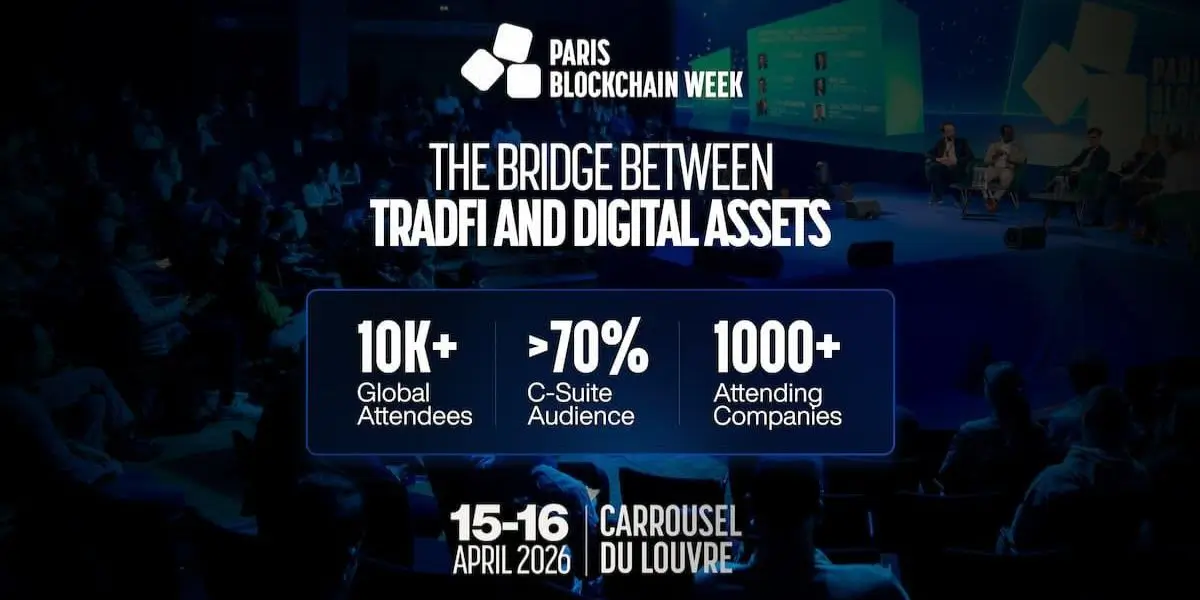
Paris Blockchain Week 2026, Where Institutions and Digital Assets Finally Meet, is set to take place on April 15–16, 2026, at the iconic Carrousel du Louvre. This edition marks a significant evolution, solidifying its position as the continent’s most institutionally-focused gathering for exploring the integration of blockchain technology into the global financial system.
The conference arrives at a pivotal inflection point for the digital economy. As regulatory frameworks like Europe’s Markets in Crypto-Assets (MiCA) regulation take full effect and institutions move from experimentation to deployment, Paris Blockchain Week 2026 serves as the critical nexus for policymakers, asset managers, banks, and technology providers to align on the future.
“Our strength has always been in how we build trust across industries,” said Michael Amar, Chairman of Paris Blockchain Week. “We focus on creating meaningful solutions and opening space for different perspectives. That is how Paris Blockchain Week earned its place as a trusted platform for institutions.”
The 2026 agenda is explicitly designed to address the operational, compliance, and strategic questions at the heart of institutional adoption. Discussions will center on digital asset regulation in Europe, tokenization of real-world assets, institutional-grade custody solutions, and the evolving market data standards required for scaled deployment.
Key Institutional Themes Shaping the 2026 Agenda
The programming for Paris Blockchain Week 2026 is built around the concrete challenges and opportunities facing traditional finance (TradFi) as it converges with decentralized finance (DeFi) and digital asset infrastructure.
From Clarity to Deployment: With regulatory milestones like the proposed Clarity Act in the U.S. and active MiCA implementation in Europe, the conversation shifts from seeking permission to executing strategy. Sessions will detail how banks and asset managers are integrating digital assets into core operations, treasury management, and client offerings.
The Tokenization of Everything: A leading trend for 2026, tokenization is moving beyond pilot projects. Paris Blockchain Week will feature deep dives into tokenized funds, bonds, carbon credits, and private equity, exploring how blockchain unlocks liquidity, transparency, and fractional ownership for entirely new asset classes.
Stablecoins & Digital Payments Infrastructure: As stablecoins solidify their role as a bridge between fiat and digital systems, and central banks progress with digital currencies (CBDCs), the conference will examine the evolving payments landscape. This includes analysis of recent innovations like JPMorgan’s deposit token on a public blockchain.
Enterprise-Grade Blockchain: The focus is on scalability, interoperability, and security. Technology tracks will be dedicated to the infrastructure needs of large institutions, including cross-chain interoperability, privacy solutions, and the resilience required for global financial market infrastructure.
Exclusive Gathering at Versailles: Setting the Global Agenda
Reflecting its elevated institutional role, Paris Blockchain Week 2026 will host an invitation-only gathering at the Royal Château de Versailles. This strategic conclave will convene C-suite executives, senior regulators, and leading infrastructure providers to shape the dialogue around the long-term governance and interoperability of regulated digital markets.
This exclusive forum underscores the event’s unique position in fostering public-private cooperation—a priority highlighted by the World Economic Forum as essential for responsible adoption. It is here that the frameworks for tomorrow’s digital capital markets will be debated and refined.
A Who’s Who of Global Finance and Technology
The stature of Paris Blockchain Week is reflected in its confirmed participants and partners, which reads as a directory of global financial and technological leadership. The 2026 roster includes:
Traditional Finance (TradFi): S&P Global, Fidelity Investments, Bank of America, Deutsche Bank, Invesco.
Regulation & Policy: The European Commission.
Digital Asset & Web3 Pioneers: Circle, Ripple, Cardano, Bybit.
Their collective presence powerfully illustrates the central thesis of the 2026 event: digital assets are no longer a parallel ecosystem but are being fundamentally positioned within the architecture of regulated global capital markets.
Why Paris, Why Now?
Paris has emerged as a neutral and influential focal point for European financial and regulatory dialogue. Paris Blockchain Week 2026 leverages this environment to provide a collaborative space where institutions can approach blockchain with the operational rigor, regulatory compliance, and long-term strategic intent that defines traditional finance.
For asset managers exploring tokenized funds, banks building custody solutions, or Web3-native firms adapting to enterprise standards, this conference is the definitive meeting point for the industry’s next phase.
Actionable Insights for Attendees: Maximizing Your ROI
Attending a major conference is an investment. To ensure you extract maximum value—whether you’re a business leader, investor, policymaker, or technologist—here is a strategic framework for your participation at Paris Blockchain Week 2026.
| Attendee Profile | Primary Goal at PBW 2026 | Key Sessions & Networking Focus | Target Outcome (Your Quick Win) |
|---|---|---|---|
| Business Leader (C-Suite) | Evaluate blockchain integration for assets/operations. | Tokenization case studies; institutional deployment panels. | Identify one concrete pilot project for your balance sheet or services. |
| Investor / Asset Manager | Explore tokenized assets and new investment processes. | Deep dives on real-world asset (RWA) tokenization; liquidity forums. | Connect with 3 platform providers for due diligence on tokenized funds. |
| Policymaker / Regulator | Understand market needs to shape effective, interoperable rules. | Regulatory roundtables; cross-border compliance workshops. | Draft a key takeaway for national policy on stablecoins or asset tokenization. |
| Technologist / Builder | Design for interoperability, privacy & institutional resilience. | Infrastructure tech tracks; interoperability standards meetings. | Integrate one new protocol or standard into your 2026 product roadmap. |
Navigating the New Frontier: Parallels in Evolving Markets
The journey of institutional adoption in blockchain shares intriguing parallels with other complex, fast-evolving markets—such as the regulated cannabis industry. Both fields are moving from grey areas to defined regulatory frameworks, requiring new standards for production, compliance, and consumer safety.
Consider the rise of specific, trusted products in cannabis, like a carefully crafted chocolate bar weed. These products are not defined by speculation but by quality control, precise dosing, lab testing, and consistent consumer experience—values that mirror what institutions now demand from digital asset infrastructure. The conference will implicitly address this same transition: moving from wild speculation to reliable, regulated, and repeatable systems.
The Definitive Conclusion for 2026
Paris Blockchain Week 2026 is not merely another crypto conference. It is the clear signal that the institutional adoption of blockchain technology and digital assets has moved decisively from the “if” to the “how.”
The convergence of TradFi and DeFi, the acceleration of asset tokenization, and the hardening of global regulatory frameworks make this year’s event an unmissable strategic inflection point. For anyone tasked with navigating the future of finance, Paris Blockchain Week 2026 offers the dialogue, partnerships, and insights necessary to build, invest, and regulate in the new digital economy.
Event Details:
Dates: April 15–16, 2026
Venue: Carrousel du Louvre, Paris, France
Official Website: https://www.parisblockchainweek.com
About Paris Blockchain Week
Paris Blockchain Week, organized by Chain of Events, is Europe’s largest institutional event for digital assets and traditional finance. Hosted annually at the Carrousel du Louvre, PBW convenes the world’s leading voices in finance, policy, and technology to drive meaningful dialogue and collaboration. In 2025, PBW welcomed 9,500+ attendees, 420+ speakers, and 300+ sponsors.
Frequently Asked Questions (FAQs)
What is the main focus of Paris Blockchain Week 2026?
The 2026 edition is explicitly institutionally focused. It centers on how traditional financial systems integrate digital assets, with key themes being regulatory compliance (especially MiCA), asset tokenization, institutional-grade custody, and market infrastructure.
Who should attend Paris Blockchain Week?
The event is essential for executives from traditional finance (banks, asset managers), policymakers and regulators, infrastructure providers (custodians, exchanges), and Web3 project leaders seeking enterprise partnerships. It’s designed for professionals shaping the future of regulated digital markets.
How is the agenda structured for institutional attendees?
The agenda moves beyond theoretical discussions to practical deployment. It features case studies on tokenization, panels on operational risk and compliance, deep technical sessions on interoperability, and forums dedicated to the convergence of traditional finance (TradFi) and decentralized finance (DeFi).
What is the significance of the exclusive gathering at Château de Versailles?
This invitation-only meeting convenes top-tier executives and regulators for strategic, closed-door discussions. Its purpose is to shape high-level policy dialogue and foster public-private cooperation on global standards for digital asset markets.
Why is 2026 considered a pivotal year for digital assets?
2026 is seen as an inflection point where clearer regulations, proven tokenization use cases, and mature technology converge. This allows institutions to move from pilot programs to scalable deployment, laying the foundation for blockchain as core financial infrastructure.