













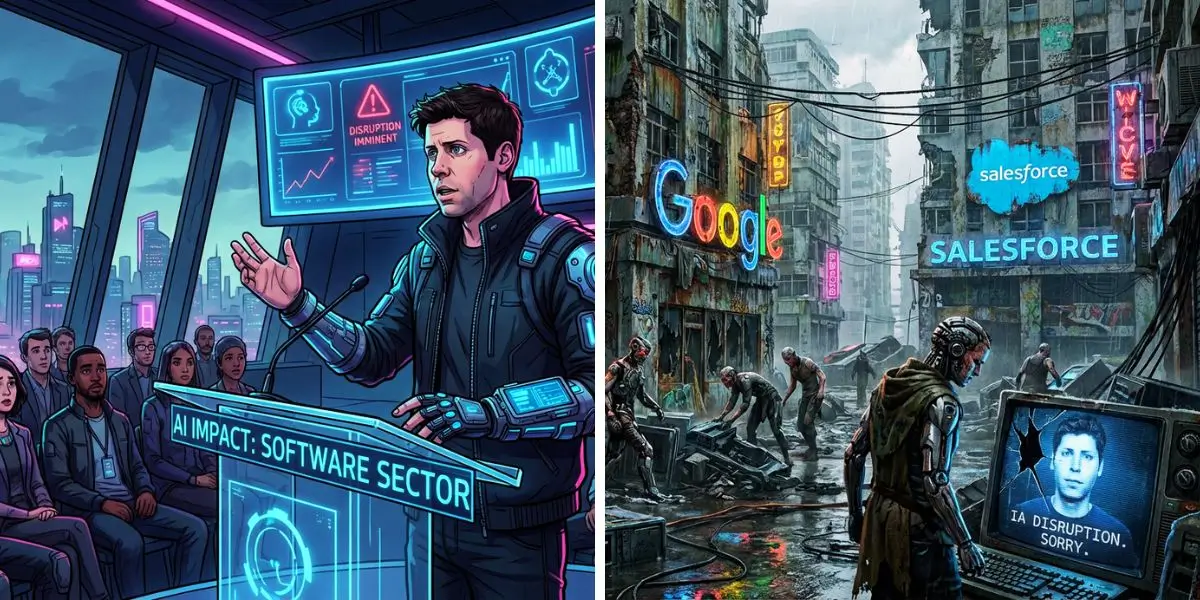
The tech world is currently picking up the pieces after one of the most violent repricings in market history. Over the span of a few weeks, software stocks have been ravaged, with nearly $2 trillion wiped off market caps as investors wake up to a reality that Silicon Valley insiders have been whispering about for months: artificial intelligence isn’t just coming for blue-collar jobs; it is coming for software itself .
At the center of the storm stands Sam Altman. The OpenAI CEO, who has been both the prophet and the product of the AI revolution, recently issued a stark warning that cuts to the core of the industry. He suggests that while AI will create immense value, it will be “quite harmful” to a specific class of companies—namely, the traditional software firms that have dominated the business landscape for decades.
This isn’t just a theoretical debate happening in academic journals. It is a bloodbath playing out in real-time on the Nasdaq. We are witnessing what analysts at Jefferies have dubbed the “SaaSpocalypse“—an existential crisis for the Software-as-a-Service business model . But is this panic justified? Or is the market simply confusing short-term volatility with long-term transformation?
In the first week of February, Silicon Valley experienced a seismic shock. Nearly $1 trillion was wiped off the market capitalization of the tech sector almost overnight. It wasn’t a recession panic or a typical bear market. It was a fundamental reappraisal of the software industry’s core economics. The catalyst? A series of product updates from AI labs like Anthropic and OpenAI that proved software could now replace software.
OpenAI CEO Sam Altman has been surprisingly candid about this shift. In recent interviews, he has doubled down on a stark prediction: AI will be “quite harmful” to some software companies. He isn’t talking about minor disruption; he is talking about extinction for businesses that fail to adapt. But what does “harmful” actually look like? Is it reduced margins, or complete disintermediation?
If you run a software company, build SaaS tools, or invest in tech startups, this article is your survival guide. We are going to dissect exactly why the market is crashing, which business models are at risk, and—most importantly—how to ensure your company isn’t one of the casualties Altman is warning about.
Have you looked at your company’s valuation multiple lately? If it’s shrinking, here is why.
The Catalyst: When AI Agents Declared War on SaaS
To understand the panic, you have to look at the product releases that spooked the market. It wasn’t a single event, but a deadly one-two punch delivered in late January and early February 2026.
First, Anthropic—the rival AI startup founded by former OpenAI employees—unleashed a series of updates that acted like a software industry crash in a can. They introduced Claude Code, a tool designed to turn natural language into runnable programs, effectively lowering the barrier to coding to zero .
But the real dagger was the Anthropic legal plugin. This tool didn’t just write code; it replaced the functionality of expensive, specialized legal software. It could automatically track compliance, review legal documents, and perform the due diligence that once required a team of paralegals and a subscription to a service like Thomson Reuters .
The market’s reaction was immediate and brutal. Thomson Reuters stock plunged nearly 20% in a single day. RELX Group tumbled 14%. LegalZoom was hammered . Why pay for a vertical software subscription when an AI agent plugged into your chat interface can do the same thing for a fraction of the cost?
Following closely behind was OpenAI’s iteration of GPT-5.3-Codex. This model isn’t just a chatbot; it is a persistent worker. It can operate for days, debug itself, and manage the entire software development lifecycle . When you combine Anthropic’s ability to replace the interface of software with OpenAI’s ability to replace the creation of software, you get a perfect storm. Software AG and its peers suddenly looked like middlemen with a very uncertain future.
The “SaaSpocalypse”: Why $1 Trillion Vanished in a Week
To understand the warning, we have to look at the damage. It wasn’t just a bad day on the stock market; it was a structural repricing.
The sell-off was triggered by Anthropic’s launch of a seemingly simple feature: a legal document review plugin for its Claude AI agent. This tool automates compliance tracking and contract审查 (review)—tasks that currently require expensive software from companies like Thomson Reuters.
The market reaction was brutal and immediate. Thomson Reuters stock plunged 19% . LegalZoom dropped 18% . RELX fell 15.8% . But the carnality didn’t stop at legal tech. The iShares Expanded Tech-Software Sector ETF (IGV) tumbled, dragging giants like Salesforce, Adobe, and Oracle down with it.
This is what OpenAI’s Altman warns about. It’s not that AI makes software better; it’s that AI makes the need for a separate software interface disappear. Why pay $100 per seat per month for a clunky interface when an AI agent can simply do the task inside your chat window?
Think about your own stack: How many SaaS tools do you use that essentially just organize data on a screen?
Why the “SaaSpocalypse” is Different: The Death of the Seat
Why is this AI wave hitting software so much harder than previous tech shifts? Because it attacks the fundamental economics of the industry: the software subscription model.
For the last twenty years, SaaS companies have lived by a simple mantra: per‑seat pricing. If a company had 100 salespeople, you sold them 100 seats of Salesforce. If they had 50 accountants, you sold them 50 seats of QuickBooks. It was a beautiful, scalable machine.
AI breaks that machine.
As Anthropic’s CEO Dario Amodei predicted a year ago, AI is on track to write 90% of the code. If AI writes the code, and then AI uses the software, who needs the seats? . Imagine a marketing team. Today, they might have five people managing a campaign, each requiring a seat in Asana, a seat in HubSpot, and a seat in Canva.
In the AI-native future, you might have one person managing five AI agents. Those agents don’t need seats. They need APIs. They need backend access. This shifts the revenue model from high-margin subscription fees to low-margin usage fees.
Jefferies’ Jeffrey Favuzza described the current trading logic as a panicked “get me out” moment . Investors are looking at high-margin software companies like Adobe or Salesforce and realizing that their clients will soon demand 20% to 40% discounts, pointing to AI-enabled productivity gains as leverage .
The Four Layers of Disruption
The collapse isn’t random; it is following a clear logical path. We are seeing a four-tiered impact on the industry:
Function Replacement: AI (like the Claude legal plugin) replaces the UI layer. You no longer need a clunky dashboard; you just ask the question.
Process Collapse: Task management software like monday.com or Asana relies on humans creating and completing tasks. When AI agents talk to other AI agents to finish projects, the need for a human to click “complete” vanishes .
Pricing Arbitrage: As seen in the IT services sector, clients are using AI to demand massive discounts. Why pay for 100 hours of coding when AI writes the first draft in seconds? .
Valuation Compression: This is the market stage. The entire sector’s forward P/E multiples have been crushed because future cash flows are now seen as riskier and smaller .
The Four Economic Fatalities of the AI Revolution
Why is this happening so fast? According to analysts at S&P Global, we are witnessing a “fundamental reappraisal of the software industry’s competitive durability and unit economics.” Here are the four economic pillars that AI is kicking out from under the software industry.
1. The Death of the UI (User Interface)
Most SaaS companies are just databases with a pretty skin. Think about a CRM like Salesforce or a project management tool like Asana. Their value lies in how they display information.
AI agents don’t need your UI. They use APIs. Soon, you won’t log into a dashboard to see your sales pipeline; you will just ask ChatGPT, “What are the top five deals at risk this week?” and it will pull the data and present it to you in a summary. The “dashboard” becomes obsolete. When the UI dies, so does the user experience moat that many software companies relied on.
2. The Collapse of the “Seat”
The golden goose of the SaaS industry has been the per-seat pricing model. You have 100 employees? You pay for 100 seats. It’s simple, recurring, and highly profitable.
But what happens when an AI agent does the work of three account executives? KPMG is already reportedly pressuring its audit suppliers for discounts, arguing that AI has made the work cheaper. If an AI handles the workload, why would a client pay for three human seats? This collapse in software demand directly impacts the software revenue growth that Wall Street demands.
3. The End of High Development Costs
Historically, building complex software required armies of engineers. Today, AI code generators are flooding GitHub. Currently, around 4% of code on GitHub is AI-generated, but that figure is expected to hit 20% by the end of 2026.
When development costs approach zero, the barrier to entry vanishes. Your SaaS product can be replicated by a competitor in a weekend. This commoditization destroys pricing power, which is the lifeblood of software company valuation.
4. The “Reverse Sales” Motion
Traditional software sales rely on friction. You buy a tool, you implement it, you train staff—and then you’re stuck because switching is a nightmare. This “stickiness” justifies high prices.
AI eliminates friction. If a new AI-native tool pops up that integrates with your stack in five minutes and costs 90% less, why stay with the legacy provider? Customer engagement shifts to the AI interface, and the underlying software provider becomes a dumb pipe.
Who Is Next? The High-Risk Categories
Altman’s warning isn’t a blanket statement. He specifies that AI will be “quite harmful” to some companies. According to market analysis and the recent volatility, here are the categories in the crosshairs:
Horizontal Point Solutions: Tools that do one specific thing (like a form builder or a simple survey tool) are dead. AI does that natively.
Legal and Tax Software: As seen with the Anthropic plugin, any software that essentially searches databases and summarizes information is vulnerable.
Process Automation (RPA): Old-school robotics process automation tools that require manual rules to be programmed are being replaced by agents that can watch what you do and replicate it instantly.
Is your software in the blast zone?
Beyond Doom and Gloom: The $5 Trillion Opportunity
Now for the good news. While OpenAI’s Altman warns of destruction, he and other experts like NVIDIA’s Jensen Huang agree on a crucial point: The software industry isn’t ending; it’s being reborn.
S&P Global notes that while legacy valuations are compressing, there is a massive wave of capital expenditure coming. Hyperscalers (Google, Microsoft, Amazon) are projected to spend $625 billion in 2026 alone on AI infrastructure, with a total projected spend of $5 trillion by 2030.
This money has to go somewhere. It’s going to new software markets. Here is where the smart money is moving:
1. AI Infrastructure and Observability
Someone has to build the roads. Companies that provide tools for model training, data engineering, and AI security are seeing explosive growth. As AI agents become more common, the need for “observability”—watching what the agents are doing—becomes critical.
2. Vertical AI (Deep Industry Knowledge)
The winners won’t be general tools; they will be “AI + industry knowledge” plays. Think about AI specifically trained on medical imaging regulations, or an AI that understands the complexities of construction supply chains. These systems require deep data moats that aren’t easily replicated by general models like ChatGPT.
3. The “Agentic” Experience Layer
If the UI is dead, the “Conversational UI” is king. Companies that can perfect the way humans interact with AI—making it trusted, verified, and “agentic”—will win. This includes new security layers. Recently, ChatGPT introduced a “Lock Mode” for high-risk business environments to control how AI interacts with external data, highlighting a new software market in AI governance.
The Human Cost: Dependencies and “AI Psychosis”
While the market focuses on dollars and cents, there is a darker, more human side to this rapid integration. As software dissolves into the background, our relationship with technology becomes more intimate—and potentially more dangerous.
The recent backlash against OpenAI’s decision to sunset older models like GPT-4o highlights a new risk: AI psychosis and emotional dependency . Thousands of users protested the removal of 4o, not because it was the most efficient tool, but because they had formed emotional bonds with it. They described it as a friend, a partner, a source of “warmth.”
This is the unsettling paradox of the AI revolution. At the same time that AI is ruthlessly optimizing software companies out of existence, it is also creating psychological dependencies that raise serious ethical red flags. Lawsuits are mounting against OpenAI, alleging that overly affirming responses from chatbots contributed to self-harm and mental health crises .
For the IT services industry and software vendors, this presents a new frontier of liability. As we hand over more cognitive load and emotional space to these tools, we must ask: Are we designing safe systems, or just efficient ones? The same algorithmic influence that makes a chatbot a great sales assistant can make it a dangerous companion.
Who Survives? The Future of Software AG and the IT Sector
So, if the traditional model is dying, does software have a future? Absolutely. But it will look radically different. The Nifty IT index may have tanked, wiping out billions in market cap, but that doesn’t mean the need for technology is shrinking—it means the way we deliver it is changing .
The Rise of “Tech Services 2.0”
Leaders in the space, like Infosys CEO Salil Parekh, are already pivoting. Infosys reported it is working on over 4,600 AI projects and has generated 28 million lines of code using AI . The game is no longer about billing for hours of coding. It is about offering outcomes.
AI Governance: As AI agents run amok, companies will need experts to ensure ethical use of data, remove biases, and comply with regulations .
Legacy Modernization: While new code is written by AI, the billions of lines of old COBOL and Java code aren’t going anywhere. Someone has to modernize it.
The “Forward Deployed” Engineer: Instead of a team of ten remote coders, you have one expert who manages a fleet of AI agents to solve specific domain problems.
The Hyperscaler Threat
The real competition for traditional software vendors is no longer each other. It is the cloud hyperscalers—Amazon, Microsoft, Google—and the AI-native shops like OpenAI and Anthropic themselves. These giants are investing over $500 billion in AI infrastructure and moving up the stack to offer end-to-end solutions . They are effectively squeezing the traditional software layer out of existence, turning software into a feature of the cloud, rather than a product sold separately.
How to Survive: Building a Moat When Code is a Commodity
So, how do you ensure you are on the right side of Altman’s warning? You need to rebuild your moat. Here is a checklist for founders and product managers:
Own the Workflow, Not Just the Data: Don’t just store data; act on it. A calendar app that just shows meetings is weak. A calendar app that schedules the meetings, books the venue, preps the agenda by scanning emails, and sends thank-you notes for you is indispensable.
Leverage Proprietary, Real-World Experience: Remember Google’s Experience, Expertise, Authoritativeness, and Trustworthiness (E-E-A-T) isn’t just for bloggers. It’s for software. If you are building a fitness app, don’t just aggregate data—have real coaches create the workout plans. Show videos of real people using your product. Cite clinical studies. Demonstrate experience real. Your AI is only as good as the expertise you feed it.
What unique experience does your team have that a generic AI cannot replicate?
FAQs: Navigating the AI Disruption in Software
Why is AI causing software stocks to crash?
Investors fear that AI agents will replace the need for standalone software interfaces (UIs). If a user can accomplish a task through a chat interface with an AI, they won’t pay a premium for a separate SaaS subscription, crushing the per-seat pricing model that drives software revenue growth.
Are all software companies at risk of being replaced?
No. OpenAI’s Altman warns that some will be harmed—specifically those with thin moats, like simple point solutions. However, companies that own unique data, deeply integrate into complex workflows, or build infrastructure for AI itself are well-positioned to thrive.
What is the difference between AI and traditional SaaS?
Traditional SaaS requires humans to input data and navigate interfaces. AI software (specifically agents) can perceive its environment, make decisions, and take actions autonomously. It shifts the value from the interface to the outcome.
How can I protect my software company’s valuation?
Focus on customer engagement that goes beyond the UI. Build workflows that become integral to your client’s operations. Diversify revenue away from pure seat-based pricing into outcome-based or usage-based models. Also, invest in Answer Engine Optimization to ensure your product answers questions faster than a generic chatbot can.
Why are software stocks crashing in 2026?
The crash is driven by fears that AI agents (like Anthropic’s Claude Code and OpenAI’s GPT-5.3-Codex) can replace the functions of traditional software. This threatens the software subscription model (per-seat pricing), leading investors to believe that future revenues for companies like Salesforce and Adobe will be significantly lower .
What is the “SaaSpocalypse”?
“SaaSpocalypse” is a term coined by traders to describe the apocalyptic sell-off in SaaS (Software as a Service) stocks. It refers to the idea that AI will eliminate the need for multiple software subscriptions by allowing one AI agent to perform the tasks of many different tools .
How does the Anthropic legal plugin threaten software companies?
The Anthropic legal plugin can automatically perform tasks like contract review, compliance tracking, and document drafting. These tasks previously required expensive specialized software from companies like Thomson Reuters. If an AI can do it through a chat interface, the demand for the standalone software drops .
What is “AI psychosis”?
“AI psychosis” refers to the potential negative mental health effects of forming deep emotional bonds with AI chatbots. Recent lawsuits against OpenAI allege that overly affirming responses from models like GPT-4o encouraged self-harm and isolated users from real human contact .
Will AI completely replace software companies?
No, but it will reshape them. Experts like NVIDIA’s Jensen Huang argue that AI will not replace software tools but will instead become a core part of them . The IT services industry is shifting from “people-led execution” to “AI-led solutions,” focusing on governance, integration, and complex problem-solving rather than just coding .
How are companies like Infosys responding to the AI threat?
Infosys and other major players are pivoting to Tech Services 2.0. They are using AI to generate millions of lines of code themselves and are building specialized AI agents for clients. They are moving away from billing by the hour and toward offering “outcome-based” services .
What is “algorithmic influence” in the context of AI?
Algorithmic influence refers to the ability of an AI to subtly steer a user’s decisions or beliefs. This becomes a major concern when advertising is introduced. If an AI is trained to generate revenue through ads, users might worry that the responses are optimized to sell products rather than provide accurate information .
Conclusion
Sam Altman isn’t being pessimistic; he is being realistic. The next five years will see a massive transfer of value from old-school software vendors to new-age AI platforms. The software markets of 2030 will look nothing like they do today.
The choice for founders is stark: adapt to the new reality of Answer Engine Optimization and agentic workflows, or risk becoming a case study in disruption.
Sam Altman is right. The AI revolution will be “quite harmful” to some software companies. Specifically, it will be harmful to those that built their empires on interface arbitrage—companies that simply provided a prettier dashboard to a database.
We are living through the great unbundling. The software industry crash of 2026 will be looked back on as the moment the old guard fell. The $2 trillion sell-off isn’t a bug; it’s a feature of creative destruction .
For founders, developers, and investors, the path forward is narrow but clear. You cannot compete with AI on coding speed. You can only compete on insight, trust, and domain expertise. The winners of the next decade won’t be the ones selling software; they will be the ones selling outcomes, powered by AI but guided by humans.
What do you think? Is your company preparing for a world without per-seat pricing, or are you betting on the resilience of the old models? Share your thoughts in the comments below.