


![[PR] EVE Frontier Free Trial Access Runs From April 1 To 13](https://www.geekmetaverse.com/wp-content/uploads/2026/03/eve-1-360x180.webp "EVE Frontier Free Trial Access Runs From April 1 To 13 - altman")




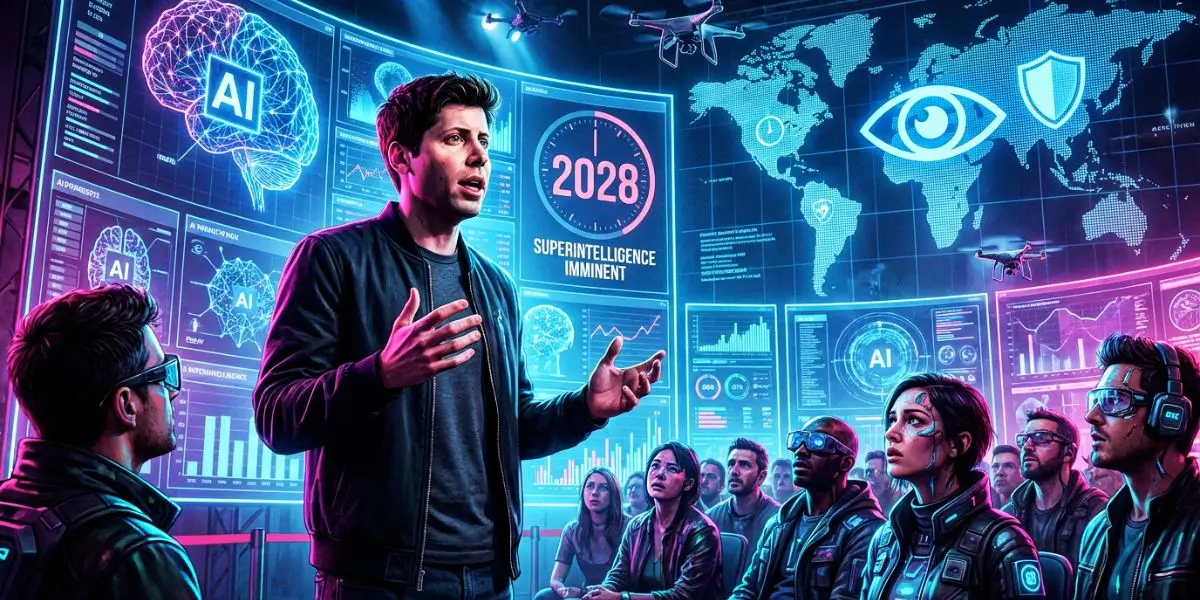
The clock on humanity’s next great revolution just ticked a little louder. At the India AI Impact Summit 2026 in New Delhi, OpenAI CEO Sam Altman dropped a bombshell that sent ripples through the tech world. He isn’t just talking about better chatbots or smarter assistants; he is talking about the end of human intellectual primacy as we know it. OpenAI’s Altman predicts superintelligence by 2028, a timeline that compresses the future into a startlingly short window. But with that prediction comes a stark warning: we need a global watchdog, and we need it now.
Imagine a world where the next Nobel Prize-winning physics theory is derived not by a human, but by a machine quietly humming in a data center. Imagine a CEO making multi-billion dollar decisions with a precision no human executive could match. This isn’t science fiction. According to Altman, this is our immediate future. “On our current trajectory,” he stated, “we believe we may be only a couple of years away from early versions of true superintelligence.”
This isn’t just another incremental tech update. It is a fundamental shift in the balance of intelligence on our planet. Are we ready for a world where we are no longer the smartest entities in the room? Let’s break down what this prediction means, why it requires an international agency to oversee it, and how it will impact your life, your job, and the global economy.
But what does this actually mean for you? For your job? For the global economy? If you feel like the future is arriving faster than you can keep up, you are not alone. The gap between science fiction and reality is collapsing, and understanding the roadmap to Artificial General Intelligence (AGI) is no longer optional. This article breaks down Altman’s vision, the evidence backing it, and the seismic shifts we need to prepare for right now. Ready to see what the world looks like on the other side of 2028?
The 2028 Prediction: More Intelligence in Data Centers Than in Human Brains
During his keynote address, Altman painted a picture of a world on the cusp of a radical transformation. “On our current trajectory, we believe we may be only a couple of years away from early versions of true superintelligence,” he stated. He quantified this shift with a staggering metric: “By the end of 2028, more of the world’s intellectual capacity could reside inside data centers than outside of them” .
Think about that for a second. The collective problem-solving power, the creativity, the analytical depth of billions of humans, potentially surpassed by machines humming in server farms. This isn’t about a smarter chatbot. This is the dawn of superintelligence, a hypothetical stage where a machine’s cognitive abilities far surpass the brightest minds across every conceivable domain—from scientific reasoning to creative arts and social wisdom .
The “First Proof” That Changed Everything
You might be thinking, “This sounds like typical Silicon Valley hype.” But Altman came armed with receipts. He cited a recent internal event at OpenAI called “First Proof,” a benchmark designed to test genuine reasoning, not just retrieval.
The Result: An OpenAI model solved seven out of ten research-level mathematics problems that had no prior published proof .
The Implication: The AI wasn’t regurgitating answers from the internet; it was generating novel solutions. Altman doubled down, claiming some models are now producing original results in theoretical physics—creating new knowledge, not just finding old data .
This is the inflection point. If machines can hypothesize and prove theorems faster than any human, the pace of innovation becomes exponential. Are your current skills future-proof against that kind of acceleration? This is the hard question businesses and individuals must face today.
What is Superintelligence, Really?
To understand the weight of this, we need to define the term. We aren’t talking about Artificial General Intelligence (AGI) , which is usually defined as AI that can perform any intellectual task that a human can. Superintelligence is the next stage. It refers to a hypothetical agent that possesses intelligence far surpassing that of the brightest and most gifted human minds in every field, including scientific creativity, general wisdom, and social skills.
Altman provided a concrete example of how close we are getting. He cited an internal OpenAI event called “First Proof” where a model solved seven out of ten research-level mathematics problems that had no prior published proof. This isn’t rote learning or data retrieval; this is the generation of new knowledge. He added that these systems are already producing novel results in theoretical physics.
Beyond Human Ceos and Scientists
Perhaps the most humbling aspect of Altman’s speech was his admission that this intelligence will leave human experts in the dust. He predicted that superintelligence, at some point on its development curve, “would be capable of doing a better job as CEO of a major company than any executive could, or doing better research than our best scientists.” He even added, with a candid dose of humility, “including myself.”
Think about that for a second. We are looking at a future where strategic leadership and groundbreaking discovery are no longer human domains. This isn’t about automation replacing factory workers; it is about intelligence replacing the “thinkers.” OpenAI’s Altman predicts superintelligence by 2028 that will force us to redefine the very concept of “work” and “value” in society.
Beyond Altman: The Industry Sees the Horizon
Altman isn’t the only one staring at this future. The consensus is building that superintelligence by 2028 is a realistic, if terrifying, target.
Anthropic’s Timelines and the “Economic Turing Test”
Just months before Altman’s speech, Anthropic co-founder Benjamin Mann (a former OpenAI engineer and founding architect of GPT-3) shared a strikingly similar prediction. He stated that based on the expansion of computing power and the “Scaling Law” (which posits that AI improves predictably with more data and compute), superintelligence could emerge as early as 2028 .
Mann introduced a powerful concept to measure this shift: the “Economic Turing Test.” He suggests that Artificial General Intelligence (AGI) will be achieved when an AI agent can pass a blind test for 50% of high-paying, high-value roles. Imagine hiring a “worker” without knowing if it’s a human or a machine. When employers stop caring, because the output is identical (or better), that’s the moment the economic fabric tears and rewrites itself .
The “Humanist” Counterpoint
Interestingly, this isn’t just a race for raw power. Mustafa Suleyman, CEO of Microsoft AI, has proposed a different vision: Humanist Superintelligence (HSI) . This approach argues that superintelligence must be designed specifically to work for people, remaining domain-specific and carefully calibrated rather than becoming an unbounded, autonomous entity . This highlights a crucial fork in the road: Do we build gods, or do we build tools?
The IAEA for AI: Why Global Oversight is Non-Negotiable
With great power comes the need for unprecedented global oversight. Altman was emphatic that we cannot let this technology fester in the hands of a few. “Centralization of this technology in one company or country could lead to ruin,” he warned .
He proposed a radical solution: a global regulatory body modeled after the International Atomic Energy Agency (IAEA).
Why the IAEA? The IAEA is designed to monitor nuclear programs, ensure they are used for peaceful purposes, and rapidly respond to threats.
For AI: Altman envisions an international body with the authority to coordinate safety standards, conduct inspections, and force a “rapid response to changing circumstances” .
This call for international coordination comes as governments scramble to catch up. According to Gartner, over 70% of IT leaders already cite regulatory compliance as a top-three challenge for deploying AI, and the landscape is a minefield. The EU is forging ahead with its binding AI Act, while the US leans toward industry self-regulation . Without a unified global front, we risk a “race to the bottom” where companies simply move their superintelligence development to the least restrictive jurisdiction.
Why an Atomic Energy Model?
The comparison to nuclear technology is deliberate. Just as fissile material can power a city or destroy it, superintelligence holds dual-use potential. Altman warned that “centralization of this technology in one company or country could lead to ruin.” He painted a stark picture of a dystopian future where a single entity uses AI to amass unprecedented power and wealth, leading to a new kind of global imbalance.
Shared Standards: An international body could establish safety standards that every nation agrees to, preventing a race to the bottom where countries loosen regulations to attract AI investment.
Monitoring High-Risk Systems: Just as the IAEA monitors nuclear reactors, this new body would monitor the largest AI training runs and data centers to ensure they aren’t being used for malicious purposes.
Rapid Response: Perhaps most importantly, Altman stressed the need for an agency with the authority to respond quickly to emergencies—whether that’s a rogue AI or the use of these systems in warfare.
He framed this as a choice between democracy and totalitarianism. “Some people want effective totalitarianism in exchange for a cure for cancer,” he said. “I don’t think we should accept that trade-off, nor do I think we need to.” This is the ethical core of his message: we must not sacrifice our liberty for technological miracles. We must have both.
The Socioeconomic Earthquake: Jobs, Education, and Power
If the machines become smarter than us, what’s left for humanity? Altman addressed this head-on, acknowledging the painful transitions ahead. He specifically warned against “cognitive offloading“—the tendency to let AI do our thinking for us—which poses an existential threat to education .
The Classroom Revolution
In India alone, OpenAI has 100 million weekly users, a third of which are students . This creates a paradox. If students use ChatGPT to write essays and solve problems, are they learning or just outsourcing their memory?
Altman argued that the very nature of teaching and evaluation must change. “If we don’t make any changes to the way we teach and evaluate students, maybe they will do too much cognitive offloading to ChatGPT,” he said. The benchmark for success must rise. Instead of testing rote memorization, we will need to test how effectively students can direct the AI and curate its output .
The Job Market Metamorphosis
Benjamin Mann of Anthropic provides a stark breakdown of the labor landscape:
Immediate Impact: AI agents are already handling specific tasks. In customer service, tools like Intercom’s Fin can now solve 82% of routine issues without human intervention. In software, AI like Claude Code can generate up to 95% of basic code, allowing human engineers to focus on the complex 5% .
Medium-Term Displacement: Mann predicts that up to 20% of white-collar jobs could disappear or be radically transformed .
Long-Term Abundance? Looking 20 years out, if we manage the transition, we could enter an era where labor is nearly free and expert intelligence is a commodity. In that world, the concept of a “job” might look as archaic as a “blacksmith” does today. However, the path to that utopia runs directly through a painful period of economic adjustment .
The Economic and Social Tipping Point
If these predictions hold true, the “AI superintelligence tipping point” will reshape our world faster than the Industrial Revolution. The conversation at the summit inevitably turned to jobs and the economy.
Hard to Outwork a GPU
Altman offered a sobering reality check for the modern workforce: “It’ll be very hard to outwork a GPU in many ways.” As AI becomes capable of handling complex cognitive tasks, the nature of employment will shift dramatically.
Job Disruption: Roles that involve processing information, from legal discovery to financial analysis, will be heavily impacted. Altman acknowledged this, noting that disruption is the flip side of technological progress.
The Human Advantage: However, he also pointed to a distinctly human trait that will become more valuable: our social wiring. “We really seem hard-wired to care about other people much more than we care about machines,” he noted. This suggests a future where interpersonal roles—caregiving, therapy, leadership, community building—become the core of human employment.
Cognitive Offloading: There is a risk that we become too dependent. Altman expressed concern about “cognitive offloading,” where students and professionals outsource their thinking to AI, potentially atrophying their own mental faculties. This is a challenge for educators and parents: how do we teach kids to use the tool without letting the tool use them?
India’s Role in the Democratization of AI
It is no coincidence that Altman chose India to make these announcements. With 100 million weekly ChatGPT users in the country—a third of them students—India is a critical front in the AI revolution. He sees the nation as a test case for the “democratisation of AI.”
Alongside the warning, OpenAI announced a partnership with the Tata Group to build sovereign AI infrastructure and rolled out over 100,000 ChatGPT Edu licenses to top Indian institutes. This is a direct attempt to distribute the benefits of AI, preventing it from becoming a tool of the elite.
“No one country should be in charge of superintelligence,” Altman reiterated in an interview. He envisions a world with a balance of power, where multiple nations and cultures have a stake in how AI develops. This prevents the imposition of a single set of values on a global superintelligence and fosters a more resilient, pluralistic future.
Preparing for the Unknown: Guiding Principles
Faced with a future that is impossible to predict with certainty, Altman outlined three beliefs to guide us through this transition :
Democratise or Die: The future must increase human agency, not suppress it. AI benefits must be broadly shared.
Resilience is Safety: We cannot build a perfect cage for AI. Instead, we must build resilient societies and systems that can withstand shocks and recover from them.
Embrace Uncertainty: The development of AI will hold many surprises. We must be humble, iterate carefully, and allow society time to co-evolve with each new level of capability.
This isn’t just a tech story. It’s a human story. OpenAI’s Altman predicts superintelligence by 2028 not to scare us, but to wake us up. The next few years will test our global society like never before.
How to Survive and Thrive in the Age of Superintelligence
So, how do you avoid being left behind? The consensus from the experts is clear: adaptation is the only way out.
1. Embrace the “Co-Pilot” Mindset
Don’t fight the tool; learn to fly it. Data shows that users who iterate with AI—refining their prompts and trying new approaches when the first response fails—see success rates soar after just 3-4 attempts . The threat isn’t the AI; it’s the human using AI better than you.
2. Double Down on Creativity
Mann suggests that while AI can handle analysis and ex
ecution, creativity may be the last line of defense for humans . The ability to imagine something that has never existed, to feel empathy, and to connect disparate ideas in novel ways remains, for now, a human stronghold.
3. Diversify Your Intellectual Portfolio
Don’t rely on a single skill that a machine can replicate. Focus on roles that require complex negotiation, high-level strategy, and interpersonal trust. As Altman noted, “We really seem hard-wired to care about other people much more than we care about machines” . Jobs built on human connection may prove the most resilient.
Conclusion: The Future is a Choice
Sam Altman’s prediction of superintelligence by 2028 is more than a headline; it is a deadline. It forces us to confront uncomfortable questions about democracy, inequality, and the very definition of human purpose. The development of AI is accelerating, and the “Scaling Law” shows no signs of slowing down .
We stand at a precipice. On one side lies the “ruin” of centralized power that Altman warns about. On the other lies the potential for a “collective external lattice” around human cognition—a scaffold that makes us smarter, healthier, and more capable than ever before . The difference between these two outcomes hinges on the decisions we make today regarding global oversight, education reform, and our personal willingness to adapt.
What side of history will you be on? The machines are getting smarter. It’s time for humanity to do the same.
Frequently Asked Questions (FAQ)
1. What is Superintelligence?
Superintelligence refers to a hypothetical stage in AI development where a machine’s cognitive abilities far surpass those of the smartest humans across every conceivable domain, including scientific creativity, general wisdom, and social skills .
2. When does Sam Altman predict Superintelligence will arrive?
Sam Altman predicts that early versions of true superintelligence could arrive within “a couple of years,” specifically stating that by the end of 2028, more intellectual capacity could reside in data centers than in humans .
3. What is the “IAEA for AI” that Altman mentioned?
Altman proposed a global regulatory body modeled on the International Atomic Energy Agency (IAEA) . This agency would be responsible for the international coordination of AI development, ensuring safety, monitoring compliance, and having the authority to respond rapidly to emergencies related to advanced AI systems .
4. How will Superintelligence affect my job?
The impact will be significant. Experts predict a transition period where AI automates specific tasks (like coding or customer service), potentially displacing up to 20% of white-collar roles. However, it will also create new roles focused on managing, directing, and collaborating with AI. Jobs requiring high creativity and deep human connection are expected to be the most resilient .
5. What is the “Economic Turing Test”?
Coined by Anthropic’s Benjamin Mann, the “Economic Turing Test” is a benchmark for Artificial General Intelligence (AGI) . It is passed when an AI system can perform a high-value job so well that an employer cannot tell (or does not care) whether the worker is a human or a machine .
6. What is “cognitive offloading”?
Cognitive offloading is the tendency to use AI tools as a substitute for critical thinking and memory. Sam Altman warned that this is a major risk in education, where students might use ChatGPT to solve problems instead of learning the underlying principles .
7. What evidence is there that we are close to Superintelligence?
Altman pointed to OpenAI’s “First Proof” event, where an AI model solved advanced math problems without prior proofs. He also noted that AI systems are beginning to generate original results in fields like theoretical physics, moving beyond simple data retrieval to actual knowledge creation .
8. Can Superintelligence be controlled?
This is the central question of AI safety. OpenAI itself has warned that superintelligence could pose catastrophic risks if not properly aligned with human values. Technical work on “alignment” (ensuring AI does what we want) is critical, which is why experts are calling for development to be paired with robust safety research and global oversight .