
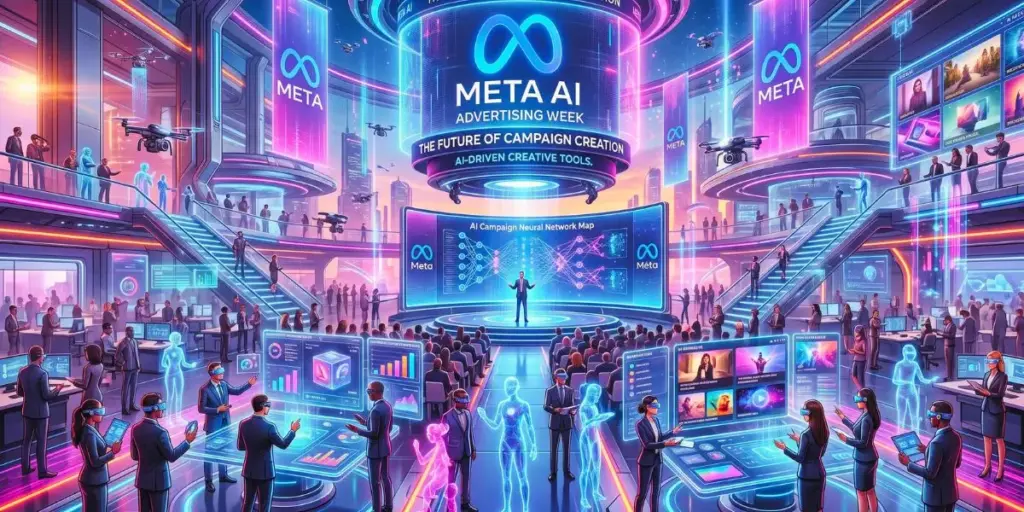

Creating a high-performing advertising campaign still requires more than generating a headline and pressing “publish.” Marketers must produce multiple creative variations, preserve brand consistency, choose audiences, manage approvals, work with creators, and evaluate performance. Meta’s latest advertising announcements aim to connect more of those tasks through AI.
At Advertising Week New York 2026, Meta presented new and expanded AI capabilities for advertisers, agencies, creator marketers, and businesses that communicate with customers through its platforms. The announcements cover creative generation, campaign guidance, brand memory, creator collaboration, multilingual production, and AI-assisted business conversations.
This article explains what Meta announced, which features appear to be in testing or gradual rollout, how the tools may affect campaign workflows, and what advertisers should evaluate before relying on AI-generated recommendations.
What did Meta announce at Advertising Week?
Meta announced a group of AI-powered advertising and business tools designed to help marketers plan, create, optimize, and connect with customers across its ecosystem.
The main areas include:
-
AI-assisted campaign planning and guidance.
-
A creative environment for analyzing performance and generating new concepts.
-
Brand memory for more consistent AI-generated assets.
-
Expanded text and image-generation features in Ads Manager.
-
Multilingual text and voice support.
-
Centralized creative approval workflows.
-
A unified creator marketing hub.
-
AI-powered business agents for customer conversations.
The announcement is better understood as an ecosystem update rather than a single new advertising product. Some features are being tested, while others represent expanded capabilities inside existing Meta tools.
Expert insight: The strategic shift is not simply “AI can make ads.” Meta is trying to connect creative production, campaign data, creator content, approvals, and customer interactions into one feedback loop.
Why is Meta investing in AI advertising tools?
Meta is investing in AI advertising tools because campaign performance depends on the interaction between creative quality, audience relevance, delivery systems, and conversion signals.
A traditional workflow might look like this:
-
A creative team develops several concepts.
-
A media buyer uploads assets to Ads Manager.
-
The campaign launches with selected audiences and budgets.
-
Performance data accumulates.
-
The team identifies stronger creative patterns.
-
New assets are produced manually.
-
The cycle begins again.
AI can shorten parts of this cycle by analyzing previous campaign data, generating variants, translating assets, and suggesting adjustments. That does not remove the need for human judgment. It changes where the team spends its time.
Meta has previously described AI as a central part of ad ranking, delivery, optimization, and business assistance. In 2026, the company said it was expanding AI support so advertisers could receive campaign recommendations and account assistance through conversational interactions.
What is Meta’s new creative AI environment?
Meta described a broader creative solution intended to help marketers explore strategy, identify high-performing creative patterns, develop new assets, and evaluate them against business objectives.
The proposed workflow includes:
-
Reviewing which creative elements perform well.
-
Identifying patterns across prior campaigns.
-
Generating new creative directions.
-
Adapting assets to different formats.
-
Testing variations against defined objectives.
-
Collaborating between media and creative teams.
This approach matters because many advertising teams struggle with a familiar bottleneck: they can buy impressions efficiently, but they cannot produce enough high-quality creative variations quickly enough.
Creative volume versus creative quality
Generating more assets is not automatically beneficial. A campaign may become harder to govern if it produces dozens of variations that differ in tone, legal language, product claims, or visual identity.
The strongest use of AI is not unlimited production. It is controlled experimentation:
-
Start with a clear brand framework.
-
Define the audience and campaign objective.
-
Generate a limited set of variants.
-
Review claims and visual details.
-
Test performance.
-
Feed validated insights back into the creative process.
Meta’s announcement suggests that its tools are designed to use campaign insights as part of future creative decisions.
What is Meta Brand Memory?
Meta Brand Memory is a proposed capability that allows AI tools to learn a brand’s tone, visual identity, historical advertising patterns, and creative preferences.
In practical terms, a brand memory system could help an advertiser maintain consistency across:
-
Headlines.
-
Primary text.
-
Product descriptions.
-
Visual composition.
-
Color usage.
-
Voiceover style.
-
Calls to action.
-
Creator and partnership assets.
Brand consistency is difficult when multiple agencies, freelancers, markets, and internal teams produce advertising at the same time. An AI system trained on approved brand material could reduce some inconsistencies.
However, a brand memory should not be treated as a substitute for a brand governance system. Marketers still need to define:
-
Prohibited claims.
-
Restricted topics.
-
Approved product terminology.
-
Legal disclaimers.
-
Regional differences.
-
Accessibility requirements.
-
Sensitive audience policies.
-
Human approval thresholds.
Pro tip: Build a “do not generate” list alongside your brand guidelines. Style instructions tell AI what the brand sounds like; exclusion rules tell it what the brand must never claim
How will Ads Manager use generative AI?
Meta is expanding generative AI features within Ads Manager to help advertisers create text for ads and integrate generated copy into visual assets.
The described capabilities include:
-
Additional headline and body-text generation.
-
Text that can appear directly inside an image.
-
Creative suggestions based on campaign history.
-
Brand-specific generation.
-
More ways to produce and test creative approaches.
This can help small teams create initial concepts faster. It can also create new review risks. Text inside images may be difficult to proofread, translate, resize, or adapt to accessibility requirements.
Marketers should inspect every generated asset for:
-
Spelling and grammar.
-
Product accuracy.
-
Pricing and availability.
-
Legal disclosures.
-
Cultural meaning.
-
Text legibility on mobile screens.
-
Unintended visual artifacts.
-
Claims that require evidence.
AI-generated copy is a draft, not an approval.
What multilingual features did Meta describe?
Meta said it was expanding language support for text integrated into images and voiceovers in video.
The languages described include:
Language support can improve production speed for international campaigns, but translation quality should be evaluated by native speakers. Literal translation may fail to preserve humor, cultural references, product terminology, or legal meaning.
A campaign translated into Spanish for Latin America, for example, may still require separate review for Mexico, Colombia, Venezuela, Argentina, and Spain. Vocabulary, currency, shipping promises, and consumer expectations can differ.
Localization is more than translation
A reliable multilingual workflow should validate:
-
The intended meaning.
-
Regional idioms.
-
Formality and tone.
-
Product names.
-
Prices and currencies.
-
Measurement units.
-
Calls to action.
-
Legal disclaimers.
-
Cultural imagery.
AI can accelerate localization, but regional experts remain necessary when the campaign involves health, finance, employment, children, politics, or regulated products.
What is the Meta Creator Marketing Hub?
Meta plans to bring creator discovery and partnership advertising functions together in a unified Creator Marketing Hub.
The announced direction connects:
-
Creator Marketplace.
-
Partnership Ads Hub.
-
Creator discovery.
-
Branded content identification.
-
Product-tagged posts.
-
User-generated content.
-
Pre-approved creator assets.
-
Paid performance insights.
Meta also said it planned to include Facebook creators in Creator Marketplace, alongside Instagram creators.
This matters because creator marketing often involves fragmented processes. A brand may discover a creator in one tool, negotiate elsewhere, approve content through email, and then turn the post into an advertisement through another workflow.
A unified hub could reduce that friction, but the quality of creator marketing still depends on fit. A creator with a large audience is not automatically the right partner. Advertisers should evaluate:
-
Audience relevance.
-
Engagement quality.
-
Brand safety.
-
Historical partnerships.
-
Content originality.
-
Disclosure practices.
-
Conversion performance.
-
Rights to reuse content.
How could Meta Business Agents affect advertising?
Meta Business Agents are designed to help businesses create, adapt, and deploy AI-powered customer experiences across Meta messaging environments.
These agents could support:
-
Product recommendations.
-
Customer questions.
-
Purchase guidance.
-
Follow-up conversations.
-
Lead qualification.
-
Service interactions.
-
Personalized shopping assistance.
This expands the role of AI beyond ad production. A campaign may attract a customer, while an AI agent answers questions and guides the next action.
That creates a new measurement challenge. Advertisers will need to understand how to connect:
-
Ad exposure.
-
Clicks.
-
Conversations.
-
Qualified leads.
-
Purchases.
-
Repeat interactions.
-
Customer satisfaction.
A conversational interaction is not automatically a sale. Businesses should establish clear definitions for qualified leads, successful recommendations, escalations, and human handoffs.
What are the benefits for advertisers?
Meta’s AI tools could provide several practical benefits:
-
Faster creative ideation.
-
More controlled asset variation.
-
Improved brand consistency.
-
Easier multilingual production.
-
Better collaboration with creators.
-
More efficient approval workflows.
-
Campaign guidance based on historical data.
-
Conversational customer support and commerce.
These benefits are most relevant to teams that already have solid campaign data and clear brand rules. AI output tends to be more useful when the input is organized, accurate, and specific.
Who may benefit most?
Small businesses may benefit from faster access to creative assistance. Agencies may benefit from centralized production and client workflows. Global brands may benefit from translation and localization support. E-commerce businesses may benefit from conversational product guidance.
The outcome will depend on implementation. AI cannot compensate for a weak offer, poor product-market fit, inaccurate tracking, or unclear positioning.
What risks should marketers consider?
The main risks include inaccurate claims, inconsistent brand output, copyright uncertainty, privacy concerns, translation errors, biased recommendations, and overproduction of low-quality creative.
Marketers should ask:
-
What data does the system use?
-
Can the brand remove or correct stored information?
-
How are customer conversations handled?
-
What review controls exist?
-
Which features are experimental?
-
Can generated assets be traced to source material?
-
How are sensitive categories restricted?
-
What happens when AI gives an incorrect recommendation?
Meta’s announcement includes features in testing and gradual expansion, so availability may vary by account, market, product, or campaign objective.about.fb
Expert insight: The most mature AI advertising operation is not the one generating the most assets. It is the one with the clearest controls for reviewing, measuring, and retiring bad assets.
A practical implementation workflow
An advertiser could adopt Meta’s AI tools through this structured process:
Step 1: Define the campaign objective
Choose one primary objective, such as sales, leads, app installs, or awareness. Avoid asking AI to optimize for an undefined mixture of goals.
Step 2: Prepare the brand system
Provide approved tone, visual guidance, product facts, legal restrictions, audience information, and examples of successful creative.
Step 3: Analyze existing performance
Identify which messages, formats, hooks, products, and calls to action produced meaningful results. Separate correlation from proof.
Step 4: Generate controlled variations
Create a small batch of alternatives. Keep one variable distinct at a time when possible, such as headline, opening frame, offer, or call to action.
Step 5: Review before launch
Use human review for accuracy, legal compliance, brand fit, accessibility, and cultural appropriateness.
Step 6: Test and document
Track the objective, audience, creative version, spend, conversion signal, and decision date. Do not rely on memory.
Step 7: Feed validated insights forward
Use performance data to improve future creative briefs, but do not treat one campaign result as a universal rule.
Final takeaways and next steps
Meta’s Advertising Week announcements point toward a connected AI advertising workflow covering campaign guidance, creative generation, brand consistency, multilingual assets, creator partnerships, and conversational commerce. The opportunity is substantial, particularly for teams that need more creative output without abandoning quality control.
The practical next step is to audit your current workflow. Identify the slowest stage—creative production, translation, approvals, creator discovery, or customer response—and test AI there first. Keep clear human approval gates, measure business outcomes rather than asset volume, and label experimental features accurately in your reporting.
FAQs
What AI advertising tools did Meta announce at Advertising Week?
Meta announced expanded AI capabilities for campaign guidance, creative generation, brand consistency, multilingual assets, creator marketing, and conversational business experiences. Some features are being tested or rolled out gradually, so availability may depend on the account, market, and product.about.fb+1
What is Meta Brand Memory?
Meta Brand Memory is a proposed AI capability designed to learn a brand’s tone, visual identity, and advertising history. It may help generate more consistent creative assets, but marketers still need human review, legal controls, and clear brand governance.
Can Meta AI create complete advertising campaigns?
Meta’s tools are designed to assist with campaign creation and management, but advertisers remain responsible for objectives, budgets, targeting, claims, approvals, and measurement. AI assistance does not guarantee performance or remove the need for human oversight.
Does Meta AI support multilingual advertising?
Meta described expanded support for text integrated into images and voiceovers in several languages. Translation and localization should still be reviewed by native speakers because literal translations can miss cultural nuance, regional terminology, or legal requirements.
What should advertisers verify before using Meta AI-generated ads?
Advertisers should verify factual claims, product details, prices, disclosures, visual accuracy, accessibility, language quality, brand fit, and policy compliance. Generated content should be treated as a draft until reviewed and approved by a qualified human.