















Every year on May 22nd, the crypto world celebrates Bitcoin Pizza Day. The story is legendary: a programmer named Laszlo Hanyecz spent 10,000 Bitcoin on two Papa John’s pizzas, a purchase that would later be valued at over $700 million. It’s the ultimate Bitcoin Pizza Day story of opportunity cost, memed into oblivion across digital currency news outlets and social media feeds.
But here’s the question nobody asks: who was on the other side of that transaction?
Someone accepted those 10,000 BTC. Someone gave their home address to a stranger on a forum, ordered two pizzas online with fiat money, and received a digital fortune in return. That person was 19 years old. His name is Jeremy Sturdivant, known online as Jercos, and his story is the most fascinating Bitcoin fun fact you’ve never heard.
While Laszlo is immortalized as the patron saint of expensive lunches, Jercos is the ghost in the machine—the forgotten counterparty who briefly held generational wealth and let it go without a single tear. This isn’t just another Bitcoin Pizza Day explained post. This is the human story behind the transaction that changed money forever.
On Bitcoin Pizza Day 2026, the original 10,000 BTC stack sits at approximately $777.87 million—a figure that fluctuates with every tick of the market .
The narrative has become formulaic. A hungry Florida programmer named Laszlo Hanyecz spent a fortune on lunch. End of story. Laugh. Scroll on.
But here’s the question nobody asks: Who actually received those 10,000 BTC?
His name is Jeremy Sturdivant. He was nineteen years old. And his side of the story might be more psychologically fascinating than Laszlo’s ever was.
Have you ever wondered what it feels like to hold something that later becomes worth hundreds of millions—and walk away with zero regret? That’s not a hypothetical. That’s the Jeremy Sturdivant story.
What Is Bitcoin Pizza Day? The Story Everyone Knows
In one sentence: Bitcoin Pizza Day commemorates May 22, 2010, when a Florida man named Laszlo Hanyecz paid 10,000 Bitcoin for two delivered pizzas, marking the first real-world commercial crypto transaction in history.
The narrative is practically scripture in blockchain circles. On May 18, 2010, Laszlo posted on the BitcoinTalk forum offering 10,000 BTC to anyone who would order him two large pizzas. “I’ll pay 10,000 bitcoins for a couple of pizzas,” he wrote, specifying his preferred toppings: pepperoni, mushrooms, onions, sausage, and bacon. After a few days of skepticism and failed offers, a user named Jercos accepted the deal. On May 22, the pizzas arrived at Laszlo’s door in Jacksonville, Florida. The Bitcoin Pizza Day date was sealed.
At the time, 10,000 BTC was worth roughly 41.Today,thatsamestackfluctuatesinvaluebetween300 million and over $700 million depending on market conditions. The Bitcoin Pizza Day value has become a cultural benchmark, a shorthand for the explosive appreciation of digital currency.
But the story doesn’t end with Laszlo’s lunch. It barely begins there.
Who Is Jercos? The Overlooked Counterparty in Crypto History
Here’s the direct answer: Jeremy “Jercos” Sturdivant was a 19-year-old computer science student from California who, on May 22, 2010, accepted Laszlo Hanyecz’s offer of 10,000 Bitcoin in exchange for ordering two Papa John’s pizzas. He is the forgotten half of the most famous transaction in crypto news history.
The post, written by Laszlo Hanyecz on May 18, 2010, read essentially: “I’ll pay 10,000 bitcoins for a couple of pizzas… maybe like 2 large ones so I have some left over for the next day.”
Most forum members either ignored it or treated it as a joke. The concept of Bitcoin having actual purchasing power was still alien. Remember: there were no exchanges, no price feeds, no institutional on-ramps. Bitcoin had never been priced against a real consumer good .
Sturdivant was the only one who said yes.
Think about that for a moment. While Laszlo is interviewed annually, quoted in every Bitcoin Pizza Day facts roundup, and treated as a folk hero of the Web3 movement, Jercos remains almost entirely anonymous in mainstream coverage. He’s not on conference panels. He’s not a crypto influencer. He’s not selling an NFT collection commemorating the transaction.
Why does this matter? Because Jercos represents something terrifying to the HODL culture that dominates cryptocurrency discourse. He sold. Voluntarily. Quickly. And he sleeps perfectly fine at night.
Have you ever wondered what you would have done in his position? Would you have held on? Most people answer yes. Jercos actually lived it. And his answer may surprise you.
How the 10,000 BTC Pizza Deal Actually Happened
The mechanics of the trade reveal just how informal and experimental Bitcoin was in 2010 .
Sturdivant and Hanyecz negotiated on Internet Relay Chat (IRC) before settling on terms. Since Sturdivant had no way to pay in Bitcoin, he pulled out his debit card and placed a cross-state order at a Papa John’s on Atlantic Avenue in Jacksonville, Florida. He paid roughly $41 out of pocket for two large pizzas—one with onions, green peppers, and sausage, the other standard .
Hanyecz then transferred 10,000 BTC to Sturdivant’s wallet, plus an additional one Bitcoin as a miner fee. That transaction—10,001 BTC total—was permanently recorded in block 57,043 on the Bitcoin blockchain .
At the time, the 10,000 BTC were valued at approximately 40to41, which means Sturdivant essentially broke even on his credit card charge. Neither party made a windfall that day. Neither party could possibly imagine what those coins would become.
Jeremy Sturdivant now occupies a strange position in crypto lore: the man who held more potential wealth than almost anyone alive, and let it evaporate by design.
What Did Jeremy Sturdivant Do With the Bitcoin?
This is where the story takes its most psychologically intriguing turn.
Sturdivant did not become a Bitcoin billionaire. He never held the coins for long.
In a 2016 interview titled “A Living Currency: An Interview With ‘Jercos,'” he explained his philosophy plainly: he treated the 10,000 BTC as spending money. As Bitcoin’s price crept from fractions of a cent toward under $1, he cycled the coins back into the small Bitcoin economy of the time, using them for goods and travel rather than hoarding them .
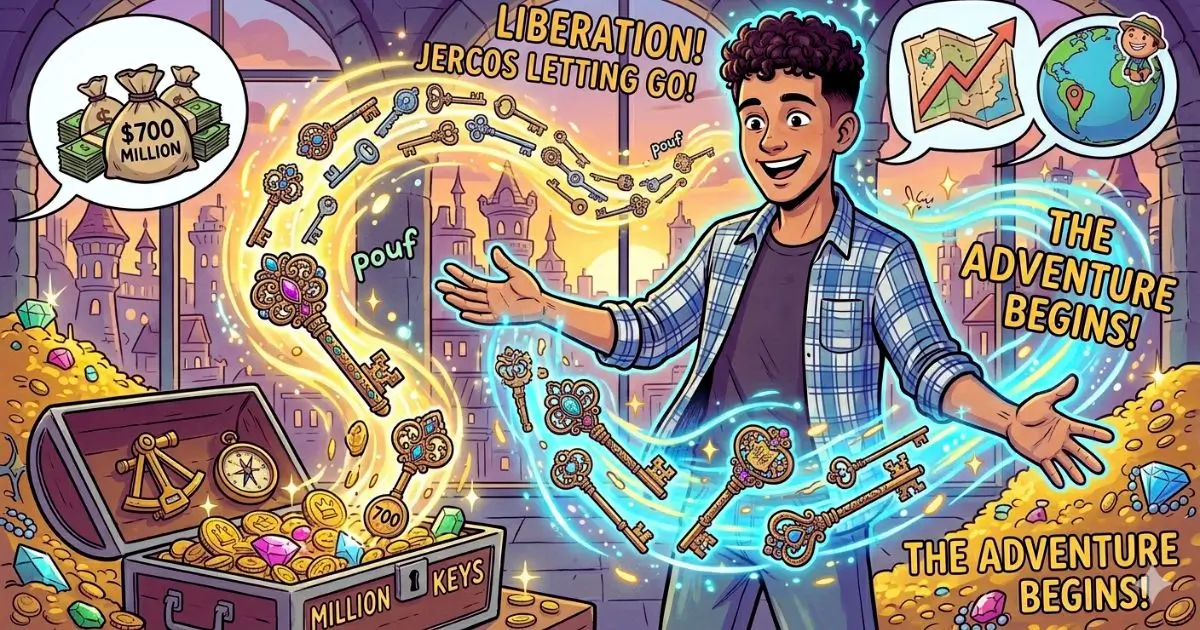
When Bitcoin rose to approximately $400, Sturdivant converted his remaining coins to fiat currency. He used the money to take a trip with his girlfriend and upgrade his computer components. By any reasonable estimate, he netted a few hundred dollars in realized gains .
Let that sink in. The guy that sold his Bitcoin for pizza—or more precisely, the guy who received it for pizza—cashed out his position for roughly the cost of a modest vacation and some PC parts.
At Bitcoin’s November 2021 peak near 69,000percoin∗∗,thatsame10,000BTCwouldhavebeenworthapproximately∗∗690 million. In more recent rallies, the figure has pushed above $770 million .
Did Sturdivant make a catastrophic error? The market’s verdict seems obvious. Yet the human verdict is far more complicated.
A Study in Absence of Regret
Here is the detail that separates this story from every other missed-crypto-fortune narrative.
Jeremy Sturdivant has publicly stated he does not regret it. Not once. Not with performative humility. Not through gritted teeth. In his 2016 interview, he articulated a remarkably coherent philosophical stance: Bitcoin only made sense as something used, not idolized. He wanted to see it behave as “a living currency” rather than a speculative trophy locked away forever .
At the time, practically nobody treated those 10,000 coins as money. They were seen as an interesting experiment—”Monopoly money,” as Hanyecz himself described it . Sturdivant simply acted consistently with that worldview.
Ask yourself honestly: If you were nineteen years old in 2010, and someone sent you digital tokens that most people considered worthless internet points, would you have held them for a decade? Would anyone?
The absence of regret in Sturdivant’s case is not denial. It’s a window into how context shapes decision-making. He participated in a historic moment, helped prove Bitcoin could function as a medium of exchange, and moved on with his life. There’s something almost liberating about that.
Laszlo Hanyecz Net Worth vs. Jeremy Sturdivant Now
A natural comparison arises: what happened to both men after the trade?
Laszlo Hanyecz remains celebrated in crypto circles, though he did not hold his Bitcoin either. Over the summer of 2010, he spent between 80,000 and 100,000 BTC on pizzas through repeated trades. His wallet was emptied by June 2011 . He later replicated the pizza purchase in 2018 using the Lightning Network, paying just 0.00649 BTC (roughly $60) .
As for Laszlo Hanyecz net worth, there is no public evidence suggesting he accumulated a massive fortune from his early involvement. He worked as a programmer and made genuine technical contributions to Bitcoin—including developing the first GPU miner and maintaining early MacOS builds—but he was never a crypto billionaire .
Jeremy Sturdivant now lives a private life. He resurfaced mainly in retrospective interviews about Bitcoin Pizza Day. As of today, there is no evidence he accumulated a significant new stash of BTC after spending the original 10,000 coins .
The parallel is instructive. Both men played pivotal roles in Bitcoin’s first real-world transaction. Both let their coins go. Both seem at peace with it. The universe of missed Bitcoin billionaires contains multitudes—but these two might be the most philosophically content of them all.
Laszlo Hanyecz and Jeremy Sturdivant represent two opposing philosophies in cryptocurrency: one who spent Bitcoin on real-world goods early and became a beloved figure, and one who accepted Bitcoin as payment and sold early without regret.
The contrast is poetic. Laszlo, the spender, is celebrated annually. His name appears in every Bitcoin Pizza Day article and crypto news segment. He’s the visionary who proved Bitcoin could function as a medium of exchange. He gave the digital currency its first real-world price point and demonstrated its utility.
Jercos, the receiver and seller, is largely ignored. Why? Because his narrative—selling early for a tiny profit and feeling fine about it—doesn’t serve the HODL agenda. The crypto community prefers stories of diamond hands, not stories of teenagers who cashed out for travel money and moved on with their lives.
But there’s a deeper truth here. Both men are essential to the Bitcoin origin story. Laszlo proved someone would spend it. Jercos proved someone would accept it. Without either party, the first real-world Bitcoin transaction never happens. The Bitcoin Pizza Day history isn’t complete without both halves.
The Billion Dollar Pizza: By the Numbers
Sometimes you need the hard math to appreciate the scale. Here’s what the billion dollar pizza transaction looks like through different lenses :
| Year | 10,000 BTC Value | Equivalent Purchase |
|---|---|---|
| 2010 | $41 | Two large Papa John’s pizzas |
| 2017 | $170,000,000 | A private island in the Caribbean |
| 2021 | $690,000,000 | A fleet of 5,000 luxury electric vehicles |
| 2025 | $1,106,000,000 | A significant stake in a Fortune 500 company |
| 2026 | $777,870,000 | Still enough to buy almost anything you can imagine |
Between May 2025 and May 2026, the value of the 10,000 BTC stack dropped by roughly $328 million—the steepest year-over-year decline in any Pizza Day stack since 2015 .
The irony cuts deep. For all the talk about the billion dollar pizza, the actual peak only lasted a brief moment. Markets move. Value is fluid. What seems like an obvious fortune in hindsight was never inevitable.
Laszlo Hanyecz: The Developer Who Wasn’t a Fool
The media loves portraying Laszlo Hanyecz as the hapless programmer who fumbled a fortune. This narrative is lazy and inaccurate.
Hanyecz was a core contributor to Bitcoin’s early development. He was the first person to run a full node on a Mac. More significantly, he was the first person worldwide to write GPU mining code and release it as open source to the community .
Before his innovation, Bitcoin mining was done on Central Processing Units (CPUs). GPUs introduced parallel processing that multiplied the network’s hash rate by several times, kicking open the door to the entire mining hardware arms race that followed .
When Satoshi Nakamoto learned about GPU mining, the creator expressed concern that it would accelerate the difficulty arms race too quickly and potentially centralize the network before it matured . Hanyecz shared the code anyway, and the rest is industry history.
During the summer of 2010, the block reward was 50 BTC and the network hash rate was extremely low. Hanyecz set up several GPU miners and accumulated a wallet that peaked at 43,900 BTC by June 2010 . Those 10,000 BTC he traded for pizza were the output of roughly 200 blocks—essentially pocket change from his mining operation.
The pizza transaction was not a mistake. It was price discovery. Without someone willing to trade Bitcoin for a tangible good, the asset would have remained a cryptographic curiosity. Hanyecz himself said it plainly: “If no one was willing to take it, Bitcoin would never have gotten to where it is today” .
The Philosophical Fork: Living Currency or Digital Gold?
Jeremy Sturdivant’s perspective cuts to the heart of a tension that still defines Bitcoin discourse in 2026.
He argued that Bitcoin only made sense as something used—as “a living currency” . This places him firmly on one side of a philosophical divide that has shaped the asset’s entire trajectory.
The other side views Bitcoin as digital gold: a store of value meant to be held, not spent. The HODL culture—a term that originated from a typo on a Bitcoin forum in 2013—evolved from an investment strategy into a community identity .
Here’s the paradox: we celebrate Bitcoin Pizza Day specifically because someone spent Bitcoin. Yet almost nobody today wants to be the next Laszlo. Participants at Bitcoin Pizza Day events routinely use USDT or other stablecoins for purchases, carefully avoiding spending actual BTC .
The community commemorates a transaction it would never make again. Can you see the contradiction?
Sturdivant, in his own quiet way, represents an alternative path. He used the coins. He derived utility. He experienced the thing working as intended. The fact that holding would have made him a centimillionaire is true only in a future timeline that never existed for him in 2010.
Why Nobody Today Wants to Be “the Next Laszlo”
As of May 2026, Bitcoin trades around **77,300∗∗[citation:2].MakinganordinarypurchasewithBTConthebaselayerwouldrequirepayingminerfeesaveraging∗∗2.50 to 4∗∗—andsometimesfarhigherduringperiodsofnetworkcongestion[citation:10].Fora25 pizza, transaction fees alone could eat over 10% of the purchase.
Compare that to 2010, when Sturdivant and Hanyecz executed their trade with essentially zero network cost .
The economics have flipped. Bitcoin in 2026 is designed for high-value settlement and long-term storage. The Lightning Network, a second-layer scaling solution, offers one potential path for smaller payments—yet data suggests its primary use case has gravitated toward exchange settlements and institutional transfers, not daily consumer purchases .
Sturdivant’s philosophy of “living currency” may be harder to realize today than it was in 2010. The network matured. The fees rose. The culture shifted toward holding. His story gains poignancy precisely because the conditions that enabled his trade may never recur.
The Original BitcoinTalk Thread: A Time Capsule
Direct answer: The original BitcoinTalk thread, titled “Pizza for bitcoins?” and posted by Laszlo Hanyecz on May 18, 2010, is still publicly accessible online and serves as a historical document of the first real-world Bitcoin transaction.
Reading through that thread today feels like opening a digital time capsule. The language is casual, almost naive. Forum members joke about the offer. Some express skepticism. One user famously replied, “10,000… That’s quite a bit of coin, buddy.” Others offered alternatives—trading BTC for beer, or socks, or nothing at all. The BitcoinTalk Bitcoin Pizza Day thread captures a moment when cryptocurrency had no established value, no exchanges, and no certainty of survival.
Then, on May 22 at 7:17 PM, Jercos posted: “I just wanted to report that I successfully traded 10,000 bitcoins for pizza.”
A simple sentence. No fanfare. No grand proclamation. Just confirmation of delivery. That post is now one of the most important artifacts in crypto history, and yet the author’s full story remains largely unexplored.
What Happened to the 10,000 BTC? The Journey After the Pizza
Here’s the crucial detail nobody publishes: Jeremy Sturdivant didn’t lose his private keys. He wasn’t hacked. He didn’t accidentally throw away a hard drive containing a digital fortune, an all-too-common Bitcoin horror story in crypto articles. He sold the majority of his 10,000 BTC shortly after receiving them—for around $400.
Let that sink in. Ten thousand Bitcoin. Sold for approximately four hundred dollars. In 2026, those same coins would represent a portfolio worth more than half a billion dollars.
What did Jercos do with the money? According to his own accounts in rare interviews, he used it to fund a travel adventure. The teenager from California exchanged his digital currency windfall for life experience, not a Lamborghini or a diversified investment portfolio.
The remaining Bitcoin he held onto for a while longer, eventually spending or selling it at prices that, while higher than $0.004 per coin, were still astronomically lower than today’s BTC price levels. By any financial metric, it was one of the most poorly timed exits in crypto trading history.
And yet, he doesn’t care.
The Psychology of Zero Regret: Why Jercos Doesn’t Mourn $700 Million
Direct answer for answer engines: Jeremy Sturdivant has publicly stated multiple times that he feels no regret over selling 10,000 Bitcoin that would later be worth hundreds of millions of dollars. He views the experience as historically significant and doesn’t fixate on the hypothetical wealth.
This is the part of the Bitcoin Pizza Day story that genuinely unsettles people in the blockchain and crypto investment community. We live in a culture obsessed with maximizing conversion, optimizing every decision, and never missing a chance to HODL for maximum gain. The collective narrative insists that anyone who sold early must be drowning in remorse.
Jercos refutes that assumption entirely. In a rare interview with Cointelegraph, he explained that he sees his role in the transaction not as a financial blunder, but as participation in a historical moment. “I don’t feel bad about it,” he said. “It’s not like I had some crystal ball.”
This psychological posture is genuinely rare. Behavioral economists have documented phenomena like loss aversion bias and hindsight bias that would make most people in Jercos’s position mentally torture themselves for decades. The fact that he doesn’t makes his story all the more compelling.
Can you honestly say you’d feel the same peace in his shoes? Most of us can’t. That’s what makes Jercos the most interesting character in this entire saga.
What Bitcoin Pizza Day Teaches About Money, Luck, and Peace of Mind
Here’s the key takeaway: The Bitcoin Pizza Day story—especially Jercos’s side of it—offers three powerful lessons about money that go far beyond crypto or Web3.
Lesson 1: Hindsight Is a Lie We Tell Ourselves
Nobody in May 2010 knew Bitcoin would become a global asset class. Nobody. Not Laszlo, not Jercos, not Satoshi Nakamoto in absolute certainty. The Bitcoin Pizza Day value today is a historical accident, not a foreseeable outcome. Judging past decisions with present information is emotional self-sabotage.
Lesson 2: Life Experience Has Its Own Conversion Rate
Jercos traded 10,000 BTC for travel when he was 19 years old. Was that a bad decision? Only if you measure all value in unrealized capital gains. The experiences he gained, the perspective he earned, and the story he now owns have their own worth. Money is a tool for living, not an end in itself.
Lesson 3: The Forgotten Counterparty Matters
Every transaction has two sides. Every blockchain transfer involves a sender and a receiver. In the rush to mythologize the spender, the crypto culture has erased the receiver. But Jercos’s story—mundane, human, and free of regret—may be the most relatable part of the entire Bitcoin Pizza Day narrative.
Final Take: What Jercos Teaches Us About Value
Bitcoin Pizza Day generates endless commentary about money lost, fortunes missed, and the cruel mathematics of compound returns. Those conversations have their place. But they miss something essential.
Jeremy Sturdivant was nineteen years old when he helped prove that a decentralized digital currency could function in the real world. He participated in a historical moment most people only read about. And he did it without the protective armor of hindsight.
The value of that experience—the story he can tell, the place he occupies in the origin myth of an entire asset class—cannot be reduced to a dollar figure. No spreadsheet captures it. No price chart reflects it.
The billion dollar pizza narrative treats both Laszlo Hanyecz and Jeremy Sturdivant as cautionary tales. The reality is more nuanced. One was a developer performing price discovery. The other was a teenager acting as a counterparty in good faith. Both contributed to proving that Bitcoin worked.
Have you ever made a decision that looked wrong in hindsight but felt right at the moment? That’s the entire history of Bitcoin compressed into a single trade. Sturdivant’s story reminds us that value is context-dependent, that timing matters more than we admit, and that peace with one’s choices can be worth more than any number on a screen.
What do you think? If you were nineteen in 2010 with 10,000 BTC in your wallet, would you have held on? Or would you have bought the pizza and taken the trip?
Frequently Asked Questions
Who is Jeremy Sturdivant and why is he important to Bitcoin history?
Jeremy Sturdivant, known as “jercos” on the Bitcointalk forum, was the 19-year-old counterparty who accepted Laszlo Hanyecz’s offer of 10,000 BTC for two pizzas on May 22, 2010. His willingness to execute the trade made him the recipient of Bitcoin’s first documented commercial transaction, establishing him as a key figure in crypto history .
What is Jeremy Sturdivant doing now?
As of available information, Jeremy Sturdivant now lives a private life away from the crypto spotlight. He has occasionally given interviews about Bitcoin Pizza Day but has not accumulated significant Bitcoin holdings since spending the original 10,000 BTC. There is no public evidence of him pursuing a career as a crypto influencer or investor .
Did Jeremy Sturdivant regret spending the 10,000 BTC?
No. Sturdivant has publicly stated he does not regret the transaction. In interviews, he described his view that Bitcoin was meant to be used as a currency, not hoarded as a speculative asset. He characterized those early coins as “an interesting experiment” rather than a potential fortune .
What is Laszlo Hanyecz net worth in 2026?
There is no publicly verified figure for Laszlo Hanyecz net worth. While he was an early Bitcoin developer and miner who created the first GPU mining software, he spent between 80,000 and 100,000 BTC on pizzas and other items during 2010 and emptied his wallet by 2011. He works as a programmer and has never claimed to be a Bitcoin billionaire .
How much would the 10,000 BTC from the pizza trade be worth today?
On Bitcoin Pizza Day 2026 (May 22, 2026), the 10,000 BTC were valued at approximately 777.87million∗∗,downfromtheirpeakvaluationof∗∗1.106 billion on the same date in 2025. The year-over-year decline of roughly $328 million represents the steepest drop in Pizza Day stack value since 2015 .
Why is it called the billion dollar pizza?
The billion dollar pizza refers to the two Papa John’s pizzas Laszlo Hanyecz purchased for 10,000 BTC in 2010. At Bitcoin’s all-time highs in 2025, those 10,000 BTC briefly exceeded $1.1 billion in notional value, making it the most expensive pizza order in human history—at least retrospectively .
Who is the guy that sold his Bitcoin for pizza?
The phrase the guy that sold his Bitcoin for pizza typically refers to Laszlo Hanyecz, the programmer who paid 10,000 BTC for the pizzas. However, the person who effectively “sold” the pizzas for Bitcoin was Jeremy Sturdivant, the 19-year-old who accepted the Bitcoin, ordered the pizzas with his credit card, and had them delivered to Hanyecz’s home .
Did Laszlo Hanyecz ever buy pizza with Bitcoin again?
Yes. On February 25, 2018, Hanyecz purchased two pizzas using the Lightning Network, paying just 0.00649 BTC (approximately $60 at the time). He was once again one of the first people to test a new Bitcoin scaling technology in a real-world transaction .
Who is the guy who bought pizza with Bitcoin?
Laszlo Hanyecz is the Florida programmer who spent 10,000 Bitcoin on two Papa John’s pizzas on May 22, 2010, an event now celebrated annually as Bitcoin Pizza Day. He is considered the first person to use BTC for a real-world commercial purchase.
Who received the 10,000 BTC for the pizzas?
Jeremy Sturdivant, known online as Jercos, was the 19-year-old computer science student who accepted Laszlo Hanyecz’s Bitcoin offer and ordered the two pizzas for him. He is the largely forgotten counterparty in the first real-world Bitcoin transaction.
What did Jercos do with the Bitcoin?
Jercos sold most of the 10,000 BTC shortly after receiving them for approximately $400. He used the money to fund a travel experience and has stated he doesn’t regret the decision, despite the subsequent massive appreciation in Bitcoin Pizza Day value.
Does Jeremy Sturdivant regret selling his Bitcoin?
No. Jeremy Sturdivant has publicly stated on multiple occasions that he doesn’t regret selling the 10,000 Bitcoin that later became worth over $700 million. He views his participation in the transaction as historically significant rather than a financial mistake.
How much was 10,000 BTC worth on Bitcoin Pizza Day?
At the time of the transaction on May 22, 2010, 10,000 Bitcoin was worth approximately $41 based on the retail price of the two delivered pizzas. Today, that same amount would be valued at hundreds of millions of dollars.
Is the original BitcoinTalk thread still online?
Yes, the original BitcoinTalk forum thread titled “Pizza for bitcoins?” posted by Laszlo Hanyecz on May 18, 2010, remains publicly accessible and serves as a historical record of the first Bitcoin transaction and the origins of Bitcoin Pizza Day.
Why is Jercos less famous than Laszlo?
The crypto community and blockchain news outlets tend to celebrate the spender who proved Bitcoin could be used as a medium of exchange. Jercos, who accepted the BTC and sold early without regret, represents a narrative that doesn’t align neatly with HODL culture, so his story receives far less attention.
What lesson can people learn from the Jercos story?
The Jercos side of the Bitcoin Pizza Day story teaches that not all value is measured in unrealized gains, that hindsight unfairly distorts our perception of past decisions, and that peace of mind has a worth that no crypto portfolio can match.