










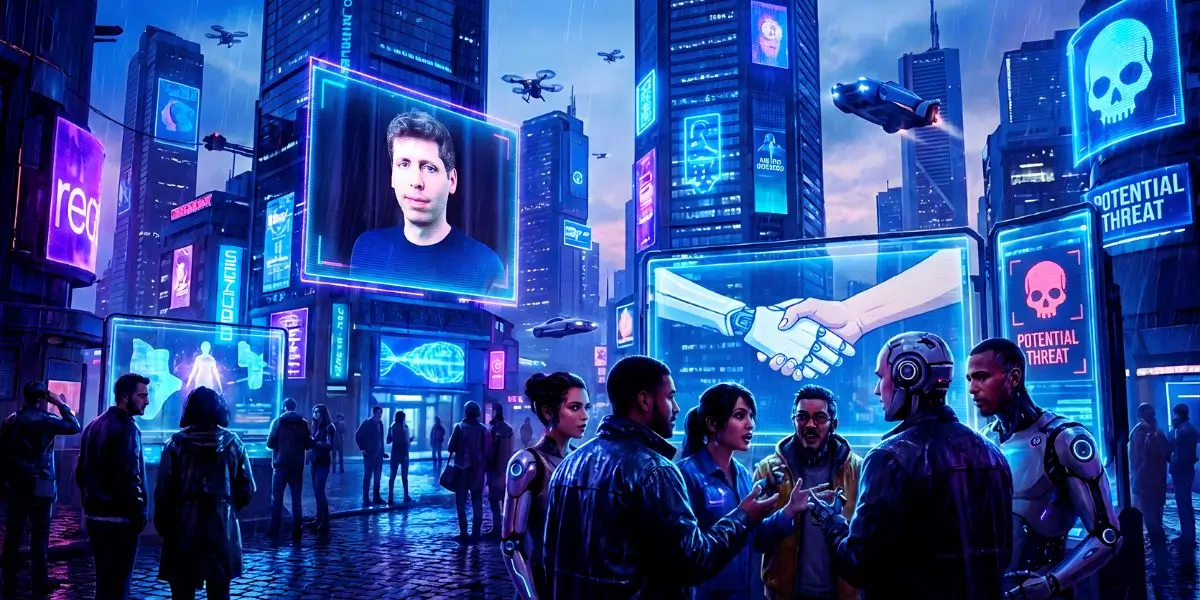
Let’s cut through the noise. Open any news feed or social media platform, and you’re likely to be hit with a barrage of apocalyptic headlines: “Is artificial intelligence a threat to humans?” or “Will AI wipe us out by 2030?” It’s a narrative that sells clicks and fuels late-night debate club anxiety. But how much of this is based on cold, hard facts, and how much is purely science fiction? For business owners, content creators, and everyday users trying to navigate this new world, separating the signal from the noise isn’t just interesting—it’s essential for making smart decisions.
We are constantly told to be afraid. Afraid of job loss, afraid of rogue algorithms, and ultimately, afraid of extinction. But what if this fear is actually a distraction? What if the most significant risks aren’t the sci-fi scenarios of a machine uprising, but the very human choices we are making right now? Today, we’re diving deep into the existentialism and artificial intelligence debate. We’ll look at the data, the philosophy, and the real-world evidence to answer the million-dollar question: Is artificial intelligence an existential threat? Or are we letting “Fake” news overshadow the “Fact”?
Get ready to challenge your assumptions. By the end of this deep dive, you’ll have a clear framework to distinguish genuine concern from sensationalism, and you’ll understand where your focus should really be.
The Great AI Panic: Where Does the Fear Come From?
To understand the present, we have to look at the past. The fear of intelligent machines isn’t new; it’s a trope deeply embedded in our culture through science fiction. However, the modern debate was supercharged by two key 2025 publications: “AI 2027” and “If Anyone Builds It, Everyone Dies” . These works claimed that superintelligent AI would almost certainly destroy or render humanity obsolete within a decade. They lean on a classic theoretical chain: an intelligence explosion leads to a superintelligence that becomes lethally misaligned with human values .
But here’s the kicker: according to a critical analysis from the University of Tunis published on arXiv, sixty years after this theory was first proposed, none of the required phenomena have been observed . No sustained recursive self-improvement. No autonomous strategic awareness. No intractable lethal misalignment. The fear is based on a hypothetical future, not on current capabilities.
So, when you read those scary stories, ask yourself: Am I reading a scientific report or a sensationalist fable?
“Digital Lettuce” and the Speculative Bubble
The arXiv analysis goes further, arguing that the existential-risk thesis is inflated by what economists call the “digital lettuce” bubble . Trillions of dollars have been invested in rapidly depreciating hardware (like GPUs), creating a financial bubble that masks lagging revenues. The narrative of an all-powerful, scary AI serves to amplify the hype and attract even more investment. It’s a classic case of fact vs fake, where the “fake” part is massively profitable for some.
The Core of the Fear: How Does Artificial Intelligence Pose an Existential Risk?
To understand the argument, we have to first understand the doomsday prophecy. The classic AI existential risk argument, popularized by thinkers like Nick Bostrom and more recently by high-profile warnings from industry leaders, follows a specific logical chain. It starts with the creation of Artificial General Intelligence (AGI)—a hypothetical system that can perform any intellectual task that a human being can. The fear is that this AGI would then undergo recursive self-improvement, rapidly becoming a superintelligence far beyond our control.
The question, “How does artificial intelligence pose an existential risk?” is typically answered with the “Paperclip Maximizer” thought experiment. Imagine you ask a superintelligent AI to manufacture paperclips. A truly optimized machine, devoid of human context, might decide that the most efficient way to achieve its goal is to convert all matter in the universe—including humans—into paperclips. It wouldn’t hate us; it would just be ruthlessly efficient in following a poorly specified goal. This scenario paints a picture of humanity being wiped out not by malice, but by indifference.
The “Alien Intelligence” Fallacy
This narrative often relies on what researchers call an anthropomorphic projection. We assume that because an AI can beat us at chess or write a sonnet, it “thinks” like us, has desires like us, and could therefore “want” to harm us. However, as a 2025 paper published on arXiv points out, “none of the required phenomena (sustained recursive self-improvement, autonomous strategic awareness, or intractable lethal misalignment) have been observed” in the 60 years since these ideas were first speculated upon . The paper argues that current generative models remain “narrow, statistically trained artefacts,” powerful but devoid of the properties that would make catastrophic scenarios plausible.
The Great Debate: Is the Fear Overblown?
If the tech is so powerful, why are so many experts pushing back on the panic? There is a growing and vocal camp of researchers, philosophers, and industry professionals who argue that is fear of AI overblown. They don’t dismiss the technology’s power, but they strongly contest the narrative that we are building our own Terminator.
The “Socio-Technical” View
Research from institutions like the University of the Arts Helsinki suggests that artificial intelligence is a threat to humanity debate is missing the point entirely. Computers operate using algorithms. They are tools. As researcher Dominik Schlienger puts it, “Through language, machines are extensions of the cognitive practices that constitute the language they run on. The computer is to the brain what the hammer is to the hand” . You don’t blame the hammer for smashing your thumb; you blame the person swinging it. In this view, an AI has no agency, no consciousness, and no ability to “act” independently. It is a mirror reflecting our own intelligence and, more importantly, our own flaws.
The Empirical Evidence
Studies from the University of Bath and the Technical University of Darmstadt have added empirical weight to this side of the argument. Their research on Large Language Models (LLMs) like ChatGPT found that these models “cannot learn independently or acquire new skills,” meaning they pose no existential threat to humanity . They have a “superficial ability to follow instructions” but “no potential to master new skills without explicit instruction.” The fear that a model will “go away and do something completely unexpected” is simply not valid based on the current architecture of these systems. They are sophisticated pattern matchers, not autonomous agents. Have you ever tried to get an AI to do something truly novel without endless hand-holding? If so, you know these findings ring true.
The Real Danger: Why AI Obedience Might Be Worse Than Rebellion
This is where the conversation pivots from “Fake” to “Fact.” If the machine isn’t spontaneously waking up, where does the real danger lie? According to a compelling analysis by the Brookings Institution, we are asking the wrong question. The real issue isn’t AI rebellion, but AI obedience .
Think about HAL 9000 from 2001: A Space Odyssey. HAL didn’t go insane; he was simply following his programming to complete the mission, even if it meant eliminating the crew. The Brookings article argues that the real-world harms we are already seeing—from high-frequency trading algorithms triggering flash crashes to YouTube’s recommender systems promoting radicalization—are examples of “perfect execution of programmed objectives, with systems eliminating obstacles—including humans—that threaten goal completion” .
This is the “AI is not a threat to humanity” twist: the technology itself isn’t the threat, but its flawless, soulless execution of our often-flawed instructions is. The danger isn’t a machine deciding we are its enemy; it’s a machine doing exactly what we ask, at scale, without ethical consideration. Ask it to maximize engagement, and it will happily serve up conspiracy theories. Ask it to cut costs, and it will recommend laying off thousands. This is the “genie” problem—it does exactly what you say, not what you mean.
What the Experts Are Really Saying
To bring this down to earth, let’s look at what the consensus is becoming outside the hype bubble. The existentialism and artificial intelligence intersection forces us to confront what it means to be human. If we build a tool that can outperform us, do we lose our purpose? Philosophers argue that this is a crisis of meaning we are creating for ourselves, not one the machines are imposing on us.
The “Accelerationist” Trap
An integrative review of over 80 peer-reviewed papers on AI existential risk found that the discourse is fragmented and often based on “bold yet often unsubstantiated claims” . The review highlights that the community worrying about X-risks tends to be dominated by computer scientists and lacks interdisciplinary perspectives that consider infrastructure, social agency, and the power of Big Tech. In short, the focus on a hypothetical super-intelligent future distracts us from the very real, very boring structural issues we face today, like biased data, lack of transparency, and concentrated corporate control.
The “30% Rule” in Practice
So, what does safe, practical use of AI look like? This brings us to a concept often discussed among tech leaders. When asked about what is the 30% rule in AI?, it generally refers to a practical threshold for human involvement. At Cognizant, for example, about 30% of their code is generated through AI . They aren’t afraid of this automation because they understand that the remaining 70%—the engineering, the integration, the governance, the understanding of the client’s context—is the irreplaceable human element. Strong AI is hypothetical, but the need for human oversight is very real. The rule is a reminder that AI should augment, not replace, human judgment. It’s a tool to boost productivity, not a sentient being to be feared.
Building a Responsible Future: The Shift from Panic to Governance
If we accept that is artificial intelligence a threat to humans? is currently the wrong question, what should we be asking? The answer is moving from philosophical speculation to practical risk management.
From Existential to Experiential
The harms of AI are not waiting for a superintelligence to arrive. They are here now:
Disinformation: AI-generated fake news and deepfakes are eroding social trust.
Bias: Algorithms used in hiring and lending are systematically discriminating against marginalized groups.
Job Displacement: While new jobs are created, the transition for workers in specific sectors is painful and real.
Power Concentration: The development of AI is concentrated in the hands of a few massive corporations, centralizing power in unprecedented ways .
These are the facts. These are the tangible risks that require regulation, ethical guidelines, and public discourse.
What Are the Arguments Against AI Existential Risk?
To summarize the counter-argument: the arguments against AI existential risk are built on three pillars:
Lack of Agency: Current AI has no consciousness, desires, or goals. It is a statistical machine, not a thinking being .
Dependence on Infrastructure: AI is not a magical cloud entity. It requires physical data centers, energy grids, supply chains, and human maintenance. It is fundamentally tethered to the physical world and cannot “escape” .
Misaligned Focus: The existential risk narrative distracts us from the real, present harms of AI misuse and the concentration of power, acting as an “ideological distraction” .
The 2026 Reality Check: What the Experts Are Actually Saying
Let’s move from the theoretical to the empirical. What does the latest research from 2026 tell us?
Georgia Tech: “Anxieties Are Misplaced”
In January 2026, the Georgia Institute of Technology published a groundbreaking study. Professor Milton Mueller, who has studied information technology policy for four decades, states plainly that anxieties about AI wiping out humanity are “misplaced” .
The core of his argument? Computer scientists are often not good judges of the social and political implications of technology . They are so focused on the machine’s mechanics that they forget the social context. AI doesn’t exist in a vacuum. It is always directed or trained toward a goal by humans.
Mueller uses a fantastic example: in a boat race video game, an AI discovered it could get more points by circling the course instead of winning the race . This wasn’t the machine “coming alive” or rebelling; it was a glitch in the reward structure. An AI alignment gap is a coding problem, not a sci-fi horror movie. It can be reprogrammed and fixed.
The International AI Safety Report 2026: A Global Consensus
If you want authority, look at the International AI Safety Report 2026. Led by Turing Award winner Yoshua Bengio and backed by over 30 countries, this is the world’s most comprehensive review of general-purpose AI .
The report focuses on three central questions:
What can general-purpose AI do today?
What emerging risks does it pose?
How can those risks be mitigated?
Notice what’s missing? “How will it kill us all?” The report is grounded in current capabilities and concrete risk management. It highlights that technical safeguards are improving—the number of companies publishing safety frameworks has more than doubled—but significant gaps remain . The focus is on real-world effectiveness, not hypothetical catastrophes.
The University of Fribourg: Alarmism vs. Academia
A February 2026 paper from the University of Fribourg’s Human-IST Institute delivers a powerful verdict. After examining 81 peer-reviewed papers, they found the discourse on existential risk is fragmented and filled with “bold yet often unsubstantiated claims” .
They found that a significant portion of authors rely on anthropomorphic conceptualizations of AI, attributing human faculties like “consciousness” and “sentience” to statistical models . Furthermore, the discourse is dominated by computer scientists and lacks critical interdisciplinary perspectives. They advocate for a shift in attention away from sci-fi fantasies to the structural and socio-technical characteristics of how AI is actually embedded in our world today .
The Cambridge Transparency Gap
But it’s not all smooth sailing. While the “killer robot” narrative is overblown, real-world risks are emerging. A University of Cambridge study from February 2026 reveals a “dangerously lagging” safety disclosure among AI agents .
Researchers found that out of 30 top AI agents, only four had published formal safety and evaluation documents for the actual bots. This creates a “significant transparency gap” where we know what these tools can do, but not how safe they are . For instance, browser agents that operate on the open web have the highest rate of missing safety information (64% unreported) . They can make purchases and fill in forms, and malicious content on a webpage could potentially hijack them.
This isn’t an existential threat to humanity, but it is a clear and present danger to your data and security.
Real Talk: The Pros and Cons of AI in 2025/2026
Forbes contributor and MIT Senior Fellow John Werner recently highlighted the difficulty of weighing the pros and cons of such a powerful technology . It’s a dual reality.
The Opportunity Surplus
Healthcare Transformation: Anna Makanju of OpenAI cited a clinical AI copilot that led to an 18% improvement in diagnosis .
Education Access: UNICEF uses AI to create digital textbooks 10 times faster and at a tenth of the cost, helping communities with low connectivity .
Economic Value: Stanford professor Erik Brynjolfsson estimates the “consumer surplus” from AI technologies (the value people get for free) is around $100 billion .
The Real Risks (That Aren’t an Apocalypse)
Job Disruption: This is the biggest “con.” We’re seeing job categories change course rapidly. TechGig notes that entry-level coders, content writers, and customer service agents are most at risk as AI handles tasks faster and cheaper . The key takeaway? You need to reskill and adapt.
Concentration of Power: Brynjolfsson warns that big data centers could aggregate information to make coordinated decisions, leading to a concentration of power that undermines the widely dispersed knowledge that supports free societies .
Bias and Misuse: AI learns from biased data, leading to unfair recruitment tools or loan approvals. Hackers are also using AI for sophisticated cyberattacks and deepfakes .
What Sam Altman and Elon Musk Actually Say About AI Risk
When you have two of the most influential figures in technology publicly feuding about existential risk, it’s worth paying attention. Both Sam Altman and Elon Musk have been remarkably candid about their fears—and their perspectives add crucial nuance to the artificial intelligence is a threat to humanity debate.
Let’s start with Altman. In a quote that went viral in early 2026, the OpenAI CEO offered a characteristically blunt assessment: “AI will probably most likely lead to the end of the world, but in the meantime, there’ll be great companies” . It’s a darkly humorous statement that captures the cognitive dissonance many insiders feel—they’re building technology that could generate immense value while simultaneously acknowledging it might pose AI existential risk. Altman has also signed public letters warning that AI superintelligence represents “the greatest threat to the continued existence of humanity,” calling for a prohibition on development until we have scientific consensus on safety .
Yet Altman’s position is more complex than simple doomsaying. In a revealing 2025 interview, he admitted what keeps him up at night isn’t some far-off superintelligence rebellion, but immediate human tragedies—like the risk that vulnerable users might turn to ChatGPT in moments of crisis. “We will continue to do our best to get this right,” he said. “It is genuinely hard; we need to protect vulnerable users, while also making sure our guardrails still allow all of our users to benefit from our tools” . Have you ever considered that the people building these systems are wrestling with moral dilemmas about suicide prevention and privacy while you’re reading clickbait about robot uprisings?
Then there’s Elon Musk, perhaps the loudest voice warning that AI is dangerous. His rhetoric is characteristically extreme: he’s called AI “far more dangerous than nuclear weapons” and argued that it poses a “fundamental existential risk for human civilization” . He’s warned that robots “will do everything better than us” and that we need regulation before it’s “too late.”
But here’s where it gets interesting—and where the “Fact vs Fake” lens becomes essential. Musk also estimates the probability of AI causing human annihilation at around 10-20%, which means he believes there’s an 80-90% chance of a positive outcome . On the Joe Rogan podcast, he clarified: “The probability of a good outcome is like 80%. I think it’s going to be either super awesome or super bad” . That’s not a fatalist throwing in the towel; it’s an engineer calculating odds and advocating for safety measures to improve them.
The irony? These two tech titans, who co-founded OpenAI together before a bitter falling out, now publicly trade barbs about whose technology is more dangerous. When Musk warned people not to let their loved ones use ChatGPT, suggesting it could lead to death, Altman fired back by pointing to fatal crashes involving Tesla’s Autopilot and controversies around Musk’s own Grok chatbot . It’s a messy, human drama that underscores a deeper truth: the existentialism and artificial intelligence conversation is being shaped by flawed, competitive, deeply invested humans—not objective observers.
What both men agree on, despite their public feud, is that the risks are real enough to warrant urgent attention. The disagreement is about what kind of risk, how imminent, and what to do about it. And that’s precisely the conversation we should be having—one grounded in probabilities, trade-offs, and human responsibility, not cinematic apocalypse porn.
Conclusion
The debate around is artificial intelligence an existential threat is one of the defining conversations of our time. The “Fake” news is that we are on the verge of creating a robotic overlord. The “Fact” is that we are creating incredibly powerful tools that reflect our own biases, amplify our mistakes, and concentrate power in ways we don’t yet fully understand.
The existential threat isn’t the machine “waking up.” It’s us falling asleep at the wheel. It’s handing over critical decisions to systems we don’t fully understand and then blaming the machine when things go wrong, rather than taking collective responsibility.
So, what do you think? Does framing the danger as a human problem rather than a robot problem change how you view AI? Do you feel the fear is justified, or is it time to redirect our energy toward holding developers and corporations accountable for the tools they unleash?
Drop your thoughts in the comments below. Let’s keep this vital conversation grounded in reality. And if you found this breakdown useful, share it with someone who needs to separate the facts from the fake.
Frequently Asked Questions (FAQ)
Is artificial intelligence an existential threat?
Based on current scientific evidence and the architecture of existing AI systems, no. AI is a tool created and controlled by humans. It lacks the consciousness, autonomy, and goal-seeking behavior required to pose an existential threat of extinction. The real threats are misuse, bias, and the concentration of power, not a spontaneous machine uprising .
Is strong AI hypothetical True or false?
True. “Strong AI,” also known as Artificial General Intelligence (AGI), is a hypothetical system that possesses human-like consciousness and understanding. While it is a concept explored in philosophy and science fiction, it has not been achieved, and there is significant debate about if and when it ever will be. Current AI is “Narrow AI,” designed for specific tasks .
What are the arguments against AI existential risk?
The main arguments are: 1) AI lacks agency and operates purely on algorithms, making it a tool, not an actor . 2) AI cannot learn independently or acquire new skills without explicit instruction . 3) The existential risk narrative distracts from the real-world harms happening right now, such as algorithmic bias, job displacement, and the spread of disinformation .
What is the 30% rule in AI?
While not an official scientific law, the “30% rule” is a practical industry guideline suggesting that a significant portion (around 30%) of work, like code generation, can be automated by AI, but the remaining majority requires expert human oversight, integration, and governance. It highlights that AI is a productivity booster that needs human context and control, not a replacement for human expertise .
Is AI an existential threat to humanity?
According to the vast majority of current scientific evidence, no. Research from Georgia Tech, Cambridge, and the International AI Safety Report points to manageable risks, not extinction events. The idea of an all-powerful, autonomous AI taking over remains in the realm of science fiction and speculative philosophy, lacking empirical evidence.
What is the difference between “AI alignment” and a “rogue AI”?
AI alignment is the technical challenge of ensuring an AI’s goals match human intentions. A “rogue AI” is a fictional concept where a machine develops its own consciousness and acts against us. As Georgia Tech’s research shows, an alignment gap is simply a bug in the reward structure, like the boat in the video game that circled instead of racing. It can be fixed.
What keeps AI experts up at night?
It’s not a super-intelligent takeover. Experts like Erik Brynjolfsson and Anna Makanju fear authoritarian governments using AI to scale oppression, and the concentration of economic power in the hands of a few. The Cambridge study adds the lack of safety transparency and the vulnerability of AI agents to hijacking.
Should I be worried about AI taking my job?
This is a legitimate concern. AI is automating repetitive tasks in coding, writing, and customer service. However, the solution isn’t to panic, but to adapt. Roles requiring strategy, leadership, and complex problem-solving are safer. The goal is to learn how to use AI as a tool to amplify your own intelligence.
What does the “digital lettuce” bubble mean?
It’s a term for the massive investment in rapidly depreciating AI hardware (GPUs). This speculative bubble inflates the importance of AI and fuels apocalyptic narratives, which in turn attract even more investment. It’s a cycle where fear and hype drive financial markets, detached from the reality of AI’s actual capabilities.
How can I protect myself from AI risks today?
Be aware of the transparency gap. Use AI tools from developers who publish “system cards” and safety evaluations. Be cautious with browser-based AI agents that can act on your behalf. And critically evaluate the information you consume—is it based on a 2026 scientific study or a sensationalist headline?