













Have you ever felt overwhelmed running your restaurant? Between managing staff, controlling food costs, keeping up with orders, and marketing your brand, it’s a constant juggling act. What if technology could help you catch those balls, or even better, automate the entire act?
That’s exactly what’s happening today. Artificial Intelligence is no longer a sci-fi concept; it’s a practical, powerful tool revolutionizing the restaurant industry from the kitchen to the front of house. It’s helping owners like you solve real problems, boost profits, and create unforgettable guest experiences.
A 2025 Deloitte survey of 375 restaurant executives found that eight in ten plan to increase their investment in AI technologies in the next fiscal year. The reasons are clear: enhanced customer experience, smoother operations, and more impactful loyalty programs. The question is no longer if AI will change the restaurant business, but how quickly you can adapt to harness its power.
This comprehensive guide will walk you through exactly how AI is transforming the restaurant industry, the tangible benefits of AI in restaurants, and the specific tools you can use to get started.
The State of Play: AI Adoption is No Longer Optional
The data is clear: the AI revolution in restaurants is already underway. According to a major Deloitte survey of 375 restaurant executives, a staggering 73% plan to increase their investment in AI technologies in the next fiscal year, with another 9% predicting a significant increase. In the U.S. alone, 79% of restaurants are now utilizing some form of artificial intelligence.
What’s driving this surge? Executives point to tangible benefits. When asked about the top expected returns, enhanced customer experience was the clear leader, cited by 60% of respondents. Following closely were smoother restaurant operations, more impactful loyalty programs, and better procurement and supply chain management. The message is unambiguous: AI for restaurants is seen as a critical lever for solving core business problems.
However, adoption is happening in waves. The first wave, already in full swing, focuses on customer experience and inventory management. The second wave, gaining momentum, targets customer loyalty and employee experience. The emerging third wave explores AI in food preparation and new product development. This phased approach allows restaurants to start with proven, high-ROI applications before venturing into more experimental areas.
Why AI Is Transforming The Restaurant Industry
The core reason AI in the restaurant industry is exploding is simple: margins are thin, customer expectations are high, and data is finally usable at scale. AI can detect patterns in sales, labor, and guest behavior that humans just do not have time to see.
Key drivers behind how AI is transforming the restaurant industry:
Rising labor and food costs are pushing operators to automate repetitive tasks and reduce waste.
Guests now expect Netflix‑style personalization in their dining experience, from AI restaurant recommendations to tailored offers.
Delivery, pickup, and on‑premise channels generate massive data that AI can convert into pricing, staffing, and menu decisions in real time.
The AI Revolution in Restaurants: Why Now?
You might wonder why AI is exploding in popularity now. The convergence of three key factors has created the perfect storm for adoption: proven technology, undeniable return on investment (ROI), and intense industry pressure.
The Data Behind the Boom
The numbers tell a compelling story. According to a 2025 survey by Toast, 86% of restaurant operators are comfortable using AI, and 81% plan to increase their use of it in the future. Furthermore, half of all restaurant operators are already using some form of AI.
The driving force? Measurable results. Restaurants implementing AI report revenue increases of up to 22% from recaptured missed calls and smart upsells, while reducing related labor costs by 17%. When technology delivers clear financial benefits, adoption is inevitable.
Key Drivers of AI Adoption
Several pressing challenges are pushing restaurants toward AI solutions:
The Labor Shortage: Finding and retaining staff remains a top struggle. AI can automate repetitive tasks like phone order-taking and inventory counting, freeing your team to focus on hospitality.
Rising Costs: Food, labor, and overhead costs are squeezing margins. AI restaurant inventory management systems can cut food waste by 30-50%, translating to thousands of dollars in monthly savings for a mid-size operation.
Customer Expectations: Today’s diners expect personalization, speed, and convenience. AI can power AI restaurant recommendations, dynamic menus, and seamless ordering across channels.
How AI is Transforming Restaurant Operations
AI’s impact is felt across every part of a restaurant’s workflow, creating a more efficient, data-driven, and profitable business.
AI-Powered Ordering and Customer Service
Missed calls during the dinner rush mean lost revenue and frustrated customers. AI restaurant ordering systems, particularly voice AI, are solving this problem.
Voice AI Phone Agents: Systems like those from SoundHound or VOICEplug can answer 100% of calls, quote wait times, take complex orders with modifications, process payments, and even handle upsells. They work 24/7, never get overwhelmed, and ensure order accuracy.
Chatbots and Kiosks: For online and in-store orders, AI chatbots provide instant service. Chains like Domino’s and Pizza Hut use them to handle orders and FAQs, improving speed and allowing human staff to manage more complex interactions.
AI Restaurant Inventory Management: Cutting Waste, Boosting Profit
Food waste is a silent profit killer. AI restaurant inventory management turns guesswork into a precise science.
Predictive Ordering: Tools like MarketMan and WISK use AI to analyze historical sales, weather, and local events to forecast demand for each ingredient with incredible accuracy.
Real-Time Tracking: Integrated with your POS, these systems update inventory levels with every sale, automatically generating purchase orders before you run out of key items.
The Result: Significant cost reduction. As highlighted earlier, these systems can save a restaurant spending $50,000 monthly on food between $6,000 and $15,000 every month by drastically reducing spoilage and over-ordering.
AI in Kitchen and Food Preparation
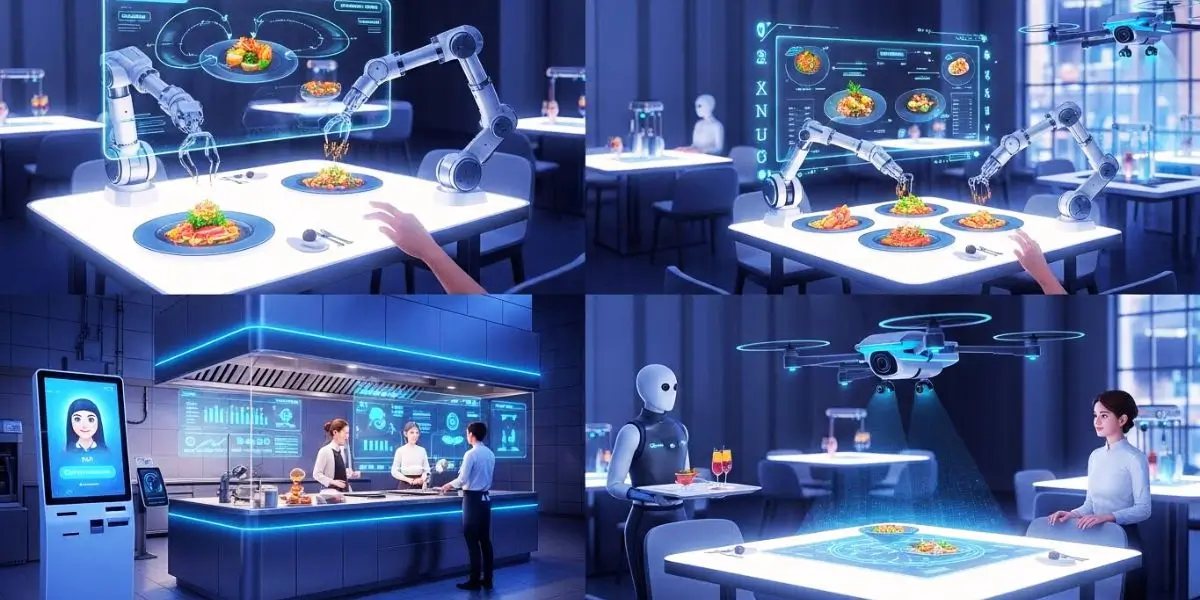
AI and robotics are entering the “back of house,” assisting with food prep and consistency.
Robotic Assistants: Robots like “Flippy” the burger-flipper or “Chippy” at Chipotle handle repetitive, precise tasks, ensuring consistent quality and freeing chefs for more creative work.
Quality Control: Computer vision AI can monitor food as it’s prepared, identifying undercooked items or potential contamination before a dish leaves the kitchen.
Enhancing the Customer Experience with AI
Beyond operations, AI is a powerful tool for crafting personalized, engaging experiences that keep guests coming back.
Personalized Recommendations and Dynamic Menus
Imagine a menu that adapts to the customer, the weather, and even local trends. That’s AI in action.
Smart Recommendations: Based on a customer’s past orders or popular pairings, AI can suggest add-ons or new dishes, increasing average order value. This is the power of AI restaurant recommendations.
Menu Engineering: AI analyzes sales data and ingredient costs to identify your most profitable dishes and suggest where to adjust prices or portion sizes. Some restaurants see an 18% higher average order value from this AI-driven menu optimization.
Dynamic Pricing: Similar to airlines or ride-sharing, AI tools for restaurants can adjust menu prices in real-time based on demand, time of day, and inventory levels, maximizing revenue.
AI-Driven Marketing and Customer Engagement
Creating compelling marketing content is time-consuming. AI is changing that.
AI-Generated Visuals: Restaurants using AI images can now create stunning, professional-quality food photos for menus and social media without expensive photoshoots. Teriyaki Madness made headlines in 2025 by creating an entire ad campaign with AI-generated actors and scenes. Tools like AI Menu Photo specialize in creating hyper-realistic food visuals.
Targeted Campaigns: AI can segment your customer data to send personalized offers (e.g., a discount on a diner’s favorite dish they haven’t ordered in a while), dramatically improving marketing ROI.
AI Tools for Restaurant Design and Layout
Planning a new restaurant or renovating an existing space is a major investment. AI is making it faster, cheaper, and more data-informed.
AI restaurant design tools allow you to visualize concepts in minutes, not weeks.
Interior Design: Platforms like ArchiVinci and Spacely.ai generate photorealistic 3D renderings of restaurant interiors based on your style preferences (modern, luxury, industrial, etc.).
Layout Optimization: AI restaurant design free tools like ChatDiagram’s floor plan maker help you create efficient layouts by simply describing your space. AI can suggest table arrangements that improve traffic flow and service speed, with some restaurants reporting 15% faster table turnover.
The Business Case: ROI of AI in Restaurants
With all these applications, what does the bottom line look like? Let’s break down the return on investment.
Cost Savings and Revenue Growth
The financial impact of AI comes from two sides: cutting costs and increasing sales.
Cost Reduction: The most immediate savings come from reduced food waste (30-50% less) and optimized labor scheduling. AI phone agents alone can cut labor costs associated with order-taking by 17%.
Revenue Growth: Recapturing 100% of phone orders, implementing smart upsells, and using dynamic pricing to maximize yield can lead to an average revenue increase of 22%.
Overcoming Implementation Challenges
Starting with AI can feel daunting. The key is to start small and focus on a single pain point.
Start with a Pilot: Choose one area, like managing phone orders with a voice AI system or implementing a basic inventory tracking tool. This lets you measure ROI and build internal comfort with the technology.
Focus on Training: AI is a tool to augment your staff, not replace them. Involve your team early, train them on how to use the new system, and emphasize how it will make their jobs easier.
Choose the Right Partner: Look for restaurant AI companies that offer strong customer support, easy integration with your existing POS system, and transparent pricing.
How AI Is Revolutionizing Restaurants: From Smart Menus To Higher Profits
Meta description: Discover how AI is transforming the restaurant industry, from smart menus and dynamic pricing to AI restaurant inventory management, labor optimization, and AI tools for restaurants that boost ROI while delighting guests.
Artificial intelligence is no longer a buzzword in hospitality; it is the new operating system of modern restaurants. How AI is transforming the restaurant industry is visible everywhere: from AI‑powered ordering kiosks and smart inventory to hyper‑personalized marketing that fills tables on slow nights. If you run or market a restaurant and you are not testing AI yet, you are leaving money, efficiency, and guest loyalty on the table.
Have you already tried any AI tools for restaurants, or are you still stuck with spreadsheets and manual guesswork?
Why AI Is Transforming The Restaurant Industry
The core reason AI in the restaurant industry is exploding is simple: margins are thin, customer expectations are high, and data is finally usable at scale. AI can detect patterns in sales, labor, and guest behavior that humans just do not have time to see.
Key drivers behind how AI is transforming the restaurant industry:
Rising labor and food costs are pushing operators to automate repetitive tasks and reduce waste.
Guests now expect Netflix‑style personalization in their dining experience, from AI restaurant recommendations to tailored offers.
Delivery, pickup, and on‑premise channels generate massive data that AI can convert into pricing, staffing, and menu decisions in real time.
Benefits Of AI In Restaurants You Can’t Ignore
The benefits of AI in restaurants are no longer theoretical; multi‑location brands report tangible improvements in cost, speed, and guest satisfaction. Even independents are achieving “chain‑level” control by layering AI on top of their POS, loyalty, and inventory systems.
Some of the biggest benefits of AI in restaurants include:
Cost reduction: Case studies show up to 30% lower food waste and significant labor optimization when AI is used to forecast demand and build smarter prep lists.
Better guest experience: AI‑driven personalization can boost satisfaction scores by more than 40% through faster service and relevant offers.
Higher revenue: Dynamic pricing, upsell engines, and targeted promotions increase average check size and seat utilization.
Which benefits of AI in restaurants would move the needle most for you right now—less waste, more covers, or higher check averages?
AI Restaurant Ordering: From Friction To Frictionless
Front‑of‑house is where guests feel AI restaurant ordering first. Instead of waiting in line or repeating complex orders, customers interact with smart kiosks, chatbots, or voice systems that understand their preferences.
Modern AI restaurant ordering systems can:
Take orders via kiosks, apps, chat, or voice, interpreting accents, modifiers, and allergies with high accuracy.
Suggest add‑ons automatically (“Would you like extra sauce or a dessert?”), increasing average ticket value.
Route orders intelligently to kitchen stations to balance load and reduce ticket times.
AI Restaurant Inventory Management: Killing Waste, Boosting Margins
Food waste is one of the fastest ways to destroy profit. AI restaurant inventory management tools analyze sales, seasonality, events, and even weather to predict exactly how much you need to order and prep.
With AI restaurant inventory management, operators can:
Forecast ingredient demand based on historic sales, local events, and day‑part patterns to minimize over‑ordering.
Get real‑time alerts when supplier prices spike, with suggestions for alternative vendors or recipe tweaks.
Consolidate ordering across suppliers in a single dashboard, cutting hours of admin every week.
Dynamic Pricing, 30/30/30/10 And The “30% Rule For AI”
Profit in restaurants is often summarized by the 30/30/30/10 rule for restaurants: roughly 30% food cost, 30% labor, 30% overhead, and 10% profit when things are healthy. AI helps you move those percentages in your favor.
AI‑powered dynamic pricing tools adjust menu prices in real time based on demand, time of day, and ingredient costs.
For some operators, the internal “30% rule for AI” is to aim for at least a 30% improvement in a KPI (waste, prep time, or marketing ROI) before rolling AI system‑wide.
AI Restaurant Design And Visual Experiences
Restaurants are also rethinking their look and feel with AI restaurant design tools. These platforms can generate layout options, décor concepts, and even visual content using restaurants using AI images as a branding lever.
How operators use AI restaurant design and restaurants using AI images:
Rapidly prototype floorplans that optimize table count, flow, and ambiance for different concepts.
Generate menu visuals, social posts, and ad creatives with photorealistic dishes, often via AI restaurant design free tools for early experimentation.
Test multiple design directions with guests online before committing capital to a full build‑out or remodel.
AI Restaurant Recommendations And Personalization
Think of AI restaurant recommendations as your always‑on digital sommelier and host. By analyzing guest history, order combinations, and behavior, AI can suggest dishes, pairings, and offers that feel tailor‑made.
Ways AI restaurant recommendations show up:
“Guests who ordered this also loved…” suggestions in apps, kiosks, and email campaigns.
Personalized promos triggered when a high‑value guest has not visited in a while, reducing churn.
Smart table or time‑slot suggestions based on guest preferences and historical patterns.
AI Tools For Restaurants And Key Players
The market for AI tools for restaurants and specialized Restaurant AI companies is scaling fast. Vendors cover everything from scheduling and forecasting to menu pricing and guest messaging.
What leading Restaurant AI companies and AI tools for restaurants typically offer:
Labor and scheduling optimization that matches staff levels to predicted demand, cutting overtime while maintaining service quality.
Marketing automation that uses AI to segment audiences, personalize offers, and track campaign ROI.
Analytics platforms bundling AI restaurant inventory management, sales forecasting, and profitability by item or channel.
Will Restaurants Be Affected By AI? (Spoiler: They Already Are)
Operators often ask: Will restaurants be affected by AI? The answer is yes—front and back of house are already changing. But that does not mean robots are taking over kitchens.
AI is handling pattern recognition, forecasting, and repetitive tasks, not replacing the art of hospitality.
Early adopters in AI in the restaurant industry report more engaged teams because staff can focus on service, not data entry or guesswork.
Is AI Replacing Chefs Or Just Helping Them?
Another common concern is: Is AI replacing chefs? In reality, most deployments enhance creativity and consistency rather than eliminate culinary roles.
In practice:
AI can suggest new recipes, flavor pairings, or cost‑optimized variations, but human chefs decide what fits the brand.
Computer vision and sensors help ensure consistent portion sizes and cook times, raising quality and reducing remakes.
Would your kitchen benefit from an assistant that never gets tired of tracking consistency and timing, while chefs stay focused on creativity?
The Front-of-House Revolution: Ordering, Service, and Personalization
AI-Powered Ordering: From Drive-Thrus to Dining Rooms
The customer’s first point of contact is being utterly transformed. Voice AI for restaurants is making ordering faster and more accurate. Major chains like McDonald’s, Wendy’s, and White Castle are implementing AI voice bots in drive-thrus to understand natural speech, process orders, and even suggest personalized add-ons. This technology isn’t just for giants; affordable solutions are bringing voice ordering to independent restaurants as well.
Simultaneously, self-service kiosks and tabletop tablets are becoming smarter. They do more than just display a menu; they use machine learning to recommend dishes based on time of day, popular pairings, or even the weather. KFC has even experimented with kiosks using facial recognition to greet repeat customers and tailor suggestions based on their order history.
Never Miss a Customer: AI Concierge and Customer Service
A missed phone call is a lost customer. Studies show 83% of customers will dine elsewhere if their call goes to voicemail more than once. AI phone answering systems like ReachifyAI are solving this crisis. These systems handle inquiries about hours, reservations, and dog-friendly patios, and can even process takeout orders directly over the phone. For example, Locals Pub saw their online sales jump by 132% within 90 days of implementing such a system. This AI concierge service operates 24/7, ensuring no opportunity slips away.
Hyper-Personalization: The New Loyalty Currency
Today’s diners don’t just want service; they want a service that knows them. AI for restaurant personalization analyzes purchase history, preferences, and behavior to create uniquely tailored experiences. Starbucks Rewards is a prime example, using AI to offer individualized deals, like a free afternoon drink to a morning cold brew loyalist.
This extends to marketing. Automated marketing and remarketing tools use AI to craft and send targeted emails and social media ads. They can identify customers who haven’t visited in a while and entice them back with a custom promotion, increasing repeat visits and order values.
What’s one routine task in your front-of-house that frustrates your staff and slows down service? An AI solution might already exist for it.
The Back-of-House Transformation: Efficiency from the Kitchen Out
Predictive Inventory and the War on Waste
Food waste is a monumental financial and ethical challenge. The U.S. wastes about 38% of its food, representing a global loss of $2.6 trillion annually. AI for restaurant inventory management is a powerful weapon in this fight. Systems like ClearCOGS use predictive analytics to forecast demand for each ingredient with startling accuracy—some within a single dollar.
By analyzing historical sales, local events, and even weather patterns, these tools tell you precisely what and how much to order. The results are dramatic. The London-based restaurant group Dishoom reduced food waste by 20% using an AI inventory tool. Another restaurant, Red White & Que, saved three full racks of ribs every day.
The Automated Kitchen: Robots as Colleagues
The image of a fully robotic kitchen is becoming reality. Miso Robotics’ “Flippy” flips burgers and fries with consistent precision, while Chipotle is testing “Chippy,” a robot that makes perfectly seasoned tortilla chips. These AI kitchen assistants aren’t designed to replace chefs but to augment them. They handle hot, repetitive, and tedious tasks, freeing human talent to focus on creativity, quality control, and complex dishes.
As Matthew Casella of Richtech Robotics puts it, robots allow human servers to boost the guest experience by handling the logistical “drudgery”. This collaborative model is the true future of the AI-driven restaurant kitchen.
Data-Driven Decisions: From Menus to Schedules
AI is turning gut-feeling decisions into science. AI menu engineering analyzes sales data to identify high-margin “star” dishes and low-performing “dogs.” It can suggest strategic placement on a digital menu or recommend bundling strategies to increase the average check size.
In the office, AI for restaurant scheduling is a game-changer for retention. Tools like HotSchedules and Fourth IQ predict customer traffic down to the hour, creating optimized schedules that prevent costly overstaffing and stressful understaffing. Chili’s Grill & Bar improved scheduling accuracy by 20% using such a system, leading to better labor cost control and happier employees.
The Financial Impact: How AI Boosts Your Bottom Line
Implementing AI in your restaurant isn’t an expense; it’s an investment with a clear and measurable return. The following table breaks down the key areas where AI drives profit.
| AI Application Area | Key Financial Benefit | Real-World Example / Data Point | Primary Source |
|---|---|---|---|
| AI Phone Answering & Lead Capture | Converts missed calls into sales, increases online order volume. | Locals Pub increased online sales by 132% in 90 days. | |
| Predictive Inventory Management | Reduces food waste and optimizes purchasing costs. | Dishoom reduced food waste by 20%. ClearCOGS helped a client boost profits by 2% overnight. | |
| AI-Driven Labor Scheduling | Reduces overstaffing costs and minimizes understaffing-related losses. | Thai Leisure Group reduced over-scheduling by 22%, saving 56,000+ hours annually. | |
| Personalized Marketing & Loyalty | Increases customer lifetime value, order frequency, and average check size. | Businesses see up to 30% more repeat visits and 25% higher order values from AI loyalty programs. | |
| Menu Engineering & Dynamic Pricing | Optimizes menu layout and pricing strategy for maximum profitability. | Data-driven menu design can boost profits by up to 15%. |
Beyond these direct gains, AI in the restaurant industry delivers significant “soft” ROI. It improves order accuracy, speeds up service times, provides deep insights into customer sentiment, and enhances employee satisfaction by removing mundane tasks. These factors collectively build a more resilient, competitive, and beloved business.
Overcoming Challenges: Navigating the AI Journey
Despite the clear benefits, adoption isn’t without hurdles. The Deloitte survey reveals a significant “readiness gap”: only about 20-30% of restaurant executives feel their organizations are prepared from a technology, talent, or governance standpoint for scaling AI.
Identifying the Right Use Case: The biggest challenge isn’t a lack of technology, but knowing where to start. Focus on a specific, painful problem—like missed calls, chronic food waste, or volatile labor costs—and find a targeted AI solution for restaurants that addresses it.
Integration with Existing Systems: The best AI tools integrate seamlessly with your current POS, reservation, and accounting software. Look for vendors with strong API support and a proven track record in the hospitality sector.
Managing Change and Training Staff: Communicate that AI is a tool to empower your team, not replace it. Invest in training to help your staff work alongside new technologies confidently.
Data Privacy and Ethics: Be transparent with customers about how you use their data to personalize their experience. Ensure any vendor you choose complies with relevant data protection regulations.
The region leading in readiness is Asia, whose restaurants report higher preparedness across all dimensions. This suggests a cultural and strategic embrace of technology that other markets can learn from.
How AI Is Changing Hospitality And Other Industries
Zooming out, how is AI changing the hospitality industry overall? Hotels, bars, and entertainment venues use similar tools for demand forecasting, dynamic pricing, and guest personalization. The same logic applies when you ask, how is AI revolutionizing industries beyond restaurants.
Hotels use AI for room pricing, upsell flows, and staffing—paralleling how AI is revolutionizing restaurants from smart menus to dynamic pricing and inventory optimization.
Airlines and ride‑sharing pioneered dynamic pricing models that F&B is now adopting with AI‑driven menu price adjustments in real time.
The Future of AI in Restaurants
The current wave of AI is just the beginning. As we look to 2026 and beyond, the integration will become even deeper.
Hyper-Personalization: AI will create unique dining experiences based on a customer’s complete profile—dietary preferences, past visits, even their mood inferred from voice tone.
Integrated AI Ecosystems: Instead of standalone tools, we’ll see unified platforms where the inventory AI talks to the ordering AI, which informs the marketing AI, creating a seamless, intelligent operation.
Advanced Robotics: Robots will move beyond single tasks to assist with more complex kitchen workflows and even customer interaction.
Generative AI and Hyper-Customization: Beyond analyzing data, generative AI will help create entirely new menu items, marketing copy, and even personalized recipe variations based on a guest’s dietary preferences and past likes.
The Rise of the Unified Data Platform: The future lies in a single, AI-powered brain for the restaurant. This platform would connect all data streams—inventory, sales, customer feedback, staffing—to make real-time, holistic decisions. It could automatically adjust menu pricing based on ingredient availability, predict a staffing shortage before it happens, and launch a marketing campaign for a dish that’s about to peak in freshness.
Enhanced Sustainability: AI will be crucial in the push for greener operations, optimizing energy use in kitchens, creating sustainable menus based on local supply, and achieving true zero-waste goals through ever-more-precise forecasting.
The journey of how AI is revolutionizing restaurants is just beginning. The businesses that will thrive are those that view AI not as a magic bullet, but as a core component of their operational philosophy—a relentless partner in the pursuit of excellence.
The trajectory is clear. As one industry report stated, “AI has evolved from a futuristic concept into a strategic advantage for operators”. The restaurants that thrive will be those that embrace this change.
Frequently Asked Questions (FAQs)
What is the simplest way to start using AI in my restaurant?
The easiest entry point is often AI-powered marketing and content creation. Tools like ChatGPT can help you quickly generate social media posts, email newsletters, and responses to online reviews. This requires minimal investment and integration while freeing up significant time. Another simple start is an AI phone answering system, which directly addresses a major source of lost revenue.
Will AI replace my restaurant staff?
No. The prevailing model is augmentation, not replacement. AI excels at handling repetitive, data-heavy, and mundane tasks (e.g., answering routine phone queries, forecasting inventory, scheduling). This allows your human staff to focus on what they do best: providing genuine hospitality, creative problem-solving, and building emotional connections with guests. The goal is to make your team’s jobs more engaging and effective.
How much does it cost to implement AI in a restaurant?
Costs vary dramatically based on the solution. Many marketing and analytics tools operate on a scalable monthly software-as-a-service (SaaS) model, which can be very affordable for independent restaurants. More complex physical installations, like kitchen robotics or integrated drive-thru systems, involve higher upfront capital costs but are justified by long-term labor savings and efficiency gains. The key is to calculate the ROI based on the specific problem you’re solving.
Is my restaurant’s data safe with AI platforms?
Reputable AI for restaurant vendors prioritize security and compliance. When evaluating a provider, ask about their data encryption standards, compliance with regulations like GDPR or CCPA, and their data usage policies. Ensure your contract specifies that your data remains your property. Always choose established vendors with transparent privacy policies.
Can AI really help with my restaurant’s chronic food waste problem?
Absolutely. Predictive inventory management is one of AI’s most powerful and proven applications. By analyzing your sales history alongside external factors (like local events and weather), AI can forecast demand for each ingredient with high accuracy. This allows for precise ordering and prep, dramatically reducing spoilage. Case studies show waste reductions of 20% or more are achievable.
How is AI revolutionizing the restaurant industry?
AI is revolutionizing the industry by automating operations (ordering, inventory), personalizing the customer experience (recommendations, dynamic menus), optimizing marketing, and providing data-driven insights for better decision-making, leading to increased efficiency, reduced costs, and higher profits.
What is the 30/30/30/10 rule for restaurants?
This is a common budgeting rule suggesting that a restaurant’s total costs should ideally be broken down as: 30% for food cost, 30% for labor cost, 30% for overhead (rent, utilities, etc.), leaving 10% as pre-tax profit. AI helps optimize the first two (food and labor) to protect or increase that profit margin.
What is the 30% rule for AI?
While not a formal rule, a useful guideline for AI project budgeting is the “30% rule for integration”: the cost of integrating and implementing an AI solution can often be about 30% of the total software cost. This highlights the importance of choosing tools that integrate easily with your existing systems.
Will restaurants be affected by AI?
Yes, profoundly and positively. AI is not about replacing restaurants but empowering them. It will affect every aspect, from how food is ordered and prepared to how restaurants market themselves and manage their finances. The impact is already being felt by early adopters who are gaining a competitive edge.
Is AI replacing chefs?
No, AI is not replacing chefs. It is augmenting their work. AI and robotics handle repetitive, precise, or data-heavy tasks (e.g., flipping burgers, optimizing menu costs), allowing chefs to focus on creativity, recipe development, quality control, and the artistic aspects of cuisine that require a human touch.
What is the best AI tool for restaurants?
There’s no single “best” tool, as it depends on your biggest pain point. For missed calls, a voice AI ordering system like those from Loman.ai or SoundHound is transformative. For food waste, an AI inventory management tool like MarketMan or WISK is best. For marketing, AI image generators and copywriting tools are highly effective. Evaluate based on your specific needs.
How is AI changing the hospitality industry?
Beyond restaurants, AI is personalizing hotel stays with chatbots for concierge services, optimizing airline and hotel pricing dynamically, managing resort bookings, and powering virtual travel assistants. The core theme is using data to create more efficient, personalized, and seamless guest experiences across the entire hospitality sector.
How is AI revolutionizing industries?
AI is revolutionizing nearly every industry by automating complex tasks, extracting insights from massive datasets, enabling personalization at scale, and driving innovation in product development. From healthcare (drug discovery) to finance (fraud detection) to manufacturing (predictive maintenance), AI is becoming a core driver of efficiency and growth.
How is AI revolutionizing restaurants from smart menus to dynamic pricing?
This phrase captures the end-to-end transformation. “Smart menus” use AI to recommend dishes and engineer profitability. “Dynamic pricing” uses AI to adjust prices in real-time for maximum revenue. Together, they symbolize how AI controls the entire customer journey and business model, from what’s offered on the menu to how much it costs at any given moment.
How is AI transforming the food and beverage industry?
Across the entire supply chain, AI is at work. It helps farmers predict crop yields, enables manufacturers to ensure quality control, allows distributors to optimize logistics, and empowers retailers (including restaurants) with demand forecasting and personalized marketing. For the end consumer, this means higher quality, more variety, and better value.
Conclusion
The evidence is overwhelming. How AI is revolutionizing restaurants is not a topic for the future; it’s the reality of today. The benefits of AI in restaurants—from hard cost savings to enhanced customer loyalty—are too significant to ignore.
You don’t need to transform everything overnight. Start by identifying your single biggest bottleneck. Is it missed phone orders? Startling food waste? Inefficient scheduling? Then, explore the AI tools for restaurants designed to solve that specific problem.
The playing field is leveling. Large chains and small independents alike have access to powerful, affordable AI solutions. The difference will be who acts first.