
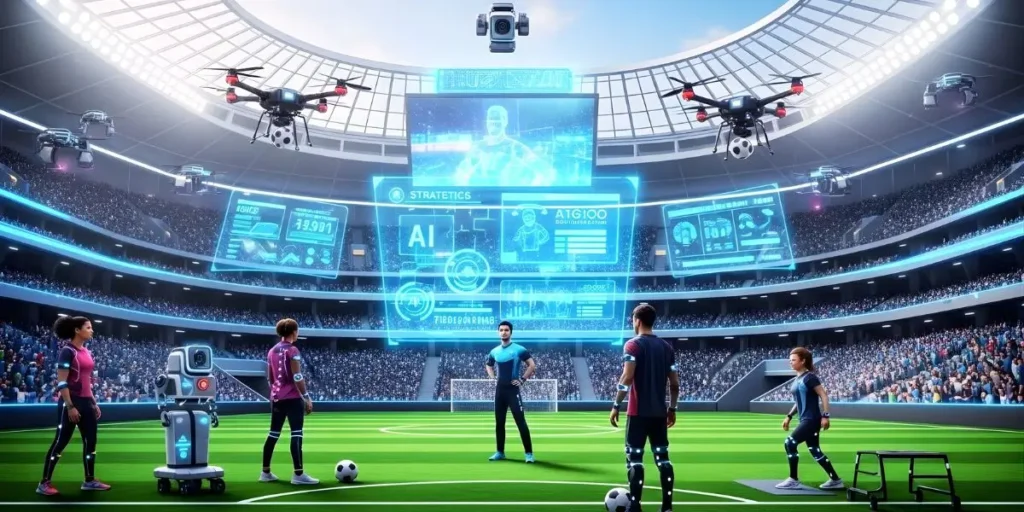

Have you ever wondered how a quarterback makes a split-second decision under pressure or how a basketball coach devises the perfect defensive scheme? The secret weapon is no longer just human instinct—it’s artificial intelligence. AI is revolutionizing professional sports, transforming it from a game of pure physical talent into a sophisticated data-driven enterprise. From optimizing an athlete’s jump shot to predicting the next viral highlight for fans, artificial intelligence is fundamentally rewriting the playbook for how sports are played, coached, broadcast, and experienced.
The integration of AI marks a seismic cultural and technological evolution, not just a simple upgrade. It enhances every facet of the game, offering a competitive edge that was unimaginable a decade ago. This isn’t about replacing the human element; it’s about augmenting it with unprecedented insight. The global market for AI in sports, valued at over $1 billion, is projected to grow significantly, fueled by the explosive volume of data and the relentless pursuit of performance. This guide will break down exactly how AI is changing the sports industry, exploring its impact on athletes, teams, broadcasters, and, most importantly, you—the fan.
Why AI Is Revolutionizing The Sports Industry
The sports industry is in the middle of a data‑driven transformation, where every pass, sprint, heartbeat, and click is captured, analyzed, and monetized in real time. How is AI revolutionizing the sports industry? By turning this data into actionable decisions that improve performance on the field and profitability off it.
-
AI in professional sports gives coaches and front offices predictive insights on player performance, injuries, and game outcomes that were impossible a decade ago.
-
AI in sports analytics uses machine learning and computer vision to process video, tracking player speed, positioning, and fatigue at scale.
How does AI work in sports at a technical level? Systems ingest sensor, GPS, wearables, and video feeds, then apply models to detect patterns, forecast events, and recommend tactical or operational decisions. Do you already track data in your organization, or are you still relying on intuition alone?
AI Sports Analytics: The New Competitive Edge
Elite teams now treat AI sports analytics as a must‑have, not a nice‑to‑have. These tools attack the game from multiple angles: performance, tactics, scouting, and business intelligence.
Performance, Strategy, And Game Intelligence
-
AI in sports performance analysis breaks down each athlete’s speed, acceleration, movement patterns, and stamina to design hyper‑personalized training plans.
-
AI for game strategy optimization analyzes historical and live data to recommend line‑ups, matchups, and in‑game tactical shifts.
By 2025, teams using advanced AI sports data analytics to guide real‑time tactical decisions saw win‑rate improvements of up to 20% in some competitions. Would your coaching staff benefit from real‑time dashboards that suggest substitutions or formation tweaks mid‑game?
Talent Identification And Recruitment
Scouting has also gone algorithmic with AI in talent identification.
-
Models evaluate thousands of prospects across leagues, tracking performance metrics, biomechanics, and consistency over time.
-
Clubs use AI in sports scouting to spot undervalued players before rivals, compressing weeks of manual video review into minutes.
How AI is Transforming the Fan Experience: Beyond the Broadcast
The most visible revolution for many is happening off the field, in the living rooms and on the smartphones of fans worldwide. AI is personalizing sports content for every type of fan, creating an always-on, interactive experience that extends far beyond the final whistle.
Hyper-Personalized Content and Interactive Engagement
Gone are the days of the one-size-fits-all broadcast. AI algorithms now analyze your viewing habits, favorite teams, and even social media interactions to curate a unique experience. Imagine asking your TV, “Show me all the game-winning three-pointers from this season,” and instantly receiving a tailored highlight reel. This is the new reality. Platforms are using natural language processing to let fans interact with live coverage, asking questions and getting real-time answers about strategies and player stats.
This personalization is crucial for engaging younger audiences like Gen Z and Gen Alpha, who expect short-form, interactive, and instantly available content. AI is revolutionizing sports broadcasting by automatically generating these highlight clips, complete with context and analysis, moments after a play happens, keeping fans engaged across social media platforms.
The In-Stadium Revolution
The game-day experience is also getting a high-tech makeover. Forward-thinking franchises are using AI in professional sports to make stadium visits seamless and magical. At venues like SoFi Stadium, AI powers everything from crowd management—monitoring queues at concessions to improve flow—to personalized “surprise and delight” moments. Facial recognition can enable hands-free entry, while AI-driven systems might automatically upgrade a loyal fan’s seat or send a complimentary item based on their engagement history.
Table: Key Areas of Fan Experience Transformed by AI
| Area of Experience | How AI is Applied | Real-World Example |
|---|---|---|
| Content Consumption | Personalized highlight reels, natural language Q&A, tailored news feeds. | Fans using voice search to query specific plays on Fox Sports. |
| Stadium Operations | Crowd flow management, inventory prediction, facial recognition entry. | Tampa Bay Buccaneers using AI for customer service and fan surprises. |
| Global Accessibility | Real-time translation of commentary and graphics, multi-language content. | La Liga’s app providing automatic highlight clips in multiple languages. |
| Community & Connection | Deeper integration with social fan communities and personalized interactions. | AWS and Formula One engaging superfans to co-design an AI-inspired trophy. |
AI on the Field: Optimizing Athlete Performance and Strategy
While fans enjoy the benefits, the core of the revolution is on the field of play. AI is revolutionizing the sports industry by providing coaches and athletes with tools for deeper analysis, injury prevention, and tactical mastery.
Next-Generation Performance Analytics
The NBA’s partnership with Amazon Web Services (AWS) is a prime example of this deep technical transformation. Their system processes over 2.5 petabytes of data per year to create advanced metrics that go far beyond traditional box scores. Let’s break down a few groundbreaking tools:
-
Gravity: This machine learning model tracks 29 body parts on each player to measure defensive pressure and spatial influence, quantifying how a defender impacts an opponent’s options.
-
Defensive Box Score: Moving past just steals and blocks, this AI model assesses a defender’s total impact on disrupting plays and constraining offensive efficiency.
-
Shot Difficulty (xFG%): By analyzing 15+ factors like defender proximity and release angle, this model calculates the expected field goal percentage for any shot, telling you not just if it went in, but how hard it was to make.
This level of analysis provides a common, data-driven language for coaches, players, and scouts, transforming subjective evaluation into objective insight.
Injury Prevention and Health Optimization
One of AI’s most valuable roles is in athlete health. By analyzing data from wearable devices that monitor heart rate, muscle load, sleep, and movement patterns, AI can identify subtle signs of fatigue or strain that may lead to injury. These systems provide early warning alerts to training staff and can recommend adjustments to workload or recovery protocols. Teams are even creating “digital twins” of players—virtual models that simulate stress and performance—to predict and prevent injuries before they occur. This proactive approach to health is extending careers and ensuring the best players stay on the field.
Democratized Training and Coaching Tools
How does AI work in sports for athletes who aren’t in the pros? It’s democratizing elite training. Apps like HomeCourt (NBA-backed) and SwingVision use a smartphone’s camera and computer vision to offer instant feedback on shooting form or tennis technique. For a monthly fee, any aspiring athlete can access analysis that was once reserved for top professionals. This aligns with the sentiment that in athletics, AI is an enabling force, not a displacing one. It provides tools for enhancement, making sophisticated coaching more accessible than ever.
The New Play-Caller: AI in Coaching, Scouting, and Operations
The coach’s clipboard has been replaced by a Microsoft Surface tablet powered by AI in professional sports. The NFL’s expanded partnership with Microsoft is integrating Copilot and Azure AI directly into sideline and front-office workflows.
Real-Time Tactical Decision Making
On the NFL sideline, coaches now have over 2,500 Surface Copilot+ PCs. These devices use AI to quickly filter through thousands of past plays based on specific situations (down, distance, field position) to recommend strategies in real time. As Los Angeles Rams coach Sean McVay noted, Copilot “enhances our efficiency and accuracy by breaking down complex data into digestible insights”. This allows for faster, more informed decisions during the high-pressure crucible of a game.
Smarter Scouting and Team Management
The impact extends beyond game day. At events like the NFL Scouting Combine, AI apps help scouts analyze prospect performance data more intelligently. In the front office, AI agents are being developed to assist with complex tasks like salary cap management and contract analysis. From evaluating draft prospects to optimizing business operations, AI is becoming a front-office executive’s most valuable assistant.
The Broadcast Booth of the Future: AI-Driven Storytelling
How is ESPN using AI? The network is pioneering new forms of analytical storytelling. Its “MNF Playbook” altcast relies on AI technology from startup Adrenaline, which was developed with the help of former All-Pro linebacker Sean Lee. The system acts as a “gridiron crystal ball,” using a model trained on millions of plays to offer real-time predictions, like whether a run or pass is coming or if a blitz is likely. The goal, as Lee states, is to “bring the meeting room to the living room,” giving fans the deep strategic insight previously reserved for coaches and players.
This is part of a broader trend where AI is revolutionizing sports broadcasting. AI can now:
-
Generate automated highlights and commentary in multiple languages almost instantly.
-
Power smart camera systems that automatically follow the action or key players.
-
Create personalized streaming recaps, like NBC’s AI-generated clone of Al Michaels that produced millions of unique versions of Olympic highlights for Peacock viewers.
Revolution Beyond the Arena: The Fitness Industry and Broader Impact
The transformative power of AI isn’t confined to professional leagues. AI is changing the fitness industry on a massive scale, creating a more personalized and effective wellness ecosystem for everyone.
The Personalized Fitness Companion
The global fitness industry, valued at over $90 billion, is leveraging AI through smart wearables and apps that track everything from heart rate to sleep patterns. These devices provide real-time feedback, and AI-powered platforms can generate customized workout plans and nutrition guidance tailored to individual goals and abilities. For fitness professionals, AI tools analyze client movement for form correction and streamline business operations like scheduling and marketing. The future points toward fully integrated holistic wellness platforms, where AI manages not just your workout but your recovery, nutrition, and overall health strategy.
A Blueprint for All Industries
Finally, it’s important to recognize that AI is revolutionizing industries far beyond sports. The advanced engineering and data frameworks developed for sports analytics are blueprints for transformation in retail, healthcare, and finance. The principle is universal: use complex data not as a static record, but as a living, intelligent asset that anticipates needs and enriches human experience. The sports industry, with its clear metrics, passionate audience, and high stakes, has become the perfect proving ground for these technologies.
How AI Is Changing The NBA And NFL
Two of the most powerful use cases of AI in professional sports today sit inside the NBA and NFL. How is AI changing the NBA? How is the NFL using AI? The short answer: everywhere from training centers to broadcast trucks.
How Is AI Changing The NBA?
The NBA is a hotspot for AI in basketball and AI-driven sports performance.
-
AI in sports analytics NBA uses tracking systems to monitor player movement, shot selection, defensive matchups, and spacing.
-
Teams lean on AI basketball analytics to simulate possessions, optimize lineups, and forecast the impact of trades and rotations.
AI in NBA coaching tools help staff identify high‑value plays and defensive breakdowns in seconds, while AI in injury prevention in sports models predict overload risk based on minutes, intensity, and movement patterns. As a fan or executive, would you trust an algorithm to tell your star to sit the next game to avoid a long‑term injury?
How Is The NFL Using AI?
In American football, AI in the NFL touches strategy, officiating, and media.
-
The NFL’s partnership with Genius Sports uses advanced data and AI sports data analytics for live graphics, betting feeds, and real‑time insights during broadcasts.
-
Teams use AI in sports video analysis to break down film, tag formations, and automatically recognize patterns in opponent tendencies.
This feeds directly into play‑calling, risk management, and even contract decisions, making AI in football analytics a central pillar of modern front offices.
Which Sport Uses AI The Most?
Which sport uses AI the most? Football (soccer), basketball, tennis, Formula 1, and esports are currently among the heaviest adopters of AI in the sports industry.
-
In global football, AI in soccer analytics powers VAR systems, offside detection, and predictive models for player recruitment and tactical adjustments.
-
In Formula 1, AI for sports performance analyzes telemetry data, tire wear, and race simulations for micro‑optimized strategies.
Esports has become a massive lab for AI sports performance analytics, tracking reaction time, decision‑making, and in‑game behavior at scale. If your sport isn’t yet leveraging AI deeply, does that represent a risk—or a growth opportunity you can still capture early?
Injury Prevention, Health, And Fitness: AI Beyond Game Day
The next wave of ROI sits where AI in sports performance analysis meets health, wellness, and fitness. How is AI changing the fitness industry? By personalizing training, automating coaching, and keeping athletes healthier for longer.
Injury Prevention And Player Safety
-
Predictive models use wearables, GPS, and biometric data to forecast injury risk and suggest adjustments in training load.
-
AI in sports injury prevention tracks muscle fatigue, hydration levels, and movement asymmetries to reduce soft‑tissue injuries.
This is not just performance optimization; it is asset protection for clubs, brands, and athletes whose careers and endorsements depend on availability.
How Is AI Changing The Fitness Industry?
In gyms, apps, and connected devices, AI in the fitness industry is now mainstream.
-
AI fitness coaching apps build dynamic, adaptive workout programs based on real‑time performance and progress.
-
AI-powered sports equipment like smart treadmills and bikes adjust intensity automatically and provide live feedback on form and effort.
If you run a fitness brand, are you integrating AI in personalized training into your offer, or leaving that space open to competitors?
AI-Powered Sports Broadcasting, ESPN, And Fan Engagement
The media side of the sports industry is also being rebuilt with AI. How does ESPN use AI? By automating coverage, scaling niche content, and personalizing viewing experiences.
How ESPN Uses AI
-
ESPN uses AI to generate automatic game recaps, highlights, and summaries for underserved leagues like women’s soccer and lacrosse.
-
With partners such as Spiideo, the network leverages AI-powered video production to stream youth sports at scale, using AutoFollow cameras and cloud‑based workflows instead of full crews.
These AI-powered sports broadcasting tools also support voice‑narrated news, adaptive captions, and language‑tailored highlight reels, making content more accessible and engaging for global audiences. As a fan, would you prefer one generic highlight package—or a feed tailored to your favorite teams and storylines?
Fan Experience And Monetization
-
AI in sports fan engagement drives personalized content recommendations, dynamic ticket pricing, and in‑stadium experiences like smart concessions and queue optimization.
-
AI sports marketing models predict which campaigns convert best, helping brands maximize sponsorship ROI and lifetime fan value.
This is where AI in sports business quietly unlocks new revenue streams: micro‑targeted offers, better retention, and higher conversion across digital channels.
Will AI Replace Professional Athletes?
One of the most common questions is: Will AI replace professional athletes? The consensus today is clear: AI will augment, not replace, human competitors.
-
AI excels at pattern recognition, simulation, and decision support, but it cannot replicate human emotion, unpredictability, and the cultural meaning of live sport.
-
What is emerging instead is a model where AI in professional sports acts like an always‑on performance coach and strategist, while humans remain the stars on the field.
That said, AI in virtual sports and fully simulated competitions will likely continue to grow as entertainment formats, especially for gaming‑native audiences. Would your brand ever sponsor an AI‑only tournament, or does your strategy remain centered on human athletes?
How Is The Sports Industry Changing Overall?
Stepping back, how is the sports industry changing because of AI?
-
Organizations are moving from intuition‑based decisions to data‑driven, model‑assisted decisions across performance, operations, and media.
-
New roles like sports data scientists, AI performance analysts, and sports tech product managers are becoming standard in elite organizations.
In parallel, AI is revolutionizing industries well beyond sports—healthcare, finance, manufacturing, entertainment—raising cross‑sector expectations for personalization, speed, and automation. Fans now expect the same level of intelligence from their sports experiences as they get from streaming, retail, and social platforms.
Practical Next Steps For Teams, Brands, And Creators
If you want to ride this wave instead of being crushed by it, here are strategic moves to consider around AI in sports and AI sports analytics.
-
Audit your data: What are you collecting today (video, GPS, CRM, sales)? Where are the gaps that limit AI in sports data analytics?
-
Start with one high‑ROI use case: injury risk modeling, AI sports performance tracking, dynamic ticket pricing, or automated highlights.
-
Partner smart: Work with experienced sports AI vendors and universities that already have battle‑tested models and infrastructure.
Remember: your goal is not to “do AI” for its own sake, but to win more, grow faster, and deliver better experiences than your competitors.
Conclusion
So, will AI replace professional athletes? The clear answer is no. An AI can’t sink a clutch three-pointer or make a spectacular diving catch. Instead, AI is the ultimate performance partner, strategist, and storyteller. It amplifies human ability, deepens our understanding, and creates richer connections to the games we love.
The sports industry is changing at a breakneck pace, driven by AI’s ability to personalize, predict, and optimize. As we look to the future, we can expect even more immersive experiences through augmented and virtual reality, more precise AI-assisted officiating, and deeper integration of real-time data into every aspect of the game.
The revolution is here, and it’s making sports more engaging, athletes more phenomenal, and the entire industry more insightful. The final score? A win for everyone involved.
Frequently Asked Questions (FAQs)
How is AI revolutionizing the sports industry?
AI is transforming sports by personalizing fan experiences with tailored content, optimizing athlete performance and injury prevention through advanced analytics, assisting coaches with real-time tactical decisions, and revolutionizing broadcasting with automated storytelling and highlights.
Will AI replace professional athletes?
No, AI is not poised to replace athletes. Athletics are considered “AI displacement-proof.” Instead, AI acts as a powerful enabling tool that democratizes access to elite training resources and enhances human performance, strategy, and safety.
How is AI changing the NBA?
The NBA, in partnership with AWS, uses AI to process petabytes of data to create next-generation metrics like “Gravity” (defensive pressure), “Defensive Box Score,” and “Shot Difficulty.” These tools provide unprecedented insights for teams, broadcasters, and fans, fundamentally changing how the game is analyzed and understood.
How is the NFL using AI?
The NFL has expanded its partnership with Microsoft to integrate AI (like Copilot) across the league. It’s used on sidelines for real-time play analysis, in scouting combines for evaluating prospects, and in front offices for business operations and salary cap management.
Which sport uses AI the most?
While top professional leagues like the NFL, NBA, and Formula 1 are heavy investors, sports with high volumes of measurable data—such as baseball (MLB Statcast) and basketball—are often at the forefront. The integration is becoming widespread, making it a key component across most major sports.
How does ESPN use AI?
ESPN uses AI to power analytical alternative broadcasts, such as its “MNF Playbook” feed. This technology, developed with startup Adrenaline, provides real-time predictive analysis (e.g., run/pass likelihood) to give fans a deeper, more strategic view of the game.
How is AI changing the fitness industry?
AI is personalizing fitness through smart wearables that track health data, apps that create custom workout and nutrition plans, and tools that help fitness professionals with client form analysis and business management. It’s making personalized, data-driven wellness accessible to a broad audience.
How is AI revolutionizing industries?
The sports industry serves as a blueprint for how AI can revolutionize other sectors. The core principle—using machine learning to transform vast, complex data into intelligent, adaptive, and personalized experiences—is applicable to retail, healthcare, finance, and more.
How does AI work in sports?
AI in sports typically works by ingesting massive amounts of data (video footage, player tracking, biometrics), processing it with machine learning models to find patterns and insights, and then outputting those insights in a usable form—such as a coach’s tactical recommendation, a personalized fan highlight reel, or a health alert for an athlete.
How is the sports industry changing?
The sports industry is evolving from a broad-brush entertainment model to a hyper-personalized, data-driven, and always-connected ecosystem. Driven by AI, changes include direct-to-fan digital experiences, the use of data analytics for competitive advantage, the growth of in-stadium technology, and an increased focus on immersive and interactive content.