
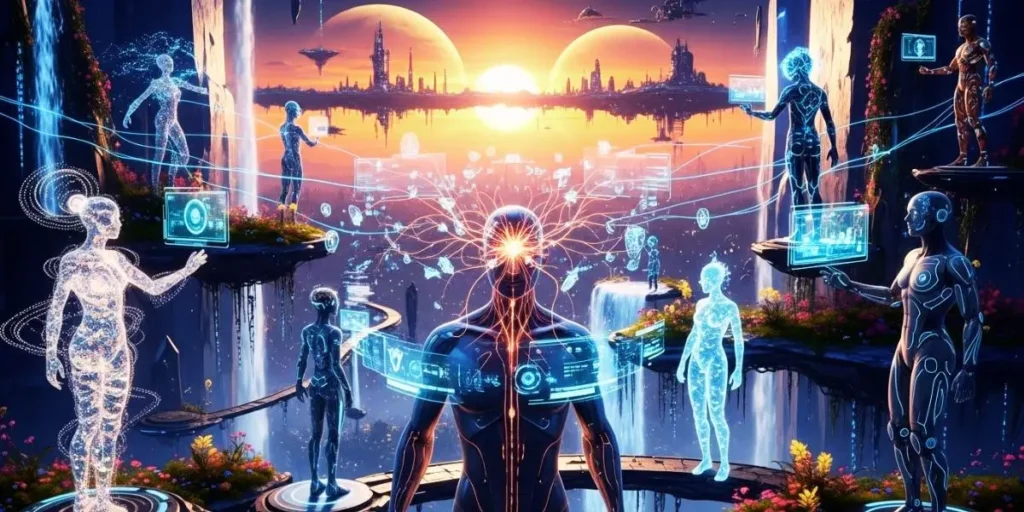

In the next few years, your favorite digital space won’t just be a place you visit—it will be a world that understands you. Artificial intelligence (AI) is fundamentally transforming virtual worlds, shifting them from static, pre-programmed environments into dynamic, intelligent spaces that learn, adapt, and respond to your every move. This isn’t a distant sci-fi fantasy; it’s the unfolding reality of 2026, where AI is evolving from a sophisticated tool into a true collaborative partner.
The fusion of AI with virtual reality (VR), augmented reality (AR), and the broader metaverse is creating a seismic shift. The market is exploding, projected to grow from $21.2 billion in 2023 to nearly $200 billion by 2033. This growth is fueled by AI’s ability to make virtual experiences deeply personal, incredibly responsive, and more immersive than ever before. From gaming and social connection to remote work and healthcare, AI-driven development is setting the stage for a future where our digital and physical lives are seamlessly intertwined.
This article is your guide to that future. We’ll explore the core technologies powering this revolution, examine tangible use cases already changing industries, and provide a clear vision of what you can expect in 2026 and beyond.
-
The Engine of Change: Discover the four key AI technologies—like machine learning and natural language processing—that are making virtual worlds smart and adaptive.
-
Real-World Impact Today: See concrete examples of how businesses in retail, healthcare, and manufacturing are already using AI-enhanced VR to train employees, design products, and connect with customers.
-
The Future of Interaction: Understand how AI-powered NPCs and intelligent avatars will create social and gaming experiences that feel genuinely alive and responsive.
-
A Practical Roadmap: Gain insights into the challenges and ethical considerations of this integration and what it means for you as a user, developer, or business leader.
The Evolution of AI in Virtual Worlds: From Static to Intelligent
Understanding the Paradigm Shift
The traditional approach to building virtual worlds relied heavily on manual design and predetermined interactions. Game developers spent countless hours crafting individual environments, scripting NPC dialogues, and animating character movements. However, AI-generated virtual environments have fundamentally changed this equation. Instead of developers manually creating every element, artificial intelligence now automates the generation of complex virtual spaces, enabling developers to focus on creative vision rather than repetitive technical tasks.
The shift toward intelligent virtual worlds marks a departure from static, scripted experiences to dynamic, adaptive environments that respond intelligently to user behavior. When AI in virtual reality systems analyze user interactions in real-time, they can personalize experiences, adjust difficulty levels, and even generate new content on the fly. This represents a seismic change in how virtual experiences are conceptualized and delivered. Have you ever noticed how some games feel repetitive because NPCs follow the same patterns? Advanced AI-driven virtual worlds are solving this problem by enabling characters that learn, adapt, and surprise players with genuinely novel interactions.
The Technology Behind Intelligent Virtual Environments
Procedural content generation powered by artificial intelligence is the engine driving this transformation. Rather than manually designing terrain, buildings, and objects, AI-based procedural generation algorithms analyze patterns in massive datasets and create infinitely diverse environments automatically. The game No Man’s Sky, for instance, uses AI procedural generation to create billions of unique planetary environments—something that would be impossible through traditional manual design.
The sophistication of these systems has reached remarkable levels. Machine learning algorithms in virtual world applications can now understand spatial relationships, physical laws, and aesthetic principles well enough to generate visually coherent and functionally sound environments. These AI-powered virtual spaces maintain internal consistency across time, allowing worlds to feel alive and reactive rather than hollow and lifeless.
One breakthrough technology in this space is Google’s Genie 2, a foundation model developed by DeepMind that can generate fully interactive 3D environments from a single image. Imagine showing the system a photograph of a forest, and moments later, receiving a playable 3D environment complete with physics simulation, object interactions, and consistent lighting. This capability has profound implications for game development, architectural visualization, training simulations, and creative industries. The technology can generate consistent worlds for up to 60 seconds while maintaining detailed object interactions, realistic physics, and even photorealistic textures.
AI-Powered Avatars: Your Digital Self Reimagined
Creating Intelligent Digital Representations
One of the most compelling applications of AI in virtual worlds is the creation of AI avatars—intelligent digital representations that go far beyond the simple customizable characters of earlier metaverse platforms. Modern personalized avatars leverage deep learning technologies and computer vision to create digital selves that don’t just look like you, but behave authentically according to your personality patterns.
The $50 billion virtual avatar economy demonstrates how significant this market has become. By 2025, AI avatars are incorporating unprecedented levels of emotional intelligence and adaptive behavior. These aren’t static representations—they’re dynamic entities that evolve as they learn your communication patterns, behavioral tendencies, and preferences. Would you be more likely to spend time in virtual worlds if your digital representation could naturally express emotions, remember past conversations, and adapt its behavior based on context?
AI-driven personalization in avatar creation enables users to craft digital personas that truly feel like authentic extensions of themselves. Using advanced facial mapping technology and behavioral analysis, systems can now generate avatars that capture subtle expressions, microexpressions, and even personality quirks. The technology has become so sophisticated that many platforms now allow users to create photorealistic avatars virtually indistinguishable from professional photographs.
Avatar Learning and Evolution
What makes modern AI avatars fundamentally different from earlier versions is their capacity for continuous learning. As you interact within virtual worlds, your avatar learns from these interactions, developing increasingly appropriate responses to different contexts. A user in a professional metaverse environment might have their avatar display different behavioral patterns than in a social gaming world—all happening automatically through machine learning systems analyzing your choices.
The applications extend beyond social engagement. Companies are beginning to deploy AI avatars as personalized customer support representatives, capable of handling inquiries with remarkable sophistication. In enterprise environments, intelligent avatars serve as professional branding tools, consistently representing company values across virtual meetings, training sessions, and customer interactions.
NPCs Reimagined: The Rise of Generative AI Characters
From Scripted to Intelligent
Traditional NPCs in games and virtual worlds have always been limited by their scripted nature. A shopkeeper might say “Welcome to my store” when you approach, but the conversation inevitably loops through a predetermined script. The emergence of AI-driven NPCs powered by natural language processing and generative AI has rendered these static characters obsolete.
Modern AI NPCs can engage in fluid, natural conversations, remembering previous interactions and adapting their behavior based on player choices. Unlike their scripted predecessors, intelligent NPCs respond contextually to player actions, developing personalities that evolve over time. Imagine entering a tavern in a virtual world where the bartender remembers your last visit, asks about your recent adventures, and offers quests tailored to your previous preferences and demonstrated skills.
The Technology Behind Generative NPCs
Companies like Inworld AI have developed comprehensive platforms that allow developers to create NPCs without extensive coding. These AI NPC systems integrate multiple machine learning models including emotions engines, machine vision, text-to-speech, speech-to-text, and real-time animation systems. The result is NPCs that feel remarkably human-like in their interactions.
The sophistication extends to NPC memory and learning. Advanced AI agents can retain information about their interactions with thousands of individual players, creating a shared virtual society where characters have their own goals, relationships, and evolving storylines. Some experimental metaverse platforms are even exploring decentralized AI NPCs—characters that can own virtual assets, conduct trades, and evolve independently according to AI-driven motivations.
Do you think encountering an NPC that genuinely remembers you and reacts based on your past actions would make virtual worlds feel significantly more immersive than current experiences?
Immersive Interaction Technologies
Natural Hand Gesture Recognition
One of the most significant barriers to true immersion in virtual worlds has been the reliance on controllers and external input devices. AI-powered gesture recognition technology is eliminating this friction by enabling natural hand-based interactions. Using computer vision and deep learning algorithms like CNNs (Convolutional Neural Networks) and Vision Transformers, modern systems can interpret hand movements in real-time without requiring any physical controllers.
The practical implications are profound. Rather than holding a controller to manipulate virtual objects, users can simply reach out, grab, and move items naturally—exactly as they would in the physical world. This creates what researchers call natural interaction, where the gap between intention and action nearly disappears. Studies show that gesture-based interaction significantly reduces arm fatigue—a problem known as “gorilla arm syndrome”—that has historically limited VR session duration.
Eye Tracking and Foveated Rendering
AI eye-tracking technology represents another breakthrough in immersive virtual reality experiences. Modern VR headsets integrated with eye-tracking sensors can monitor exactly where users are looking, enabling sophisticated applications. One particularly clever application is foveated rendering—a technique where high resolution is rendered only in the area where the user is looking, with lower resolution in peripheral vision.
This approach, powered by AI systems that predict where eyes will move next, dramatically improves performance and visual quality. Systems can deliver sharp, detailed visuals in the focus area while reducing computational load elsewhere. Additionally, eye-tracking technology enables more natural interaction paradigms. Rather than pointing at objects with controllers, users can simply look at what they want to interact with and use subtle hand gestures to confirm selection.
Predictive AI and Comfort Enhancement
Beyond interaction, predictive AI systems in VR are improving user comfort. By analyzing eye and head movements, AI can predict potential motion sickness triggers and adjust rendering parameters in real-time. This might involve adjusting frame timing, reducing latency, or subtly modifying how the environment responds to movement—all transparently to the user.
For businesses deploying VR training systems, these AI-driven comfort improvements translate directly to longer, more productive training sessions. Medical trainees can undergo extended surgical simulations without discomfort. Corporate teams can conduct longer collaborative sessions in virtual meeting spaces.
Generative AI: Creating Infinite Virtual Worlds
From Images to Playable Worlds
Perhaps the most revolutionary advancement in AI virtual world creation is the ability to generate fully functional, playable 3D environments from simple inputs like images or text descriptions. Google’s Genie 2 represents a watershed moment in this capability, demonstrating that AI can understand physics, causality, and environmental logic well enough to generate complex, interactive worlds.
The practical process is deceptively simple: provide Genie 2 with an image, and the system generates a complete 3D environment you can explore and interact with. The AI has learned physics principles from massive video datasets, enabling it to simulate realistic object interactions, gravity, lighting, reflections, and even character animations. This isn’t pre-rendered video—it’s genuine 3D simulation responding to your input in real-time.
Long Horizon Memory and Consistent Worlds
One of Genie 2’s most remarkable features is its long horizon memory—the ability to maintain consistent world state for extended periods. Earlier AI models would generate coherent environments for mere seconds before breaking down visually. Genie 2 can maintain consistency for up to 60 seconds while you navigate through space, solving problems, and interacting with objects.
The technology achieves this through maintaining an internal representation of world state—essentially the AI remembers areas of the environment you’re not currently viewing. If you leave a room and return later, the system will reconstruct that room in the exact state you left it. While current versions have limits (visual artifacts begin appearing after about 60 seconds), the trajectory is clear: increasingly sophisticated persistent worlds generated entirely by AI.
Training Data and Infinite Scenarios
The implications for AI training and robotics are staggering. Instead of developing robots in limited real-world training environments, AI-generated virtual worlds can create infinite variations of scenarios for training. A warehouse robot can be trained in thousands of different configurations—narrow aisles, crowded spaces, obstacle patterns—all synthetically generated. This diversity dramatically improves generalization, ensuring robots perform well in novel situations they’ve never explicitly trained on.
This also addresses what researchers call the “data crisis.” As modern AI systems have consumed most publicly available training data, synthetic data generation becomes increasingly important. Genie 2 and similar systems could generate an essentially unlimited supply of training scenarios, fueling the next wave of AI advancement across robotics, autonomous vehicles, and countless other domains.
The Core AI Technologies Powering Smarter Virtual Worlds
The magic behind responsive virtual worlds isn’t magic at all—it’s a suite of advanced AI technologies working in concert. These are the building blocks that transform a beautiful but static digital scene into a living, breathing environment.
Machine Learning (ML) and Neural Networks are at the heart of this transformation. By analyzing vast amounts of data on user behavior, ML algorithms allow environments to learn and predict. In a virtual world, this could mean a game that intelligently adjusts its difficulty based on your skill level or a virtual shopping mall that rearranges storefronts to match your interests. These systems enable personalized game activities and adaptive learning paths that make each user’s experience unique.
Natural Language Processing (NLP) breaks down the barrier between you and the digital world. It’s the technology that allows you to have a natural conversation with an AI-powered NPC or give voice commands to control your environment. This goes far beyond simple commands. With advanced NLP, you could debate strategy with a virtual character, negotiate with an AI merchant, or receive tutoring from an avatar that understands your questions and confusion. This makes immersive experiences feel far more intuitive and social.
Computer Vision and Generative AI handle the perception and creation of the virtual space itself. Computer vision enables the system to “see” and interpret user movements and gestures, allowing for precise control and interaction. Meanwhile, Generative AI is revolutionizing content creation. Instead of artists manually designing every tree and building, AI can generate vast, unique landscapes, realistic 3D assets, and even entire ecosystems on the fly. This AI-driven development is key to building the massive, persistent worlds required for the metaverse.
What would you ask an AI character if you knew it could understand the nuance of your question?
AI in Action: Transforming Industries Today
The theoretical potential of AI in virtual spaces is already being realized in practical, high-impact applications across the global economy. These aren’t prototypes; they are solutions delivering measurable value right now.
Immersive Training and Simulation
One of the most powerful applications is in immersive employee training. Companies like Walmart and UPS use VR simulations powered by AI to train millions of employees in everything from customer service to driver safety. The AI doesn’t just run the simulation; it acts as an intelligent coach. It can observe a trainee’s actions, identify mistakes in real-time, and provide personalized feedback. This leads to faster learning, better knowledge retention, and a safe environment to practice high-risk tasks. In fields like medicine, AI-driven VR platforms allow surgeons to practice complex procedures repeatedly in a hyper-realistic virtual operating room, receiving AI-generated performance analytics that help them refine their technique.
Intelligent Design and Prototyping
The process of creating products—from cars to consumer electronics to buildings—is being revolutionized. AI-generated VR environments allow design teams to build, test, and iterate on prototypes in a virtual space long before any physical materials are used. Ford, for example, has used collaborative VR design reviews for years. With AI integration, these sessions become even more powerful, as AI can instantly flag potential design flaws, ergonomic issues, or manufacturing conflicts. This slashes development costs and can cut months off a product’s time-to-market.
The Future of Retail and Commerce
AI is transforming virtual worlds into the next major commerce platform. Imagine a virtual clothing store where an AI assistant knows your size, style history, and even what you’ve browsed recently. You can try on garments that drape and move realistically on your digital avatar. Brands like IKEA use AR (a cousin to VR) to let you place true-to-scale 3D furniture models in your own home through your phone’s camera, dramatically reducing purchase uncertainty and returns. This personalized retail experience is powered by AI that curates products and customizes the virtual store layout for each visitor.
Could you see yourself making a significant purchase, like furniture or a car, after experiencing it in a detailed virtual environment?
The Next Frontier: AI, Gaming, and the Social Metaverse
While enterprise use cases are proving the ROI of AI-driven VR, the most profound evolution in user experience is happening in gaming and social interaction within the metaverse. Here, AI is moving from controlling basic enemy behavior to generating entire worlds and fostering meaningful social bonds.
Revolutionizing Gameplay with Intelligent NPCs
For decades, non-playable characters (NPCs) followed rigid, pre-scripted patterns. AI-powered NPCs are changing everything. These characters can now learn from player interactions, remember past encounters, and adapt their behavior dynamically. A landmark example is the “Nemesis System” from Middle-earth: Shadow of Mordor, where defeated enemies would remember the player, hold grudges, and return with new strengths and strategies. In the future, natural language processing in virtual worlds will allow for open-ended conversations with any character, making game narratives infinitely branching and deeply personal. This creates immersive experiences that are different for every single player.
Building Persistent, Living Worlds
The dream of a persistent metaverse—a digital world that continues to exist and evolve even when you log off—relies heavily on AI. AI-driven development through procedural generation can create boundless, unique landscapes. More importantly, AI can manage the ecosystem of that world. It can simulate weather patterns, wildlife behavior, and the long-term consequences of player actions on the environment. If players collectively over-hunt a virtual forest, the AI might make resources scarce or trigger a migration of creatures, creating emergent storytelling and gameplay.
Fostering Authentic Social Connection
In social VR platforms and the metaverse, AI enhances human interaction. It can provide real-time language translation between avatars, breaking down communication barriers for global communities. AI can also be used to create realistic, responsive digital humans for companionship, coaching, or customer service. Furthermore, AI in VR, AR, and the metaverse can help moderate communities, detect harmful behavior, and ensure social spaces remain safe and inclusive.
The following table contrasts the old paradigm of virtual experiences with the new, AI-driven reality taking shape for 2026:
| Feature | Traditional / Current Virtual Worlds | AI-Transformed Virtual Worlds (2026+) |
|---|---|---|
| World Dynamics | Static or manually scripted changes. | Real-time environment adaptation based on user/player behavior. |
| Characters (NPCs) | Pre-scripted dialogue and fixed behaviors. | Human-like NPCs with context awareness, memory, and adaptive responses. |
| Content Creation | Entirely handcrafted by artists and developers. | AI-assisted generation of landscapes, assets, and even narrative elements. |
| User Experience | Generalized, one-size-fits-all design. | Hyper-personalized experiences that adapt to individual behavior and preferences. |
| Social Interaction | Basic avatar gestures and voice chat. | Emotion-driven avatar interactions and AI-facilitated communication (e.g., translation). |
| Economic Systems | Simple in-game currencies and markets. | Complex, AI-powered economies with dynamic pricing, asset portability, and smart contracts. |
Advanced Neural Rendering and Realism
The quest for visual perfection has long been limited by computing power. Traditionally, simulating every photon of light (a technique called ray tracing) to create realistic materials was prohibitively slow. AI-driven graphics are changing the rules.
Researchers like Dr. Zahra Montazeri are pioneering AI systems that learn how light interacts with complex materials. Instead of painstakingly calculating each light bounce, the AI predicts the outcome, generating hyper-realistic images and textures in a fraction of the time. This means virtual worlds can achieve cinematic quality in real-time, making digital cloth flow, hair shine, and metal gleam with believable authenticity.
This leap is powered by techniques like 3D Gaussian splatting, which allows for the high-fidelity capture and reconstruction of real-world environments. Soon, scanning your living room to create a perfect virtual copy for friends to visit online could be as simple as taking a panorama with your VR headset.
Generative AI and World Building
What if you could describe a world and step into it? Generative AI is making this possible. Platforms are emerging where users can input text, images, or video prompts to conjure explorable 3D environments.
-
From Prompt to Place: Startups like World Labs, founded by AI pioneer Fei-Fei Li, have launched platforms where a text description like “a neon-lit cyberpunk alley in the rain” generates a navigable space.
-
Democratizing Creation: This dramatically lowers the barrier to entry. Professional designers can prototype rapidly, while anyone can become a creator, shaping AI-generated virtual worlds for gaming, socializing, or storytelling.
While today’s AI-generated worlds can sometimes feel unstable or “hallucinatory” upon close inspection, the trajectory is clear. Just as AI image and video generation advanced from novelty to near-perfection, so too will AI for immersive experiences.
Spatial Intelligence and Contextual Awareness
For a virtual world to feel real, it must understand its own space and your place within it. This is spatial intelligence—AI’s ability to perceive, interpret, and interact with 3D environments.
Fei-Fei Li describes this as “the frontier beyond language—the capability that links imagination, perception and action”. An AI with true spatial intelligence doesn’t just render a vase; it knows the vase is on a table, can be picked up, and might break if dropped. This allows for:
-
Persistent Physics: Objects have weight and behave consistently.
-
Intelligent Interaction: Virtual characters can navigate a room naturally, avoiding obstacles.
-
Contextual Blending in AR: Digital objects in augmented reality can occlude correctly behind real-world furniture.
This layer of understanding is what separates a pretty picture from a believable world.
Here’s a quick comparison of how these core AI technologies contribute to the virtual experience:
| AI Technology | Primary Function | Impact on User Experience |
|---|---|---|
| Neural Rendering | Simulates realistic light & materials | Creates visual fidelity indistinguishable from reality. |
| Generative AI | Creates 3D environments & assets from prompts | Enables infinite, personalized worlds on demand. |
| Spatial Intelligence | Understands 3D layout & object relationships | Allows for logical, persistent interaction and physics. |
| Neural Interfaces | Translates user intention into digital action | Makes control feel natural and effortless. |
The New Human-Computer Interface: Thinking, Not Clicking
A stunning world is only half the equation. How we interact with it is getting a revolutionary upgrade, moving beyond handheld controllers to intuitive, natural input.
The Rise of Neural and Gestural Interfaces
Imagine scrolling through a menu or selecting an object with just a subtle thought or finger movement. This is the promise of neural interfaces like the Meta Neural Band, an EMG (electromyography) wearable that translates subtle neural signals from your arm into digital commands.
Historically, such interfaces required tedious individual calibration. AI has changed the equation. By training on diverse datasets, companies have built generalizable models that work for a broad population instantly—no setup needed. The band can already recognize gestures for clicks and scrolls, with capabilities like recognizing handwritten letters in the air on the horizon. This represents a foundational shift in human-computer interaction, tightening the loop between intention and action.
AI Glasses: Your Context-Aware Companion
While VR fully immerses you, AI-powered smart glasses like the Ray-Ban Meta are designed to blend the digital and physical. They act as a second pair of eyes and ears for an AI assistant. A feature called “Conversation Focus” can intelligently amplify the voice of the person you’re speaking with in a noisy room, because the AI understands your environment.
These glasses are becoming a defining hardware category, moving us toward a future where computing complements our lives more than it intrudes. Instead of looking down at a screen, information and assistance are woven into your natural field of view and hearing.
Personalization and Adaptive Experiences: The World That Knows You
The ultimate goal is a virtual experience that feels uniquely crafted for you. AI personalization is the engine making this possible, analyzing your behavior, preferences, and even emotions to shape the world in real-time.
-
Dynamic Content & Difficulty: In education, an AI tutor can adjust a lesson’s complexity based on your comprehension. In a game, enemy behavior and story branches can evolve based on your play style.
-
Emotion Recognition: AI algorithms can analyze facial expressions, voice tone, and biometric data to gauge your emotional state. A virtual fitness coach could offer encouragement if it detects frustration, or a narrative could take a darker turn if it senses you’re engaged.
-
The Proactive Digital Assistant: Beyond reacting, future AI will anticipate needs. As Microsoft notes, your AI companion could help furnish a virtual apartment by finding matching items and suggesting layouts, all based on your stated preferences and past behavior.
This level of adaptive AI in VR transforms passive consumption into a dynamic, collaborative relationship between you and the digital world.
Transforming Industries: Real-World Applications Today
The fusion of AI and virtual worlds isn’t a distant future concept—it’s actively reshaping sectors from healthcare to retail. Here’s how.
Healthcare and Medical Training
VR training simulations powered by AI are revolutionizing medical education. Companies like Oxford Medical Simulation create environments where students can practice complex procedures on realistic 3D anatomical models. The AI can generate infinite variations in patient conditions and lifelike complications, providing risk-free, hands-on experience. Furthermore, AI-driven analysis in VR therapy sessions can help treat conditions like PTSD or phobias through controlled, adaptive exposure.
Education and Corporate Training
Immersive learning leads to significantly higher knowledge retention. One VR medical training program reported a 63% increase in knowledge retention and a 72% boost in user engagement. In corporate settings, VR simulations for high-stakes fields like aviation and engineering allow employees to master skills like engine repair in a safe, repeatable environment, achieving engagement rates as high as 84%.
Retail, Entertainment, and Social Connection
-
Virtual Commerce: AI in AR shopping allows for virtual try-ons, where algorithms accurately map clothing or glasses to your body. IKEA’s app uses AR to let you place true-to-scale furniture in your home.
-
Next-Gen Entertainment: Imagine not just watching a film, but being inside it. Pioneers like James Cameron are exploring premium 3D content for VR. In VR cinema apps, special effects can spill out from the screen into the virtual room around you.
-
Social VR: Platforms like Horizon are integrating AI generation tools, letting friends build and share worlds together simply by describing them. This fosters a new form of collaborative creativity and presence.
Challenges, Ethics, and the Road Ahead for 2026
As with any transformative technology, the integration of AI into virtual worlds comes with significant challenges and ethical questions that must be addressed as we move toward 2026.
Technical and Infrastructural Hurdles: Creating these intelligent worlds requires immense computing power. The industry is responding by building smarter, more efficient AI infrastructure that acts like “air traffic control” for computing workloads, ensuring every cycle of power is used effectively. Another major challenge is creating hardware, like AR glasses, that are socially acceptable, lightweight, and powerful enough for all-day use—a key focus for research hubs like the one at ETH Zurich in collaboration with Google.
Ethical and Societal Considerations: The data required to train these personalizing AIs raises serious privacy concerns. Developers must be transparent about data collection and implement robust safeguards. Furthermore, AI systems can inherit and amplify biases present in their training data, potentially leading to unfair or discriminatory experiences in virtual worlds. Establishing ethical frameworks for AI-driven development will be crucial.
The Human-AI Collaboration: The goal is not to replace human creativity but to amplify it. The most successful applications will be those designed for human-AI collaboration, where AI handles data-heavy tasks and generation, while humans provide strategic direction, creative vision, and emotional intelligence. The future belongs to those who learn to work alongside AI as a partner.
The Future Landscape: Challenges and What’s Next
As with any transformative technology, the path forward is paved with both immense potential and significant considerations.
Current Challenges and Ethical Considerations
-
The “Hallucination” Problem: Generative AI can create convincing but incorrect or nonsensical content—a major issue for training or educational simulations where accuracy is critical.
-
Data and Privacy: Personalized and emotionally-aware AI requires vast amounts of sensitive user data. Ensuring this data is secure and used ethically is paramount.
-
Accessibility and the Digital Divide: Will these AI-powered virtual experiences be accessible to all, or will they create a new tier of digital haves and have-nots? Initiatives like Google’s AI Futures Fund aim to democratize access to tools, but the infrastructure cost remains high.
The Horizon: Integrated Agents and the Blended Metaverse
Looking ahead, the trends point toward deeper integration:
-
AI Agents in Virtual Worlds: Autonomous AI agents will inhabit these worlds, not just as non-player characters, but as helpful guides, customer service reps, or collaborative partners that can execute multi-step tasks.
-
The Evolving Metaverse: The vision remains a persistent, interconnected metaverse. AI will be the glue that binds it together, making shared virtual spaces feel coherent, manageable, and rich with user-generated content.
-
Driving Scientific Discovery: Beyond entertainment, these simulated worlds will become laboratories. AI-driven protein-folding simulations are already accelerating drug discovery. Virtual “world models” could one day let scientists simulate climate patterns or quantum physics with unprecedented fidelity.
Quantum Computing and Complex Simulations
As quantum computing matures, it promises to dramatically expand the complexity and fidelity of AI-generated virtual worlds. Current AI systems in virtual environments operate within computational constraints. Quantum computing could enable physics simulations of unprecedented accuracy, more sophisticated NPC decision-making, and larger persistent worlds with more simultaneous users.
Decentralized and Blockchain-Integrated Metaverse
The future of AI-powered virtual worlds increasingly involves blockchain integration, enabling true digital ownership and decentralized governance. Rather than companies controlling virtual assets, users could own avatars, land, and items that retain value and can transfer between different virtual platforms.
AI systems in decentralized metaverse environments could manage autonomous trading, facilitate player-to-player transactions, and maintain shared world state across multiple independent platforms. This represents a fundamental shift from centralized virtual worlds controlled by single companies to distributed ecosystems where users have genuine ownership and agency.
Enhanced Accessibility Through AI
AI-powered virtual worlds have profound accessibility implications. Gesture recognition technology enables people with mobility challenges to interact naturally in VR environments. AI translation systems break down language barriers, enabling global collaboration in virtual spaces. Voice interfaces powered by natural language processing allow people with visual impairments to navigate and interact with virtual worlds.
Progressive organizations are intentionally designing AI-enhanced virtual experiences to be inclusive from the ground up rather than retrofitting accessibility later.
Practical Applications Across Industries
Healthcare and Medical Training
Perhaps the most immediately impactful application of AI in virtual worlds is medical education and training. VR medical simulations powered by AI are transforming how future healthcare professionals develop critical skills.
In surgical training, AI-powered simulations provide surgeons with adaptive scenarios that respond to their decisions in real-time. Administer the wrong medication and the virtual patient exhibits authentic physiological responses reflecting that error. Make an incorrect incision and the simulation evolves to reflect those consequences. This creates a safe environment for learning from mistakes—something impossible with live patients.
Voice-controlled AI interactions in virtual patient simulations enable medical students to practice communication skills they’ll need in real practice. Difficult conversations—breaking bad news, de-escalating angry patients—can be practiced repeatedly in realistic environments with AI patients that respond contextually to the student’s tone and word choice.
The statistics are compelling. Healthcare institutions deploying AI-enhanced VR training report improved learning outcomes, increased trainee confidence, and more efficient skill development—all without requiring expensive physical simulators or cadavers.
Enterprise Collaboration and Remote Work
AI-powered virtual workspaces like Meta Horizon Workrooms and Microsoft Mesh are transforming distributed work dynamics. Rather than video calls where participants are reduced to faces on screen, immersive virtual offices enable teams to collaborate in shared 3D spaces with embodied presence.
AI in these environments handles translation between languages, manages ambient noise and audio quality, suggests meeting logistics, and even generates documentation from meeting discussions. For organizations with global teams, AI-enhanced virtual collaboration can reduce the cognitive burden of distributed work while increasing the sense of presence and connection.
Gaming and Entertainment
The gaming industry represents perhaps the most visible early application of AI virtual world transformation. AI-generated NPCs eliminate repetitive dialogue loops that plagued earlier games. Procedural content generation creates effectively infinite replayability. Personalized game worlds adapt difficulty, pacing, and narrative based on individual player behavior.
Games like No Man’s Sky use AI procedural generation to create billions of unique planets, each with distinct ecosystems, alien creatures, and resources. Players exploring one corner of the galaxy will never encounter identical environments to other players. This represents an entirely new approach to game design—instead of developers creating hand-crafted content, AI generates it algorithmically within defined parameters.
Educational Transformation
Virtual learning environments powered by AI are democratizing access to expert instruction. Rather than being limited to students in prestigious universities, learners worldwide can access AI-driven educational simulations that adapt to their learning style, pace, and comprehension level.
AI tutoring systems in virtual classrooms can identify misconceptions in real-time, provide targeted interventions, and adjust pacing dynamically. A student struggling with particular concepts receives additional support and simplified explanations. A student racing ahead can dive into advanced material. This personalization at scale would be impossible with traditional classroom instruction.
The Future: Convergence of Technologies
Quantum Computing and Complex Simulations
As quantum computing matures, it promises to dramatically expand the complexity and fidelity of AI-generated virtual worlds. Current AI systems in virtual environments operate within computational constraints. Quantum computing could enable physics simulations of unprecedented accuracy, more sophisticated NPC decision-making, and larger persistent worlds with more simultaneous users.
Decentralized and Blockchain-Integrated Metaverse
The future of AI-powered virtual worlds increasingly involves blockchain integration, enabling true digital ownership and decentralized governance. Rather than companies controlling virtual assets, users could own avatars, land, and items that retain value and can transfer between different virtual platforms.
AI systems in decentralized metaverse environments could manage autonomous trading, facilitate player-to-player transactions, and maintain shared world state across multiple independent platforms. This represents a fundamental shift from centralized virtual worlds controlled by single companies to distributed ecosystems where users have genuine ownership and agency.
Enhanced Accessibility Through AI
AI-powered virtual worlds have profound accessibility implications. Gesture recognition technology enables people with mobility challenges to interact naturally in VR environments. AI translation systems break down language barriers, enabling global collaboration in virtual spaces. Voice interfaces powered by natural language processing allow people with visual impairments to navigate and interact with virtual worlds.
Progressive organizations are intentionally designing AI-enhanced virtual experiences to be inclusive from the ground up rather than retrofitting accessibility later.
Market Dynamics and Investment Landscape
Explosive Growth Projections
The metaverse market is experiencing explosive growth. In 2025, the market reached $203.7 billion, with projections exceeding $1 trillion by 2030 and reaching $2.3 trillion by 2032. These figures underscore the massive economic opportunity driving competition and innovation.
AI and virtual world investment is led by the computer and IT sector (17% of metaverse investments), followed by education (12%), finance (11%), and marketing and advertising (10%). This distribution reflects the diverse applications emerging across industries.
Financial Services in Virtual Worlds
An emerging sector is metaverse finance, with estimated value of $76 billion in 2025 and projected growth to $200+ billion. DeFi protocols within metaverse ecosystems recorded 42% year-over-year growth in active wallets. Virtual real estate and tokenized assets now constitute multi-billion-dollar markets.
The combination of AI and blockchain in virtual economies enables sophisticated financial systems—lending, insurance, and trading occurring entirely within virtual worlds yet with real financial consequences. As these systems mature, virtual economy management becomes increasingly automated by AI systems trained to maintain market stability and prevent fraud.
Challenges and Considerations
Data Privacy and Security
As AI systems in virtual worlds become more sophisticated, they necessarily collect increasingly detailed data about user behavior, preferences, and even biometric information (eye tracking, hand movements, voice patterns). Ensuring this data remains secure and is used ethically represents an ongoing challenge.
Progressive platforms are implementing privacy-by-design principles, where data protection is engineered into systems from the beginning rather than added afterward. However, as virtual worlds become more intimate and integrated with real identity, data security challenges will only intensify.
Ethical AI and Preventing Misuse
The sophistication of AI-driven virtual worlds creates potential for misuse. Deepfake avatars could impersonate real people. AI NPCs could be manipulated to inappropriate purposes. Virtual spaces could be weaponized for harassment or manipulation.
Organizations developing AI-powered virtual experiences must implement robust safety systems, clear ethical guidelines, and responsive moderation. Transparency about how AI systems make decisions—particularly decisions affecting user experience or safety—builds trust and enables users to hold systems accountable.
Technical Limitations
Current AI-generated virtual worlds face technical constraints. Genie 2’s 60-second consistency window, while impressive, still falls short of persistent seamless worlds. Current gesture recognition systems occasionally misinterpret movements, breaking immersion. AI NPCs, while increasingly sophisticated, occasionally produce responses that break character or feel uncanny.
These limitations aren’t permanent—they represent the current frontier of capability that will steadily improve. However, acknowledging them honestly helps set realistic expectations about how quickly fully immersive AI-powered virtual worlds will mature.
Conclusion: Embracing an Intelligent Virtual Future
The transformation driven by artificial intelligence in virtual worlds is not a single event but an ongoing journey. As we look to 2026, the trends are clear: virtual experiences will become deeply personalized, persistently dynamic, and intelligently responsive. AI is fundamentally transforming virtual worlds from passive destinations into active partners in how we work, learn, play, and connect.
This shift presents unparalleled opportunities—for businesses to engage customers in revolutionary ways, for educators to create truly adaptive learning, and for individuals to explore social connections and identities in safe yet expansive new frontiers. By understanding the technologies, acknowledging the challenges, and focusing on human-centric design, we can steer this evolution toward a future that amplifies human potential and creativity.
What’s Next? The virtual world is what we make it. Start a conversation: What aspect of AI-transformed virtual reality excites or concerns you the most? Share your thoughts in the comments below, and subscribe for our deep-dive articles on the future of AI in VR, AR, and the metaverse.
Frequently Asked Questions (FAQs)
How is AI currently being used in virtual reality?
AI is currently used in VR for multiple purposes: creating hyper-realistic graphics through neural rendering, generating dynamic in-game characters and environments, providing personalized learning paths in training simulations, and enabling natural interaction through gaze and gesture tracking. It’s the technology making VR worlds feel more responsive and alive.
What are AI-powered virtual worlds?
AI-powered virtual worlds are digital environments that are either created or significantly governed by artificial intelligence. Unlike traditional, manually-built worlds, they can be generated from text prompts, feature landscapes and characters that adapt in real-time to user behavior, and contain AI entities that act with a degree of autonomy. They are dynamic, personalized, and often more expansive than human-built counterparts.
What is the difference between AI in VR and AI in AR?
The core difference lies in application:
-
AI in VR (Fully Immersive): Focuses on building and managing entirely synthetic environments. Key uses include world generation, realistic physics simulation, and intelligent virtual agents.
-
AI in AR (Overlay on Reality): Focuses on understanding and integrating with the real world. Key uses include object recognition (to place digital items accurately), spatial mapping (to understand surfaces), and contextual information display (like translating text in real-time).
Both use overlapping AI technologies like computer vision, but apply them to different problems.
Will AI replace human creators in building virtual experiences?
No, AI is best viewed as a powerful tool for creators, not a replacement. It automates tedious tasks (like rendering light or modeling basic objects), provides new creative instruments (like generating concepts from text), and lowers technical barriers. This allows human artists, designers, and storytellers to focus on high-level vision, narrative, and emotional depth—the aspects that truly define a memorable experience. The future is a collaborative partnership between human creativity and AI capability.
What are the biggest challenges facing AI in virtual worlds?
Key challenges include:
-
Technical Fidelity: Achieving both visual realism and accurate physical simulation, especially for complex systems like human movement or fluid dynamics.
-
Computational Cost: Running advanced AI models and rendering high-fidelity worlds requires significant energy and processing power, posing sustainability and accessibility challenges.
-
Ethical and Safety Concerns: Ensuring user privacy, preventing the generation of harmful content, and managing the psychological effects of deeply immersive, persuasive virtual environments.
-
Data Requirements: Training robust world models requires massive, diverse datasets that are difficult and expensive to curate.
How is AI currently being used in virtual reality (VR) today?
Today, AI enhances VR primarily through personalization and intelligent automation. Key uses include:
-
Immersive Training: Providing adaptive feedback in corporate and medical simulations.
-
Smart NPCs: Creating non-player characters in games that react dynamically to user actions.
-
Procedural Content: Generating unique VR environments and assets to save development time.
What is the difference between AI in VR and AI in the metaverse?
While related, the scope differs. AI in VR typically focuses on enhancing a single, contained virtual experience—like a training simulation or a game—making it more realistic and interactive. AI in the metaverse operates on a much grander scale. It’s responsible for managing the persistent state of a massive, interconnected digital universe, governing economies, ensuring cross-world consistency, and facilitating social interactions between countless users simultaneously.
What are “AI-powered NPCs” and how do they make games better?
AI-powered NPCs (Non-Playable Characters) are digital characters controlled by advanced AI algorithms instead of simple scripts. They make games better by:
-
Remembering Interactions: They can recall past encounters with the player and change their attitude or strategy.
-
Adapting Behavior: They react to player tactics in real-time, making combat and social interactions more challenging and unpredictable.
-
Enabling Natural Dialogue: Using NLP, players can have open-ended conversations with them, leading to deeper storytelling and immersion.
When can we expect to see widespread consumer use of AI-driven augmented reality (AR)?
Widespread consumer AR, particularly through stylish smart glasses, still faces hardware hurdles like miniaturization and battery life. However, significant progress is expected by 2026. Major tech companies and research institutions (like Google and ETH Zurich) are actively working to solve these problems. We will likely see continued growth in smartphone-based AR first, with dedicated glasses becoming more common later in the decade.
Does using AI to create virtual world content threaten the jobs of artists and designers?
The prevailing view is that AI acts more as a collaborative tool than a replacement. AI-driven development automates repetitive, time-consuming tasks like generating initial texture variations, populating large landscapes with foliage, or modeling simple assets. This frees up human artists and designers to focus on high-concept creative direction, complex storytelling, and fine-tuning the emotional impact of a world—tasks where human creativity remains essential. The result is often a greater capacity for creativity and innovation, not fewer jobs.
What exactly is the metaverse, and how does AI transform it?
The metaverse refers to interconnected virtual spaces where users interact as avatars. AI transformation makes these spaces more intelligent by enabling NPCs with realistic conversations, procedurally generated environments, and personalized experiences that adapt to individual users rather than serving identical content to everyone.
How can I start experiencing AI-powered virtual worlds today?
Accessible options include Meta Horizon Worlds (social VR), VRChat (customizable avatars and worlds), and various platform-specific experiences. Many users begin with smartphone-based VR, though higher-end headsets like Meta Quest Pro or Apple Vision Pro offer more sophisticated immersive experiences.
What are the most practical near-term applications of AI in virtual worlds?
Healthcare training ranks among the most mature applications, with medical VR simulations already improving educational outcomes. Enterprise collaboration platforms like Horizon Workrooms and Microsoft Mesh are becoming increasingly common. AI-enhanced gaming continues advancing rapidly.
How do AI avatars learn and adapt to my behavior?
Modern AI avatars incorporate machine learning systems that analyze your communication patterns, behavioral choices, and interaction styles. Over time, these systems adjust the avatar’s responses to become more aligned with your authentic personality and preferences.
Can AI-generated worlds truly maintain consistent environments?
Current technology like Google Genie 2 can maintain visual and physical consistency for approximately 60 seconds. While this exceeds earlier capabilities significantly, persistent worlds fully matching player expectations remain in development. However, the trajectory shows rapid improvement.
What security measures protect my data in AI-powered virtual worlds?
Leading platforms implement encryption, access controls, and data minimization practices. However, the immersive nature of VR—requiring tracking of eye movements, hand positions, voice patterns, and behavioral data—means privacy protection remains an ongoing challenge requiring user awareness and platform transparency.
How will AI-generated procedural content affect game and world design?
Rather than eliminating designers, AI-driven procedural generation shifts their role toward defining rules and parameters that AI systems follow. Designers become architects of possibility spaces rather than creators of individual assets—enabling vastly more content with smaller teams.