














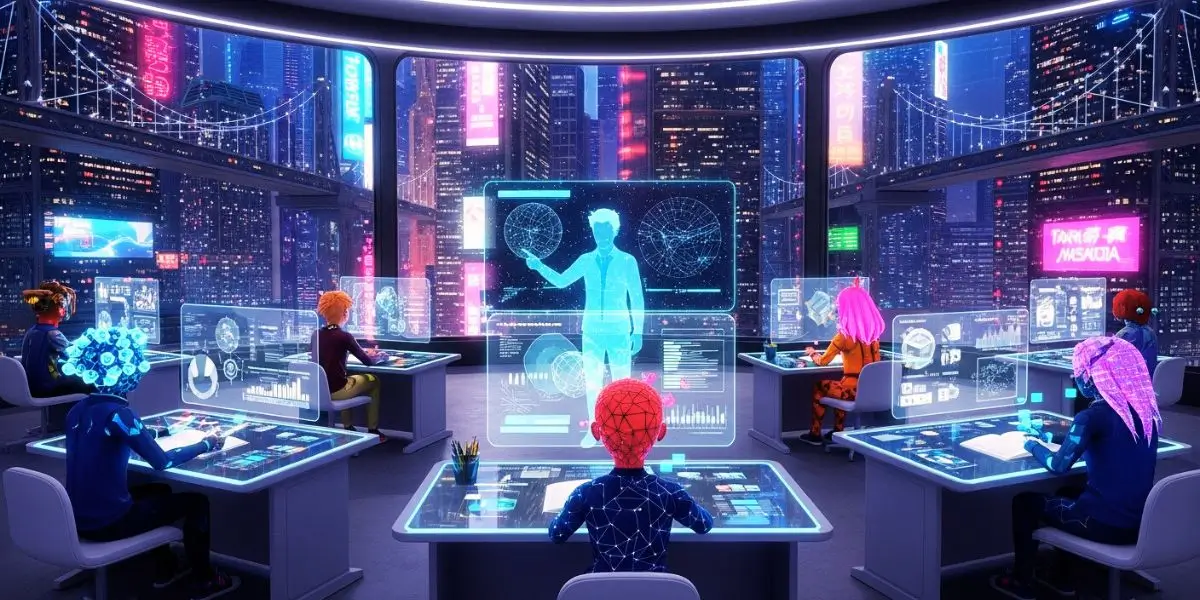
Have you ever watched a student struggle to grasp a complex, three-dimensional concept from a flat, two-dimensional textbook? Or felt the frustration of trying to make a historical event feel real, or a biological process feel tangible? You’re not alone. The traditional educational model, while powerful, has inherent limitations of scale, cost, and immersion.
But what if you could transport your entire class to the trenches of World War I, walk them through the human circulatory system as a red blood cell, or practice a high-stakes surgical procedure with zero risk? This is no longer science fiction—it’s today’s classroom reality.
Education in the Metaverse is fundamentally restructuring how we teach and learn. It’s not just another tech trend; it’s a seismic shift towards experiential, student-centered learning that drives measurable outcomes. From boosting national exam pass rates by 10-15% to increasing student confidence by 25%, the data is clear: immersive learning works.
In this definitive guide, we’ll move beyond the hype. We’ll break down exactly how leading institutions are leveraging the metaverse to solve real problems, achieve tangible ROI, and future-proof their educational offerings. Whether you’re an administrator, a curriculum designer, or an educator ready to innovate, you’ll discover actionable strategies, proven use cases, and a clear roadmap for implementation.
Defining the Educational Metaverse: More Than Just VR
Let’s demystify the term. In an educational context, the Metaverse in the education sector is not a single app or a pair of VR goggles. It’s best understood as a convergence of persistent, shared, three-dimensional virtual spaces where users, represented by avatars, can interact with each other and digital objects in real-time for learning purposes.
This ecosystem is built on several interdependent pillars:
Immersive Technologies: This includes Virtual Reality (VR) for full immersion, Augmented Reality (AR) for overlaying digital information on the physical world, and Mixed Reality (MR) which blends both.
Digital Infrastructure: This encompasses the platforms (like Spatial or Mozilla Hubs), cloud computing, and high-speed connectivity that make these worlds accessible.
Web3 Elements: While not universally required, concepts like blockchain for verifiable credentials and digital asset ownership (NFTs) are beginning to play a role in creating portable, learner-owned records of achievement.
Artificial Intelligence (AI): AI is the “brain” that enables adaptive learning paths, powers intelligent tutoring avatars, and creates dynamic, responsive environments.
Crucially, educational Metaverse platforms differ from traditional video conferencing or Learning Management Systems (LMS). As expert Camino López García notes, “It will be a new model of learning… It will be returning to meeting in the hallways even if we live thousands of kilometers apart”. It’s about embodied presence and shared experience, transcending the flat, grid-based fatigue of conventional digital tools.
The Transformative Power of Metaverse Learning (The “Why”)
The transition to metaverse-based education is driven by more than novelty; it’s fueled by a convergence of pedagogical need and technological possibility. It addresses core gaps in traditional and even standard online learning by making the abstract concrete and the inaccessible available.
Core Benefits: Engagement, Retention, and Accessibility
The benefits are multifaceted, impacting learners, educators, and institutions:
Skyrocketing Engagement & Motivation: When students are inside the lesson, they pay attention. A Forrester Consulting study found that 76% of educators agree VR visualizations make learning more realistic, and 59% agree it helps students engage more deeply with content. In one case, 90% of students reported greater interest in their classes after VR integration.
Deeper Knowledge Retention & Understanding: Experiential learning creates stronger neural pathways. At the University of Glasgow, research confirmed that immersive learning experiences significantly outperform 2D video in both immediate and long-term knowledge retention. One educator noted a student claimed to know an answer because they had “been there” in VR.
Safe, Scalable Practical Skill Development: The metaverse provides a risk-free sandbox for high-stakes training. Universities like NYU College of Dentistry have trained over 1,600 students in delicate procedures like anesthetic injection using immersive MR simulations. Students can fail, reset, and try again without consequence.
Democratizing Access & Breaking Barriers: It eliminates geographical and physical constraints. A student in a rural community can tour the Louvre, conduct a complex chemistry experiment, or collaborate on a project with peers across the globe in real-time.
Powerful Data & Personalized Learning Pathways: Every interaction in a virtual environment can be measured, providing unprecedented insights into student comprehension, decision-making, and engagement patterns, allowing for truly adaptive learning journeys.
The Tangible Business Case: ROI for Educational Institutions
For decision-makers, the investment must make financial sense. The metaverse delivers by:
Reducing Operational Costs: Virtual labs and simulations eliminate the need for expensive physical materials, equipment, and dedicated lab space. Pfizer reported saving $23,000 per instructor-trainee pair by switching to VR for aseptic training.
Improving Key Performance Metrics: This isn’t just about engagement; it’s about results. Purdue Global saw a 10-15% increase in national nursing exam pass rates after implementing VR training. Better outcomes enhance institutional reputation and attract more students.
Enabling Scalable, High-Quality Instruction: One expert-led virtual simulation can be deployed to thousands of students simultaneously, ensuring consistency and freeing faculty to mentor rather than just demonstrate.
The Metaverse Educator’s Toolkit: Hardware, Software, and Strategy
Entering the metaverse for education doesn’t require building a universe from scratch. A robust ecosystem of accessible tools already exists.
Essential Hardware: The Gateway to Immersion
The primary tool is the VR/MR headset. Meta Quest devices have emerged as a leader in educational adoption due to their balance of quality, affordability, and manageability.
Why Meta Quest? They are wireless, require no powerful external PC, and come with management suites like Meta Quest for Education for easy device deployment and control at classroom scale.
The Experience Factor: High-resolution displays and intuitive controllers allow students to forget the technology and focus on the experience, whether they’re manipulating a 3D model of a DNA strand or writing on a virtual whiteboard with peers.
Foundational Software Platforms: Building Your Virtual Campus
This is where you create and host your experiences. Platforms vary from ready-made content libraries to full-fledged creation studios.
| Platform Type | Examples | Primary Use Case | Best For |
|---|---|---|---|
| Immersive Creation & Annotation | ThingLink, ENGAGE | Adding interactive hotspots, information layers, and assessments to 360° media. | Creating virtual field trips, interactive diagrams, and student projects. |
| Virtual Campus & Classroom | Virbela, Spatial | Hosting live classes, lectures, and social gatherings in persistent 3D spaces. | Institutions building a full digital twin campus for remote and hybrid learning. |
| Specialized Simulation | Labster (Science), VR Patients (Healthcare), Bodyswaps (Soft Skills) | Providing hyper-realistic, curriculum-aligned practice scenarios. | Vocational training, medical education, and professional skill development. |
| Comprehensive Educational Suites | Victory XR, OptimaEd | Offering a full catalog of immersive courses and experiences across subjects. | Schools seeking a turnkey solution with pre-built, standards-aligned content. |
The Strategic Implementation Blueprint
Jumping in without a plan leads to wasted resources. Follow this phased approach:
Define Your Learning Objective: Start with the pedagogical goal, not the tech. Are you aiming to improve spatial reasoning in engineering? Teach empathy in social work? Clarify the “why.”
Select the Right Tool: Match the platform to your objective. A virtual field trip needs a different tool than a medical simulation.
Pilot with a Champion: Identify an enthusiastic educator and a single class for a controlled pilot. Gather feedback on logistics, student response, and learning impact.
Integrate, Don’t Isolate: Embed the metaverse experience within the broader curriculum. Use it as a capstone event, a practice lab, or a collaborative project—not a disconnected gimmick.
Train Your Educators: Success depends on teacher comfort. Provide dedicated training on both the technology and the new pedagogical methods it enables.
Measure and Iterate: Use the qualitative feedback and quantitative data (assessment scores, engagement metrics) to refine the experience and build your case for broader rollout.
From Theory to Practice: Metaverse Use Cases That Are Working Now
Let’s move from concept to concrete examples. Here’s how pioneering institutions are already achieving success.
1. Revolutionizing Higher Education and STEM
University of Glasgow: Faced with the challenge of teaching 3D concepts (like molecular structures or archaeological sites) with 2D tools, they launched an MR competition for faculty. The result was 12 immersive learning apps now used by thousands of students each semester, fundamentally transforming teaching approaches.
Inspired Education Group: This global network implemented VR to unify teaching for both in-person and remote students. The results were staggering: 94% of students learned better, 90% were more engaged, and overall confidence in subject matter rose by 25%.
2. Transforming Professional and Vocational Training
Healthcare & Nursing (Purdue Global, NYU): To address a national nursing shortage, Purdue uses VR to simulate real-world patient scenarios, leading to a 10-15% boost in exam results. NYU’s College of Dentistry uses MR for anesthesia training, allowing students to repetitively practice a critical skill without risk.
Corporate Upskilling (L’Oréal, Pfizer): Companies are using metaverse platforms for everything from onboarding to complex technical training. L’Oréal created a “university” in the metaverse for global beauty experts, while Pfizer achieved massive time and cost savings in compliance training.
3. Fostering Soft Skills and Global Citizenship
Locker Room Talk: This nonprofit uses VR to train youth sports coaches in gender equality and emotional intelligence. Their metaverse experience has reached over 11,000 players, tackling sensitive topics in an engaging, scalable way.
Global Collaboration Projects: Students from different countries can co-create museum exhibits, solve environmental crises in simulation, or conduct joint cultural research in a shared virtual space, building collaboration and communication skills.
Navigating the Challenges: A Realist’s Guide
Ignoring the hurdles leads to failed projects. A successful strategy acknowledges and plans for these key challenges:
The Digital Divide & Equity: Not all students have equal access to high-speed internet or capable devices. Solution: Implement a hybrid model, use device loaner programs, and ensure experiences can run on lower-end hardware where possible.
Initial Investment & Content Development Cost: While hardware costs are falling, developing custom, high-quality content can be expensive. Solution: Leverage the growing library of pre-built, curriculum-aligned content from partners. Start with off-the-shelf experiences before investing in custom builds.
Digital Wellness & Safety: Prolonged headset use can cause discomfort (cybersickness), and virtual spaces require strong community guidelines. Solution: Keep VR sessions focused (20-30 mins), ensure frequent breaks, and implement robust digital citizenship protocols and privacy safeguards.
Faculty Adoption & Training: Resistance to new technology is natural. Solution: Involve educators in the selection process from day one, provide continuous professional development, and celebrate early adopters as champions.
The Unmatched ROI: Core Benefits and Strategic Advantages
Investing in the Metaverse isn’t about chasing a trend; it’s about securing measurable, transformative outcomes. Here’s the breakdown of the core value proposition.
Exponential Engagement Through Immersion & Gamification
The fundamental power of the Metaverse is its ability to turn learning into an experience. By leveraging gamification in the Metaverse, educators can integrate reward systems, narrative quests, and interactive challenges directly into the curriculum. This approach is proven to boost motivation, attention, and knowledge retention by tapping into intrinsic human drivers. Platforms like KAI XR transport students to the bottom of the ocean or the surface of Mars, creating a sense of wonder and active exploration that a textbook simply cannot match.
2.2 Master Practical Skills in Zero-Risk Simulations
This is perhaps the most powerful application for vocational and professional training. The Metaverse provides a perfectly safe, repeatable, and cost-effective environment for high-stakes practice. Medical students can perform virtual surgeries, engineering students can disassemble complex machinery, and chemistry students can conduct explosive experiments—all without physical risk, consumable cost, or logistical nightmare. Studies, like one from a Fortune 100 software company, show knowledge retention increases of over 70% following immersive Metaverse training.
Democratize Access and Collapse Geographic Barriers
The Metaverse inherently creates a borderless classroom. A student in a remote village can join a seminar at a top-tier university, and a global corporate team can conduct hands-on onboarding in a shared virtual space. This breaks down the traditional barriers of geography and physical infrastructure, making elite education and standardized corporate training universally accessible. It also enables powerful virtual field trips in education, allowing entire classes to visit the Louvre, the Great Wall, or a coral reef ecosystem in a single lesson.
Hyper-Personalized Learning Pathways Powered by AI
When combined with AI, the Metaverse moves beyond one-size-fits-all instruction. The system can analyze a student’s interactions, pace, and decision-making in real-time. It can then dynamically adjust content difficulty, provide instant personalized feedback through an AI tutor, or recommend specific learning modules. This creates a truly adaptive learning journey that caters to individual strengths and addresses weaknesses as they happen, optimizing the educational funnel for maximum completion and mastery.
Tangible Applications: Key Use Cases Transforming Sectors
The theoretical benefits are compelling, but how is this applied on the ground? Here are the transformative use cases driving adoption.
Table: Key Metaverse Applications Across Educational Sectors
| Sector | Primary Use Case | Example & Impact |
|---|---|---|
| Higher Education | Virtual Campuses & Complex Labs | Universities like Curtin (Australia) use platforms like LearnBrite for interprofessional hospital visits. Students from pharmacy, psychology, and social work collaborate in simulated clinical environments. |
| Corporate Training | Immersive Onboarding & Soft Skills | Companies like Pfizer use virtual spaces for team-building and coaching. L’Oréal runs a “University” in the Metaverse for training influencers and makeup artists on new products. |
| Vocational & Trade Skills | Hands-On Technical Practice | In the UK, Newcastle College Group uses Metaverse Learning content to teach plastering apprenticeships. Students practice techniques virtually, reducing material waste and allowing for unlimited repetition before touching real materials. |
| K-12 & STEAM | Interactive Exploration & Creativity | Tools like Minecraft: Education Edition allow students to model scientific concepts or historical events in 3D. It fosters skills in problem-solving, resource management, and collaboration. |
| Professional Certifications | Simulation-Based Assessment & Credentialing | The UNIR university in Spain integrates Metaverse simulations into its Master of Law practice. Students conduct mock trials and client meetings in virtual courtrooms, with professors acting as judges. |
Real-World Impact: Case Studies of Pioneering Success
Let’s move from theory to proven results. These organizations aren’t just experimenting; they are achieving measurable success.
1. Staffordshire Training Services (Vocational Training, UK): Faced with the challenge of training for the high-risk gas and renewable energy sectors, this provider panered with Metaverse Learning. They created immersive VR simulations for gas safety procedures. The result was an award-winning program that significantly improves safety comprehension, provides scalable training, and offers a consistent, standardised experience for every apprentice, leading to superior qualification rates.
2. Universidad Europea (Higher Education, Spain): To host its 17th International Conference on University Innovation, the university didn’t use a standard webinar tool. Instead, it built a digital twin of its Madrid campus in the Metaverse. Over 2,700 attendees explored expo stands, attended workshops, and networked in real-time around the theme “Technology in Learning Transformation.” This not only facilitated rich discussion but powerfully demonstrated the subject matter itself, enhancing the institution’s brand as an innovator.
3. BBVA (Corporate Finance, Spain): For its “Open House 2020” onboarding event, BBVA turned to the Metaverse to welcome over 200 new hires dispersed globally. The virtual event featured keynote speeches from leadership, collaborative team-building workshops, and exhibition spaces—all within a custom 3D environment. This ensured a unified, engaging, and memorable introduction to the company culture, bypassing the limitations and costs of physical gatherings.
Navigating the Challenges: A Realist’s Roadmap
No transformative technology is without its hurdles. A successful strategy acknowledges and plans for these challenges upfront.
Accessibility & The Digital Divide: High-quality VR hardware and reliable, high-speed internet are not universally available. Strategy: Adopt a phased “BYOD” (Bring Your Own Device) approach initially, utilizing browser-based or smartphone-compatible platforms (like WebAR) to ensure wide accessibility. Partner with community organizations or offer on-campus access points for students lacking resources.
Pedagogical Shift & Faculty Training: The greatest barrier is often not technology, but mindset. Educators need training to transition from lecturers to “experience architects” and guides. Strategy: Invest in comprehensive professional development. Create “faculty innovation grants” to incentivize Metaverse curriculum development. Start with pilot programs led by early-adopter teachers.
Privacy, Safety, and Digital Citizenship: Persistent virtual worlds raise valid concerns about data privacy, user safety, and ethical behavior. Strategy: Choose platforms with robust, transparent privacy policies and built-in safety tools (like moderation, reporting, and controlled access spaces). Integrate digital citizenship and ethics directly into the student orientation for the Metaverse.
Cost and Technical Integration: Initial development and hardware costs can be significant. Strategy: Begin with low-cost, off-the-shelf platforms (e.g., Mozilla Hubs, Gather.town) to prove concept and generate internal buy-in. Seek grants focused on educational innovation. View investment through the lens of long-term ROI on engagement, reach, and reduced physical resource costs.
Your Implementation Blueprint: A 6-Step Action Plan
Ready to begin? Follow this actionable framework to ensure a strategic, successful rollout.
Step 1: Define Your “North Star” Objective & Audience
Start with the “why.” Is your goal to increase enrollment from abroad? Improve pass rates in a difficult lab course? Enhance soft skills training? Clearly define the success metric (KPI) and identify the specific learner persona you are designing for.
Step 2: Audit Assets & Start with a Minimal Viable Experience (MVE)
Don’t try to build a full university on day one. Audit existing content (3D models, videos, presentations) that can be repurposed. Launch a single, high-impact MVE, such as a virtual open day, a specific science lab simulation, or a monthly networking lounge.
Step 3: Select the Right Technology Platform
Choose based on your MVE goals and audience access.
For maximum immersion & training: Dedicated VR platforms (e.g., ENGAGE, VR Chat).
For accessibility & quick starts: Browser-based social worlds (e.g., Mozilla Hubs, Gather.town, Spatial).
For integration with existing systems: Investigate LMS-compatible solutions or custom development.
Step 4: Develop Content with Pedagogy First
Work with instructional designers and subject matter experts to rebuild the learning experience for immersion. How can a concept be explored rather than explained? Use game mechanics, storytelling, and social collaboration as core design principles.
Step 5: Execute a Pilot, Measure, and Iterate
Launch your MVE with a controlled pilot group. Collect both quantitative data (time spent, completion rates, assessment scores) and qualitative feedback (surveys, interviews). Use this data rigorously to refine the experience before a wider roll-out.
Step 6: Scale Strategically and Build Community
Based on pilot success, develop a phased roadmap for scaling. Train a cohort of educators. Create clear guidelines and best practices. Foster a community of practice where early adopters can mentor others, share resources, and champion the culture shift.
The Future of Education is Experiential: What’s Next?
The metaverse in education is not a destination but an evolving journey. We are moving towards:
AI-Powered Adaptive Learning: Imagine a virtual lab where the simulation dynamically changes difficulty based on a student’s performance, or an AI tutor avatar that provides real-time, personalized guidance.
True Digital Twins of Campuses: Persistent virtual replicas of entire universities, like Morehouse College’s digital twin created with VictoryXR, will become standard for administrative services, social events, and hybrid learning.
Credentialing & the Skills Passport: As meta learning (learning how to learn in new environments) becomes crucial, achievements and micro-credentials earned in the metaverse could be recorded on verifiable digital ledgers, creating a portable “skills passport” for learners.
The Rise of Digital Twins: Exact virtual replicas of physical campuses, laboratories, or industrial facilities will become commonplace for remote operation, simulation, and hybrid learning models, blurring the line between physical and digital assets.
Blockchain-Verified “Learn-to-arn” Models: Expect growth in portable, tamper-proof digital credentials (badges, certificates) stored on blockchain. This may evolve into sophisticated “learn-to-earn” or skill-verification ecosystems that directly connect learning to career advancement.
Neuro-inclusive and Haptic Design: As hardware advances, a greater focus will be placed on designing inclusive experiences for diverse neurological profiles. The integration of haptic (touch) feedback will add a powerful new sensory dimension to practical training
The institutions that thrive will be those that view the metaverse not as a piece of software, but as a new philosophy of education—one centered on doing, experiencing, and collaborating.
Conclusion: Your First Step into the Immersive Classroom
The evidence is overwhelming. Education in the Metaverse delivers higher engagement, better retention, practical skill mastery, and a compelling return on investment. It solves tangible problems for administrators, educators, and learners alike.
Your journey begins with a single, focused experiment. Don’t try to boil the ocean.
For Educators: Choose one lesson module that is highly visual or difficult to demonstrate. Use a platform like ThingLink to create an interactive 360° image tour or run a pre-built science simulation from Labster.
For Administrators: Identify a departmental champion and fund a small-scale pilot. Measure the impact on a specific, predefined metric—be it test scores, skills assessment, or student satisfaction surveys.
The future of learning is immersive, personalized, and boundless. The tools are here, the case studies are proven, and the students are ready. The only question left is: when will you take the first step?
Ready to transform learning at your institution? Share your biggest question or barrier in the comments below, and let’s build the future of education together.
Frequently Asked Questions (FAQ)
Can virtual reality be used for education?
Absolutely. Virtual Reality (VR) is not only being used but is proving highly effective in education. It creates immersive, hands-on learning experiences that improve engagement and knowledge retention. For example, Purdue University saw a 10-15% increase in national nursing exam results after implementing VR training. From virtual science labs to historical field trips, VR makes abstract concepts tangible and allows for safe practice of high-stakes skills.
What are the 4 types of metaverse?
While the metaverse is a continuum, educational applications often fall into these four categories:
Social Metaverses: Platforms like Virbela or Spatial focused on interaction, used for virtual classrooms and campus life.
Simulation Metaverses: Purpose-built for training (e.g., Labster for science, VR Patients for healthcare), offering hyper-realistic practice environments.
Gaming Metaverses: Worlds like Minecraft: Education Edition, which leverage game mechanics for engagement and project-based learning.
Creative/Enterprise Metaverses: Platforms such as ENGAGE or tools like Unreal Engine, used for building custom educational experiences, presentations, and collaborative design projects.
What is meta learning in education?
In the context of the metaverse, “meta learning” refers to the higher-order skills students develop by learning within virtual environments. It encompasses digital literacy, navigating 3D information spaces, collaborating with avatars, and adaptive problem-solving in dynamic simulations. It’s about learning how to learn effectively in the new, immersive digital paradigms that will define future workplaces.
Is Meta Quest educational?
Yes, Meta Quest headsets are widely used in educational settings. They are considered a leading device due to being wireless, cost-effective, relatively easy to manage at scale, and supported by a large ecosystem of educational apps and creation tools. Many universities and schools use Meta Quest devices to access virtual field trips, simulations, and collaborative learning experiences.
What equipment do students need to access educational Metaverse experiences?
The requirement varies. Many basic social and collaborative platforms are accessible on standard computers, tablets, or smartphones with an internet browser. For full immersive VR experiences, dedicated headsets like Meta Quest or HTC Vive are needed. The trend is toward greater accessibility, with many institutions adopting a hybrid model.
Is the Metaverse in education just a passing fad?
No. While the term “Metaverse” may evolve, the core technologies (VR, AR, AI, persistent online worlds) and the pedagogical shift toward immersive, experiential learning are irreversible trends backed by significant investment from both the tech industry and educational institutions worldwide. The proven improvements in engagement and outcomes suggest it is a sustainable evolution of digital learning.
How can we ensure student safety and privacy in these virtual spaces?
This is a paramount concern. Choose enterprise or education-focused platforms that offer private, secure instances, robust admin controls, and moderation tools. Establish and communicate clear codes of conduct for digital citizenship. Ensure the platform provider is compliant with relevant data protection regulations (like GDPR or FERPA).
What’s the difference between the Metaverse and simple Virtual Reality (VR)?
VR is a technology that provides immersion. The Metaverse in the education context is a connected ecosystem. Think of VR as a television. The Metaverse is the entire internet—a persistent, social, and shared network of interconnected virtual spaces where your identity and progress are maintained across different experiences.
How do we measure the ROI of investing in Metaverse education?
Track metrics aligned with your initial objectives: Student Engagement (session time, return rates), Learning Outcomes (assessment scores, pass/fail rates, skill mastery speed), Operational Efficiency (reduced cost of physical materials, lab space, travel), and Institutional Reach (geographic diversity of enrollments, brand perception surveys).