






![[PR] EVE Frontier Free Trial Access Runs From April 1 To 13](https://www.geekmetaverse.com/wp-content/uploads/2026/03/eve-1-360x180.webp "EVE Frontier Free Trial Access Runs From April 1 To 13 - crypto")











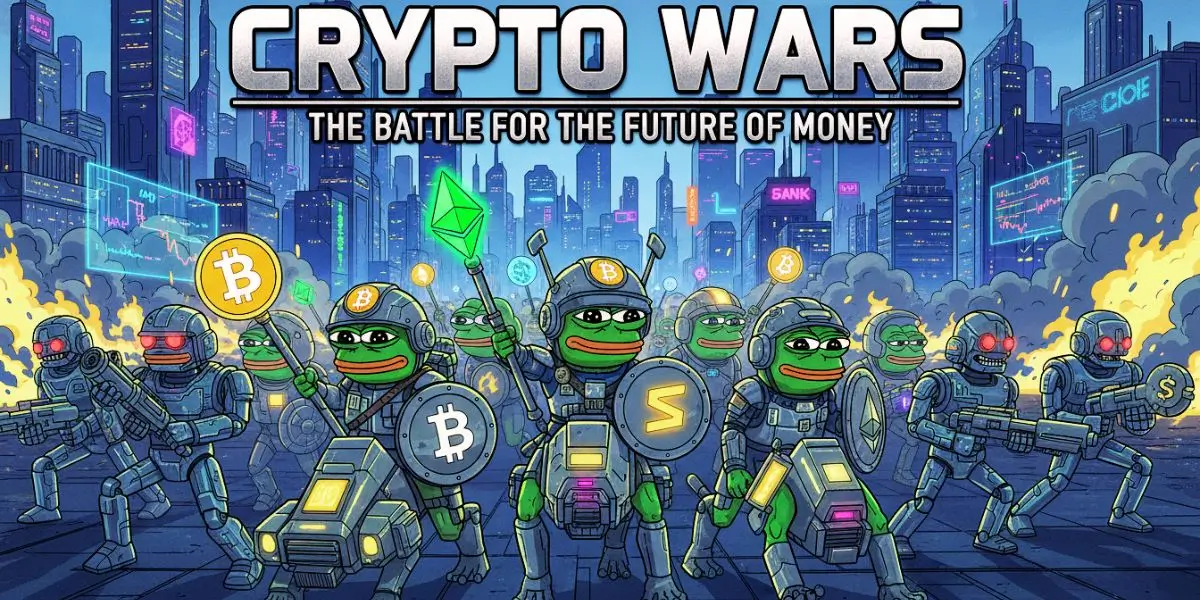
In a world increasingly driven by technology, the question on everyone’s mind is: Will cryptocurrency be the future of money? The rise of digital currencies like Bitcoin, Ethereum, and countless others has sparked heated debates about the future of finance. Is this the dawn of a new era where traditional money becomes obsolete? Or will governments and central banks maintain control over monetary systems?
Imagine a world where the government can see every coffee you buy, freeze your savings instantly, or program your money to be spent only on groceries. Now, imagine a world where you are your own bank—your wealth is a code only you control, borderless and censorship-resistant. This isn’t a sci-fi plot; it’s the central conflict of our time, a struggle we call the Crypto Wars.
Imagine a world where your money moves across borders as easily as a text message, where a government can’t freeze your assets, and where privacy is programmable into every transaction. This is the promise of cryptocurrency. Yet, for over three decades, a parallel Crypto Wars have been fought in the shadows, a high-stakes struggle over who gets to control the very tools that make this future possible.
This battle isn’t about a single technology or asset. It’s a fundamental clash over who controls value in the digital age. On one side stand nation-states and central banks, armed with Central Bank Digital Currencies (CBDCs) and sweeping regulations. On the other, a sprawling ecosystem of decentralized finance (DeFi), privacy coins, and communities built on blockchain principles.
As we move through 2025, the stakes have never been higher. The crypto industry, despite gaining “just about everything on its wish list” in terms of institutional support and regulatory clarity, still faces existential questions about its volatility and societal role. Meanwhile, governments from China to the European Union are racing to deploy their own digital currencies, with the digital yuan already in use and a digital euro in testing. The outcome of these Crypto Wars will define the future of money for generations.
Today, these wars are converging. The historical battles over strong encryption—the right to digital privacy—are now inseparable from the geopolitical contest over decentralized digital currencies. As nations rush to build strategic reserves of Bitcoin and global giants launch spot Bitcoin ETFs, a new front has opened: the Crypto Wars for economic supremacy.
This article will guide you through the intricate battlefield of the modern Crypto Wars. We’ll explore the core technologies at stake, analyze the key players from nation-states to Wall Street institutions, and provide you with a clear, actionable strategy to navigate this volatile landscape as an investor.
The Dawn of Crypto: A Brief History
To truly grasp the significance of the Crypto Wars, we must first look back at the origins of cryptocurrency. The first major conflict in this space, often referred to as the first crypto war, was fought over the principles and potential applications of digital currencies. This early battle laid the groundwork for what we see today—a fierce competition between traditional financial systems and the burgeoning world of crypto.
The Pioneers and Their Vision
The inception of Bitcoin in 2009 by an anonymous individual or group known as Satoshi Nakamoto marked a pivotal moment. It introduced a decentralized digital currency that aimed to eliminate the need for intermediaries like banks. This innovation sparked a wave of enthusiasm and skepticism, setting the stage for the Crypto Wars. But what does this mean for the future? How can cryptocurrency change the future of the economy?
The Potential Impact on the Global Economy
Cryptocurrencies have the potential to revolutionize the global economy in several ways. By providing a decentralized and secure method of transactions, they can reduce costs, increase transparency, and offer financial inclusion to the unbanked. However, the journey is not without its challenges. Regulatory hurdles, market volatility, and security concerns are just a few of the obstacles that need to be addressed.
A New Era of Financial Inclusion
One of the most promising aspects of cryptocurrencies is their potential to bring financial services to the underserved. In regions where traditional banking is inaccessible, digital currencies can offer a lifeline. This shift could lead to greater economic stability and growth on a global scale. But as we look ahead, what does the future hold for cryptocurrency?
Why Are Cryptocurrencies Shaping the Future of Finance?
The first crypto war wasn’t fought with weapons but with ideas. It began when Bitcoin emerged in 2009 as a decentralized alternative to traditional banking. Since then, the battle has evolved into a global movement challenging the status quo of centralized financial systems.
Cryptocurrencies offer several advantages over traditional currencies. They provide transparency through blockchain technology, reduce reliance on intermediaries like banks, and enable fast, borderless transactions. For example, imagine sending money across continents without worrying about high fees or exchange rates—cryptocurrencies make that possible.
But here’s a question for you: What does the future hold for cryptocurrency? While adoption is growing rapidly, challenges such as regulation, scalability, and public trust remain significant hurdles.
How Can Cryptocurrency Change the Future of the Economy?
One of the most exciting aspects of cryptocurrency is its potential to reshape entire economies. By eliminating intermediaries, reducing transaction costs, and enabling peer-to-peer exchanges, cryptocurrencies could democratize access to financial services worldwide. According to recent studies, over 20% of Americans now own some form of cryptocurrency, signaling a major shift toward digital assets.
Key Economic Impacts of Cryptocurrency
- Financial Inclusion: Cryptocurrencies can empower unbanked populations by providing access to financial tools via smartphones.
- Decentralization: Unlike fiat currencies controlled by central banks, cryptocurrencies operate on decentralized networks, giving users more autonomy.
- Global Trade: Businesses can streamline international payments using cryptocurrencies, avoiding costly currency conversions.
So, how can cryptocurrency change the future of the economy? Simply put, it has the power to disrupt outdated systems and create opportunities for innovation at every level.
The Two Fronts of the Modern Crypto War
To understand today’s conflict, you must recognize it’s being fought on two distinct but interconnected fronts. One is a legal and ideological battle over privacy and control, a legacy of the 1990s. The other is a fierce, 21st-century economic race for market dominance and financial innovation.
Front #1: The Encryption Wars – A Battle for Digital Privacy
The original Crypto Wars began long before Bitcoin. In the 1990s, governments, particularly the United States, treated powerful encryption software like munitions, restricting its export as if it were a weapon of war. The logic was simple: if criminals and adversaries had access to unbreakable codes, it would create “going dark” problems for intelligence and law enforcement.
Landmark moments defined this era:
The PGP Case: Programmer Phil Zimmermann was prosecuted by the U.S. government for distributing his Pretty Good Privacy (PGP) encryption software internationally without a munitions license, treating a software program like a tank.
The Clipper Chip: The NSA proposed embedding a backdoor in all secure communications devices via the “Clipper Chip,” a move widely rejected by industry and privacy advocates who argued it would weaken security for everyone.
Weakened Standards: There were documented cases of intelligence agencies weakening global encryption standards. For instance, the GSM mobile phone standard’s A5/1 encryption was reportedly reduced from a proposed 128-bit key to a more breakable 56 bits at the insistence of British intelligence.
This struggle never ended; it evolved. Today, it centers on end-to-end encryption (E2EE) in messaging apps. Governments argue E2EE hampers crime-fighting, while technologists maintain that weakening encryption for “good guys” inherently makes systems vulnerable to all bad actors. This fundamental tension—security versus privacy—remains the ideological bedrock of the Crypto Wars.
Front #2: The Currency Wars – A Battle for Financial Sovereignty
The second front exploded with the invention of Bitcoin. This was no longer just about hiding messages; it was about creating a new, decentralized form of money outside the traditional banking system. The battle lines now are drawn over economic control, monetary policy, and national security.
The stakes were highlighted in events like Harvard’s “Digital Currency Wars” simulation, which modeled a White House National Security Council meeting responding to a crisis triggered by the rise of digital currencies. Nations are now actively engaging in this war through:
Regulatory Onslaught: Agencies like the U.S. Securities and Exchange Commission (SEC) are intensely scrutinizing the space, issuing complex guidance on how traditional financial rules apply to crypto assets.
The ETF Arms Race: The approval of spot Bitcoin and Ethereum ETFs by giants like BlackRock and Fidelity represents a monumental shift. It’s a legitimization that funnels billions of institutional dollars into the space, but also a co-opting by traditional finance.
National Strategic Reserves: Proposals, such as the one floated in the U.S. in early 2025, to create a national “Crypto Strategic Reserve” holding Bitcoin, Ethereum, and other major assets signal that nations now view digital assets as strategic resources akin to oil or gold.
What does this mean for you, the investor? It means the rules of the game are being written in real-time, and understanding these two fronts is crucial to assessing both the monumental risks and opportunities.
The Great Divide: Decentralization vs. Centralized Control
At the heart of the Crypto Wars lies a philosophical rift: the ethos of decentralization versus the established order of centralized financial control.
Decentralization is the founding principle of cryptocurrencies like Bitcoin and Ethereum. It means no single entity—not a government, not a bank—has ultimate authority. Transactions are verified by a distributed network, ownership is proven by private keys, and the rules are enforced by code. Proponents argue this is the ultimate form of financial freedom, a system resilient to corruption, censorship, and institutional failure.
In stark contrast stands the traditional banking system, a model of centralization. Here, central banks control the money supply, commercial banks act as gatekeepers, and governments enforce rules through regulation. This system offers stability and consumer protections but is often criticized for being slow, exclusionary, and prone to the whims of policymakers.
The tension between these two models is palpable. A 2023 paper from the Bank for International Settlements noted that we are entering “a new era of contestable monetary sovereignty,” where money is “no longer the sole domain of states”. This contest is the engine of the Crypto Wars.
CBDC vs Cryptocurrency: The Defining Clash of Digital Currencies
The most direct front in the Crypto Wars is the competition between state-backed CBDCs and permissionless cryptocurrencies.
What Are CBDCs?
A Central Bank Digital Currency (CBDC) is simply a digital version of a nation’s fiat currency, issued and backed by its central bank. It’s not a new currency but a new form of an old one. Projects like China’s digital yuan and the proposed digital euro aim to modernize payments, enhance monetary policy tools, and maintain sovereign control in a digital world.
The Crypto Counterpart
Cryptocurrencies, by design, are the antithesis of CBDCs. They are global, decentralized, and not issued by any state. Bitcoin is often called “digital gold,” a store of value with a fixed supply. Ethereum and other smart contract platforms enable DeFi and tokenization. Stablecoins like USDC bridge the gap, offering the stability of fiat with the efficiency of blockchain.
The Battle Lines
The clash is not just technological but ideological. A 2025 report to Congress noted that CBDCs are “more likely to compete with crypto as a payment means”. Governments view cryptocurrencies as a threat to financial stability and monetary control, often citing risks like volatility and use in illicit finance. The crypto community, in turn, views CBDCs as tools for unprecedented financial surveillance and control.
Who will win? The more likely outcome is a fractured future. Some analysts argue that “CBDCs offer efficiency, security, and inclusion while keeping monetary sovereignty,” while “cryptocurrencies enable programmable finance and financial freedom,” suggesting a future of coexistence rather than a clear victor.
The Regulatory Battleground: SEC, CFTC, and Global Frameworks
Regulation is the arena where the Crypto Wars are fought with laws and lawsuits. The landscape shifted dramatically in 2025, moving “from enforcement to frameworks”.
The U.S. Scene: GENIUS Act and the Clarity Act
In the United States, two pivotal pieces of legislation have shaped the battle. The GENIUS Act, signed into law in July 2025, created a regulatory structure for privately issued stablecoins. This was a major win for the crypto industry, legitimizing a key part of its infrastructure.
Hot on its heels is the Digital Asset Market Clarity Act. This bill, which has passed the House, would bar the Federal Reserve from piloting a government-issued digital currency without congressional approval, effectively protecting private stablecoins from public competition. Critics, including those in The New York Times, warn this could saddle the U.S. with a “less clear, less innovative and less safe” monetary system.
The Global Patchwork
Globally, approaches vary wildly. The European Union has implemented the sweeping Markets in Crypto-Assets (MiCA) framework. China maintains its strict crypto ban while aggressively promoting its digital yuan. Meanwhile, the SEC continues its enforcement actions, treating many tokens as unregistered securities, while the CFTC asserts jurisdiction over digital commodities.
This regulatory fragmentation itself is a weapon in the Crypto Wars, determining which jurisdictions become innovation hubs and which become backwaters.
Case Study: Bitcoin’s Civil War – Core vs. Knots
Even within the crypto camp, there is infighting. Bitcoin, the original cryptocurrency, is currently experiencing a new “civil war” over the soul of its blockchain.
The Core Faction: The established group of developers wants to modify Bitcoin’s software to allow more non-financial data (like messages or proofs) to be stored on the blockchain. They see this as a way to promote new uses and generate extra fees for miners.
The Knots Faction: A growing rival group, making up over 20% of node operators, vehemently opposes this. They see it as a corruption of Bitcoin’s purpose as pure “digital gold” and a gateway for “spammers and ‘scam adjacency’ projects”.
This technical schism echoes the earlier Bitcoin block size wars and underscores a critical tension: should cryptocurrencies evolve and add functionality, or remain pure and focused? This internal battle shapes Bitcoin’s resilience and its role in the larger war.
Case Study: El Salvador’s Bitcoin Experiment – Victory or Cautionary Tale?
In 2021, El Salvador made global headlines by adopting Bitcoin as legal tender, a bold move in the Crypto Wars. It was hailed as a revolutionary step toward financial freedom and inclusion.
By 2025, the experiment had dramatically recalibrated. Bitcoin was rescinded as legal tender in the country after research showed it was “rarely used by the public” and following criticism from institutions like the IMF. The Economist termed the experiment a “failure” for the Salvadoran economy.
However, the story didn’t end there. Under President Nayib Bukele, El Salvador continued to accumulate Bitcoin as a strategic national asset, adding over 1,000 BTC during a market downturn in November 2025. By late 2025, the IMF was praising the country’s stronger-than-expected 4% GDP growth, notably not repeating its previous demands to halt Bitcoin accumulation.
What does this mean for the Crypto Wars? El Salvador’s journey is a microcosm of the conflict. It highlights the immense practical challenges of mass cryptocurrency adoption (volatility, usability, public trust) but also demonstrates how nations might strategically engage with digital assets outside the traditional banking system. It’s neither a pure victory nor a total defeat for either side.
Privacy vs. Surveillance: The Security Dilemma
Perhaps the most personal front in the Crypto Wars is the fight over privacy.
CBDCs, by their nature, can be programmed and tracked. A central bank could theoretically see every transaction, impose spending limits, or make funds expire. This offers powerful tools for combating crime and implementing policy but creates a surveillance nightmare for civil liberties.
Cryptocurrencies offer a spectrum of privacy. While Bitcoin transactions are pseudonymous (tied to a wallet address, not a name), coins like Monero and Zcash use advanced cryptography to obscure transaction details entirely. This provides genuine financial privacy but is criticized by regulators for enabling money laundering and illicit finance.
The dilemma is clear: how do we balance the legitimate need for security and law enforcement with the fundamental human right to privacy? This question is unresolved and fuels constant skirmishes in the Crypto Wars.
The New Frontiers: DeFi, NFTs, Web3, and the Metaverse
The battlefield of the Crypto Wars is expanding beyond simple payments into entirely new digital economies.
DeFi (Decentralized Finance): This ecosystem uses smart contracts on blockchains like Ethereum to recreate financial services—lending, borrowing, trading—without intermediaries. It’s a direct challenge to the traditional banking system but carries risks of smart contract bugs and speculative bubbles.
NFTs (Non-Fungible Tokens) & Tokenization: NFTs prove unique ownership of digital (and sometimes physical) items. More broadly, tokenization is the process of representing real-world assets (real estate, art, carbon credits) on a blockchain. This could revolutionize ownership and liquidity but raises complex legal and regulatory questions.
Web3 & The Metaverse: These are visions of a next-generation internet built on blockchain principles, where users own their data and digital identities. The metaverse—persistent virtual worlds—is expected to be powered by digital currencies and NFTs. These frontiers represent the ultimate prize: controlling the foundational layers of the future digital economy.
Decoding the 2025 Crypto Battlefield: Key Trends and Assets
Navigating the Crypto Wars requires a map of the current landscape. Let’s break down the dominant forces shaping 2025, from overarching trends to the specific digital assets commanding attention.
The Macro Trends Reshaping the Ecosystem
The market is being propelled by several powerful, interconnected trends that go far beyond mere price speculation.
Table: Dominant Crypto Market Trends for 2025
| Trend | What It Means | Key Players/Examples | Impact on Investors |
|---|---|---|---|
| Institutional Adoption & ETFs | Traditional finance giants entering via regulated products. | BlackRock Bitcoin ETF (IBIT), Fidelity Ethereum Fund (FETH) | Increased liquidity, legitimacy, and potential for reduced volatility. |
| Real-World Assets (RWAs) & DeFi 2.0 | Tokenizing traditional assets (real estate, bonds) on-chain. | MakerDAO, Ondo Finance | New yield opportunities and bridges between crypto and traditional finance. |
| AI-Powered Blockchains | Blockchains that use AI for data validation, automation, and scaling. | Bittensor (TAO), Hyperliquid | Exposure to cutting-edge convergence of two transformative technologies. |
| Regulatory Adaptation | Clearer global rules emerging (e.g., EU’s MiCA). | SEC guidance for broker-dealers | Reduces “headline risk” but imposes compliance costs. |
| On-Chain Interoperability | Seamless movement of assets and data across different blockchains. | Polkadot, Cosmos, Sui Network | Reduces ecosystem fragmentation, improves user experience. |
The Contending Assets: From Blue Chips to Disruptors
In any war, you need to know the major powers and the rising challengers. Here’s a breakdown of the key assets in the 2025 Crypto Wars.
1. Bitcoin (BTC): The Digital Gold Standard
Bitcoin’s role is clear: digital gold. Its scarcity (capped at 21 million), robust security, and first-mover advantage have made it the institutional-grade entry point. The catalyst of spot Bitcoin ETFs has unlocked a flood of Wall Street capital. Its price movements are increasingly driven by macro policy, as seen when it surged following the 2024 U.S. election on hopes of crypto-friendly policies. For investors, BTC is increasingly seen as a non-correlated asset and a potential hedge against inflation.
2. Ethereum (ETH): The Programmable Financial Highway
If Bitcoin is gold, Ethereum is the global financial highway and app store. It’s the foundational layer for DeFi (decentralized finance), RWAs, and NFTs. The 2024 approval of spot Ethereum ETFs was a watershed moment, signaling deep institutional confidence. Its ongoing technical upgrades, like the recent “Pectra” upgrade aimed at scalability, are critical to watch. For investors, ETH offers exposure to the growth of the entire decentralized application ecosystem.
3. Solana (SOL): The High-Speed Challenger
Solana has positioned itself as the high-speed, low-cost alternative to Ethereum. Its ability to process tens of thousands of transactions per second makes it a favorite for high-frequency trading, meme coins, and a vibrant NFT scene. The potential for a spot Solana ETF is a major narrative for 2025, with applications already filed by firms like VanEck. Its inclusion in the proposed U.S. strategic reserve underscores its perceived systemic importance.
4. The Next-Generation Networks: Sui & Hyperliquid
Beyond the established top three, new architectures are emerging.
Sui Network (SUI): A high-performance Layer 1 that uses parallel processing for speed and the secure Move programming language. It has seen explosive growth in active addresses and DeFi volume.
Hyperliquid (HYPE): A novel high-performance Layer 1 built around a fully on-chain order book for a decentralized exchange. It has rocketed to prominence with billions in trading volume, representing a new model for DeFi infrastructure.
How do you, as an individual, deploy your capital across this complex battlefield without being caught in the crossfire? The answer lies in a disciplined, strategic approach.
Your Survival Guide: Investment Strategy for the Crypto Wars
Investing in the midst of the Crypto Wars is not for the faint of heart. It requires a strategy that respects both the transformative potential and the extreme volatility of the asset class. Let’s build your personal playbook.
Foundational Principle: Know Your Position Sizing
The single most important decision is not which crypto to buy, but how much of your portfolio to allocate to it. This is your strategic reserve, and it must be sized appropriately for your risk of ruin.
The Conservative Rule: Most financial advisors suggest crypto should constitute no more than 5% of a well-balanced, diversified portfolio. Many opt for a 1% to 3% allocation.
Personal Assessment: Your allocation depends on your financial stability, investment horizon, and risk tolerance. A useful checklist from industry guides suggests: 0-1% if you’re living paycheck to paycheck, 1-3% with basic savings, 3-5% with stable income and some experience, and 5-10%+ only for diversified investors with high risk tolerance.
Never invest more than you can afford to lose. If tracking prices causes you anxiety or affects your sleep, you’ve allocated too much. Your crypto investment should be sized so that you can ignore the daily “battles” and focus on the long-term “war.”
Tactical Deployment: Strategies for Entry and Management
Once you’ve determined your allocation, you need tactics for deployment.
1. Dollar-Cost Averaging (DCA): Your Best Defense Against Volatility
DCA—investing a fixed dollar amount at regular intervals (e.g., $100 every week)—is arguably the most effective strategy for most investors. It automates your buying, removes emotion, and ensures you buy more when prices are low and less when they are high. In the volatile trenches of the Crypto Wars, DCA is your armored personnel carrier.
2. Strategic Diversification Within Crypto
Don’t put all your capital in one token. Think of it as building a platoon with different roles.
The Foundation (60-75%): Allocate the majority to the established leaders: Bitcoin and Ethereum.
The Growth Squad (20-30%): Allocate a smaller portion to higher-potential, higher-risk assets like Solana or next-gen platforms like Sui.
The Speculative Scouts (5-10%): A minimal allocation for truly experimental assets, acknowledging this capital is highly at risk.
Table: A Sample Diversified Crypto Portfolio for a Moderate-Risk Investor
| Asset | Role in Portfolio | Sample Allocation | Investment Rationale |
|---|---|---|---|
| Bitcoin (BTC) | Store of Value / Digital Gold | 50% | Institutional anchor, ETF-driven, macro hedge. |
| Ethereum (ETH) | Platform for DeFi & Innovation | 25% | Exposure to dApp ecosystem, staking yield, RWA growth. |
| Solana (SOL) | High-Speed Challenger | 15% | Bet on scalability and high-frequency use cases, potential ETF catalyst. |
| Sui (SUI) / Other | Next-Generation Disruptor | 10% | Strategic bet on innovative technology and new developer adoption. |
3. Secure Your Assets: Custody is King
In a war, you must guard your supplies. The collapse of exchanges like FTX underscored the critical importance of self-custody and platform security.
Use Reputable Exchanges: Start with platforms known for security, transparency, and regulatory compliance. Look for those that provide Proof-of-Reserves.
Withdraw to Self-Custody: For significant, long-term holdings, move your assets off exchanges. Use a hardware wallet (cold wallet) for maximum security or a trusted, open-source software wallet.
The Battle for Dominance: Crypto vs. Traditional Currency
As we delve deeper into the Crypto Wars, a central question emerges: Can crypto replace cash? While it may seem far-fetched to some, the rapid adoption of digital payment methods suggests that the transition is already underway. The convenience and security of cryptocurrencies make them an attractive alternative to traditional cash transactions.
The Role of Bitcoin and Other Major Cryptos
Bitcoin, often hailed as the king of cryptocurrencies, has garnered significant attention. Its value has skyrocketed over the years, leading many to wonder, What will Bitcoin be worth in 20 years? While predictions vary, the underlying technology and its potential applications continue to drive interest. But is Bitcoin alone in this battle? Other cryptocurrencies like Ethereum and Litecoin are also making waves, each with their unique features and use cases.
Predicting the Future: Trends and Forecasts
The future of cryptocurrency is a topic of intense speculation. With new projects and innovations emerging constantly, it’s challenging to predict which ones will thrive. However, some trends are worth noting. For instance, which crypto will boom in 2025? Which crypto will boom in 2030? These questions are on the minds of many investors, and while it’s impossible to provide definitive answers, certain factors can influence outcomes.
The Influence of Technology and Regulation
Advancements in blockchain technology and increasing regulatory clarity will play crucial roles in shaping the future of cryptocurrencies. As governments around the world grapple with how to regulate digital assets, the balance between innovation and security will be key. This ongoing dialogue will determine the trajectory of the Crypto Wars.
The Gold Standard: Will Bitcoin Replace Gold?
Another intriguing aspect of the Crypto Wars is the comparison between Bitcoin and gold. Historically, gold has been a reliable store of value, but Bitcoin’s digital nature offers unique advantages. Will Bitcoin replace gold? This question is at the heart of many debates, as both assets have their proponents and detractors. While gold’s physical presence and historical significance are undeniable, Bitcoin’s potential for growth and accessibility make it a compelling contender.
Ensuring a Secure Future: The Safety of Crypto
As the Crypto Wars continue, one critical concern is the safety and security of digital assets. Is crypto safe for the future? This question is paramount, as the integrity of the financial system depends on it. With advancements in cybersecurity and the development of more robust protocols, the future of cryptocurrency looks promising. However, vigilance and continuous improvement are essential to maintaining trust.
Can Crypto Replace Cash?
This is one of the most debated topics in the financial world today. While cryptocurrency offers undeniable benefits, replacing physical cash entirely may not happen overnight. For starters, cash remains deeply ingrained in our daily lives due to its simplicity and universality. However, countries like Sweden are already experimenting with digital currencies, paving the way for a cashless society.
Still, skeptics argue that widespread adoption depends on addressing key issues:
- Security concerns
- Volatility of crypto markets
- Regulatory frameworks
Which Crypto Will Boom in 2025 and Beyond?
Predicting which cryptocurrencies will thrive in the coming years is tricky, but certain trends give us clues. As of 2025, Bitcoin remains the dominant player, often referred to as “digital gold.” However, altcoins like Ethereum, Solana, and Cardano are gaining traction due to their unique features and use cases.
Experts predict that by 2030, projects focused on sustainability, scalability, and real-world applications will dominate the market. So, which crypto will boom in 2030? Keep an eye on emerging technologies like DeFi (Decentralized Finance) and NFTs (Non-Fungible Tokens), as they continue to drive innovation.
Will Bitcoin Replace Gold?
For decades, gold has been the ultimate store of value. But with the rise of Bitcoin, investors are questioning whether digital gold could dethrone its physical counterpart. Proponents argue that Bitcoin’s fixed supply of 21 million coins makes it inherently deflationary, much like gold. Additionally, Bitcoin’s portability and divisibility give it a clear edge.
However, critics point out Bitcoin’s volatility and lack of intrinsic value compared to gold. So, will Bitcoin replace gold as the go-to safe haven asset? Only time will tell.
What Will Replace Money in the Future?
As we look ahead, it’s clear that the concept of money itself is evolving. Whether it’s cryptocurrency, central bank digital currencies (CBDCs), or even entirely new forms of value exchange, the future of money will likely be digital. But what exactly will replace traditional money?
Some possibilities include:
- CBDCs issued by governments
- Stablecoins backed by fiat currencies
- Fully decentralized cryptocurrencies
Is Crypto Safe for the Future?
Security is a top concern for anyone considering investing in cryptocurrency. While blockchain technology is incredibly secure, risks still exist, particularly around hacking and scams. To protect yourself:
- Use hardware wallets for storage
- Enable two-factor authentication
- Stay informed about phishing attempts
What Will Bitcoin Be Worth in 20 Years?
If history is any indication, the value of Bitcoin could skyrocket in the next two decades. Analysts project that Bitcoin’s price could reach six figures within the next few years, driven by increasing institutional adoption and limited supply.
The Future of the Conflict: What Comes Next?
The Crypto Wars are entering a new, more complex phase. We can expect the battle lines to shift in several key areas:
The Regulatory Siege Will Intensify: The SEC’s recent detailed guidance for broker-dealers on handling crypto assets is just the beginning. Clearer global regulations will reduce uncertainty but will also force projects to adapt or be sidelined.
The Geopolitical Dimension Will Expand: The concept of national crypto strategic reserves will gain traction. Digital currency will become a tool of statecraft, affecting sanctions, cross-border payments, and economic influence.
Technology Will Advance Under Fire: Innovations in privacy-preserving tech (like zero-knowledge proofs) and scaling solutions will accelerate, partly in response to regulatory pressure and partly to meet user demand. The merging of AI and blockchain will create entirely new capabilities and vulnerabilities.
The ultimate question is not which side will “win,” but what new equilibrium will emerge between individual financial sovereignty and state control, between open innovation and consumer protection.
The Future of Money: Scenarios for 2030 and Beyond
As the Crypto Wars rage, several potential futures emerge:
The CBDC Dominance Scenario: Governments successfully roll out CBDCs. Cryptocurrencies are heavily restricted to niche roles, and financial privacy is greatly diminished. Monetary sovereignty is reinforced.
The Hybrid Coexistence Scenario: A fragmented but functional system emerges. CBDCs handle everyday domestic payments, while permissionless blockchains and stablecoins power global trade, DeFi, and niche communities. This is the most likely near-term outcome.
The Decentralized Victory Scenario: A “black swan” event—like a major banking crisis or hyperinflation—erodes trust in the traditional system. Cryptocurrencies and DeFi see mass adoption as alternatives, fundamentally reshaping global finance.
Conclusion: Join the Crypto Revolution
The Crypto Wars are not a spectator sport. They are a fundamental restructuring of our financial and digital infrastructure. You have a choice: be a passive casualty of the volatility, or become a strategic, informed participant.
Start today. Define your risk tolerance and set a strict portfolio allocation. Begin with Dollar-Cost Averaging into the foundational assets like Bitcoin and Ethereum. Prioritize security above all else. And commit to continuous learning, because the landscape of this war changes not by the year, but by the week.
The future of money is being decided now. Will you simply watch the battle, or will you learn the terrain, fortify your position, and take a strategic stand?
FAQs
What were the original ‘Crypto Wars’ about?
The original Crypto Wars, dating back to the 1990s, were conflicts between governments (particularly the U.S.) and privacy advocates over the public’s access to strong encryption. Governments sought to limit or install backdoors in encryption to maintain surveillance capabilities, treating the software as a controlled munition, while activists fought for digital privacy as a fundamental right.
How are today’s Crypto Wars different?
Today’s Crypto Wars have expanded from a focus on communication privacy to encompass a battle over financial sovereignty and control. The conflict now includes governments attempting to regulate decentralized currencies, institutions vying for dominance via products like ETFs, and nations considering digital assets as strategic reserves, making it a multifaceted geopolitical and economic struggle.
Is it too late to invest in Bitcoin and other major cryptocurrencies?
Most analysts do not believe it is too late. The entrance of major institutional players through Bitcoin ETFs and Ethereum ETFs is viewed as a new phase of adoption, not an end point. Strategies like Dollar-Cost Averaging (DCA) are recommended for entering the market at any time, as they mitigate the risk of buying at a single high price.
What is the safest way for a beginner to gain exposure to crypto?
For beginners, the safest and simplest methods are: 1) Using a reputable, regulated exchange or traditional broker that offers crypto, 2) Starting with a small, periodic Dollar-Cost Averaging plan into major assets like Bitcoin, and 3) Considering a spot Bitcoin ETF or Ethereum ETF within a traditional brokerage account, which allows exposure without the complexities of direct custody.
How can I keep my cryptocurrency investments secure?
Security is paramount. Key steps include: using strong, unique passwords and two-factor authentication on all exchange and wallet accounts; storing significant holdings in a personal hardware wallet (cold storage) rather than leaving them on an exchange; and being extremely vigilant against phishing scams and unsolicited investment offers.
Will cryptocurrency be the future of money?
Yes, many experts believe cryptocurrencies will play a significant role in the future of money, though widespread adoption may take time.
What was the first crypto war fought over?
The first crypto war centered around the creation of Bitcoin and its challenge to centralized financial systems.
How can cryptocurrency change the future of the economy?
Cryptocurrencies can promote financial inclusion, reduce transaction costs, and enable decentralized systems.
What does the future hold for cryptocurrency?
The future looks promising, with increased adoption, regulatory clarity, and technological advancements expected.
Can crypto replace cash?
While unlikely to replace cash entirely, cryptocurrencies could complement or even dominate certain areas of the economy.
Which crypto will boom in 2025?
Bitcoin and Ethereum are strong contenders, but emerging altcoins may also see significant growth.
Will Bitcoin replace gold?
Bitcoin has the potential to rival gold as a store of value, though challenges remain.
What will replace money in the future?
Digital currencies, including CBDCs and cryptocurrencies, are likely candidates to replace traditional money.
Which currency will be stronger in the future?
Cryptocurrencies like Bitcoin and stablecoins may gain prominence alongside traditional currencies.
Which crypto will boom in 2030?
Projects focusing on scalability, sustainability, and real-world applications are expected to thrive.
Is crypto safe for the future?
With proper security measures, cryptocurrencies can be a safe investment option.
What will Bitcoin be worth in 20 years?
Projections suggest Bitcoin could reach unprecedented values, depending on market conditions and adoption rates.