
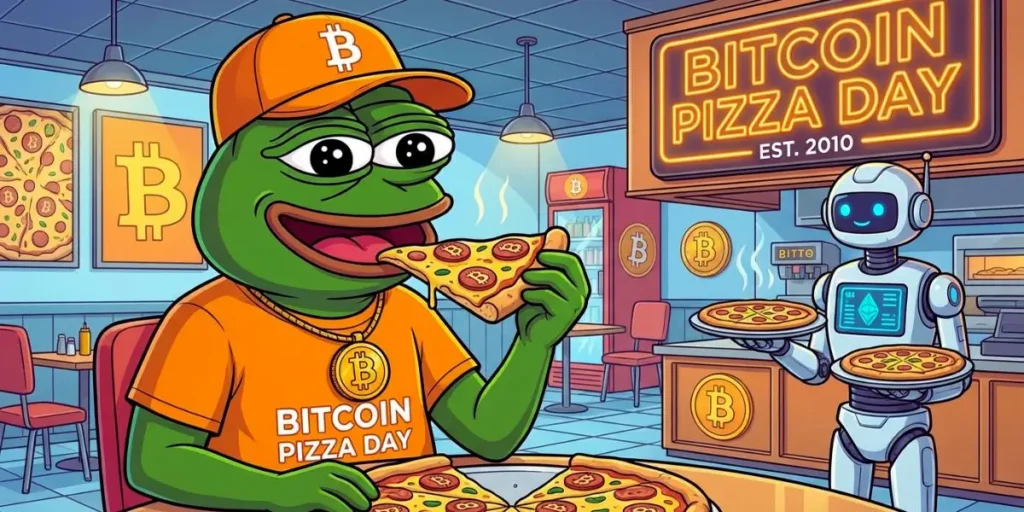

Every year on May 22, the crypto world stops to chew on a delicious piece of history. Social media floods with memes of pepperoni pies, exchanges launch promotional giveaways, and thousands of pizzas are distributed across five continents . But beneath the party, a fundamental question lingers for newcomers and skeptics alike: Is Bitcoin Pizza Day just a clever piece of crypto folklore, or did a real person actually trade a fortune in digital gold for a couple of takeout boxes?
If you have ever heard the story of the $700 million pizza and wondered if it was too wild to be true, you are in the right place. The answer is not only a definitive “yes, it happened,” but the reality of that transaction is far more nuanced—and more important to the survival of Bitcoin—than the urban legend suggests.
It sounds like the setup for a crypto joke: a hungry programmer pays $1.1 billion for two pizzas and becomes a legend. But unlike many tales in the digital asset space, this one is 100% real. Every May 22nd, the crypto community pauses to celebrate Bitcoin Pizza Day, a holiday commemorating the first time Bitcoin was used to buy a real-world, physical good.
But behind the memes and the celebrations lies a story that is equal parts fascinating, philosophical, and cautionary. Who was the man hungry enough to make the trade? What happened to the guy on the other side of the screen who accepted the 10,000 Bitcoin for pizza? And most importantly, how does a $41 meal turn into a billion-dollar headline? Let’s dive deep into the transaction that proved Bitcoin was more than just ones and zeros.
The History of Bitcoin Pizza Day: 10,000 BTC for a Pizza
To understand the magnitude of Bitcoin Pizza Day, you have to erase everything you know about today’s crypto market. Forget the ETFs, the institutional investors, and the $100,000+ price tags. In May 2010, Bitcoin was a digital ghost.
It was an experimental playground for cypherpunks and nerds on forums like Bitcointalk.org. The concept of “value” was abstract; coins were mined on laptop CPUs overnight just for fun. There was no Bitcoin price to speak of—at least, not in the way we think of it today. It was in this digital Wild West that a Florida-based programmer named Laszlo Hanyecz logged on with a craving.
The 10,000 BTC Offer
On May 18, 2010, Laszlo Hanyecz posted a proposal in the “Goods” section of the Bitcointalk forum. His message was simple, direct, and would go down in history:
“I’ll pay 10,000 bitcoins for a couple of pizzas… like maybe 2 large ones so I have some left over for the next day.”
He was specific about his order. He wanted standard toppings—onions, peppers, sausage, mushrooms—and explicitly stated, “no weird fish topping.” For days, the offer sat there. At the time, many thought it was a joke. Others considered the amount of Bitcoin offered to be too low. Little did they know, this was the first documented asking price for a currency that would one day challenge the global financial system.
The Bitcoin Pizza Agreement
Finally, on May 22, 2010, a user named “jercos” stepped up. That user was a 19-year-old from California named Jeremy Sturdivant. He saw the potential in the trade, even if that potential wasn’t measured in dollars yet.
The logistics were clunky—a reminder of how early this was. Jeremy Sturdivant didn’t pay with Bitcoin; Papa John’s didn’t accept it. Instead, he used his credit card to order two large pizzas for delivery to Laszlo’s home in Jacksonville, Florida. The total cost to Jeremy was about $25. Upon confirmation of delivery, Laszlo Hanyecz executed the transfer from his digital wallet. The 10,000 Bitcoin moved across the blockchain to Jeremy. The first real-world transaction was complete.
Jeremy Sturdivant: The Lucky Buyer
Whenever the story of the Bitcoin Pizza Day is told, the narrative usually focuses on Laszlo—the man who “wasted” a fortune. But what about Jeremy Sturdivant? He is the other half of this equation, the man who received the digital gold.
So, what happened to the guy that bought pizza with Bitcoin? Actually, he’s the one who sold the pizza for Bitcoin. And his story is a fascinating counterpoint to the idea of “HODLing.”
Unlike the modern mantra of “hold for dear life,” Jeremy was a spender. He was a teenager who suddenly had 10,000 BTC in his pocket. At the time, that was roughly $25 worth of value—a 10x return on his pizza investment. For a 19-year-old in 2010, that was a win.
Jeremy Sturdivant didn’t hold onto his fortune. He used the Bitcoin to fund other aspects of his digital life, primarily buying travel and games. In interviews years later, he revealed that he quickly converted most of his BTC into cash—netting himself a profit of about $400. Today, out of the original 10,000 Bitcoin, he reportedly has less than $200 worth left.
Does he regret it? Surprisingly, no. Jeremy views his role not as a missed opportunity for wealth, but as a crucial part of history. He validated the system. He proved that someone was willing to exchange real-world value for this strange internet money. For him, the 10,000 Bitcoin to USD conversion at the time gave him a decade of experiences and a permanent place in crypto lore.
The Man Behind the Bitcoin Pizza Day: Laszlo Hanyecz
On the other side of the transaction sits Laszlo Hanyecz, the man whose hunger sparked a movement. The public often wonders about Laszlo Hanyecz net worth and whether he kicks himself every time Bitcoin price hits a new high.
If you look purely at the numbers, it’s staggering. Let’s do the math on that 10000 Bitcoin to USD conversion:
-
2010 Value: ~$41
-
2015 Value: ~$2.4 Million
-
2021 Peak Value: ~$690 Million
-
2025/2026 Value: Over $1.1 Billion
By today’s standards, Laszlo Hanyecz paid over a billion dollars for two pizzas. But when asked about it, Laszlo Hanyecz doesn’t show an ounce of regret. In a famous interview with CBS News, he clarified that the narrative of “loss” is a matter of perspective. “It wasn’t like bitcoins had any value back then,” he said. “So the idea of trading them for a pizza was incredibly cool. It made bitcoin real.”
Considerations on Early Crypto Transactions
To truly understand Laszlo Hanyecz net worth, you have to look at how he got those coins. He wasn’t an investor in the traditional sense. He was a miner. Back in 2010, Laszlo Hanyecz was using his personal computer’s graphics processing unit (GPU) to mine blocks—a task that requires massive data centers today. The coins were, effectively, “printed” by him at zero fiat cost.
From his perspective, he didn’t lose a billion dollars; he spent $41 worth of “magic internet money” on dinner. He proved the utility of the asset. He was a pioneer, not a gambler. Today, he remains a humble programmer, content with having facilitated the first brick in the road to mass adoption. He still uses Bitcoin, and his legacy is far greater than any bank balance.
Fun Facts About Bitcoin Pizza Day
-
The Pineapple Incident: Laszlo was very specific about his pizza. He explicitly banned pineapple. “No weird fish topping or anything like that,” he wrote, inadvertently starting a debate on whether pineapple belongs on pizza that would mirror the Bitcoin vs. Bitcoin Cash debates years later.
-
The 15th Anniversary: By the 15th anniversary of Bitcoin Pizza Day in 2025, the Bitcoin price had surged so high that the transaction value officially crossed the $1.1 Billion mark, depending on the day’s valuation .
-
Two Pizzas, Two Stories: Many don’t realize that the famous “pizza” wasn’t just one. It was two large pies. So, technically, the price per slice is astronomical.
-
Jeremy’s Stance: Jeremy Sturdivant has often joked that he should have bought a lifetime supply of pizza with his profits, but stands by his decision to sell early, enjoying his life rather than staring at a chart .
Bitcoin Pizza Day’s Significance
Why does this matter? Why does the crypto world throw virtual parties and eat pizza every May 22nd? Because Bitcoin Pizza Day is the antidote to speculation. In a world where crypto is often viewed solely as an investment vehicle (a “digital gold” to hoard), this day reminds us of the original vision: Peer-to-Peer Electronic Cash.
It’s about utility. Laszlo’s transaction broke the psychological barrier. Before May 22, 2010, Bitcoin was just a theory. After that day, it was a currency. You could use it to get food delivered to your door. It solved a problem (hunger) using a new technology.
Moreover, it serves as a humility check for all of us. It reminds us that we are still early. If a billion-dollar pizza seems crazy, imagine explaining NFTs or the metaverse to someone in 2010. The spirit of innovation is about trying things, even if they seem silly at the time.
The “Urban Legend” vs. The Blockchain Proof
Let’s address the elephant in the room immediately. In an age of deepfakes and internet hoaxes, it is fair to wonder if the story of Laszlo Hanyecz and his 10,000 Bitcoin (BTC) is just a cautionary tale cooked up to make early adopters feel better about holding their coins.
The short answer is: It is 100% real. This is not a myth; it is the first verified peer-to-peer transaction using Bitcoin for a physical good. We know it is real for two specific reasons.
First, we have the digital receipts. Unlike a cash transaction that disappears into a pocket, every Bitcoin move is etched into the blockchain forever. You can go on any blockchain explorer today and look up the transaction hash (a62bb2e14cbf6b2adc6f3d03eccda8b1a3cf898107e76a0a4140f3eac099babe). That record shows the movement of 10,000 BTC from Laszlo’s address to the wallet of Jeremy Sturdivant (known on the forum as “Jercos”), the guy in California who took him up on the offer .
Second, we have the primary source. On May 18, 2010, Laszlo posted on the Bitcointalk forum: “I’ll pay 10,000 bitcoins for a couple of pizzas… like maybe 2 large ones so I have some left over for the next day.” He was specific about his toppings, too, writing, “I like things like onions, peppers, sausage, mushrooms, tomatoes, pepperoni, etc.. just standard stuff no weird fish topping or anything like that” .
It wasn’t a corporate marketing stunt; it was a hungry developer. When we look at the evidence, the urban legend dissolves, leaving behind the much more interesting story of a real transaction that gave Bitcoin its first tangible price.
The Real Transaction: Not Just a Purchase, But a Proof of Concept
To understand why Bitcoin Pizza Day is celebrated rather than mourned, we have to step out of 2025 and into the economic reality of 2010.
Back then, Bitcoin was a ghost. It existed in code, mined by a handful of cypherpunks on their laptops. It had no liquidity, no exchanges, and, most importantly, no market value. You could argue it was worth the electricity cost to mine it (pennies), or you could argue it was worth nothing because you couldn’t do anything with it.
Laszlo Hanyecz didn’t just buy dinner; he created the first funnel from the digital world to the physical world. He proved that Bitcoin could cross the chasm from being a hobbyist’s token to a medium of exchange.
The Mechanics of the First Real-World Trade
How did it actually work? Papa John’s certainly wasn’t accepting crypto in 2010. This is where the ingenuity of the community came in. Jeremy Sturdivant, a 19-year-old student at the time, saw Laszlo’s offer. Jeremy lived in California and had a credit card. He used his dollars to order the pizzas to Laszlo’s door in Florida.
In exchange, Laszlo sent the 10,000 BTC to Jeremy’s wallet.
This was the first documented instance of a global, trustless, peer-to-peer transaction bypassing the traditional banking system. It validated the idea that you didn’t need a bank to send value; you just needed code. As one early observer noted on the forum, “A great milestone reached” .
From $41 to $1.1 Billion: The “Cost” of Those Pizzas
Now, let’s talk about the numbers that fuel the legend. When Laszlo made the trade, the 10,000 BTC were worth roughly $41 based on the time and energy it took to mine them. To make that deal worth it, Jeremy effectively valued 1 BTC at $0.0041.
Fast forward to today. With Bitcoin trading at record highs, those two pizzas are now valued at over $1.1 billion .
It is easy to look at that figure and call Laszlo the unluckiest investor in history. However, we must view this through the lens of risk and adoption. In 2010, Bitcoin could have died the next day. It could have been regulated out of existence, or a technical flaw could have rendered it worthless. The expected value of holding 10,000 BTC was near zero.
By spending them, Laszlo inadvertently set the first anchor for the conversion funnel. He proved that you could exchange Bitcoin for goods. This proof of concept was arguably worth more to the ecosystem’s survival than hoarding the coins would have been.
The “HODL” Fallacy
We often joke about the HODL mentality—holding onto your coins through every dip and peak. But if Satoshi Nakamoto’s first adopters had all just held, Bitcoin would have died of uselessness.
-
Utility drives adoption: People need a reason to acquire a currency. If it can’t buy pizza, why would a merchant ever accept it?
-
Liquidity breeds value: The more transactions occur, the more legitimate the asset becomes for institutional players.
As the CEO of Bitget, Gracy Chen, stated recently, “Every year, we celebrate Bitcoin Pizza Day because it reminds us how far this industry has come—from 10,000 BTC being worth just $40 to now touching $1 billion. It marks the epitome of any financial vehicle’s success in history” .
The Man Behind the Myth: Laszlo Hanyecz
Laszlo is often portrayed as the guy who made the worst financial decision in history. But this narrative misses the point of who he was. He wasn’t a trader; he was a builder. He was one of the first people to run Bitcoin on his MacBook and was the first to implement GPU mining, massively increasing the network’s hashing power .
In a 2019 interview on 60 Minutes, Laszlo reflected: “It made it real for some people, I mean it certainly did for me… I wouldn’t have spent $100 million on pizza, right? But if I hadn’t done that, maybe Bitcoin wouldn’t have become so popular” .
He didn’t just buy one pizza, either. Throughout the summer of 2010, Laszlo continued to trade Bitcoin for food, eventually spending a total of 79,000 BTC—worth nearly $8.7 billion today—on multiple pizza orders .
Was He Trolling Us?
Interestingly, Laszlo Hanyecz has largely stayed out of the public spotlight in recent years . But his legacy is set in stone. He didn’t just buy a snack; he stress-tested the network. He showed that even if you weren’t a business, you could receive value from anywhere in the world instantly. He traded code for cheese, and in doing so, he gave Bitcoin its soul.
Why Wall Street and the White House Now Care About a Pizza
It might seem absurd that fifteen years later, major financial news outlets like the Associated Press, Nasdaq, and the Economic Times are covering a pizza purchase . But the anniversary has become a barometer for how far we have come.
In the early years, Bitcoin Pizza Day was a niche joke for forum dwellers. Today, it serves as a powerful contrast to the institutional adoption we are witnessing.
-
Corporate Treasuries: Companies like Strategy (formerly MicroStrategy) and MetaPlanet now hold Bitcoin as a primary treasury reserve asset, accumulating billions .
-
Government Reserves: The United States government has recently signed executive orders to establish a strategic Bitcoin reserve, treating it alongside gold and foreign currency .
-
Spot Bitcoin ETFs: The approval of Spot Bitcoin ETFs by the SEC in early 2024 brought in over $106 billion in inflows from Wall Street giants like BlackRock and Fidelity .
Just last week, the fast-food chain Steak ‘n Shake announced it would start accepting Bitcoin via the Lightning Network . The cycle is completing itself: from a single pizza order to a national payment option in restaurants.
Bitcoin Pizza Day 2025: A Global Movement
This year, the 15th anniversary was bigger than ever. It’s no longer just about memes; it’s about engagement and community building.
The Great Pizza Giveaway
Cryptocurrency exchange Bitget led the charge by distributing over 5,000 pizzas in more than 20 cities worldwide, including Abuja, Buenos Aires, Mexico City, Milan, and Taipei . These events serve a dual purpose: they honor the industry’s roots and onboard new users in a friendly, tangible way.
Digital Tributes
In the metaverse, the Pizza_DAO left a symbolic tower of pizza boxes at The Sandbox’s Paris office, a tribute to the original transaction that underscores Bitcoin’s remarkable appreciation .
Why does this matter for you? It shows that the community is still hungry. The spirit of experimentation that led Laszlo to trade code for food is the same spirit driving innovation in decentralized finance, NFTs, and Web3 today .
Lessons for Today’s Investor: Quick Wins and Errors to Avoid
So, what can we learn from Laszlo Hanyecz 15 years later? Whether you are a seasoned trader or just bought your first satoshi, the Bitcoin Pizza Day story offers concrete takeaways.
Quick Wins: How to Think Like a Builder, Not Just a Holder
-
Focus on the Funnel: Understand the user journey. In 2010, the funnel ended at “buy pizza.” Today, the funnel ends at “borrow against crypto,” “stake for yield,” or “pay with Lightning.” Look for projects solving real-world friction.
-
Engage with the Community: Laszlo didn’t get his pizza by mining in a dark room. He posted on a forum. He engaged. The crypto community is still the strongest driver of adoption. Participate in Bitcoin Pizza Day events near you; they are great for networking.
-
Utility over Hype: Laszlo’s transaction proved Bitcoin worked. When evaluating a new project (an altcoin, a dApp), ask yourself: “Does this have utility, or is it just code?” The projects that survive are the ones people actually use.
Critical Errors to Avoid
-
The “I’ll Never Spend” Trap: While HODLing is a strategy, refusing to use crypto for transactions stifles adoption. You don’t have to spend your life savings, but try paying for a coffee with Lightning Network. Experience the user experience (UX) yourself.
-
Ignoring Regulatory Shifts: The biggest change from 2010 to 2025 is regulation. Ignore it at your peril. The reason Bitcoin is a trillion-dollar asset today is partly due to government and institutional acceptance . Keep an eye on policy changes in the US, Brazil, and the EU.
-
The “Get Rich Quick” Mentality: Laszlo didn’t get into Bitcoin to get rich; he got into it because he was interested in the technology. While the returns have been life-changing for many, entering the space solely for speculative gains often leads to poor decision-making during market dips.
Frequently Asked Questions
Is the bitcoin pizza story real?
Yes, it is 100% real. On May 22, 2010, programmer Laszlo Hanyecz traded 10,000 BTC to Jeremy Sturdivant for two Papa John’s pizzas. The transaction is recorded on the blockchain and has been verified by numerous sources, including the original forum posts on Bitcointalk.org .
What happened to the guy who received 10,000 bitcoin for pizza?
That was Jeremy Sturdivant. Unlike a long-term holder, Jeremy spent most of his Bitcoin shortly after receiving it. He converted it to cash (roughly $400) to fund travel and gaming. Today, he holds very little of that original sum but remains a beloved figure in the community for his role in facilitating the first real-world trade .
Who made the historic Bitcoin transaction for pizza?
The transaction was a two-party event. Laszlo Hanyecz was the buyer who offered the Bitcoin and wanted the pizza. Jeremy Sturdivant was the seller who accepted the Bitcoin, used his credit card to pay for the pizza in dollars, and had it delivered to Laszlo.
Is Bitcoin Pizza Day real or a myth?
It is 100% real. It refers to May 22, 2010, when programmer Laszlo Hanyecz traded 10,000 Bitcoin for two Papa John’s pizzas. The transaction is still verifiable on the blockchain today .
How much is the Bitcoin Pizza worth now?
As of the 2025 anniversary, with Bitcoin trading over $110,000, those 10,000 BTC are valued at approximately $1.1 billion . This makes them arguably the most expensive pizzas in history.
Who bought the pizza with Bitcoin?
Laszlo Hanyecz, a Florida-based software developer and early Bitcoin miner. He was an active contributor to the Bitcoin codebase and the first to implement GPU mining .
Does Laszlo Hanyecz regret buying the pizza?
He has stated publicly that he does not regret it. At the time, it was a fair trade that proved Bitcoin could function as currency. He has noted that if he hadn’t done it, Bitcoin might not have become as popular as it did .
Why is Bitcoin Pizza Day important for crypto?
It represents the first real-world transaction using Bitcoin. It transformed the asset from a theoretical digital token into a functional medium of exchange, providing the proof of concept needed to spark future adoption .
How is Bitcoin Pizza Day celebrated?
It is celebrated annually on May 22 with pizza parties, meme-sharing, educational events, and promotions by crypto companies. Exchanges like Bitget often host global gatherings to distribute pizza and connect with the community .
Conclusion: A Slice of History You Can Still Taste
Bitcoin Pizza Day is far more than an urban legend. It is the bedrock of crypto culture. It is the annual reminder that this entire digital economy was built not by suits in boardrooms, but by curious individuals willing to experiment.
Laszlo Hanyecz didn’t just buy two pizzas; he lit the fuse on a financial revolution. He showed the world that decentralized money could be used for the most mundane and human of activities: sharing a meal. Fifteen years later, as Bitcoin sits alongside gold in government treasuries and corporate balance sheets, that first bite tastes sweeter than ever.
So, the next time you see the price of Bitcoin hit a new high, remember the guy who spent a billion dollars on dinner. And maybe, just maybe, buy a pizza with crypto yourself. It’s the best way to honor the transaction that started it all.
Have you ever spent crypto on something you regret (or celebrate)? Share your story in the comments below! And if you enjoyed this deep dive into crypto history, share it with a friend who still thinks Bitcoin is just a bubble.