














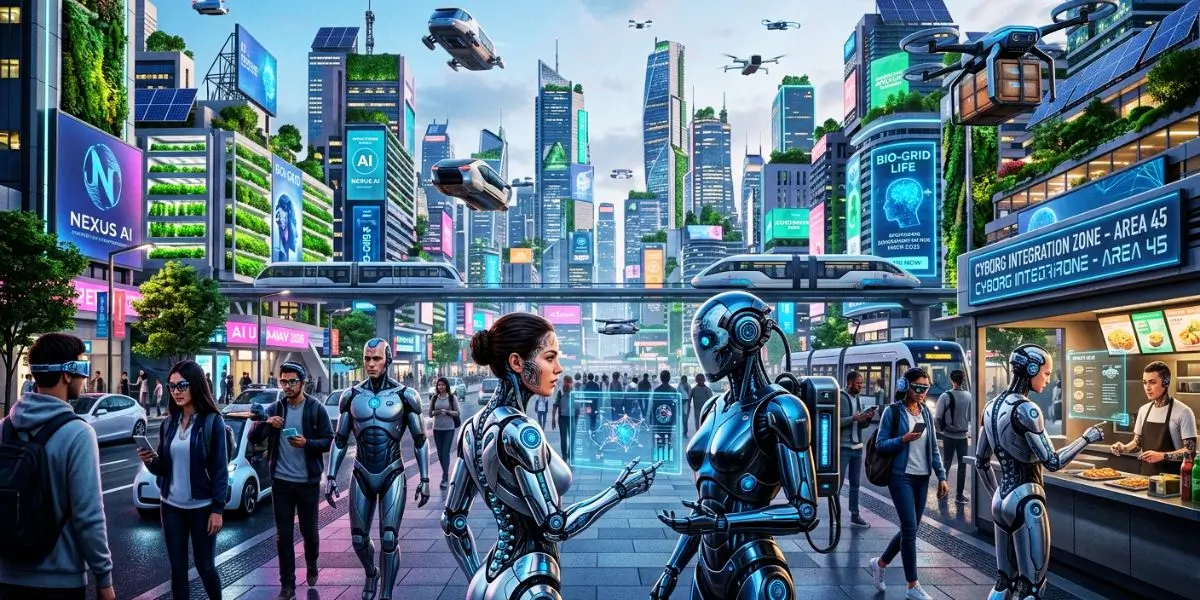
Artificial intelligence isn’t knocking at the door anymore. In 2026, it has kicked the door down, rearranged the furniture, and started making breakfast. What felt like experimental hype just a few years ago has solidified into infrastructure. From how we write code to the way blockbuster films are pre-visualized, the AI trends defining 2026 aren’t incremental updates—they’re structural shifts. If you’re trying to wrap your head around the future of AI, this is the moment where adoption curves harden into universal standards.
The predictions that sounded speculative in late 2024 have become quarterly earnings drivers. Whether you’re a developer, an investor, or just someone wondering how people are actually using AI in 2026, the landscape has shifted faster than most organizations can keep up. This article breaks down the artificial intelligence trends that matter—no fluff, no keyword stuffing.
The Conversation Has Changed
The dialogue around artificial intelligence has matured. After years of dazzling demos and breathless hype, 2026 marks the moment AI stops being a novelty and becomes infrastructure. The question is no longer whether machines can generate a poem or pass a bar exam. It’s whether they can reliably run a supply chain, diagnose a disease, or orchestrate an entire enterprise workflow without someone holding their hand the whole way.
This year, the industry is growing up. Capital is flowing toward practical outcomes, not just bigger models. Organizations are demanding proof of impact, not proof of concept. And the technology itself is evolving from single-purpose chatbots into autonomous, multi-modal systems that reason, plan, and act across both digital and physical environments.
The Big Picture: AI in 2026 vs 2025
The leap from 2025 to 2026 isn’t about one breakthrough. It’s about convergence. Last year, we watched isolated tools get smarter. This year, those tools are talking to each other, acting without human micromanagement, and running on hardware that fits in your pocket. The AI industry trends we’re seeing now reflect a maturation phase: fewer demos, more deployment. If 2025 was the year of experimentation, 2026 is the year of integration.
From Chatbots to Action: The Rise of Agentic Systems
If there’s one shift defining 2026, it’s the move from conversation to execution. For the past few years, interacting with AI meant typing a prompt and getting a response. That paradigm is rapidly giving way to agentic AI—systems that understand high-level goals, break them into steps, and complete complex tasks across multiple applications with minimal human intervention.
According to Gartner, over 43% of organizations already had AI agents in production as of early 2026, and that figure is expected to climb dramatically by year-end. The success rate of these agents has improved substantially. Tasks that agents completed correctly roughly 20% of the time in 2025 are now being handled accurately more than three-quarters of the time.
What makes this transition significant isn’t just automation. It’s the emergence of super agents—cross-functional, cross-channel systems that operate across your browser, your inbox, your code editor, and your enterprise software simultaneously. Rather than managing a dozen separate AI tools, users will increasingly interact with a single control plane that delegates work to specialized agents behind the scenes.
This changes the nature of work itself. The role of the knowledge worker is shifting from performing tasks to directing intelligent systems. A marketer might brief an agent on a campaign, review its output, and refine the strategy—rather than writing every email or adjusting every ad bid by hand. A software developer is becoming more of a conductor, articulating intent while AI agents handle refactoring, testing, and deployment.
Models Are Becoming Commodities. Systems Are What Matter Now.
For a long time, the AI race was defined by parameter counts. Who had the biggest model? Who scored highest on the latest benchmark? That arms race isn’t over, but it’s no longer the whole story.
Industry leaders now agree that the model itself is becoming a commodity. What differentiates one organization from another is the system built around the model—the orchestration layer that combines multiple models, tools, data pipelines, and workflows into a coherent solution. As one IBM architect put it, when you use ChatGPT, you’re not talking to a raw model. You’re talking to a software system that includes web search, code execution, memory, and agentic loops.
This has given rise to cooperative model routing, where smaller, efficient models handle routine queries and only escalate to larger, more expensive models when necessary. The result is faster response times, lower costs, and more resilient architectures. Companies are discovering that a carefully tuned 7-billion-parameter model running on edge hardware can outperform a general-purpose giant on specific, high-value tasks.
The implication is clear: competitive advantage in 2026 will come from integration and orchestration, not from having access to the latest frontier model.
Smaller, Smarter, and Specialized: The End of One-Size-Fits-All AI
Hand in hand with the systems-over-models trend is the rise of domain-specific AI. The era of throwing a general-purpose large language model at every problem is fading. Instead, organizations are investing in smaller models that are fine-tuned for particular industries, workflows, and regulatory environments.
In healthcare, this means models trained on clinical data that can assist with symptom triage and treatment planning. In legal and financial services, it means systems that understand specialized terminology and compliance requirements. In manufacturing, it means AI that can interpret sensor data and optimize production lines in real time.
Open-source innovation is accelerating this shift. The release of efficient, reasoning-tuned open models has made it feasible for enterprises to customize AI without relying entirely on proprietary APIs. This democratizes access and addresses growing concerns about data sovereignty—the need to keep sensitive information within controlled environments rather than sending it to third-party cloud providers.
The economic logic is compelling. A smaller, specialized model requires less compute, less energy, and less latency than a general-purpose behemoth. For many real-world applications, it’s also more accurate.
Efficiency Is the New Scaling Strategy
The physics of AI is changing. For years, progress was driven by a simple formula: more data plus more compute equals better performance. That scaling law is hitting diminishing returns. Training runs for the largest models now require multi-gigawatt data centers, straining energy grids and corporate budgets alike.
In response, the industry is pivoting toward efficiency-first architectures. Hardware diversification is a major theme. While GPUs remain dominant, specialized accelerators, chiplet designs, and analog inference chips are maturing. Edge AI—running lightweight models on local devices rather than in distant data centers—is moving from hype to reality.
This isn’t just an engineering concern. It’s a strategic one. As inference costs account for an ever-larger share of AI spending, organizations that optimize their compute footprint will gain a significant cost advantage. The winners in 2026 will be those who can deliver powerful AI experiences without the massive infrastructure overhead that characterized the early generative AI boom.
AI Steps into the Physical World
Perhaps the most visually striking trend of 2026 is the acceleration of physical AI. After years of dominance by text and image models, attention and investment are shifting toward robotics, autonomous systems, and AI that can sense, act, and learn in real environments.
This is driven partly by the plateau in pure language model scaling and partly by genuine breakthroughs in embodied intelligence. We’re seeing AI systems that can interpret visual and spatial data, manipulate objects, and navigate unstructured environments. In manufacturing, this translates to smarter automation. In logistics, it means autonomous fleets that optimize routes in real time. In healthcare, it points toward surgical assistants and rehabilitation robots.
The boundary between digital and physical intelligence is dissolving. A multimodal AI system might analyze a video feed from a factory floor, detect an anomaly, dispatch a maintenance drone, and update the enterprise resource planning system—all without human intervention.
Trust, Security, and the Governance Imperative
As AI agents gain more autonomy and access to sensitive systems, security and governance are moving from afterthoughts to foundational requirements. Every agent needs an identity, clear permissions, and audit trails. Without these guardrails, an AI agent isn’t a productivity tool—it’s a liability.
Microsoft’s security leadership has emphasized that agents should have protections comparable to human employees, including access controls and threat monitoring. The risk isn’t abstract. As attackers begin using AI to automate phishing, vulnerability discovery, and social engineering at scale, defenders are deploying their own AI agents to detect and neutralize threats in real time.
Regulatory pressure is also mounting. The second phase of the EU AI Act is approaching, and organizations worldwide are being forced to implement transparency, fairness, and accountability measures. Responsible AI is no longer a marketing slogan. For many enterprises, it’s becoming a prerequisite for doing business.
Healthcare and Scientific Discovery: AI as a Collaborator, Not Just a Tool
One of the most promising frontiers for AI in 2026 is scientific discovery. AI is no longer just summarizing research papers or suggesting hypotheses. It’s actively participating in the scientific method—designing experiments, analyzing results, and iterating on findings.
In medicine, this is translating into tangible progress. AI diagnostic systems are demonstrating accuracy rates that rival experienced specialists in complex cases. Beyond diagnostics, AI is extending into treatment planning, drug discovery, and personalized medicine. With global health worker shortages projected to worsen, AI is increasingly viewed not as a replacement for clinicians but as a force multiplier that extends expertise to underserved populations.
The same pattern is emerging in materials science, climate modeling, and physics. AI is becoming a genuine research partner, capable of exploring solution spaces that are too vast or complex for human researchers to navigate alone.
The Economic Reckoning: Pragmatism Over Hype
After years of sky-high valuations and speculative investment, 2026 is bringing a measure of economic realism to the AI sector. Global corporate AI investment reached unprecedented levels in 2025, and while funding continues to flow, the criteria have tightened. Investors and executives are asking harder questions about return on investment.
This doesn’t mean the AI boom is over. It means the market is maturing. The focus is shifting from training massive models to deploying efficient ones at scale. Companies are prioritizing use cases with clear, measurable business outcomes over experimental pilots. The “trillion-dollar pivot to pragmatic AI” isn’t a retreat from innovation; it’s a redirection of resources toward sustainable, profitable applications.
Some analysts have warned of a potential correction in AI valuations if revenue growth fails to match infrastructure spending. Whether or not a bubble deflates, the underlying technology is here to stay. The organizations that thrive will be those that treat AI as a core operational capability, not a speculative bet.
Democratization: Everyone Becomes an AI Builder
Perhaps the most democratizing trend of 2026 is the emergence of tools that allow non-technical users to create and deploy AI agents. The technical barriers that once confined AI development to specialized engineers are falling. Business analysts, marketers, operations managers, and healthcare administrators are increasingly able to design intelligent workflows tailored to their specific needs.
This is a profound shift. The people closest to real-world problems are often not software developers. By empowering domain experts to build their own AI solutions, organizations unlock a wave of bottom-up innovation that no central IT team could replicate. The result is a more agile, responsive enterprise where intelligence is embedded at every level, not just in the technology department.
Trend 1: Agentic AI Goes Mainstream
From Chatbots to Autonomous Agents
We’ve all interacted with chatbots that feel like sophisticated search bars. In 2026, that paradigm is fading. The next big thing AI has delivered is the autonomous agent: systems that can plan, execute multi-step tasks, and recover from errors without constant human prompting. Imagine an AI that doesn’t just draft your email but researches the recipient, checks your calendar, schedules the follow-up, and updates your CRM. That’s agentic AI, and it’s moving from research labs to live production environments at a staggering pace.
Real-World Deployments in Enterprise
Enterprise adoption is where this trend gets real. Companies aren’t just piloting agents anymore—they’re deploying fleets of them. Customer service departments are using agents that can access internal knowledge bases, process refunds, and escalate complex issues with full context. The shift from copilot to autopilot—supervised but independent—is redefining operational efficiency. This is the trajectory from adoption to agentic: we’ve moved from asking AI for suggestions to assigning it objectives.
The Rise of Multi-Agent Systems
Single agents are impressive, but multi-agent systems are where the real magic happens. These are networks of specialized AI agents that collaborate, debate, and refine outputs. One agent might handle data extraction while another verifies compliance and a third generates the final report. This architecture mirrors human team dynamics and is proving far more resilient than monolithic models trying to do everything alone.
Trend 2: Reasoning Models Change the Game
OpenAI o3, Gemini 2.5, and Claude AI
Reasoning is the new battleground. Models like OpenAI’s o3 series, Google’s Gemini 2.5, and Claude AI from Anthropic aren’t just predicting the next token—they’re thinking through problems step-by-step. These systems pause, reflect, and self-correct before delivering an answer. The result is a dramatic jump in reliability for complex tasks. When people ask what’s driving the most significant AI predictions in 2026, reasoning capability consistently tops the list.
STEM Breakthroughs: Math, Code, and Science
The impact on STEM fields has been profound. These reasoning models are scoring at expert levels on mathematics competitions, generating production-ready code architectures, and assisting in peer-reviewed scientific research. They’re not replacing PhDs, but they’re becoming indispensable research partners. In 2026, having an AI co-author on a scientific paper is no longer noteworthy—it’s practically expected.
What This Means for Knowledge Workers
For knowledge workers, the bar has been raised. Routine analytical tasks are being absorbed by AI, which means human value is shifting toward framing the right questions, validating assumptions, and integrating insights across domains. The knowledge worker of 2026 is a strategist and a curator, not just a producer.
Trend 3: AI Regulation Becomes Real
EU AI Act Enforcement Begins
After years of drafts and debates, the European Union’s AI Act is now being enforced. Companies deploying high-risk AI systems face mandatory conformity assessments, transparency obligations, and significant penalties for non-compliance. The regulatory landscape in Europe is no longer theoretical, and global companies are restructuring their AI stacks to avoid being locked out of the world’s second-largest market.
US Executive Orders and State Laws
Across the Atlantic, regulation is patchier but no less impactful. Federal executive orders are shaping government procurement standards, while states like California and New York are passing their own AI disclosure and safety laws. The result is a complex compliance mosaic that multinational firms must navigate carefully.
Canada’s Approach to AI Governance
Canada continues to take a collaborative, research-first approach to governance. Rather than punitive frameworks, Canadian regulators are emphasizing voluntary codes of conduct and public-private partnerships. It’s a softer touch, but as the global regulatory consensus hardens, Canada is expected to align more closely with European standards.
Compliance Costs for AI Companies
Regulation isn’t free. Compliance costs are now a major line item for AI startups and giants alike. Legal teams have ballooned, red-teaming has become a standard pre-release requirement, and documentation overhead has slowed release cycles. The era of “move fast and break things” is officially over for AI deployment.
Trend 4: Small Language Models (SLMs) Surge
Running AI Locally on Phones and Laptops
Not every breakthrough requires a data center. One of the most democratizing artificial intelligence trends of 2026 is the rise of Small Language Models (SLMs) that run locally on consumer hardware. Your smartphone can now host a capable AI assistant that works offline, respects your privacy, and responds instantly. This shift is critical for users in regions with unreliable connectivity and for anyone concerned about data sovereignty.
Phi-4, Gemma 3, and the Efficiency Race
Microsoft’s Phi-4, Google’s Gemma 3, and a wave of open efficiency-focused architectures are proving that you don’t need a trillion parameters to be useful. These models are optimized for specific tasks—summarization, coding assistance, translation—and they deliver results that rival their larger cousins within narrow domains.
Why Bigger Isn’t Always Better
The “bigger is better” mantra is losing its grip. Inference costs, latency, and environmental impact are forcing a re-evaluation. In 2026, the smartest engineering teams aren’t scaling up—they’re scaling right. They’re distilling massive models into lean, task-specific tools that can be deployed at the edge. This efficiency race is arguably more important for the long-term sustainability of AI than any single large model release.
Trend 5: AI Video Generation Hits Hollywood Quality
Sora, Veo 3, and Runway Gen-4
Text-to-video technology has crossed the uncanny valley. Tools like OpenAI’s Sora, Google’s Veo 3, and Runway’s Gen-4 are generating cinematic footage that’s increasingly indistinguishable from traditional film. Directors are using these tools for storyboarding, pre-visualization, and even final-cut background plates. The visual effects industry is being rewritten in real time.
The Disruption of Traditional Production
Production timelines are collapsing. What once required a green screen, a crew, and a week of shooting can now be generated overnight from a detailed prompt. Independent creators are producing feature-quality content on laptop budgets. Studios are adapting, but the power dynamic has shifted decisively toward the individual creator.
Deepfake Concerns and Detection Tools
With great power comes great scrutiny. The same technology enabling creative expression is supercharging disinformation. Deepfakes are more convincing than ever, which has sparked an arms race in detection tools. Watermarking standards, provenance tracking, and real-time verification APIs are becoming essential infrastructure for any platform hosting video content.
Trend 6: AI Hardware Wars Intensify
NVIDIA’s Dominance Under Threat
NVIDIA has been the undisputed king of AI training, but 2026 is the year its monopoly faces serious pressure. Competitors aren’t just catching up—they’re carving out specialized niches where NVIDIA’s general-purpose chips are overkill. The market is diversifying, and customers are eager for alternatives that reduce dependency on a single supplier.
Custom AI Chips from Google, Amazon, Microsoft
Google’s TPUs, Amazon’s Trainium and Inferentia chips, and Microsoft’s Maia processors are no longer side projects. They’re production-grade silicon optimized for specific AI workloads. Cloud customers are seeing price-performance advantages by routing inference tasks to these custom chips, and the major hyperscalers are aggressively verticalizing their AI stacks from silicon to software.
The Rise of AI Inference Optimization
Training gets the headlines, but inference pays the bills. In 2026, the real hardware innovation is around inference optimization—chips and architectures designed to serve AI responses at massive scale with minimal energy. As agentic AI and real-time multimodal applications explode, efficient inference has become both the bottleneck and the opportunity.
Trend 7: AI in Scientific Discovery
AlphaFold 3 and Protein Design
DeepMind’s AlphaFold 3 has accelerated biological research by providing unprecedented accuracy in protein structure prediction. Drug designers are using these insights to engineer novel therapeutics faster than traditional methods allow. The ripple effects are being felt across biotechnology, agriculture, and materials science.
AI-Generated Materials and Drugs
Beyond biology, AI is inventing new materials. From battery electrolytes to carbon-capture substrates, generative models are proposing molecular structures that human chemists hadn’t considered. Several AI-discovered compounds are now in clinical trials, marking a potential inflection point for pharmaceutical R&D timelines.
Nobel Prizes Won with AI Assistance
The scientific establishment has taken notice. Recent Nobel laureates in physics and chemistry have publicly credited AI tools as essential to their award-winning research. This isn’t just symbolic—it signals that AI is now a legitimate instrument of discovery, as fundamental to modern labs as the microscope once was.
Trend 8: The AI Job Market Shift
Roles Being Replaced vs Roles Being Created
Automation anxiety is nothing new, but in 2026 the labor market is showing a clear split. Repetitive cognitive tasks—basic coding, data entry, first-line content creation—are being absorbed by AI. However, new roles are emerging faster than headlines suggest. AI trainers, ethics auditors, human-AI interaction designers, and agent supervisors are now standard job titles.
AI Engineering as the Hottest Job
If there’s one role that every tech company is desperate to fill, it’s the AI engineer. Not just researchers, but practitioners who can build, deploy, and maintain AI systems in production. These engineers bridge the gap between cutting-edge models and real-world applications. Salaries remain at a premium, and the talent gap is global.
The Prompt Engineer Is Dead, Long Live the AI Architect
The “prompt engineer” fad has faded. Simply knowing how to phrase questions to a chatbot is no longer a marketable skill. In its place, the AI architect has emerged: a professional who designs system-level AI integrations, orchestrates multi-agent workflows, and ensures that AI outputs align with business logic and safety constraints.
Trend 9: Multimodal AI Becomes Standard
Text + Image + Audio + Video in One Model
Single-modality AI is becoming a relic. The leading models of 2026 process and generate text, images, audio, and video within a unified architecture. You can upload a spreadsheet, a voice memo, and a sketch, and receive a comprehensive analysis that references all three. This seamless integration is changing how we interact with information.
Real-Time Voice and Vision Capabilities
Conversational AI now sees and hears in real time. Live video analysis, ambient voice assistants, and augmented reality overlays powered by AI are standard features on flagship devices. The latency is low enough that the interaction feels natural, and the contextual understanding is deep enough to be genuinely helpful.
Accessibility Breakthroughs
Multimodality is also driving accessibility innovation. Real-time sign language translation, audio description for live events, and voice-controlled navigation for visually impaired users are no longer niche products. They’re baked into mainstream operating systems, thanks to AI models that understand the world through multiple sensory channels.
Trend 10: Open Source vs Closed Source AI
DeepSeek and the Open Source Challenge
The open-source movement has found its footing. Models like DeepSeek have demonstrated that community-driven or openly available weights can compete with closed APIs on several benchmarks. For developers and researchers, this means freedom from vendor lock-in and the ability to fine-tune models for specialized applications without licensing fears.
Meta’s Llama Strategy
Meta continues to push the frontier with its Llama family, releasing increasingly capable models under permissive licenses. The strategy is clear: commoditize the foundation model layer and monetize the social and advertising ecosystem built on top. It’s working. Llama derivatives power everything from indie apps to enterprise internal tools.
Can Open Source Compete with GPT-5?
The billion-dollar question remains: can open source keep up with the next generation of closed models, including whatever OpenAI releases as GPT-5? The answer in 2026 is nuanced. Open source wins on flexibility, cost, and privacy. Closed source wins on raw capability, safety guardrails, and enterprise support. For most applications, the gap is narrow enough that the choice depends on use case, not just performance.
What These Trends Mean for You
For Developers
If you write code, 2026 is the year to level up. Learn to build with agentic frameworks, optimize for inference, and design systems where AI is a first-class citizen, not an afterthought. The tools have never been more powerful, but the expectations for what constitutes a production-ready AI feature have never been higher.
For Investors
The AI Index 2026 suggests that the easy money in AI has been made. The winners of the next phase will be companies that solve real infrastructure problems—compliance, edge deployment, inference efficiency—not just those with the largest models. Look for moats built on data flywheels and vertical integration.
For Everyday Users
For the average person, the AI trends of 2026 boil down to something simple: AI is becoming invisible. It’s in your camera, your email, your calendar, and your car. The best AI in 2026 is the AI you don’t notice until it saves you an hour of tedious work.
Predictions for 2027
AGI Timelines Revisited
The definition of Artificial General Intelligence remains contested, but by the end of 2026, the consensus has shifted. Most experts now believe that systems capable of general economic usefulness—if not consciousness—are achievable before 2030. Whether that counts as AGI depends on who you ask, but the trajectory is unmistakable.
The First $10 Trillion AI Company?
Market capitalization records are being tested. If current growth rates continue, the first $10 trillion company will almost certainly be an AI-native or AI-transformed enterprise. The question isn’t if but when, and which business model—cloud infrastructure, consumer platforms, or vertical AI applications—gets there first.
AI Consciousness: Still Science Fiction?
Despite sensational headlines, there’s no credible evidence that current AI systems possess consciousness, sentience, or subjective experience. In 2026, the scientific community remains firm: these are sophisticated pattern-matching engines. The philosophical debate will continue, but the technical reality hasn’t changed.
Frequently Asked Questions
Is AI still improving, or has progress plateaued?
Progress continues, but the nature of improvement is changing. Rather than relying solely on scaling up model size, the industry is achieving gains through efficient architectures, specialized models, and better system integration.
Will AI replace jobs in 2026?
The more accurate framing is that AI is reshaping jobs. Repetitive cognitive tasks are increasingly automated, but new roles are emerging in AI orchestration, governance, and human-AI collaboration. The net effect varies significantly by industry and skill level.
What is the difference between an AI agent and a chatbot?
A chatbot responds to individual prompts within a single session. An AI agent can pursue multi-step goals, use tools, access external data, and operate across systems over extended periods to complete tasks autonomously.
Is open-source AI catching up to proprietary models?
Yes. In 2026, open-source models have reached competitive parity with proprietary systems in many domains. This is driving adoption among enterprises concerned with cost, customization, and data sovereignty.
How can small businesses benefit from AI in 2026?
Small businesses can leverage domain-specific AI tools and no-code agent builders to automate customer service, marketing, accounting, and operations without hiring large technical teams.
What are the main risks of AI agents?
The primary risks include security vulnerabilities, lack of transparency in decision-making, potential bias, and over-reliance on autonomous systems without adequate human oversight. Governance frameworks are essential to mitigate these risks.
Will AI cause an economic bubble?
Some analysts have raised concerns about inflated valuations relative to current revenue. However, the underlying demand for AI capabilities appears durable. A market correction is possible, but the technology itself is unlikely to disappear.
What skills should professionals develop to stay relevant?
Focus on systems thinking, AI literacy, data interpretation, and domain expertise. The ability to orchestrate AI tools, evaluate their outputs, and integrate them into business processes is becoming more valuable than traditional coding alone.
Is AI regulation increasing?
Yes. Regulations like the EU AI Act are entering enforcement phases, and organizations worldwide are implementing stricter governance around transparency, fairness, and accountability in AI systems.
What is the biggest AI trend in 2026?
The dominant trend is the mainstream adoption of agentic AI. We’re witnessing a fundamental shift from passive AI assistants to active autonomous agents that can execute complex, multi-step workflows with minimal human supervision. This is reshaping enterprise operations and consumer expectations alike.
Will AI replace programmers in 2026?
No, but it’s transforming the role. Routine coding tasks are increasingly automated, which means programmers are spending more time on architecture, system design, and AI orchestration. The demand for skilled engineers who can work alongside AI has actually increased.
Is AI regulation stifling innovation?
It’s a balancing act. Regulation adds compliance costs and slows deployment for high-risk applications, but it also builds public trust and creates market clarity. Most industry leaders agree that thoughtful regulation is preferable to a Wild West scenario that invites a catastrophic backlash.
What’s the best AI to use right now?
There’s no single answer. For reasoning and coding, Claude AI and OpenAI’s reasoning models lead. For multimodal tasks, Gemini 2.5 is highly competitive. For local, private deployment, small models like Phi-4 or Gemma 3 are excellent. The “best” tool depends entirely on your specific workflow and constraints.
How do I stay updated on AI trends?
Follow primary sources—research papers from Anthropic, OpenAI, Google DeepMind, and Meta. Subscribe to curated newsletters that analyze rather than sensationalize. And pay attention to earnings calls from major cloud providers; they often contain the most honest assessments of where enterprise demand is heading.
Conclusion
The AI trends of 2026 aren’t a distant forecast—they’re the water we’re already swimming in. From agentic systems that act on our behalf to small models that run in our pockets, from Hollywood-grade video generation to the first real enforcement of global AI law, this year marks a transition from potential to practice. The future of AI is being written by those who adapt quickly, ask the right questions, and treat artificial intelligence not as a magic solution but as a powerful new layer of infrastructure. Whether you’re researching how people are really using AI in 2026 or preparing your business for the next wave, one thing is clear: the reshaping has already begun.