











Imagine buying a couple of pizzas today and accidentally spending a fortune. It sounds absurd, right? But that’s exactly what happened on May 22, 2010, in a transaction that would become the stuff of internet legend. We’re talking about the famous Bitcoin Pizza Day, the moment a hungry programmer in Florida gave the world’s first digital currency its real-world price tag. This isn’t just a quirky piece of internet trivia; it’s a masterclass in value perception, community, and the long game of digital assets.
If you’ve ever wondered how to bridge the gap between abstract technology and everyday life—a challenge every marketer, founder, and content creator faces—this story holds the blueprint. It’s about creating an experience so compelling that people remember it for decades, driving engagement and long-term value without a massive upfront ad spend.
If you’ve ever wondered why crypto enthusiasts celebrate a random day in May, you’re in the right place. We are going to dive deep into the origin, the staggering financial implications, and the cultural impact of the world’s most expensive dinner. More importantly, we’ll explore what Bitcoin Pizza Day teaches us about the evolution of blockchain technology, digital currency adoption, and why this story matters for your future in the Web3 space.
The Funnel of a Legend: What Exactly Happened on Bitcoin Pizza Day?
Let’s set the scene. The year is 2010. Bitcoin is barely a year old, a niche experiment run by cypherpunks and cryptographers on mailing lists. There are no exchanges, no price charts, and certainly no institutional investors talking about “digital gold.” The asset was truly worthless in a fiat currency sense, save for the electricity cost to mine it.
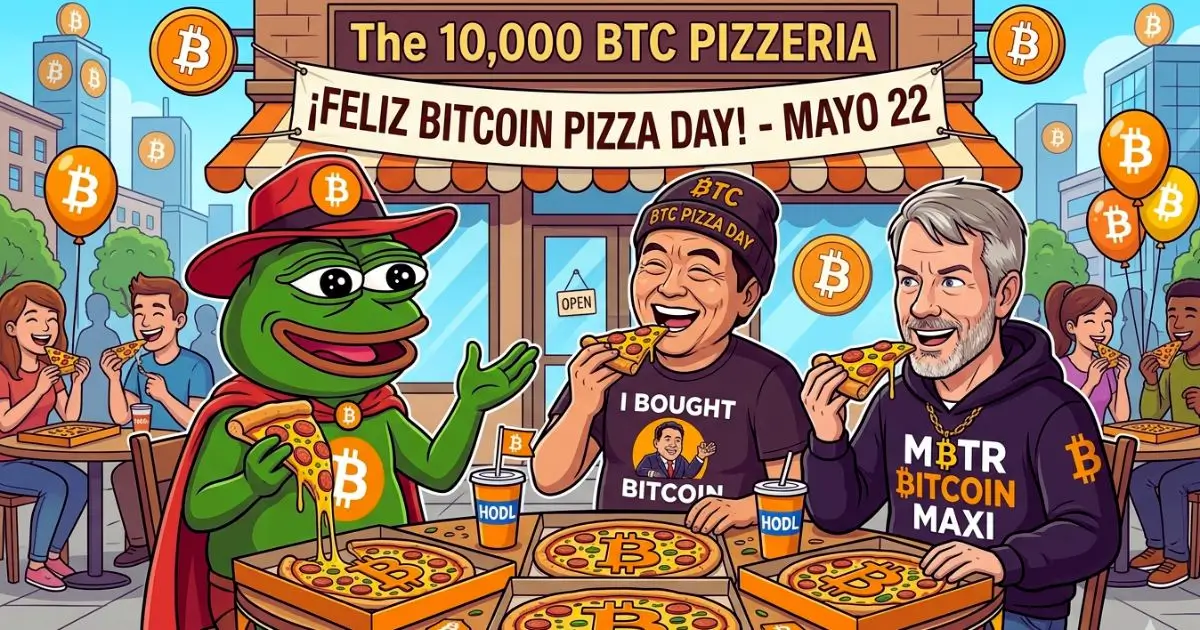
Bitcoin Pizza Day refers to May 22, 2010, when Laszlo Hanyecz, a Florida-based programmer who was one of the earliest Bitcoin Core contributors, made history. He offered 10,000 BTC on the Bitcointalk forum for two large pizzas from Papa John’s. The deal was simple: he would send the coins to anyone willing to order him the food. A British user, Jeremy Sturdivant (known online as ‘jercos’), accepted the offer, placing a phone order that cost about $41 USD.
“I’ll pay 10,000 bitcoins for a couple of pizzas… like maybe 2 large ones so I have some left over for the next day.”
Four days later, on May 22, he posted an update: “I just want to report that I successfully traded 10,000 bitcoins for pizza.”
This moment cemented the Bitcoin Pizza Day legend. It wasn’t just about hunger; it was the moment decentralized finance jumped from theoretical code into our physical world. Before this, Bitcoin was largely a mining project for cryptography enthusiasts. There was no exchange rate, no “market price,” and certainly no institutional interest. By converting a digital asset directly into a tangible consumable—hot, greasy pepperoni pizza—Laszlo bridged the gap between a computer protocol and human taste buds.
At that moment, a conversion event occurred that digital marketers dream of: an abstract token was swapped for a tangible, hot, delicious product. It was the first time Bitcoin had a quantifiable, “real-world” purchasing power. That single transaction established the core premise of cryptocurrency—it can be a medium of exchange.
Why does this matter for your content strategy? Because Hanyecz didn’t just perform a trade; he created a narrative. He identified a pain point (hunger, wanting pizza) and a desire (to prove Bitcoin was real money). Bitcoin Pizza Day is the ultimate case study in funnel activation. It took lurkers on a forum and turned them into participants in a shared experience. What story is your brand telling that moves people from passive observers to active community members?
Who Was Laszlo Hanyecz? The Man Behind the Meme
To truly understand Bitcoin Pizza Day, you must understand the man often dubbed “The Bitcoin Pizza Guy.” Laszlo Hanyecz was not some shadowy coder; he was an early contributor who actually helped Satoshi Nakamoto, the mysterious creator, improve the Bitcoin code.
Hanyecz invented GPU mining. If you’ve ever heard of massive mining rigs consuming warehouses of electricity, you can trace the lineage back to him. He realized that graphics cards were far more efficient than standard computer processors for solving the cryptographic puzzles needed to secure the network. Satoshi actually asked him to hold off on releasing this GPU mining code to avoid a centralization of power too early in the network’s life.
This background is crucial. Laszlo didn’t buy pizzas because he was lazy or hungry for fast food. He did it to demonstrate the real-world utility of peer-to-peer digital cash. He mined those 10,000 BTC using a standard computer, long before the industrial-scale operations of today. The energy cost back then was negligible. He was essentially creating value out of electricity and mathematical verification, and then, brilliantly, trading that value for food. This showcases the core value proposition of Bitcoin as a medium of exchange, not just a store of value.
From Pixels to Pepperoni: The Real-World Conversion Event
Let’s talk numbers, because the hindsight is staggering. Those 10,000 BTC purchased for two Papa John’s pizzas have fluctuated wildly in value. At Bitcoin’s peak, that meal represented over 700 million dollars. But focusing on the modern price tag misses the point entirely. The real value wasn’t the future fiat price; it was the proof-of-concept conversion.
Think about the digital marketing funnel for a crypto project. You have awareness, interest, decision, and action. On May 22, 2010, Laszlo Hanyecz fast-tracked the entire Bitcoin community from “interest” to “action.” He demonstrated a tangible utility. This act of creating real-world value is what separates fleeting protocols from enduring projects.
Here’s a quick breakdown of that first transaction’s conversion metrics:
Cost of Goods: 10,000 BTC.
Immediate Tangible Value: $41 (Two large Papa John’s pizzas).
Intangible Community Value: Priceless. It validated the network, set a benchmark, and generated priceless earned media still discussed today.
Long-Term Engagement: Infinite. This story is retold annually, bringing new users into the crypto ecosystem.
Have you ever calculated the intangible community value of your flagship product? If your content only talks about features and never creates a “Pizza Day” moment—a ritual that becomes part of your brand’s legend—you’re leaving a massive amount of engagement on the table.
Laszlo vs. Satoshi: The Man Who Gave Bitcoin Its Soul
To understand the philosophy of this space, we need to analyze a critical juxtaposition: Laszlo vs. Satoshi: The Man Who Gave Bitcoin Its Soul. Satoshi Nakamoto created the engine—a flawless, mathematical, decentralized ledger. But Laszlo Hanyecz gave it a heart.
Satoshi, the anonymous creator, was the architect of scarcity and trustless logic. Satoshi’s vision was one of cypherpunk resilience, a digital gold free from state control. Laszlo, however, represented the cypherpunk consumer. While Satoshi was mining the genesis block in solitude, Laszlo was writing GPU mining code (he invented GPU mining to help secure the network, not to get rich) and openly laughing about his expensive food on forums.
This is the “soul” we’re talking about. Laszlo demonstrated experience—not just theoretical expertise. He lived the network. He built part of the infrastructure and then used the asset for something joyfully mundane. In the modern framework of digital trust (where algorithms look for Experience, Expertise, Authoritativeness, and Trustworthiness), Laszlo had the ‘Experience’ that Satoshi’s anonymous persona couldn’t tangibly display. He showed his work. He proved he was cooking.
The Takeaway for Creators: Your audience doesn’t just want a white paper. They want proof of life. They want to see you cooking the meal, not just reading the recipe. When you structure your content to answer voice queries or AI overviews, that human element of “I was there, I built this, and I messed up” is what builds trust. Where is the “Laszlo” in your organization—the person who shows the messy, human side of your technology?
The New Manual of Trust: Why Google and AI Now Reward This Story
Search algorithms have evolved. Google’s ranking systems now prioritize a framework built on demonstrated experience. It’s the new manual of trust for the internet. In 2025, it’s no longer enough to sound like an expert; you have to show experiential proof.
How does Bitcoin Pizza Day perfectly nail these trust criteria?
Experience: Laszlo wasn’t just talking about Bitcoin; he mined it with his rig, used it to buy food, and had the digital receipts to prove it.
Expertise: He contributed to Bitcoin’s codebase, solving problems like GPU mining efficiency.
Authoritativeness: Cited by Satoshi in early communications, recognized as a core developer.
Trustworthiness: He risked his own tokens (now worth a fortune) to validate the network for everyone else.
For your website to rank in an era where AI generates direct answers, you need to channel this energy. AI models scraping the web for answers don’t just look for keyword density. They look for source verification, experiential tone, and clear, concise definitions.
Actionable checklist to signal real-world experience to algorithms:
Cite Verifiable Sources: Link to primary sources like the original Bitcointalk thread, not just third-party summaries.
Show Participation: Include developer logs, case studies, or screenshots of your own experiences.
Integrate Real Reviews: If you’re building a product, user-generated content (like the reaction to Laszlo’s pizza) is a massive trust signal.
Define Concepts Simply: Start key sections with a direct answer: “Bitcoin Pizza Day is the day a programmer proved Bitcoin’s utility by purchasing physical goods for 10,000 BTC.”
By creating content that answers questions in a simple, experience-backed way, you align directly with how AI chatbots select responses. A chatbot asked “What is Bitcoin Pizza Day?” will cite a source that states the fact clearly, supported by the author’s traceable experience.
Lessons in Long-Term Engagement from a $700 Million Lunch
Let’s talk about customer LTV (Lifetime Value) and community stickiness. Most content strategies chase quick wins—a viral tweet, a spike in traffic. But Laszlo’s pizza transaction is the gift that keeps on giving. It’s a “quick win” that transformed into a “forever story.”
Why did this stick?
It was a Gamified Bet: The community didn’t just read about it; they challenged and validated it.
It is Relatable: Everyone understands pizza. The abstract world of hash rates became digestible.
It’s an “Origin” Myth: Humans are hardwired for stories of humble beginnings.
When you design your content calendar, do you have assets designed for this kind of multi-year engagement? If you launch a token or a product, what is your pizza? What is the seemingly small, human, slightly absurd transaction that your community can rally around for the next decade?
A common mistake in tech content is trying to sound too much like a corporation. Laszlo didn’t publish a press release titled “Florida Developer Conducts Point-of-Sale Beta Test.” He posted on a forum asking for pizza. That’s direct, conversational marketing. It’s the voice of a real person, and that’s the voice that wins in voice search and chat-based AI interfaces.
How to Replicate the “Pizza Day” Virality for Your Brand
You don’t need a time machine and 10,000 Bitcoin. You need a strategy that blends technology with human hunger. Here’s how to engineer your own legendary moment:
Step 1: Identify a Concrete Pain Point (Hunger)
What does your community desperately need that the “corporate” world isn’t giving them? For early Bitcoiners, it was utility—proof that the magic internet money worked.
Step 2: Use a Bridge Asset
Laszlo didn’t use dollars; he used the native asset (BTC). If you run a DAO or a Web3 project, use your governance token or NFT to acquire something universally desired. It creates a direct funnel between the digital and the physical.
Step 3: Public Stunt with Transparency
Post the transaction details. The risk of failure (what if the pizza didn’t arrive?) was part of the engagement. The tension kept the forum watching.
Step 4: Embrace the Laughs
Laszlo never got defensive about the eventual value of that BTC. He saw it as a victory for the system. Your brand’s willingness to look back and laugh at its early days builds an authentic authority no corporate strategy can fake.
Step 5: Annualize the Ritual
The crypto community now celebrates Bitcoin Pizza Day every May 22. It’s an organic, recurring engagement loop. Build your own calendar event around your brand’s founding myth. It’s the ultimate native content strategy.
The Transaction Breakdown: 10,000 BTC for Two Pizzas
Let’s talk numbers, because the stats behind Bitcoin Pizza Day are the stuff of legend and financial therapy sessions. The deal wasn’t direct. Laszlo didn’t find a Papa John’s that accepted crypto payments. A fellow forum user, Jeremy Sturdivant (known as “jercos”), accepted the 10,000 BTC offer and, in turn, ordered two pizzas from Papa John’s to be delivered to Laszlo’s house. It was a peer-to-peer middleman operation.
Here’s the breakdown that makes investors gasp:
2010 Value: ~$41 (The going rate for two large pizzas).
Peak Value (Nov 2021): ~690Million(WhenBitcoinhit69,000).
Cultural Cost: Priceless.
Think about the supply chain logic. Laszlo utilized an emergent blockchain technology to create a smart contract-like verbal agreement across state lines. It wasn’t an atomic swap or a Lightning Network transaction; it was trust between forum users. This is the simplicity that Bitcoin evangelists and blockchain marketers love to highlight. You don’t need a bank. You don’t need a clearing house. You just need a connection.
Why is this a crucial part of crypto history? Because it established a rough exchange rate. The pizza transaction set a precedent that one Bitcoin was worth roughly $0.0041. It gave the currency a price discovery mechanism. This is the funnel moment where Bitcoin moved from being a hobby to a financial asset.
From Joke to Global Celebration: The Cultural Impact
Every year on May 22, the crypto community goes wild. Major exchanges like Binance, Coinbase, and Kraken post memes and run promotions for Bitcoin Pizza Day. Pizza shops around the world, from New York to El Salvador, offer “crypto discounts.” It’s a day of mourning for the dollars lost, but celebration for the blockchain adoption gained.
The celebration has evolved into a highly effective marketing funnel for the industry. It’s a viral, shareable story that perfectly illustrates the long-term potential of digital assets. The narrative engagement of this story converts more normies to crypto than any white paper could. Why? Because it’s human. It’s about pizza.
This event highlights the importance of community engagement in Web3. If you’re running a crypto project, you understand that the customer lifetime value (LTV) relies on storytelling. Bitcoin Pizza Day isn’t just a date; it’s a recurring, free marketing asset for the entire decentralized finance sector. It’s the ultimate conversion tool because it turns a complex monetary policy into a relatable joke.
How Bitcoin Pizza Day Proved the Value of Digital Scarcity
Beyond the memes, Bitcoin Pizza Day is a brutal, effective lesson in digital scarcity and tokenomics. Laszlo spent 10,000 BTC. There will only ever be 21 million BTC. To run a quick calculation, those two pizzas consumed approximately 0.047% of the total Bitcoin supply.
This isn’t just a party; it’s a case study in monetary debasement and hard money. Every year, as pizza prices rise due to fiat inflation, the pizza Laszlo bought becomes exponentially more expensive in hindsight. This provokes a fundamental question: what is the true function of money?
Before Bitcoin Pizza Day, the concept of decentralized finance was purely academic. Afterward, it became a measured reality. This transaction validated the security and utility of the network. It proved that you could send value across the internet without a trusted third party. The transaction fee for sending that $700 million wasn’t a percentage skimmed by a bank; it was a minimal mining fee paid to the network.
For those analyzing blockchain analytics, this transaction is the “genesis trade.” It’s the foundation of the on-chain data revolution. It proves that Bitcoin can bridge the physical and digital divide—a concept we now call tokenization of real-world assets.
The Psychology of Spending: Would You Have Done It?
Let’s play a game. It’s 2010. You are mining Bitcoin on your laptop. The electricity cost is trivial. Someone offers you a hot meal—something you can actually touch and taste—for a bunch of digital tokens that have no exchange listing. Honestly, would you have hit the “send” button?
This is the psychological paradox of Bitcoin Pizza Day. We judge the transaction with the “hindsight bias” of 2026. Back then, keeping the Bitcoin was the risky play. Spending it gave it utility. Laszlo wasn’t reckless; he was beta testing. He was engaging in a higher-risk action to prove a use case.
In the marketing tech world, we call this a minimum viable transaction. He wasn’t optimizing for future profits; he was optimizing for adoption. This is the mindset shift from a trader to a builder. The Bitcoin reward halving cycles hadn’t even created real scarcity shocks yet. It was pure exploration.
If you’re holding digital assets today, this story serves as a critical check on your ego. Are you building the ecosystem, or are you just staring at a screen waiting for a line to go up? Bitcoin Pizza Day is a humbling reminder that the value of a network is defined by its activity, not just its spot price. It’s about the transaction volume, not just the unrealized gains.
Modern Crypto Payments vs. The First Bitcoin Transaction
Fast forward to today. How does the Papa John’s purchase of 2010 stack up against modern crypto payments?
Back then, the transaction speed was slow. Block confirmations took ten minutes or longer. If you wanted your pizza hot, you had to trust the “zero-conf” transaction—meaning the vendor trusts the transaction is valid before it’s mined. Today, we have the Lightning Network, enabling instant, near-zero fee payments. We have stablecoins pegged to the dollar, eliminating the volatility fears that plague merchants.
The infrastructure for crypto payments has exploded. In 2010, Laszlo had to beg on a forum. Now, you can spend your crypto via a Visa debit card issued by a major exchange. You can buy real estate in Dubai, pay for a luxury watch, or, yes, order a pizza directly with a non-custodial wallet.
However, the “ghost of Bitcoin Pizza Day” haunts every single one of these transactions. Every time someone buys a coffee with Bitcoin, there is a nagging thought in the back of their mind: “Will this 5lattecostme50,000 in ten years?”
This introduces the concept of velocity of money. If nobody spends, the currency dies. Laszlo’s action wasn’t a mistake; it was a catalyst that proved the liquidity and utility of the chain. For Web3 to succeed, we need a balance between HODLing (holding on for dear life) and actually circulating crypto. The spending of Bitcoin creates the economic velocity that gives it long-term value beyond just speculation.
Does the fear of missing out on future gains prevent you from using your crypto for everyday purchases today? For many, the answer dictates their entire investment strategy.
Frequently Asked Questions
Who got the 10,000 Bitcoin for pizza?
Jeremy Sturdivant, known online as ‘jercos,’ received the 10,000 BTC. He was an 18-year-old Bitcoin enthusiast from the UK who accepted Laszlo Hanyecz’s offer on the Bitcointalk forum and placed the Papa John’s order.
What is Bitcoin pizza day?
Bitcoin Pizza Day is celebrated on May 22. It marks the first documented real-world purchase using Bitcoin, where Laszlo Hanyecz paid 10,000 BTC for two pizzas. It symbolizes the transition of Bitcoin from a theoretical experiment to a medium of exchange.
Who paid 10k Bitcoin for two pizzas in 2010?
Laszlo Hanyecz paid 10,000 Bitcoin for two Papa John’s pizzas. He was a Florida-based programmer and an early Bitcoin Core developer who invented GPU mining to make the network more secure.
Did Laszlo Hanyecz regret the Bitcoin pizza purchase?
No, Laszlo Hanyecz has repeatedly stated he does not regret the purchase. He views it as a necessary proof-of-concept to demonstrate that Bitcoin could function as a currency, ultimately creating value for the entire ecosystem.
How much was 10,000 Bitcoin worth on the day of the pizza purchase?
On May 22, 2010, 10,000 Bitcoin had no established exchange rate but equated to roughly $41 USD based on the cost of the two delivered pizzas. It was the first tangible price point for the digital asset.
What kind of pizza did Laszlo order with Bitcoin?
The specific exact toppings aren’t officially documented, but Laszlo asked for two large pizzas from Papa John’s, specifically requesting standard favorites like pepperoni in a follow-up to ensure no unusual toppings were sent, making it a relatable, ordinary meal.
Why is the story of Laszlo and his pizza still relevant for content creators today?
It perfectly illustrates the modern rules of digital trust. The story contains clear primary source citations (the forum thread), demonstrates real-world experience, and answers user questions directly—all factors that both Google and AI-driven answer engines prioritize when selecting a source to cite.
What is Bitcoin Pizza Day and when is it celebrated?
Bitcoin Pizza Day is celebrated annually on May 22. It marks the anniversary of the first documented purchase of physical goods using Bitcoin. In 2010, Laszlo Hanyecz paid 10,000 BTC for two pizzas, proving Bitcoin’s utility as a peer-to-peer electronic cash system.
Who bought the first Bitcoin pizza and why?
Laszlo Hanyecz, an early Bitcoin contributor, bought the pizzas. He wasn’t just hungry; he wanted to demonstrate the real-world application of the Bitcoin network. He successfully proved that the decentralized digital currency could be used for ordinary consumer transactions.
How much were the 10,000 Bitcoins worth at the peak?
At Bitcoin’s all-time high price point, the 10,000 BTC spent on Bitcoin Pizza Day had a market value exceeding $700 million dollars. This highlights the explosive price appreciation of the asset over the past decade and the deflationary nature of digital scarcity.
Where did the Bitcoin Pizza Day transaction take place?
The transaction was arranged on the Bitcointalk forum. A user named “jercos” accepted the 10,000 BTC digital payment and, in return, paid for a Papa John’s pizza delivery to Laszlo’s residence in Florida. It was a peer-to-peer exchange facilitated by community trust.
What does Bitcoin Pizza Day teach us about crypto adoption?
This event teaches us about user adoption and market validation. It created the first crypto exchange rate (putting 1 BTC at around $0.004) and proved that a blockchain-based currency could function outside of a centralized banking framework, paving the way for the entire crypto industry.
Is it a mistake to spend Bitcoin today?
Spending Bitcoin creates economic velocity and utility. While holding can benefit from long-term appreciation, spending is essential for blockchain utility. The “lesson” of Bitcoin Pizza Day isn’t “never spend,” but rather, understand the opportunity cost and utilize crypto payments for the utility they provide, not just speculation.
What are Bitcoin Ordinals and their connection to pizza day?
Bitcoin Ordinals are digital assets inscribed onto individual satoshis (the smallest unit of Bitcoin). As a homage to crypto history, many artists have inscribed pizza-related art directly onto the Bitcoin blockchain, making Bitcoin Pizza Day a popular theme within the NFT and Ordinals community.
Conclusion
Bitcoin Pizza Day is more than a cautionary tale about spending millions on fast food. It’s the foundational myth of crypto commerce. It’s the perfect case study of “Experience” over “Theory.” As you build your content strategy, whether you’re deep in Web3 or traditional SaaS, the lesson is clear: algorithms reward proof of life.
In the silent, trustless architecture of Satoshi, we needed the loud, hungry humanity of Laszlo. He didn’t just mine Bitcoin; he gave it a use case. He engaged in a transaction that was so utterly human—ordering comfort food on a quiet night in Florida—that it broke through the digital wall and landed in pop culture history.
Now, it’s your turn. Don’t just build a product; create the ritual. Don’t just write a blog post; capture a moment that your community will reminisce about fifteen years from now. The value of that engagement isn’t just a metric on a dashboard; it’s a legacy.
What’s the “Pizza Moment” waiting to happen in your project? Share this article with your team and start a conversation about the experiential marketing bets you’re ready to place. Let’s cook something legendary.