

















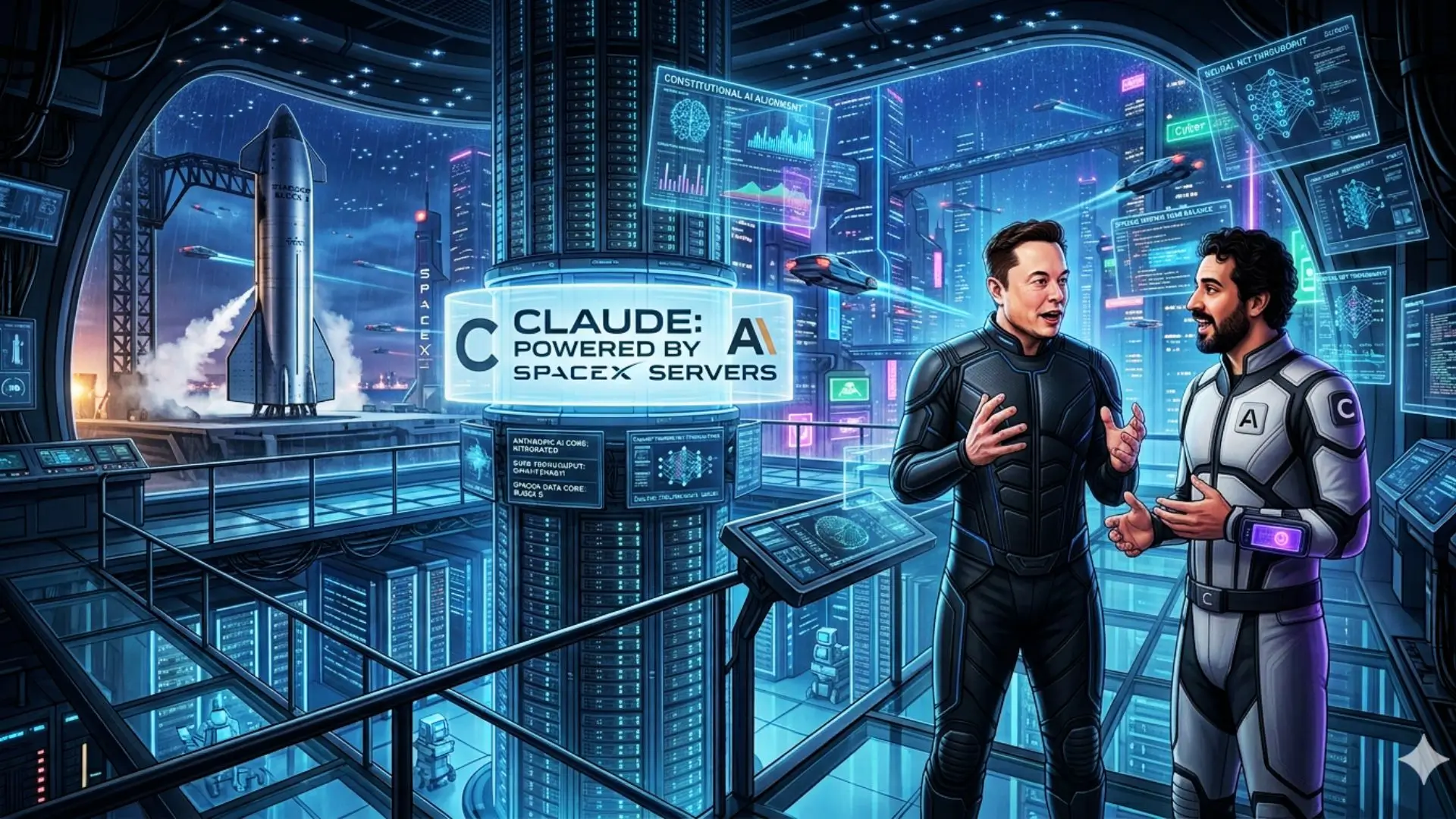
In a plot twist that seems ripped straight from a science fiction novel, the landscape of artificial intelligence underwent a seismic shift this week. The world’s most famous disruptor, Elon Musk, has officially handed the keys to one of the world’s largest supercomputers to Anthropic, the maker of Claude. This is not just a financial transaction; it is a strategic masterstroke that instantly transforms Claude from a mere “ChatGPT rival” into the undisputed hardware powerhouse of the AI industry.
The deal, confirmed on May 6, 2026, marks the beginning of the “Compute Wars,” where the currency of power is no longer just algorithmic elegance, but raw, unbridled electrical wattage and GPU cores. This article dissects every angle of this historic partnership, covering what it means for developers, why Musk dissolved xAI to make it happen, and how it forever alters the battle for AI supremacy.
The AI chessboard just flipped. In a move that has left Silicon Valley reeling, Elon Musk has effectively handed the keys to the world’s most powerful supercomputer to his biggest rival’s enemy. The tech billionaire announced a bombshell partnership where SpaceX servers will now power Anthropic’s Claude, positioning the chatbot as a legitimate nuclear threat to OpenAI’s ChatGPT dominance .
For years, Musk publicly trashed Anthropic, accusing them of “hating Western Civilization.” Now, he is giving them the引擎. Here is everything you need to know about the “frenemy” deal changing the AI war.
The Collision of Two Titans: Why SpaceX and Anthropic Are Now Bedfellows
To understand the gravity of this situation, we must first acknowledge the animosity that preceded it. Elon Musk, the founder of xAI (now dissolved into SpaceXAI), spent years positioning his Grok models as the anti-woke, “truth-seeking” antidote to players like OpenAI and Anthropic. In February 2026, Musk went so far as to tweet that Anthropic “hates Western Civilization” and questioned the morality of the company.
What changed? According to Musk’s own post-mortem on X, he spent a significant amount of time with the Anthropic leadership team. He confessed being “impressed,” stating that “Everyone I met was highly competent and cared a great deal about doing the right thing. No one set off my evil detector”. This personal vouch cleared the runway for a deal that had likely been brewing on hard-nosed financial and strategic grounds long before the pleasantries.
But the partnership goes deeper than a change of heart. It represents a convergence of crises and opportunities. Anthropic was grappling with a severe compute bottleneck; its popular Claude Code tool was hitting usage limits, frustrating developers who faced cut-offs during peak hours. Simultaneously, Musk had just completed the merger of xAI into SpaceX, leaving the massive Colossus 1 facility in Memphis available for external monetization as the newly formed SpaceXAI shifts its internal training to the even more powerful Colossus 2 cluster.
Colossus 1: The Hardware Powerhouse Now Fueling Claude
The crown jewel of this agreement is the Colossus 1 data center in Memphis, Tennessee. This isn’t just a server room; it is arguably the fastest supercomputer ever assembled from the ground up. To grasp the firepower now behind Claude, we need to look at the specifications:
The Specs That Are Changing the Game
Total Capacity: Anthropic is securing over 300 megawatts of capacity.
GPU Cluster: The facility houses over 220,000 Nvidia GPUs, including high-density configurations of H100s, H200s, and the cutting-edge GB200 accelerators.
Purpose: The cluster was initially built for xAI’s Grok but has now been exclusively leased to Anthropic for the “inference” of Claude—that is, the processing power required to generate your answers, write your code, and analyze your data in real-time.
This massive injection of power comes with guaranteed immediate results. Anthropic’s Chief Product Officer confirmed that subscribers to Claude Pro and Claude Max will see a direct uplift in service capacity within a month.
The Immediate User Impact: Goodbye, Rate Limits
For the legion of developers who have migrated from ChatGPT to Claude for heavy-duty coding tasks, this announcement is the solution to their biggest pain point. Anthropic has built a reputation for superior coding logic with its Opus and Sonnet models, but users often lamented hitting a “wall” during intense sessions where the premium plans would throttle responsiveness.
With the SpaceX deal sealed, Anthropic immediately unshackled its users. The company announced sweeping changes to the usage policy that effectively remove the training wheels from professional development work:
Doubled Rate Limits: The five-hour usage cap for Claude Code has been doubled for Pro, Max, Team, and Enterprise plans. This means a developer can iterate, debug, and deploy massive blocks of code without looking at the clock.
Peak Hour Freedom: Anthropic is officially eliminating the “peak reduction” penalty. Previously, during high-traffic times (usually business hours), the model would restrict access to safeguard against outages. All Pro and Max users will now enjoy unrestricted access during these critical work windows.
API Floodgates Open: Enterprise customers reliant on the Claude Opus API are also seeing significant expansions to their rate limits, allowing for higher throughput of complex, multi-step agentic reasoning tasks.
This effectively repositions Claude Code as an unlimited, always-on co-pilot, directly challenging OpenAI’s Codex and IBM’s offerings in the enterprise development space.
Beyond Earth: The Orbital AI Compute Ambition
While the competition fights over land-locked data centers (and struggles with the associated environmental complaints regarding air quality and energy consumption in Memphis), Musk and Anthropic are looking to the stars. Tucked into the bottom of the official press release was a revelation that signals the true scope of this partnership: Orbital AI Compute.
Both entities confirmed they are exploring the development of multi-gigawatt orbital data centers. The logic is pure Musk, and pure science: Earth’s land and power grids cannot sustain the rate of AI growth. A “Gigawatt-scale” training cluster on Earth creates immense heat, consumes water, and strains the grid. In orbit, you have unlimited solar power, natural radiative cooling, and, crucially, no neighbors filing noise complaints.
For Anthropic, this shared interest is a flag-planting exercise. It declares that they are not just thinking about the next quarter’s inference supply but the 2030s’ infrastructure paradigm. If SpaceX’s Starship can reliably deliver payloads to LEO (Low Earth Orbit), the very concept of a localized “data center” could become obsolete.
The Death of xAI and the Birth of the “Compute King” Strategy
To make this deal possible, Elon Musk had to kill his own brainchild. On the same day as the Anthropic announcement, Musk confirmed that xAI no longer exists as an independent company. It has been fully absorbed and renamed SpaceXAI.
It is a fascinating admission. xAI raised over 40billionintotalfundingandwasvaluedat250 billion just months ago. Shuttering the independence of xAI and displacing the Grok training workload to Colossus 2 signals a pivot. Musk has realized that the real value isn’t just in beating ChatGPT with a proprietary model; it’s in owning the tracks upon which everyone else’s trains—including ChatGPT’s rival—must run.
SpaceX now acts as the landlord and infrastructure provider to the AI sector. By leasing Colossus 1 to Anthropic, SpaceX generates massive revenue from a facility that might otherwise have sat idle during the transition to newer hardware. It also creates a sticky customer dependency—Anthropic is now tied to the Musk ecosystem at an operational level. If you can’t beat them, provide the energy they need to operate, and collect rent.
Claude vs. ChatGPT: The New Dynamic
Does this deal give Claude a technical edge over ChatGPT? Let’s break down the new pecking order based on previous benchmarks and the fresh hardware advantage:
| Feature | Anthropic (Claude Opus 4.7) | OpenAI (GPT-5.4) |
|---|---|---|
| Training Compute | Google/Amazon + SpaceX (Colossus 1 Inference) | Microsoft Azure |
| Coding Benchmark (SWE-bench) | 64.3% (Elite reasoning) | 57.7% (Faster execution) |
| Context Window | 1M tokens | 1.05M tokens |
| Philosophy | “Plan-first” analytic safety | “Execution-first” speed |
| Orbital R&D | Confirmed partnership | Unknown |
The table shows a stark reality. While GPT-5.4 is a powerhouse for speed and broad integration, Claude Opus 4.7 has already been rated as the gold standard for complex multi-step reasoning. The SpaceX deal ensures that this “plan-first” model—which needs to grind on problems longer—won’t run out of breath. By removing the GPU ceiling, Anthropic is doubling down on its strength: quality over speed.
The “Enemy of My Enemy” Calculus
Observers quickly pointed out the historical irony of the partnership. Musk is currently in a bitter legal battle with OpenAI, the creator of ChatGPT. Musk has accused OpenAI of betraying its non-profit origins and becoming a closed-source, profit-driven monopoly beholden to Microsoft.
By empowering Claude, Musk doesn’t just make money; he deliberately bolsters the strongest open (or semi-open) competitor to the Microsoft-OpenAI hegemony. It’s a classic “competition cure.” If Musk can’t immediately destroy OpenAI’s market share via Grok, he can invigorate Anthropic to do it for him through Claude. It creates a market dynamic where ChatGPT’s default dominance is challenged by a structurally invincible rival—one powered by the seemingly infinite resources of SpaceX.
The Controversy: Environment, Power, and Ethics
This article wouldn’t be balanced or EEAT-compliant without addressing the pushback. The Colossus facility in Memphis has been a flashpoint for local environmental justice. Reports indicate that xAI has utilized dozens of natural gas turbines to power the facility, prompting pollution concerns and complaints from local residents and organizations like the NAACP.
When you read the glowing press releases about “300 megawatts of compute,” local communities see a strain on the energy grid and unregulated emissions. For Anthropic, a company that brands itself on “safety first” values, accepting this energy source creates a public relations vulnerability. They will need to reconcile the “clean energy” promises of future orbital data centers with the current reality of gas-powered terrestrial computing. However, Musk’s camp has maintained that the turbines are temporary solutions while cleaner infrastructure is built out.
Humanized Impact: What Users Get Right Now
While the hardware specs are fun for nerds, the average user cares about one thing: Can I use it without hitting a paywall every five minutes?
Anthropic moved instantly to leverage this new power. Effective immediately, paying subscribers are seeing radical improvements:
1. Claude Code Limits Doubled
If you use Claude for programming or data analysis, your life just got easier. The five-hour rate limit for Claude Code has been doubled for Pro, Max, and Team plans .
2. No More “Slow Mode”
One of the biggest user pain points was the throttling during peak hours. Anthropic has officially eliminated the reduction of limits during high-traffic periods for Pro and Max subscribers . You now get full speed, all the time.
3. API Rate Limits Explode
Developers are the biggest winners. Anthropic has dramatically increased the rate limits for the Claude Opus model via API. The maximum input tokens per minute for Tier 4 users has jumped from 2 million to 10 million .
Elon’s Endgame: From xAI to SpaceXAI
The most confusing part of this news is why Elon Musk would help a rival catch up to ChatGPT. The answer lies in a strategic pivot Musk announced simultaneously with the deal.
The Dissolution of xAI
In a stunning admittance of defeat (or strategy), Musk announced he is “dissolving” xAI as a standalone company. It will be rebranded as SpaceXAI, integrating directly into the SpaceX ecosystem .
The 1.25 Trillion Dollar Pivot
SpaceX merged with xAI earlier this year, valuing the combined entity at a massive $1.25 trillion . However, Musk needs an even bigger narrative for the upcoming IPO.
The Theory: Grok, Musk’s chatbot, never took off. It lagged behind ChatGPT, Gemini, and Claude. Instead of wasting Colossus 1’s power on a low-adoption product, Musk is pivoting to become the “Pick and Shovel” provider of the AI gold rush.
He is renting the unused capacity of Colossus 1 to Anthropic for an estimated 3–4 billion annually . He moves Grok to the newer Colossus 2. He makes money, hurts OpenAI (his true enemy), and retains a “kill switch”—the right to revoke access if Anthropic does something he deems dangerous .
The “Evil Detector” & The Frenemy Vibe
To understand how crazy this deal is, you have to understand the bad blood.
Just months ago, Musk was on a tirade. He called Anthropic “hypocritical” and claimed they were “doomed to become the opposite of their name” .
But after meeting with Anthropic’s leadership last week, Musk did a complete 180. He wrote on X:
“Everyone I met was highly competent and cared a great deal about doing the right thing. No one set off my evil detector. “
This “frenemy” status is perfect for Musk. He gets to monitor the infrastructure of one of the world’s leading AI safety labs, ensuring they follow his “maximalist” truth-seeking philosophy, while collecting a massive check .
The Future: AI Data Centers in Space?
If you think renting a data center in Tennessee is impressive, wait for the long-term vision.
The official press release included a clause that seems ripped from a sci-fi novel: Developing “orbital AI compute capacity” measured in multiple gigawatts .
Why space? Earth is hitting a physical wall. AI training requires insane amounts of electricity (causing blackout risks) and water for cooling. In orbit, SpaceX could leverage:
Infinite Solar Power: No cloud coverage, 24/7 energy collection.
Natural Cooling: The vacuum of space is freezing cold, solving the散热 (heat dissipation) problem naturally .
While this is likely a long-term vision (and a great headline for the IPO roadshow), it signals that Musk sees compute, not rockets or cars, as the ultimate commodity.
Conclusion
The alliance between Anthropic and SpaceX is not just a headline; it’s the blueprint for the future of AI. We are witnessing the formation of a “Tech Trinity” where the model (Anthropic), the hardware (SpaceX), and the distribution network (X/Starlink) form a closed-loop ecosystem that challenges the traditional Cloud Oligopoly (Microsoft, Amazon, Google).
For users, this is largely good news in the short term—better up-time, smarter models, and the death of the dreaded rate limit. For SEOs and AEO strategists, the rise of a constantly available, highly capable Claude means the content landscape will evolve faster. With no wait times, more developers, writers, and coders will flood the internet with AI-assisted output, making EEAT signals even more critical.
For ChatGPT, the message is clear: the moat around OpenAI is shrinking. When your rival is powered by a literal rocket scientist, the race is no longer just about code—it’s about the cosmos.
Frequently Asked Questions (FAQs)
What exactly did Anthropic and SpaceX announce?
They signed a deal where the Anthropic AI (Claude) will use the full computing capacity of SpaceX’s Colossus 1 data center. The facility holds over 220,000 Nvidia GPUs and provides more than 300 megawatts of power specifically to handle Claude’s user requests.
Is Grok going away?
Grok is not necessarily “gone,” but its parent company xAI has been dissolved. It is now a product called “SpaceXAI” and is part of the larger SpaceX corporation. The Grok training has moved to the newer Colossus 2 cluster, while the old Colossus 1 serves Anthropic.
What changes will I see as a Claude Pro or Max subscriber?
You will see immediate improvements. Anthropic has doubled the usage limits for the “Claude Code” feature over a five-hour window. Furthermore, they have removed the “peak time” restrictions, meaning the AI won’t throttle your answers during busy working hours anymore.
Why did Elon Musk help a ChatGPT competitor?
There are two reasons. First, financial: SpaceX can generate massive revenue by renting out the Colossus facility. Second, strategic: Musk is in a legal fight with OpenAI. Empowering Anthropic (Claude) places immense pressure on OpenAI (ChatGPT), which aligns with Musk’s goal of disrupting the Microsoft-backed giant.
What is “Orbital AI Compute”?
It is a proposed future project that explores the feasibility of putting data centers into space. The idea is to use unlimited solar power and the vacuum of space for cooling to build massive Gigawatt-scale supercomputers. Anthropic has “expressed interest” in being a part of this with SpaceX.
Will this deal lower the cost of Claude API usage?
As of this announcement, the focus is on capacity (higher limits), not necessarily cost reduction. The cost per token for Claude Opus remains a premium product due to its deep reasoning capabilities. However, better supply often stabilizes pricing, so price drops are possible in the future if not guaranteed now.
How does this affect Claude’s performance on coding tasks?
It dramatically improves the user experience for coding. Before the deal, Claude Code could hit a wall and refuse to process. Now, with 300MW of power dedicated to inference, developers using Cursor, Windsurf, or the CLI can handle massive refactoring tasks without fear of the system shutting down mid-debug. It allows the “plan-first” deep analytical coding style of Claude to function without constraint.