














Let’s be honest. The crypto market moves at light speed. By the time a trend is headline news on CNBC, the early-stage ROI has often been captured. For the retail trader, this constant chase can feel exhausting and unprofitable. You’re not just trading tokens; you’re trading narratives, stories about the future that drive capital, developer activity, and user adoption.
The question isn’t just “What will go up?” but “Which fundamental story will the market believe next?” If you spent 2021 chasing memecoins or missed the early signals of decentralized finance (DeFi), you understand the cost of being late to a narrative shift.
This article is your strategic map for 2026. We’re moving beyond hype to analyze the crypto narratives with tangible traction, real-world use cases, and the potential to shape the next market cycle. From the explosive convergence of Artificial Intelligence (AI) and blockchain to the multi-billion dollar opportunity in Real World Assets (RWA), we’ll provide a clear, actionable breakdown. Consider this your guide to moving from reactive trading to strategic positioning. Your engagement with these trends today could define your financial conversion from spectator to savvy participant tomorrow.
Understanding the Power of Crypto Narratives: More Than Just Hype
Before we dive into the specific trends for 2026, let’s establish a foundational truth: in crypto, narratives are infrastructure. They are the frameworks that explain why a technology matters, attracting developers, venture capital, and ultimately, users.
Think of a crypto narrative as the thesis behind an investment. It’s the answer to the question: “What problem does this solve, and why will it attract massive value?” For instance, the “DeFi Summer” narrative was about disintermediating traditional banks. The “NFT Boom” narrative centered on digital ownership and creator economies.
For the retail trader in 2026, understanding this is your quick win. You’re no longer just reading charts; you’re gauging the strength of a story. Is it backed by genuine technological progress and growing adoption metrics (on-chain data), or is it purely speculative social media chatter? This discernment is what separates portfolio growth from portfolio churn.
The New Market Reality: Why 2026 Demands a Smarter Approach
The crypto market is entering a new phase of maturity. Key structural changes have redefined the playing field, making old strategies less effective and new opportunities more nuanced.
Institutional Integration is Complete: Spot Bitcoin ETFs, which launched in 2024, have grown into a dominant market force. For example, BlackRock’s IBIT had accumulated tens of billions in assets by late 2025. These products create massive, rapid capital flows that can significantly move prices.
Regulatory Frameworks Are Active: In the U.S., the proposed GENIUS Act aims to create comprehensive rules for stablecoins. In Europe, the Markets in Crypto-Assets (MiCA) regulation is fully applicable, setting the first continent-wide standard. This clarity, while adding compliance, is inviting traditional finance giants to participate more deeply.
The “Four-Year Cycle” May Be Evolving: While historically significant, some analysts argue that the predictable Bitcoin halving cycle is being reshaped by the influx of institutional capital with longer time horizons. This suggests a potential for extended market phases that don’t strictly adhere to past patterns.
For you, the retail trader, this means the game has changed. Success hinges less on chasing hype and more on identifying projects with sustainable fundamentals, clear utility, and a path to integration within this new, regulated, and institutionally-backed landscape.
The Top Crypto Narratives to Dominate 2026
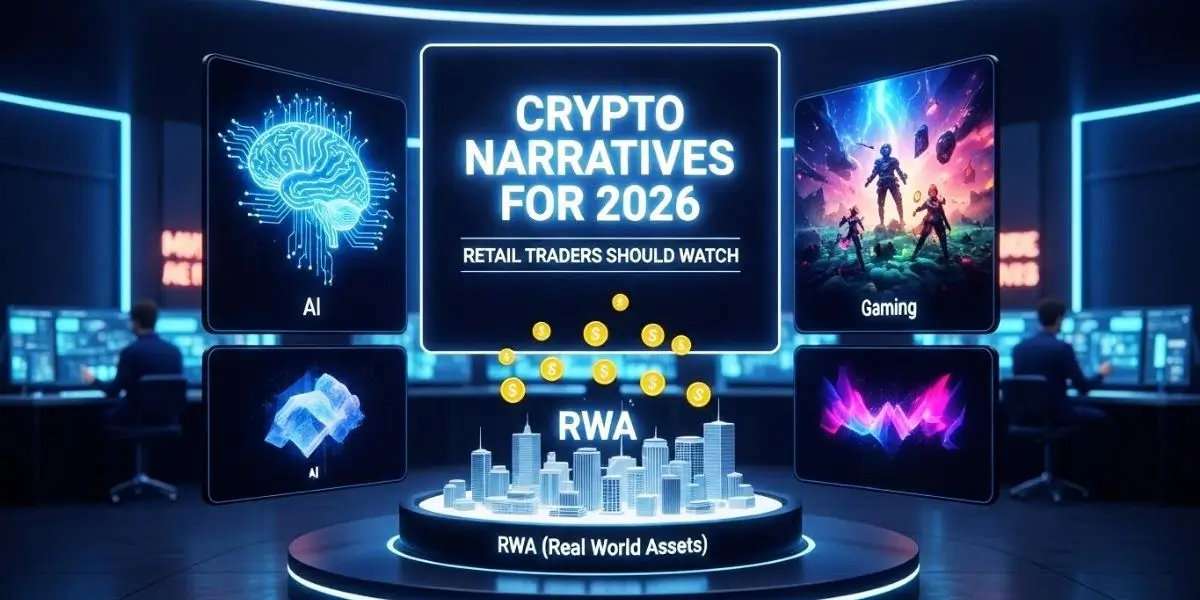
We’ve analyzed developer activity, funding rounds, regulatory tailwinds, and technological readiness to identify the narratives most likely to mature and capture significant market share by 2026.
1. Artificial Intelligence (AI) x Blockchain: The Synergy Narrative
At its core, this narrative asks: How can decentralized networks power and democratize the next generation of AI?
The AI revolution is undeniable, but it’s currently centralized in the hands of a few tech giants controlling data, model training, and access. Blockchain introduces verifiability, transparency, and a new economic model for AI.
Decentralized Physical Infrastructure Networks (DePIN): Projects like Render Network (distributing GPU power for rendering) are early blueprints. In 2026, expect massive growth in networks that offer decentralized computing power for AI model training—a critical bottleneck. This isn’t just a crypto narrative; it’s a multi-trillion dollar hardware and services industry being reimagined on-chain.
AI Agents & Autonomous Economies: Imagine AI assistants that can not only schedule your meeting but also pay for it using crypto from a wallet they manage. Smart contracts will enable these AI agents to perform complex, trustless transactions. The best crypto narrative for 2025-2026 in this space revolves around the protocols that will become the “rails” for this agent economy.
Data Sovereignty & Monetization: Blockchain allows individuals to own and permission their data for AI training, potentially being paid via microtransactions. This tackles the core ethical and supply-chain issue of modern AI.
Actionable Takeaway for Traders: Look beyond tokens with “AI” in the name. Focus on protocols providing verifiable compute (DePIN), oracle networks feeding real-world data to AI, and platforms enabling the creation of autonomous AI agents. The ROI potential lies in the foundational infrastructure, not just the application layer.
2. Blockchain Gaming & The Dawn of True Digital Ownership
The question here is: Can Web3 finally deliver games that are fun first and financial second?
The “play-to-earn” model of 2021-22 highlighted the potential but often failed on gameplay. The 2026 narrative is maturing into “play-and-own.” The value proposition shifts from grinding for token rewards to truly owning in-game assets (characters, items, land) as NFTs that are usable across multiple gaming worlds or experiences.
Major Studio Adoption: Large, traditional gaming studios are dipping their toes in, experimenting with NFT item drops or blockchain-based loyalty programs. By 2026, we may see a AAA title with seamless Web3 integration that doesn’t compromise user experience.
Interoperability & Gaming Ecosystems: The true breakthrough will be assets from one game being usable in another. Protocols focusing on creating shared standards for identity and asset portability are critical bets in this space. This builds long-term user engagement and LTV (Lifetime Value).
Community-Owned Franchises: Games governed by decentralized autonomous organizations (DAOs) where players have a say in development, lore, and economies. This creates powerful, sticky communities.
Actionable Takeaway: Research gaming studios with strong Web3 divisions and the layer-1 or layer-2 blockchains specifically optimized for gaming (fast transactions, low fees). Monitor player metrics, not just token price. A game with a growing, active, non-bot player base is a stronger signal than speculative asset pumps.
3. Real World Assets (RWA): Bridging Trillions into Crypto
This is arguably the most consequential narrative for long-term, large-scale crypto adoption in 2026.
RWA involves tokenizing traditional financial assets—like treasury bonds, real estate, commodities, and invoices—on a blockchain. It brings stability, yield, and immense scale from the old financial system into the new.
Yield for the DeFi Ecosystem: DeFi protocols can offer stable, regulated yield sourced from U.S. Treasury bills, making them attractive to conservative capital. This isn’t speculative yield farming; it’s real-world cash flow.
Fractional Ownership & Liquidity: Tokenization can break down a $10M commercial property into 10 million $1 tokens, enabling fractional investment and creating liquidity for historically illiquid assets.
Institutional On-Ramp: This is the Trojan horse for institutional money. BlackRock’s tokenized money market fund on Ethereum was a watershed moment. It signals that traditional finance (TradFi) sees the blockchain as a superior settlement and custody layer.
Actionable Takeaway: This narrative is heavily tied to regulation and institutional players. Focus on the most credible, compliant protocols partnering with established financial institutions. Look for projects with clear legal frameworks and audits. The risk here is regulatory, not just technological.
4. The Bitcoin Ecosystem: Beyond a Store of Value
The prediction for Bitcoin in 2026 is no longer just “digital gold.” The emergence of layers like the Lightning Network for payments and novel protocols like Ordinals (inscribing data on satoshis) has sparked a renaissance.
Bitcoin as a Productive Asset: With protocols enabling DeFi-like activities (lending, staking) on Bitcoin without altering its core code, BTC can become a yield-bearing asset. This could dramatically alter its valuation model.
Layer-2 Scalability: For Bitcoin to be a global payment system or a foundation for applications, Layer-2 solutions must achieve mainstream user-friendly adoption. Progress here is a major bullish indicator.
Institutional Adoption as a Macro Asset: Continued adoption by ETFs, corporations, and nation-states provides a rock-solid price floor and reduces volatility, making the entire crypto space more palatable for traditional capital.
Actionable Takeaway: While Bitcoin itself remains a core portfolio holding, the ancillary ecosystem tokens (Layer-2 networks, DeFi protocols built on Bitcoin) may offer asymmetric growth opportunities as this narrative develops.
5. Decentralized Social & Creator Monetization
Tired of algorithms controlling your reach and platforms taking a giant cut? Decentralized social networks built on blockchain promise user-owned social graphs, censorship resistance, and direct creator-to-fan monetization.
Tokenized Communities: Creators can issue social tokens or NFTs that grant access to exclusive content, governance, and experiences, building stronger, more valuable community engagement.
Portable Reputation: Your followers and engagement could move with you across different apps, breaking the platform lock-in we experience today.
Actionable Takeaway: This space is early and user experience is still clunky. However, monitoring daily active users on leading decentralized social apps can provide early signals. The first platform to crack intuitive UX with real network effects could be monumental.
How to Implement These Narratives in Your 2026 Trading Strategy
Knowing the narratives is one thing; acting on them is another. Here’s a tactical checklist to integrate this knowledge into your process:
Allocate by Conviction, Not Hype: Don’t FOMO into every trending narrative. Choose 1-2 you deeply understand and believe have the strongest fundamentals. Allocate a portion of your portfolio specifically for these thematic bets.
Practice Phased Entry: Instead of going all-in, use dollar-cost averaging (DCA) to build positions in projects aligned with your chosen narratives over time. This manages volatility risk.
Monitor On-Chain Metrics & Developer Activity: Use dashboards from places like Token Terminal, Dune Analytics, or GitHub. Are developers actively committing code? Are real users transacting on the protocol, or is it just speculative trading? These are E-E-A-T (Experience, Expertise, Authoritativeness, Trustworthiness) signals for a project’s health.
Set Clear Risk Parameters: Define your exit strategy before you enter a trade. What event or metric failure would prove your narrative thesis wrong? Adhering to this discipline is the hallmark of a strategic trader versus a gambler.
Deep Dive: The Five Core Narratives Shaping 2026
Let’s analyze the narratives with the strongest foundations, separating genuine innovation from temporary hype.
1. Real-World Asset (RWA) Tokenization: The Multi-Trillion Dollar Bridge
This is arguably the most significant structural shift. RWA tokenization involves converting ownership of traditional assets—like U.S. Treasury bonds, real estate, or private credit—into digital tokens on a blockchain.
Why It’s Exploding Now: Major financial institutions are no longer experimenting; they are launching products. BlackRock’s BUIDL fund, a tokenized U.S. Treasury fund, grew to hold billions in assets and expanded to multiple blockchains. Analysts from firms like BCG project the total market for tokenized assets could reach $16 to $19 trillion by 2030.
The Retail Trader’s Lens: This narrative isn’t about a token magically gaining value. It’s about investing in the infrastructure and protocols that enable this revolution. Look for projects that facilitate the minting, management, and trading of these assets. Tokens tied to real, yield-generating assets (like tokenized Treasuries) can offer a novel source of on-chain yield.
Key Projects to Research: ONDO (Ondo Finance, focused on tokenized Treasuries), CFG (Centrifuge, connecting real-world assets to DeFi), and the MKR governance token (which oversees the DAI stablecoin, increasingly backed by real-world collateral).
2. AI x Crypto: Autonomous Agents and Decentralized Infrastructure
The convergence of Artificial Intelligence (AI) and crypto moves beyond adding “AI” to a whitepaper. The powerful narrative for 2026 focuses on two areas: AI agents as independent economic participants and decentralized infrastructure for AI development.
AI Agents on the Blockchain: Imagine autonomous programs that can trade, manage portfolios, and execute complex DeFi strategies 24/7. For these agents to operate, they need a native financial system—this is where blockchain comes in. The concept of “Know Your Agent” (KYA) frameworks is emerging to provide these agents with verifiable identity and permissions on-chain.
DePIN for AI (Decentralized Physical Infrastructure Networks): Training advanced AI models is prohibitively expensive and centralized in a few tech giants. Crypto projects are building decentralized markets for GPU compute power, data, and AI model training. Networks like Akash claim to offer compute at up to 80% cheaper than traditional cloud providers.
Key Projects to Research: TAO (Bittensor, a decentralized intelligence network), FET (part of the Artificial Superintelligence Alliance, focused on agent infrastructure), and RNDR (Render Network, decentralized GPU rendering now used for AI workloads).
3. The Evolution of Money: Stablecoins & Bitcoin’s Second Layer
Money on the internet is being rebuilt. This narrative has two powerful, interwoven threads.
Stablecoins as Global Financial Infrastructure: Stablecoins are transitioning from a crypto trading tool to a backbone for global payments. Their annual transaction volume already rivals major card networks, with projections suggesting it could exceed $20 trillion in 2026. Regulatory clarity is turning them into a tool for instant, cross-border salaries and merchant settlements.
Bitcoin Develops an Application Layer: Bitcoin is no longer just “digital gold.” Layer 2 (L2) networks are building atop it to enable faster payments, smart contracts, and DeFi. The Lightning Network (for payments) and chains like Stacks (STX) and Rootstock (RSK) (for smart contracts) are creating a vibrant ecosystem where Bitcoin itself can be used as productive collateral.
Key Areas to Watch: Monitor the integration of stablecoins into traditional payment rails. For Bitcoin L2s, track growth in Total Value Locked (TVL) and active addresses on networks like Stacks and Merlin Chain.
4. Consumer Crypto & Gaming: Mass Adoption Through User Experience
For crypto to reach a billion users, it must become invisible and frictionless. This narrative is about removing barriers.
The Telegram & TON Ecosystem: With billions of users, Telegram is becoming a major on-ramp. Its integration with The Open Network (TON) allows users to interact with wallets, games, and DeFi services directly within the chat app, without needing a separate browser extension. This “Web2-like UX” is a game-changer for adoption.
Blockchain Gaming Matures: The “play-to-earn” hype has evolved. The next generation focuses on high-quality, fun games where ownership of in-game assets (NFTs) is a feature, not the sole purpose. Games built on chains like Immutable and Polygon are leading this charge, aiming to attract traditional gamers.
The Opportunity: This narrative is about betting on the platforms that successfully onboard the next wave of users. Look for ecosystems with growing developer activity, seamless user experiences, and partnerships with major brands.
5. Prediction Markets & Enhanced Privacy
These two narratives address fundamental human and market needs: forecasting the future and protecting sovereignty.
Prediction Markets Go Mainstream: Platforms like Polymarket have evolved from niche betting sites to serious information markets. They aggregate crowd-sourced wisdom on events ranging from elections to corporate outcomes. This sector, sometimes called “InfoFi,” is attracting institutional interest for its potential as a decentralized oracle for real-world data.
Privacy Becomes Non-Negotiable: As blockchain analysis becomes more sophisticated, demand for financial privacy grows. Zero-Knowledge Proof (ZK-proof) technology, which allows you to prove something is true without revealing the underlying data, is moving from theory to application. This enables compliant privacy for DeFi and RWAs.
Key Projects to Research: POL (Polymarket’s upcoming token) for prediction markets. ZEC (Zcash) and emerging ZK-rollups for privacy-focused transactions.
Comparative Analysis of 2026’s Top Crypto Narratives
| Narrative | Core Driver | Stage of Adoption | Key Risk for Traders | Retail Trader Action |
|---|---|---|---|---|
| RWA Tokenization | Institutional efficiency & new yield sources | Early institutional product stage | Regulatory complexity & off-chain legal risk | Research infrastructure protocols, not asset proxies |
| AI x Crypto | Autonomous economies & cheaper compute infrastructure | Early protocol development & agent testing | Technological hurdles & “AI-washing” of existing projects | Focus on projects with verifiable, decentralized demand |
| Stablecoins & Bitcoin L2 | Global payment rails & Bitcoin utility expansion | Scaling & integration phase | Regulatory shifts & L2 security model risks | Monitor transaction volume growth and L2 TVL |
| Consumer Crypto (Telegram/TON) | Mass-market user experience (UX) | Rapid user growth phase | Scam proliferation & platform dependency | Assess genuine user retention, not just viral user acquisition |
| Prediction Markets & Privacy | Demand for information & data sovereignty | Niche to early mainstream crossover | Legal ambiguity & user adoption speed | Look for integrations with larger DeFi/insurance products |
Actionable Strategy: Building Your 2026 Portfolio
Understanding narratives is step one. Implementing a strategy is step two. Here is a framework to turn insight into action.
Adopt a “Infrastructure-First” Mindset: Instead of asking “which token will pump?”, ask “which protocol is essential for this narrative to function?” Value will accrue to the picks and shovels, not just the mines.
Practice Rigorous Due Diligence (DYOR 2.0):
For RWA Projects: Is there a regulated entity and audited collateral behind the token? What is the legal claim of the token holder?
For AI Projects: Does the project have live, paying customers for its compute or data? Is there a clear economic advantage over centralized alternatives?
Check On-Chain Metrics: Use tools like DeFi Llama or Dune Analytics to verify Total Value Locked (TVL), unique active wallets, and revenue. Narrative must be backed by usage.
Allocate Strategically, Not Emotionally: Treat your portfolio like a venture capitalist. Make smaller, focused bets on high-conviction narratives rather than chasing every trending coin. Always have an exit plan for each position.
Embrace Staking and Earning Yield: In a maturing market, staking and providing liquidity can generate real yield (from protocol fees, for example) that isn’t dependent solely on token price appreciation. This is a hallmark of a more sustainable ecosystem.
Common Pitfalls to Avoid as a Retail Trader in 2026
Chasing “Shiny Object” Narratives Without Research: A narrative lasting two weeks on Crypto Twitter is not an investment thesis.
Ignoring Regulatory Developments: This is especially critical for RWA and AI narratives. Regulatory clarity can be a massive tailwind or a devastating headwind.
Overconcentration in Micro-Caps: While they offer high upside, balance them with established assets (like Bitcoin and Ethereum) that provide portfolio stability.
Neglecting Security: As narratives attract money, they attract scammers. Use hardware wallets, beware of phishing links, and never share your seed phrase. Security is your number one operational priority.
Navigating Risks in a Maturing Market
The increased institutional presence doesn’t eliminate risk; it changes it.
Regulatory Headlines Will Cause Volatility: Positive news (like the passage of the GENIUS Act) or enforcement actions will trigger sharp market movements. Use volatility as a potential opportunity, not a reason for panic.
Beware of “Narrative Washing”: Just as “cloud-washing” occurred in tech, expect many projects to rebrand themselves as “AI” or “RWA” plays without substance. Always look for the underlying technology and product-market fit.
Security is Paramount: As the value flowing through protocols increases, they become bigger targets. Diversify across custodial (exchange) and non-custodial (hardware wallet) storage. Be extremely cautious with new, unaudited protocols promising unrealistic yields.
Conclusion
The crypto narratives for 2026 we’ve outlined—AI x Blockchain, Gaming, RWA, the Bitcoin Ecosystem, and Decentralized Social—are not mere speculation. They are converging trends driven by technological innovation, market demand, and in some cases, undeniable economic logic.
For the proactive retail trader, this is a call to action. Start your research today. Dive into the leading projects in each category. Follow their development, join their communities, and understand their challenges. By building your knowledge base now, you position yourself to make informed, confident decisions when the market cycle turns.
The goal is not to predict the exact top or bottom but to have conviction in the fundamental stories that will drive value creation for years to come. Which of these narratives resonates most with your vision of the future? Share your thoughts in the comments below—let’s build a community of strategic thinkers.
Ready to go deeper? Check out our [internal link: Advanced On-Chain Analysis Guide] to learn how to validate narrative strength with data, or explore our [internal link: Crypto Portfolio Builder Tool] to help structure your allocations.
FAQs
Which Crypto narratives matter most in 2026?
The most consequential narratives for 2026 are those bridging crypto with massive existing industries: Real World Assets (RWA) for bringing trillion-dollar traditional finance on-chain, and Artificial Intelligence (AI) x Blockchain for decentralizing the infrastructure of the AI economy. Blockchain Gaming also matters hugely if it achieves a breakthrough in user experience.
Do crypto narratives really matter for retail traders in 2026?
Absolutely. Narratives are the primary drivers of capital flows and attention in the crypto market. For retail traders, identifying a strong, credible narrative early is a strategic tool for uncovering potential high-growth sectors before they become mainstream, directly impacting portfolio ROI.
How will crypto adoption be shaped in 2026?
Adoption in 2026 will be less about “people buying Bitcoin” and more about users unknowingly interacting with blockchain technology. This will be shaped by institutional adoption via RWA, seamless Web3 gaming experiences, and practical AI services running on decentralized networks, making the technology invisible but indispensable.
What is the best crypto narrative for 2025-2026?
While all have merit, Real World Assets (RWA) is positioned as one of the best crypto narratives for 2025-2026 due to its direct pipeline to institutional capital, clear regulatory pathways being established, and its ability to provide stable, real-yield to the DeFi ecosystem, addressing a major criticism of the space.
What is the prediction for Bitcoin in 2026?
The prediction for Bitcoin in 2026 extends beyond a simple store of value. Expect Bitcoin to mature as a yield-generating asset through its growing Layer-2 ecosystem (like Lightning and other DeFi protocols). Its role as institutional “digital gold” will solidify, potentially leading to reduced volatility and a higher market-cap floor, while its utility network effects continue to expand.
Disclaimer
This article is for informational and educational purposes only. It is not intended as financial, investment, or trading advice. You should conduct your own due diligence and consult with a qualified financial advisor before making any investment decisions. Cryptocurrency investments are highly volatile and risky. You could lose all of your invested capital. Past performance is not indicative of future results. The author and publisher are not responsible for any financial losses incurred based on the information provided.