



















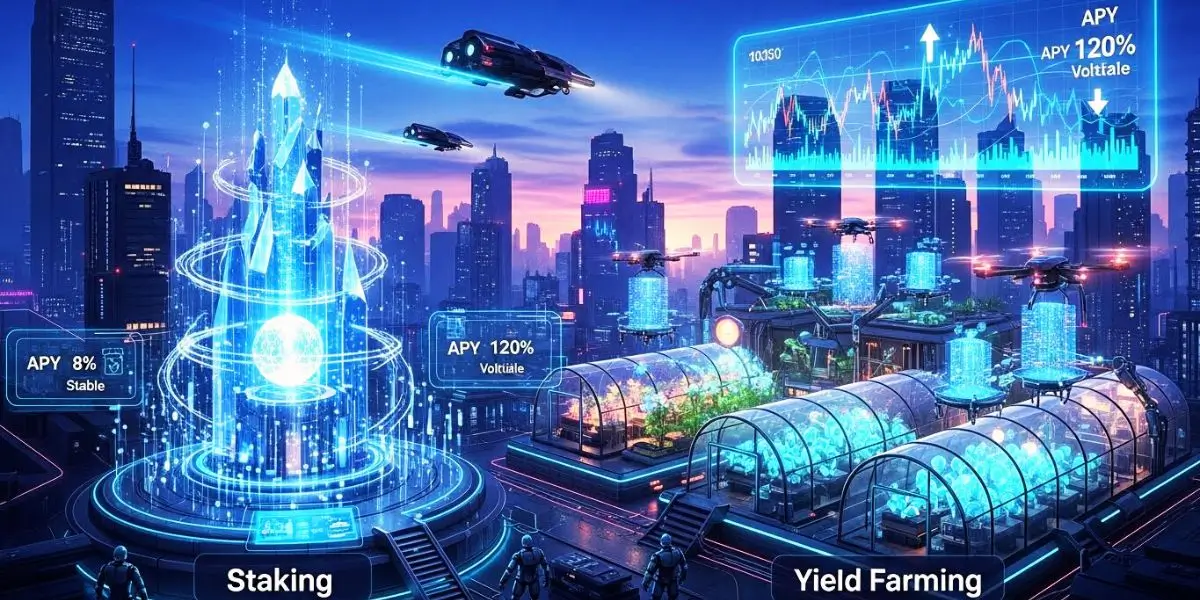
If you’re holding cryptocurrency, you’re probably asking yourself a crucial question: “How can I make my assets work for me?” Staking vs yield farming represents one of the most significant financial decisions a crypto investor can make today. Rather than letting your digital assets sit idle, these strategies offer a pathway to generate passive income, but they cater to vastly different appetites for risk, technical know-how, and involvement.
In this comprehensive guide, we’ll dive deep into the mechanics, rewards, and risks of staking and yield farming. You’ll learn not just the definitions, but also gain the practical knowledge to decide which strategy—or combination—aligns with your financial goals for 2025 and beyond. Let’s get started.
Understanding the Core Concepts: What Are You Really Doing?
Before comparing staking vs yield farming, we need clear, foundational definitions.
What is Staking?
At its heart, staking is the process of actively participating in transaction validation on a Proof-of-Stake (PoS) blockchain by locking up your tokens. Think of it as putting your crypto to work as security for the network. In exchange for contributing to the blockchain’s security and operations, you earn additional tokens as rewards.
Purpose: Primarily to secure a blockchain network and validate transactions.
How it Works: You delegate your tokens to a validator (or run your own validator node). These tokens act as collateral, ensuring the validator acts honestly. For this service, the network issues new tokens as rewards.
Key Point: Your staked crypto isn’t lent out; the rewards come directly from the network protocol.
What is staking is often the first question for newcomers, and it’s widely regarded as the more straightforward entry point into crypto passive income.
What is Yield Farming?
Yield farming is a more dynamic and complex strategy within the decentralized finance (DeFi) ecosystem. It involves lending or staking your crypto in a DeFi protocol to earn high returns, often in the form of interest, fees, or additional tokens. A key subset of this is liquidity mining, where you provide tokens to a liquidity pool on a decentralized exchange (DEX).
Purpose: To maximize returns on crypto assets by supplying liquidity or capital to various DeFi protocols.
How it Works: You deposit your tokens into a smart contract-based liquidity pool. These funds are then used for activities like lending, borrowing, or facilitating trades. In return, you earn a share of the fees generated and often receive governance tokens as an extra incentive.
Key Point: Yield farming crypto strategies can involve moving assets between different protocols to chase the highest yields, a practice sometimes called “yield hopping”.
The distinction between liquidity mining vs yield farming can be subtle. While the terms are often used interchangeably, liquidity mining is typically a specific action (providing liquidity to a DEX), whereas yield farming is the broader strategy that may include liquidity mining, lending, and other tactics.
“Yield farming supplies liquidity to DeFi protocols, while staking often involves locking up assets to become a network validator.”
How They Work: The Mechanics of Earning
The fundamental processes behind staking and yield farming are what create their distinct risk and reward profiles.
The Staking Process: Securing the Network
Choose a Network: Select a PoS blockchain like Ethereum, Cardano, or Solana.
Delegate or Validate: For most users, the easiest path is to delegate tokens to a trusted validator through an exchange (like Kraken) or a dedicated wallet. Advanced users can run their own validator node, which requires a significant minimum stake and technical expertise.
Earn Rewards: Once your tokens are staked, you begin earning staking rewards. These are usually distributed periodically and are a function of the network’s inflation rate and total amount staked.
Unstaking: Tokens are typically locked for a defined period. Unstaking often involves a waiting or “unbonding” period, which can range from a few days to several weeks.
The Yield Farming Process: The DeFi Engine
Connect a Wallet: Use a Web3 wallet (like MetaMask) to connect to a DeFi platform.
Provide Liquidity: For liquidity mining, you deposit an equal value of two tokens (e.g., ETH and a stablecoin) into a pool. You receive Liquidity Provider (LP) tokens representing your share.
Stake LP Tokens: To start yield farming, you often then deposit those LP tokens into a separate “farm” or vault to earn the protocol’s native token as an additional reward.
Compound or Harvest: You must actively manage your position—either harvesting rewards to sell or reinvesting (compounding) them to maximize returns.
This multi-step process is why yield farming vs staking is considered more complex and hands-on.
Weighing the Risks: What Can Go Wrong?
Understanding the risks is non-negotiable. Higher potential rewards always come with increased potential downsides.
The Risks of Staking
Slashing Risk: If the validator you delegate to acts maliciously or goes offline, a portion of your staked tokens can be “slashed” or confiscated as a penalty.
Liquidity Lock-up: Your assets are illiquid during the staking and unstaking period. You cannot sell them if the market crashes.
Protocol Risk: The underlying blockchain could suffer a critical bug or a 51% attack, though this is rare for established networks.
Reward Dilution: As more participants stake, the individual reward rate can decrease.
The Risks of Yield Farming
Impermanent Loss (IL): This is the most significant risk in liquidity mining. It occurs when the price of your deposited tokens changes compared to when you deposited them. You end up with less value than if you had simply held the tokens. IL is most pronounced in pools with volatile assets.
Smart Contract Risk: DeFi protocols are built on code. A bug or vulnerability in the smart contract can be exploited by hackers, potentially leading to a total loss of your deposited funds.
Rug Pulls & Scams: Malicious developers can create fake projects, attract liquidity, and then disappear with all the funds—a “rug pull”.
Complexity & Gas Fees: Actively managing farms requires knowledge and incurs high transaction (“gas”) fees on networks like Ethereum, which can eat into profits.
Reward Volatility: The attractive APYs (Annual Percentage Yields) advertised can plummet quickly based on protocol emissions and market conditions.
Is there a downside to staking? Absolutely, but its risks are generally more predictable and tied to network performance. The risks in yield farming crypto are more numerous and often more severe, relating to market mechanics and code security.
Staking vs. Yield Farming vs. Liquidity Mining: A Detailed Comparison
To make an informed choice, let’s break down the key differences in a clear, structured format.
| Feature | Staking | Liquidity Mining (a form of Yield Farming) | Advanced Yield Farming |
|---|---|---|---|
| Primary Goal | Secure a blockchain network | Provide liquidity to a DEX | Maximize returns via complex DeFi strategies |
| How Rewards Are Earned | Network issuance for validation | Trading fees + extra protocol tokens | Fees, protocol tokens, and leveraged strategies |
| Complexity | Low (Often one-click on exchanges) | Medium (Requires managing LP tokens) | Very High (Active portfolio management) |
| Typical APY Range | Lower (3% – 10%) | Medium (5% – 25%) | Higher (10% – 100%+, but highly variable) |
| Capital Risk | Slashing, price volatility | Impermanent loss, smart contract risk | All of the above, plus strategy failure |
| Liquidity | Locked for a period (days/weeks) | Usually unlocked, but may have timers | Varies, often locked for higher rewards |
| Best For | Beginners, long-term HODLers, those seeking simplicity | Intermediate users comfortable with DeFi basics | Experts who can monitor markets and protocols daily |
This staking vs yield farming vs liquidity mining comparison shows a clear trade-off: ease and security versus complexity and potential return.
How to Choose: Aligning Strategy with Your Profile
The choice between staking and yield farming isn’t about which is objectively better, but about which is better for you. Ask yourself these key questions:
1. What is Your Risk Tolerance?
This is the foremost question. If the thought of potentially losing a significant portion of your principal keeps you up at night, staking is your clear path. If you have a high risk tolerance and view a portion of your portfolio as “high-risk, high-reward” capital, then exploring yield farming could be an option.
2. What is Your Level of Technical Expertise and Time Commitment?
Are you a crypto beginner or someone who prefers a hands-off approach? Staking through a reputable exchange or wallet is designed for you. Are you comfortable navigating DeFi interfaces, managing private keys, and dedicating time to research and monitor positions? If so, you have the foundational skills for yield farming.
3. What is Your Investment Horizon and Need for Liquidity?
Are you a long-term believer in a particular blockchain and don’t need immediate access to those funds? Staking supports that vision. Do you need quicker access to your capital or want the agility to jump on new opportunities? The flexibility of many yield farming pools might be appealing, though you must weigh this against gas fees for frequent moves.
4. What is the Size of Your Capital?
For smaller investments, the transaction fees associated with active yield farming can eat heavily into your profits. Staking often has a lower fee overhead, making it more efficient for smaller amounts.
Consider a Hybrid Approach: You don’t have to choose just one. Many savvy investors adopt a core-satellite strategy: they stake the bulk of their long-term holdings (like ETH or ADA) for steady, low-maintenance returns and allocate a smaller, risk-capital portion to yield farming in pursuit of higher yields.
The Emerging Middle Ground: Liquid Staking
Innovation in crypto never stops. Liquid staking has emerged as a fascinating hybrid that attempts to solve the liquidity problem of traditional staking. Protocols like Lido (stETH) and Rocket Pool (rETH) allow you to stake your crypto (e.g., Ethereum) and receive a derivative token in return.
How it works: You lock your ETH with the protocol, which stakes it collectively. You receive stETH tokens, which represent your staked ETH and accruing rewards.
The magic: You can then use these liquid staking tokens (like stETH) in other DeFi protocols for yield farming, as collateral for loans, or simply trade them. This lets you earn staking rewards while still having liquidity to deploy elsewhere.
The catch: This adds an extra layer of smart contract risk (you now trust both the underlying blockchain and the liquid staking protocol) and introduces potential de-pegging risk if the derivative token loses its 1:1 value with the underlying asset.
So, which is right for you? Ask yourself these questions:
Profile A: The Conservative Investor (Choose Staking)
You Believe in a Project Long-Term: You’re bullish on Ethereum, Cardano, or another PoS coin and plan to hold for years.
You Want “Set and Forget” Income: You prefer to stake your tokens and not think about daily management.
Your Risk Tolerance is Low to Moderate: The idea of impermanent loss or smart contract hacks keeps you up at night.
Action: Use a reputable platform like Coinbase, Kraken, or a project’s official wallet to stake your holdings. Consider a staking farm approach by diversifying across several trusted PoS networks.
Profile B: The Active DeFi Enthusiast (Choose Yield Farming)
You Understand Crypto Markets: You’re comfortable with terms like AMM, LP tokens, and gas fees.
You Can Actively Monitor Positions: You’re willing to spend time tracking APYs and moving funds.
You Accept High Risk for High Reward: You only invest capital you are prepared to lose in pursuit of superior yields.
Action: Start with stablecoin pools on major best yield farming platforms like Curve Finance or Aave to minimize impermanent loss. Never invest in unaudited or new protocols with unsustainable APYs.
Getting Started: Your First Steps
Starting with Staking:
Acquire PoS Tokens: Buy tokens like ETH, SOL, or ADA on a major exchange.
Choose a Platform:
Exchange (Easiest): Kraken yield farming (and staking) services offer a user-friendly start.
Native Wallet (More Control): Use the official wallet for maximum decentralization.
Delegate and Monitor: Click “Stake,” choose a validator, and monitor your rewards.
Starting with Yield Farming:
Education First: Deeply understand impermanent loss and how to use DeFi dashboards like DeFi Llama.
Fund a Wallet: Transfer funds to a MetaMask wallet. Start with a small test amount.
Choose a Reputable Platform: Begin on a blue-chip yield farming crypto platform. A great starting point is providing stablecoin liquidity (e.g., USDC/DAI) on Curve or Aave to learn the ropes.
Use a Tool: Consider an optimizer like Yearn Finance or Beefy Finance to automate compounding, simplifying the process.
How much can you earn from yield farming? It varies wildly. Stablecoin farms might offer a steady 5-10% APY, while more risky farms with new tokens can promise (but not guarantee) triple-digit APYs. Always be skeptical of the highest numbers.
The Future and Evolution of Crypto Earning
The landscape of staking and yield farming is not static. Key trends for 2025 include:
Liquid Staking Tokens (LSTs): Protocols like Lido allow you to stake ETH and receive stETH, a token representing your stake that you can use elsewhere in DeFi. This blurs the line between staking and farming.
Institutional DeFi: Security and compliance improvements are attracting larger players, potentially stabilizing yields and reducing scam risks.
Cross-Chain Yield Aggregation: Platforms will increasingly automate farming across multiple blockchains (Ethereum, Polygon, Arbitrum) to find the best yields.
Real-World Asset (RWA) Integration: Yield farming opportunities will emerge for tokenized real-world assets like treasury bonds, offering new yield sources.
Is yield farming dead? Far from it. While the frenzied, unsustainable “DeFi summer” of 2020 has passed, yield farming has matured into a cornerstone of a more robust and innovative DeFi economy.
Conclusion
The journey through staking vs yield farming reveals a spectrum of opportunity. Staking is your anchor—a relatively secure way to earn while supporting foundational networks. Yield farming is your sail—capable of catching powerful winds of return but requiring skill to navigate stormy risks.
The most prudent strategy for many in 2025 might be a hybrid approach: use staking for the core of your long-term holdings and allocate a smaller, risk-capital portion to yield farming on the best yield farming platforms to pursue higher growth.
Your next step is to start small. Whether you choose to stake a portion of your ETH or deposit $100 into a stablecoin liquidity pool, hands-on experience is the ultimate teacher. The world of crypto passive income is waiting.
Frequently Asked Questions (FAQs)
Is staking the same as yield farming?
No, they are fundamentally different. Staking involves locking tokens to secure a Proof-of-Stake blockchain network and earn rewards from protocol issuance. Yield farming is a broader DeFi strategy where you supply crypto to liquidity pools or lending protocols to earn fees and additional tokens.
Is there a downside to staking?
Yes. The primary downsides are liquidity lock-up (you cannot sell staked tokens immediately), slashing risk (penalties for validator misbehavior), and exposure to the token’s price volatility while your assets are locked.
Is yield farming worth it?
It can be for investors with the right profile. If you have a high risk tolerance, understand DeFi mechanics, and can actively manage positions, the potential returns can outpace traditional finance. However, for beginners or passive investors, the risks often outweigh the rewards.
How much can you earn from yield farming?
Earnings are highly variable. Stablecoin pairs may yield 5-10% APY, while more volatile pairs or new protocol incentives can show 50%+ APY. However, these high rates are often unsustainable and come with significant risk of impermanent loss or capital depreciation.
Is yield farming dead?
No. While the initial hype has subsided, yield farming remains a vital, evolving part of DeFi. It has matured, with a focus on more sustainable yields, better risk management, and integration with real-world assets.
Why do farmers carry out staking?
In crypto, “farmers” typically refer to yield farmers. They might use staking as one component of a complex strategy—for example, staking a governance token earned from yield farming to earn additional rewards and voting power.
What is another name for yield farming?
Liquidity mining is often used synonymously, though technically it’s a subset of yield farming focused specifically on providing liquidity to DEXs.
What does staking mean in agriculture?
In traditional agriculture, staking refers to using a stake to support a growing plant. In crypto, it’s a metaphor: your assets (the stake) provide support and security for the blockchain network (the growing system).
What is a staking yield?
A staking yield is the annualized return you earn from participating in staking, usually expressed as a percentage (APY). It is the reward paid by the network for helping to validate transactions and secure the blockchain.
What exactly is yield farming?
Yield farming is the practice of using your cryptocurrency to generate high returns by lending, borrowing, or providing liquidity through smart contract-based DeFi protocols. The goal is to optimize your capital to earn the highest possible yield, often by moving assets between different protocols.
What is the main difference between staking and yield farming?
The core difference lies in their primary objective. Staking is primarily about securing a Proof-of-Stake blockchain network, while yield farming is about providing liquidity to decentralized finance (DeFi) protocols so they can function. Staking is generally simpler and lower risk, while yield farming is more complex and carries higher potential rewards alongside higher risks.
Can you lose money with staking?
Yes. The most common way is through market volatility—if the price of the token you’ve staked falls significantly, the value of your holdings drops, even if you’re earning rewards. There’s also a risk of “slashing,” where a portion of your stake can be penalized due to validator misbehavior, and the opportunity cost of having your funds locked during a market dip.
What is impermanent loss, and does it affect staking?
Impermanent loss is a specific risk to yield farming (providing liquidity). It occurs when the value of tokens in a liquidity pool changes relative to each other, potentially leaving you with less value than if you had simply held the tokens. Staking a single token is not subject to impermanent loss.
Which is better for a beginner: staking or yield farming?
For beginners, staking is almost universally recommended as the better starting point. It requires less technical knowledge, involves lower risk, and offers a gentler introduction to earning passive income in crypto. Beginners should thoroughly understand the risks of yield farming, especially impermanent loss and smart contract vulnerabilities, before participating.
Do staking and yield farming have tax implications?
In most jurisdictions, yes. Rewards from both staking and yield farming are typically considered taxable income at the time you receive them. Furthermore, disposing of those rewards (or the original assets) later may trigger a capital gains tax event. Tax laws vary widely by country, so it is crucial to consult with a tax professional familiar with cryptocurrency regulations.