
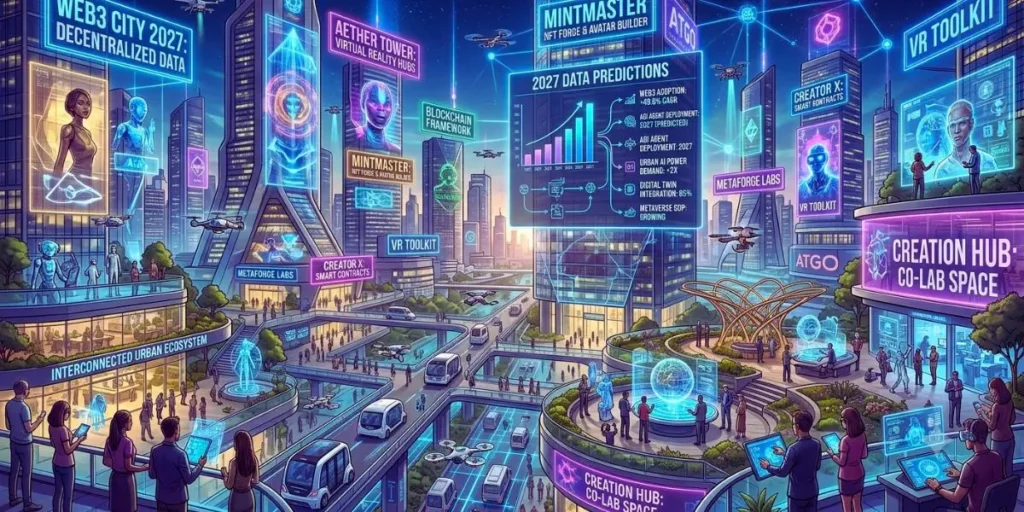

By the time you finish reading this sentence, an AI agent will have executed a micro-transaction on a blockchain you’ve never heard of, and a digital twin of a wind turbine in the Metaverse will have predicted its own mechanical failure. We are no longer asking if Web3, AI, and the Metaverse will converge. The critical question for 2027 is: what does the world look like when they do?
The technological narrative between 2023 and 2025 was dominated by fragmentation. Generative AI exploded into the mainstream through ChatGPT and Midjourney, while the Metaverse endured a “trough of disillusionment” following Meta’s billion-dollar rebrand, and Web3 quietly rebuilt its infrastructure beneath the rubble of exchange collapses. But by 2027, these distinct plotlines will merge into a single, undeniable story. We are transitioning from an era of speculative roadmaps to a reality of utility-driven, data-validated scenarios.
If 2023 was the year generative AI exploded and 2024-2025 the period of regulatory cleanup and the speculative token winter, 2027 is shaping up to be the year of quiet utility. We’ve moved past asking “what is the Metaverse?” or “is blockchain good for anything?” Now, the conversation revolves around invisible interoperability.
According to Gartner projections and market analysis from Messari, by Q4 2026, over 60% of interactions in virtual worlds will be mediated by advanced AI agents (next-gen NPCs) verified on-chain. This isn’t science fiction; it’s the logical consequence of the digital trust crisis.
This article isn’t about science fiction. It’s a data-driven projection of the symbiotic relationship between decentralized ledgers, autonomous intelligence, and spatial computing over the next 36 months.
The End of the UI as We Know It: Agentic Web3
The most profound shift by 2027 won’t be visual; it will be architectural. Currently, interacting with Web3 requires a steep learning curve—managing seed phrases, approving gas fees, and navigating decentralized applications (dApps). By 2027, the primary user interface for the blockchain will not be a screen; it will be an AI agent.
We are entering the phase of Agentic Web3. In this paradigm, you don’t manually swap tokens on Uniswap. You express a high-level intent: “Rebalance my portfolio to be risk-off if inflation data comes in hot tomorrow morning.” An AI agent, secured by a Smart Contract Wallet with Account Abstraction (ERC-4337), executes this autonomously.
Data-Driven Scenario:
According to scaling trends on Ethereum Layer 2 networks like Base and Arbitrum, transaction throughput has increased by over 2,000% since 2023, while gas costs have plummeted to fractions of a cent. By 2027, micro-transactions will be economically viable for machines, but not for humans. Gartner predicts that by 2027, 25% of enterprise digital commerce interactions will be initiated by non-human identity agents.
This unlocks “Machine-to-Machine (M2M) DePIN” (Decentralized Physical Infrastructure Networks). Imagine a fleet of autonomous electric taxis, owned by a DAO. When energy prices spike, a fleet-wide AI agent instantly auctions surplus battery storage back to the grid using a smart contract, settling in USDC. The human owner is asleep; the AI agent is earning yield. This is the liquidation of the human bottleneck.
The Metaverse’s Resurrection: Interoperable Digital Twins
Headlines in 2024 declared the Metaverse dead, buried alongside cartoonish legless avatars. However, to focus on the social metaverse of Horizon Worlds is to miss the industrial revolution happening quietly in the enterprise sector. The 2027 Metaverse is not about recreation; it’s about simulation.
The killer app for the Metaverse in 2027 is Industrial Digital Twinning, powered by AI and settled on Web3 ledgers for verifiable audit trails.
1. Predictive Infrastructure
NVIDIA’s Omniverse platform is currently enabling factories to simulate entire production lines before a single brick is laid. By integrating physics-informed AI (where AI understands gravity, fluid dynamics, and thermodynamics, not just pixels), these simulations become predictive. If a digital twin of a jet engine simulates a stress fracture in a specific scenario, an AI agent automatically orders a physical inspection via a smart contract.
2. Geospatial Sovereignty
The consumer Metaverse will resurface, but with a critical Web3 backbone: the “Open Spatial Web.” Rather than a singular corporate domain, the Metaverse of 2027 functions like the internet itself—a network of interconnected spaces. Users will carry digital assets (clothing, art, identity credentials) across platforms like Roblox, Fortnite, and Web3-native worlds via an interoperable inventory.
The 2027 Metaverse Stack:
-
The Layer: Unreal Engine 5.5+ for photorealism.
-
The Ledger: Solana or Polygon for high-throughput ownership verification.
-
The Intelligence: On-device SLMs (Small Language Models) for real-time NPC dialog.
Scenario: The Virtual REIT
By 2027, real estate investment trusts (REITs) focused on virtual land will have pivoted from scarcity speculation to utility leasing. A virtual shop on a high-traffic gaming boulevard won’t be worth $1M because the land is scarce, but because the AI auditing platform can prove 2.3 million unique users walked past it last month, with a conversion rate of 4%. The data proof, stored on-chain, justifies the lease. This is Metaverse monetization backed by verifiable on-chain analytics.
The Identity Crisis Solved: Zero-Knowledge Proofs and Sovereign AI
The convergence of AI and Web3 creates a terrifying dystopia if not handled correctly: the Deepfake Singularity. By 2027, a video of a politician speaking will be cryptographically indistinguishable from an AI-generated decoy. This erodes the fabric of democratic reality. The solution lies in a cryptographic primitive called Zero-Knowledge Proofs (ZKPs), specifically zk-SNARKs.
The future is Proof of Humanity and Provenance.
The Anti-Deepfake Protocol:
Cameras at the hardware level (e.g., future iPhone Pros or dedicated news agency rigs) will digitally sign every pixel of a captured image at the moment of creation using a private key sealed in a secure enclave. When that video is uploaded, a validity proof (a ZKP) is posted to a blockchain. The proof says, “This media was generated by a physical lens registered to the Associated Press, and I can mathematically verify it wasn’t stitched together by a latent diffusion model, without revealing the camera’s exact coordinates.”
Sovereign Data Vaults:
In 2027, your personal AI companion—which knows your medical history, therapy notes, and financial traumas better than your spouse—will run on a decentralized compute network, not a centralized server. Using Self-Sovereign Identity (SSI) standards, you will grant zero-knowledge permissions.
A lender doesn’t need to see your entire bank statement. You generate a ZK-proof that states: “My income over the last 12 months was above $100,000, and I have never defaulted on a loan.” The AI generates this proof from your encrypted data vault. The bank verifies the math, not the raw data. Privacy becomes a provable feature, not a promised policy. This is the AAVE model (AI-Assisted Verifiable Evidence).
The Creative Singularity: Generative AI and Intellectual Property in the Immutable Ledger
The biggest friction point in the AI industry today is copyright. Generative AI models trained on the open web ingested centuries of human creativity without consent. By 2027, the Web3 ledger will provide the economic plumbing for compensation.
The Derivative Rights Protocol:
Consider a musician. They upload a latent space representation of their sound (an embedding) to a registry on the blockchain. When a film producer uses an AI music tool to generate a “track in the style of [Artist],” the similarity score is checked against the on-chain registry. If the cosine similarity exceeds a threshold, a smart contract automatically splits the royalty: 50% to the prompt engineer, 40% to the original artist, and 10% to the platform.
The Scenario: Hollywood 2027
A screenwriter’s guild tokenizes a base narrative structure. A studio licenses it. An AI director agent adapts it into 10,000 different character arcs for a personalized streaming experience—each viewer sees a slightly different movie, optimized for their emotional response (detected via smartwatch biometrics). The blockchain serves as the mass settlement engine for the micro-royalties generated from these 10,000 permutations. The legal team isn’t suing for copyright infringement; they are simply auditing the revenue split on-chain.
Challenges and Friction Points (The Real Talk)
A purely utopian view is a marketing pitch, not an analysis. The 2027 convergence faces three “Execution Glaciers” that could delay this reality by 24 months.
The Energy Quadrillemma
Spatial computing (Metaverse) rendering requires immense GPU power. Large Language Models (LLMs) require immense energy. Proof-of-Work is largely obsolete, but the sheer combined load of an AI-enhanced, always-on, rendered 3D world powered by constant cryptographic verification is a sustainability nightmare. The solution by 2027 will be edge computing tokens: users who contribute idle GPU cycles from their home gaming rigs to a decentralized rendering network, earning tokens in return, creating a “Compute-Commons.”
The Oracle Problem 2.0
Blockchains cannot inherently “see” the physical world. They rely on oracles (like Chainlink) to bring in data. If an AI agent buys an insurance policy based on satellite imagery, what happens if the AI interprets the imagery incorrectly? A “smart contract dispute” can’t be solved by code alone. By 2027, we will see the rise of Decentralized Arbitration Organizations (DAOs), where juries of specialized humans and niche AI models vote on subjective truth claims, using prediction market mechanics (truth-telling incentives) to resolve on-chain disputes.
The Lip Sync Trap
The Uncanny Valley remains unconquered. Despite advances in NeRF (Neural Radiance Fields) and 3D Gaussian Splatting, digital humans in 2027 will still look “off” enough to cause distrust in high-stakes scenarios like virtual therapy or court proceedings. The pivot will be toward stylized realism (Pixar-like grammar) rather than photographic replication to maintain trust.
The Death of the “Consumer Metaverse” and the Birth of the Industrial Digital Twin
The first data-driven prediction is counterintuitive for the general public but obvious to venture capital analysts: the Metaverse centered on social avatars and virtual concerts won’t reach critical mass in 2027. Instead, the real scaling will happen in the enterprise sector.
Market Prediction: ROI in Digital Twins
By 2027, the digital twin market will reach $120 billion, driven not by entertainment but by operational efficiency. Companies like Siemens and NVIDIA Omniverse are already laying the groundwork.
What is a Digital Twin? It’s a virtual replica of a factory, a city, or a supply chain receiving real-time data via IoT (Internet of Things).
-
2027 Scenario: The Metaverse will be the user interface for this data. Instead of staring at an Excel spreadsheet, an engineer wearing Apple Vision Pro (version 3) or Meta Quest 5 glasses will walk through their virtual factory.
-
Web3’s Role Here: The data integrity of those IoT sensors will be sealed via hashes on blockchains (decentralized oracles). Thus, the industrial Metaverse becomes an immutable production record, crucial for ESG (Environmental, Social, and Governance) audits.
Interoperability as the Key (The IEEE P2888 Standard)
By 2027, interoperability will no longer be a wish. The IEEE standard for the Metaverse will mature, allowing a digital asset purchased or licensed in a Siemens environment to be visualized in a Bosch environment. This is true “metaverseness”: the ability to move identity, credentials, and assets between virtual spaces. Without Web3 (dynamic NFTs and Decentralized Identity), this is technically impossible.
Autonomous AI Agents: The New Internet Population
The most disruptive prediction for 2027 is that the majority of blockchain traffic won’t come from humans but from AI agents. We are entering the era of the “Agent Economy.”
Machine-to-Machine (M2M) Payments
Imagine an AI agent needing to pay for decentralized computing power (GPU on the Render or Akash network). A human won’t click “pay”; the AI will negotiate the rate and execute the transaction. This requires programmable stablecoins or gas tokens.
-
Key Data Point: By 2027, micro-payment transactions (under $0.01) on Ethereum Layer 2 networks (Arbitrum, Base) are expected to increase by 5000% exclusively due to AI agents paying for API calls or storage.
The Authenticity Problem and “Proof of Human”
If AI agents populate the Metaverse and social networks, how do you know if you’re talking to a person? Here emerges the critical synergy:
-
Web3 provides the identity: “Proof of Humanity” or Soulbound Tokens (SBTs) will be standard in 2027. To access certain spaces in the financial or legal Metaverse, you’ll need to cryptographically prove you’re a unique human without revealing your civil identity (Zero-Knowledge Proofs).
-
Answer Engine Optimization: For brands, this changes how they approach visibility. In 2027, you won’t just optimize for traditional search engines, but for the gatekeepers (AI agents) that verify your SBT before showing you content. Content without a cryptographic signature will be considered spam by large language models (LLMs).
The Creator 3.0: From the Attention Economy to the Asset Creation Economy
The creator economy is about to collapse and be reborn. Currently, a creator depends on opaque YouTube or TikTok algorithms. In the Future of Web3 2027, power returns to the creator through verifiable digital scarcity.
Dynamic NFTs and Generative AI
The NFTs of 2021 (static JPEG images) are archaic. In 2027, a Metaverse creator will sell a Dynamic NFT: a 3D asset that changes its appearance based on on-chain data or user behavior.
-
Example: A digital jacket for your avatar that turns gold if the wearer has attended over 10 AI conferences.
-
AI’s Role: That creator didn’t model the jacket in Blender for 10 hours. They used a “text-to-3D” prompt (models like Meshy or future Luma AI) to generate it in seconds, then minted ownership on the chain.
-
Programmable Royalties: The smart contract ensures that if that jacket is resold 50 times, the original creator (human) and the AI that generated it (model developer) automatically split the royalties.
The Decentralized Metaverse as a Showcase (Spatial Commerce)
By 2027, spatial commerce will be tangible. Web browsers will be immersive. A creator can set up a virtual store on platforms like Spatial or OVR in minutes, connect their wallet, and sell directly to a global user without the typical 30% Apple or Meta commissions. The AI will act as a virtual salesperson, an agent trained with the store’s data, capable of negotiating and closing sales 24/7 in natural voice within the Metaverse.
Decentralization of AI: The Hidden Battlefront
There is an existential risk few debate outside technical forums: the centralization of AI by corporations like OpenAI or Google. The prediction for 2027 is that Web3 will be the only viable alternative for verifiable and decentralized AI.
On-chain Inference
In 2027, data won’t just be stored on blockchain; lightweight AI inference will be executed directly within smart contracts (thanks to advanced EIPs and zkML – Zero-Knowledge Machine Learning).
-
Use Case: A parametric insurance contract in a rural area. A decentralized AI analyzes satellite drought imagery. If the AI determines crop loss, it executes the payout to farmers. No corrupt human adjuster, no insurance CEO denying the claim. The AI makes the judgment, and the proof it did so honestly is published on-chain for auditing.
GPU Networks and the “Airbnb of Computing”
The hardware needed to train AI is expensive and hoarded. By 2027, decentralized computing networks (DePIN – Decentralized Physical Infrastructure Networks) like Render, io.net, and Akash will have matured. Gamers will rent out their GPU when not gaming to train fragments of AI models, earning tokens. This democratizes access to AI power and aligns incentives to build a more photorealistic Metaverse without depending on AWS.
Risk Scenarios: The Threats on the 2027 Horizon
No optimistic prediction can ignore catastrophic risks.
The Generative Spam Apocalypse
The number one risk is the Metaverse filling with AI-generated “noise.” If creating a virtual room or a 3D object is free and instant, the value of digital space tends toward zero due to overabundance. The Web3 solution is Reputation Staking: to deploy content in certain Metaverse zones, a creator must stake tokens they’ll lose if the community reports their content as spam or malicious.
User Sovereignty vs. Big Tech
The most likely scenario for 2027 is a tense hybrid model. Microsoft, Meta, and Apple will try to create “walled gardens” of AI+Metaverse with polished but extractive experiences (taking your behavioral data). The decentralized ecosystem will offer sovereignty but with user friction.
The bet for 2027: The average user will choose the comfort of corporate tyranny, while a critical, valuable minority (creators, developers, high-risk financial assets) will operate exclusively in the sovereign ecosystem.
The Role of Discovery in a Spatial Web
Let’s talk marketing. If the Metaverse is three-dimensional and AI is the interface, how do people find your products?
Search Engine 4.0: Visual and Spatial Search
In 2027, you’ll optimize for search engines that crawl 3D spaces.
-
NFT Metadata: Your 3D product GLTF/USD files will carry embedded semantic metadata.
-
AI Discovery: A user will tell their AI agent: “Find me a virtual sofa matching my Japanese minimalist decor style, costing under 50 USDC.” Your AI agent won’t search for keywords; it will analyze the 3D geometry of sofas listed on the blockchain and return the results. Discovery will be three-dimensional.
The Death of Cookies and the Triumph of Credentials
Targeted advertising in 2027 won’t use cookies. In the Metaverse, brands will offer discounts or VIP access in exchange for users selectively revealing their credentials (Verifiable Credentials) stored in their wallet. “Share that you hold the NFT from conference X and get a free pass to VIP area Y.” This is precision marketing with cryptographic consent.
Frequently Asked Questions
These questions are optimized for voice search and Google’s “People Also Ask” featured snippets.
What is the main trend driving Web3 in 2027?
The primary trend is the shift from human-controlled wallets to AI-agent-controlled smart wallets. This is called the “Agentic Web,” where autonomous programs use stablecoins to pay for services like compute power, storage, and data feeds without human intervention, creating the Machine Economy.
Will the Metaverse require VR headsets in 2027?
While dedicated VR/XR headsets like the Apple Vision Pro (or its lighter successors) will offer the most immersive experience, 90% of the “Industrial Metaverse” traffic in 2027 will occur on flat screens and mobile devices. The Metaverse is defined by 3D spatial data persistence and shared simulation, not just the hardware used to view it. AR overlays for mobile devices will be the mass-market entry point.
How does AI solve the problem of trust in the Metaverse?
AI solves trust through Zero-Knowledge Proofs (ZKPs) and on-chain provenance. AI-generated content that is cryptographically signed at the point of creation can be verified as “real” or “brand-owned.” Additionally, “Proof of Inference” enables AI models to compute data off-chain and deliver the result to the blockchain with cryptographic confirmation that the model wasn’t tampered with, resolving the “oracle problem.”
Is Web3 dead, or is it just evolving?
Web3 is evolving from speculative token trading into a backend settlement layer for AI and the Metaverse. The user no longer interacts with the blockchain directly; they interact with a sleek AI interface. Web3 is “dead” only in the sense that the engine of a car is “dead”—you don’t touch it to drive, but the vehicle doesn’t move without it. The terminology is being absorbed into “The Spatial Internet.”
Which industries will be disrupted first by the 2027 Convergence?
Supply chain logistics and insurance will face the most disruption. A digital twin of a shipping container, monitored by an AI agent and settled via a smart contract, automates freight insurance claims instantly when a temperature sensor detects spoilage. This eliminates weeks of manual claims processing. Gaming and IP licensing will follow closely.
How do I prepare my business for the 2027 Convergence?
Stop creating “NFT drops” or “Metaverse HQs.” Start building a structured, API-accessible data lake of your products and IP. AI agents in 2027 will query your data to recommend your products to users in virtual spaces. If your product catalog is a static PDF, it is invisible to the autonomous Web3 economy. You need an Embeddings Strategy, not just a Blockchain Strategy.
Will AI replace Web3 in the Metaverse by 2027?
No, they are symbiotic. AI without Web3 is a black box we can’t audit. Web3 without AI is a slow database with terrible UX. AI generates infinite content and personalizes the Metaverse in real-time; Web3 verifies the provenance, ownership, and value of that content. There is no rich Metaverse without AI, but no reliable Metaverse without Web3.
Will volatile cryptocurrencies still be necessary, or will stablecoins be used?
By 2027, volatility in internal Metaverse transactions will be residual. The ecosystem will operate predominantly with regulated stablecoins (like USDC or central bank digital currencies – CBDCs) and utility tokens for governance and gas. No one will buy a virtual coffee with volatile Ethereum; they’ll use USDC on an ultra-fast Layer 2. Speculation will be isolated in advanced DeFi layers.
What hardware will dominate access to the Metaverse in 2027?
The prediction is that lightweight Mixed Reality (MR) glasses will replace the monitor as the primary productivity device in design and engineering sectors. However, mass access to the social and entertainment Metaverse will remain split between 6G mobile devices (boosted by AI for cloud rendering) and consumer glasses. The bulky Quest-style headset will become obsolete against lightweight glasses tethered to the phone.
How does AI affect traditional search visibility?
Traditional search optimization is giving way to Answer Engine Optimization. With generative AI (ChatGPT, Google’s SGE), the user no longer visits websites; the AI extracts the answer and provides it. By 2027, brands must structure their data (advanced Schema Markup) and have verifiable on-chain authority so AI agents cite their products as the definitive answer. If your content isn’t legible by agents, you are invisible.
Is data safe in an AI-powered Metaverse?
The biggest risk is identity theft via AI (real-time deepfakes). The solution in 2027 will be Self-Sovereign Identity (SSI). The biometric data to create your photorealistic avatar will never leave your device; your wallet will generate cryptographic proofs that you are over 18 or a verified employee without showing your date of birth or ID number. Privacy by design will be a critical competitive advantage.
Will traditional 3D design jobs disappear?
They won’t disappear; they’ll mutate. The 3D designer of 2027 will be a “Creative Director of Agents.” They won’t create polygon by polygon but will write complex prompts, curate the results of generative AI, and manage the asset tokenization and scarcity strategy. Value will shift from manual skill to conceptual vision and token economics.
The Human Element in a Synthetic World
As we look toward these data-driven scenarios, the central tension remains fiercely human. By 2027, we will have built a technological stack capable of generating infinite synthetic worlds, populated by AI agents transacting in a trustless, iron-clad economy. The risk is not that this system collapses, but that it functions so perfectly that it leaves humanity behind, creating a “Ghost Economy” where bots trade with bots over assets no human cares about.
The only antidote is purposeful design. The Web3 stack must be used not to automate human connection, but to protect its provenance. A token-gated concert in a virtual forest, where attendance is verified by a zero-knowledge proof of being an actual human (not a sybil bot), and where the artist’s AI understudy performs a specific set generated only for the holders of a specific digital memory—this is the premium experience of the future.
Conclusion
By 2027, the word “Web3” may be terminally uncool. It will be replaced by terms like “The Spatial Web,” “The Semantic Web,” or simply “The Internet of Value.” The technology will vanish into the backend, becoming an ambient ledger that hums silently beneath the AI and the Metaverse.
We will stop talking about “gas fees” and start talking about “auto-settlements.” We will stop visiting the “Metaverse” and start spending our day inside a persistent, AI-populated digital layer that maps onto our physical reality. The convergence point is simple: AI provides the brain, the Metaverse provides the body, and Web3 provides the blood that carries value between them.
The future isn’t a place where you log into a virtual mall to buy a pixelated hat. The future is a world where you walk into a physical store, scan a dress, and your visual cortex (via smart contact lenses) instantly overlays the dress’s entire supply chain—from the cotton farm’s water usage recorded on-chain to the AI-designed pattern—and your autonomous wallet pays for it the moment you walk out the door, while a tokenized micro-royalty instantly flows to the designer in Milan.
The future of Web3, AI, and the Metaverse in 2027 isn’t a vertical takeoff into a Ready Player One-style world, but a silent, horizontal integration process already happening beneath our digital feet.
The three golden rules for companies and creators who want to survive this cycle are:
-
Chain Invisibility: No one should know they’re using blockchain. The phrase “connect wallet” will be as archaic as “dial the modem.” User experience will be key, and Web3 infrastructure will be the invisible trust layer.
-
Content Generated, Ownership Verified: Generative AI reduces content production costs to zero. The only way to monetize in 2027 will be through the instant verification of scarcity and authenticity that Web3 provides. Digital luxury will be provenance.
-
Agentic AI as the First Audience: Don’t write thinking only of humans. Design spaces, contracts, and assets thinking that the first visitor will be an AI agent. If a bot can’t understand, use, and recommend your product in the Metaverse, you don’t exist.
We are leaving behind the era of empty speculation and entering the era of tangible utility. 2027 will be remembered as the year these technologies stopped being a pastime and became the operating system of global society. The convergence isn’t coming; it’s already here. The question is whether your organization is structurally optimized for agents, or stuck in Web 2.0.
Are you architecting your digital assets to be discoverable by the Autonomous Web? Explore our deep-dive reports on the Agentic AI economy and prepare your infrastructure for the 2027 convergence today.