















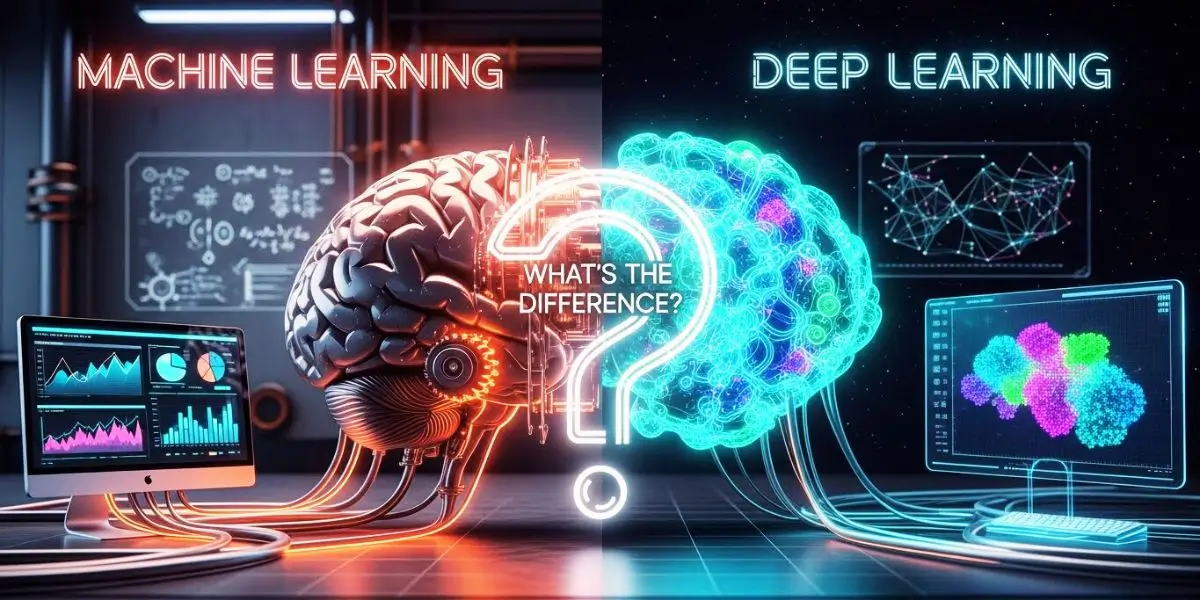
In the whirlwind of tech buzzwords, two terms consistently rise to the top: Machine Learning (ML) and Deep Learning (DL). They’re hailed as the twin engines of the modern Artificial Intelligence (AI) revolution, powering everything from your Netflix recommendations to the voice assistant in your smart speaker. But if you’ve ever found yourself nodding along while secretly wondering, “Aren’t they basically the same thing?”—you’re not alone.
Many people use these terms interchangeably, but understanding the distinction is more than academic nitpicking. It’s the key to unlocking which powerful technology is the right tool for your project, business, or career path. At its core, the difference hinges on how each approach learns from data. Machine Learning often requires a guiding human hand to point out what’s important, while Deep Learning attempts to mimic the human brain’s own learning process, discovering complex patterns on its own.
This guide will demystify both fields. We’ll break down their core principles, compare them head-to-head, and provide a clear framework so you can confidently choose between Machine Learning and Deep Learning for your next big idea.
Understanding the AI Family Tree: Where ML and DL Fit
Before diving into their differences, it’s crucial to understand how they relate. Think of Artificial Intelligence (AI) as the broad, overarching field of creating intelligent machines. Within AI, Machine Learning emerged as a revolutionary subset. Instead of programming a computer with explicit rules for every scenario (like early chess programs), ML provides algorithms with data and allows them to learn patterns and make decisions.
Deep Learning is a further specialization. It is a subset of Machine Learning that uses specific structures called artificial neural networks. The “deep” refers to the number of layers in these networks. While a basic neural network might have three layers, deep learning models have many more—sometimes hundreds—enabling them to learn from data with incredible complexity and abstraction.
Key Takeaway: AI > Machine Learning > Deep Learning. All deep learning is machine learning, but not all machine learning is deep learning.
What is Machine Learning?
Machine Learning (ML) is a branch of Artificial Intelligence (AI) focused on building systems that can learn from data, identify patterns, and make decisions with minimal human intervention. The core idea is simple yet powerful: instead of hand-coding software routines with specific instructions, you feed an algorithm large amounts of data, and it learns for itself.
How Machine Learning Works: The Human-in-the-Loop
A traditional ML process heavily relies on an expert’s guidance in a crucial step called feature engineering. This is the process of selecting, extracting, and transforming the most relevant variables (features) from the raw data for the model to learn from. For example, if you’re building a model to predict housing prices, a data scientist would decide which features matter—square footage, number of bedrooms, zip code, year built—and prepare that structured data for the algorithm.
Types of Machine Learning
ML algorithms learn in different ways, generally categorized into three main types:
Supervised Learning: The algorithm is trained on a labeled dataset. This means each training example is paired with the correct answer (the label). It’s like learning with an answer key. Common applications include spam filtering (labeling emails as “spam” or “not spam”) and predictive analytics.
Unsupervised Learning: Here, the algorithm is given data without any labels and must find hidden patterns or intrinsic structures on its own. It’s great for customer segmentation or recommendation systems where it can group similar users or products together.
Reinforcement Learning: The model learns by interacting with an environment, receiving rewards for good actions and penalties for bad ones. This trial-and-error approach is famously used in training AI to play games like Go or Chess.
Strengths and Ideal Use Cases for ML
Machine Learning models excel when you have well-defined problems and structured, tabular data (like spreadsheets or databases). They are typically:
Faster and Less Resource-Intensive: They train quickly on standard CPUs and don’t require massive datasets to start delivering value.
More Interpretable: It’s often easier to understand why an ML model made a particular decision, which is critical in regulated fields like finance and healthcare.
Perfect for Automation: From detecting fraudulent credit card transactions to powering Amazon’s product recommendation engine, ML automates complex decision-making at scale.
What is Deep Learning?
Deep Learning (DL) is an advanced subset of Machine Learning inspired by the structure and function of the human brain. It uses artificial neural networks with many layers—hence “deep”—to learn from vast amounts of data.
How Deep Learning Works: The Self-Learner
The fundamental unit of deep learning is the artificial neural network. These networks consist of interconnected nodes (neurons) arranged in layers: an input layer, multiple hidden layers, and an output layer. Data passes through these layers, and each connection has a weight that adjusts during training.
The most significant leap from traditional ML is automatic feature extraction. In a deep learning model, you can feed raw, unstructured data—like a pixelated image or a block of text—directly into the network. The early layers might learn simple features (e.g., edges in an image), intermediate layers combine these into more complex shapes, and deeper layers recognize high-level concepts (like a face or a car). This eliminates the need for manual feature engineering.
Common Deep Learning Architectures
Different network architectures are designed for specific types of data:
Convolutional Neural Networks (CNNs): The gold standard for image and video processing. They excel at tasks like facial recognition, medical image analysis, and enabling computer vision in self-driving cars.
Recurrent Neural Networks (RNNs) & LSTMs: Specialized for sequential data like time series, speech, and text. They have a “memory” that allows them to process sequences, making them ideal for language translation and speech-to-text applications.
Transformers: A more recent architecture that has revolutionized Natural Language Processing (NLP). They handle long-range dependencies in text incredibly well and are the backbone of large language models like GPT and BERT.
Strengths and Ideal Use Cases for DL
Deep Learning shines when tackling problems involving high-dimensional, unstructured data where patterns are incredibly complex.
State-of-the-Art Accuracy: For tasks like image classification, speech recognition, and complex game playing, DL models often achieve superhuman performance.
Handles Unstructured Data Masterfully: It is the go-to technology for computer vision, NLP, and audio processing.
Scalability with Data: Deep learning models generally improve their accuracy as you feed them more data, making them powerful in the era of big data.
Practical Applications Across the Spectrum
Table: Real-World Applications of AI Technologies
| Technology | Example Applications | Key Characteristic |
|---|---|---|
| Artificial Intelligence | Chess-playing computers, rule-based customer service chatbots, general problem solvers | Broad capability to mimic human intelligence |
| Machine Learning | Spam email filters, product recommendation systems, credit scoring models | Learns patterns from structured data to make predictions |
| Deep Learning | Facial recognition systems, voice assistants, medical image analysis, autonomous vehicle perception | Learns complex patterns directly from raw, unstructured data |
These applications demonstrate the progression from broad AI concepts to specialized techniques. A traditional spam filter (ML) might analyze specific features like sender reputation and keywords, while a deep learning system could understand the nuanced meaning and context of an entire email.
Machine Learning vs. Deep Learning: A Detailed Comparison
Problem-Solving Approach and Feature Engineering
The fundamental difference between machine learning and deep learning with examples becomes clearest when examining how each processes information. Traditional machine learning typically requires significant human intervention through a process called feature engineering. Data scientists must manually select, extract, and sometimes transform the most relevant features from raw data before feeding them to the algorithm.
For instance, if building a machine learning model to identify cats in photos, a data scientist would need to explicitly program the system to look for features like ear shape, whisker patterns, or tail characteristics. The algorithm then learns to weigh these human-identified features appropriately.
Deep learning fundamentally changes this paradigm by automating feature extraction. Deep neural networks learn to recognize relevant features directly from raw data through their multiple processing layers. In our cat identification example, a deep learning model would analyze thousands of cat photos and automatically discover which patterns matter most—perhaps identifying features humans might overlook.
This automatic feature learning gives deep learning a significant advantage with unstructured data like images, audio, and text, where manually identifying relevant features would be exceptionally difficult or time-consuming.
Data Requirements and Performance Characteristics
Table: Key Differences in Technical Requirements
| Aspect | Machine Learning | Deep Learning |
|---|---|---|
| Data Volume | Works well with smaller datasets (hundreds to thousands of examples) | Requires massive datasets (thousands to millions of examples) |
| Data Structure | Prefers structured, labeled data | Excels with unstructured data (images, text, audio) |
| Training Time | Relatively fast (minutes to hours) | Can take days or weeks |
| Hardware Needs | Can often run on standard CPUs | Typically requires GPUs or specialized processors |
| Interpretability | Generally easier to understand and explain | Often considered a “black box” due to complexity |
The difference between machine learning and deep learning and artificial intelligence extends to how each handles data scarcity. Machine learning algorithms can often deliver reasonable performance with limited data, making them practical for many business applications where collecting massive datasets isn’t feasible. Deep learning models, by contrast, typically require substantial data to avoid overfitting—memorizing training examples rather than learning generalizable patterns.
This distinction has practical implications: if you’re developing a recommendation system for a niche product line with limited customer data, machine learning might outperform deep learning. Conversely, if you’re Google or Facebook with access to billions of user interactions, deep learning can uncover patterns no human-engineered features could capture.
Head-to-Head: Key Differences Between ML and DL
Now that we understand them individually, let’s compare them directly. The table below summarizes the critical distinctions that guide the choice between Machine Learning and Deep Learning.
| Comparison Basis | Machine Learning (ML) | Deep Learning (DL) |
|---|---|---|
| Core Definition | A subset of AI where algorithms learn patterns from data to make predictions. | A subset of ML that uses multi-layered neural networks to learn from data. |
| Data Requirements | Works well with small to medium-sized, structured datasets. | Requires very large datasets; excels with massive amounts of unstructured data. |
| Feature Engineering | Manual. Experts must select and extract relevant features from raw data. | Automatic. Neural networks learn hierarchical features directly from raw data. |
| Hardware & Training Time | Can often be trained on CPUs; relatively faster and less resource-intensive. | Typically requires powerful GPUs/TPUs; training is computationally heavy and time-consuming. |
| Interpretability | Generally more interpretable and transparent (e.g., decision trees). | Often a “black box”; very difficult to interpret why a specific decision was made. |
| Problem-Solving Approach | Solves problems by breaking them down into smaller steps, often using statistics. | Learns end-to-end, mapping inputs directly to outputs through layered transformations. |
| Example Applications | Spam filters, credit scoring, predictive maintenance, basic recommendation systems. | Facial recognition, real-time speech translation, autonomous vehicles, advanced chatbots. |
Advantages and Disadvantages: A Balanced View
Choosing a technology means weighing its strengths against its limitations. Here’s a clear breakdown to inform your decision.
The Pros and Cons of Deep Learning
Deep Learning offers groundbreaking capabilities but comes with significant trade-offs.
Pros:
Automatic Feature Learning: Eliminates the need for time-consuming, expert-led feature engineering.
Superior Performance on Complex Tasks: Achieves state-of-the-art, often human-level accuracy in vision, speech, and language tasks.
Handles Unstructured Data Seamlessly: Uniquely capable of processing images, text, and audio directly.
Cons:
High Computational Cost: Demands expensive GPUs and substantial energy, leading to longer training times and higher costs.
The “Black Box” Problem: The internal decision-making process is opaque, raising challenges for debugging, trust, and regulatory compliance in sensitive areas.
Data Hunger and Sensitivity: Requires massive volumes of data and is highly sensitive to data quality; biases in training data are directly learned and amplified by the model.
The Pros and Cons of Machine Learning
Traditional Machine Learning remains a robust and often more practical choice for a wide array of problems.
Pros:
Efficiency with Smaller Data: Delivers effective results without needing millions of data points, reducing collection costs and time.
Speed and Lower Resource Needs: Models train faster on less powerful hardware, enabling rapid prototyping and deployment.
Interpretability and Transparency: Simpler models like decision trees or linear regression are easier to explain and audit, which is vital for business and ethical reasons.
Cons:
Dependency on Feature Engineering: Model performance is limited by the human expert’s ability to identify and create the right features.
Performance Plateau on Complex Tasks: Struggles with very high-dimensional, unstructured data where deep learning excels.
Limited Automation: Requires more ongoing human involvement for feature design and model selection compared to deep learning’s more end-to-end approach.
How to Choose: Machine Learning or Deep Learning?
So, which one is right for your project? Ask yourself these key questions:
What is the nature and size of your data?
Choose ML if: You have structured, tabular data or a limited, smaller dataset.
Choose DL if: You have large volumes of unstructured data (images, text, audio) or extremely complex patterns within big data.
What are your computational resources and timeline?
Choose ML if: You have limited budget, standard computing hardware, or need a quick, deployable solution.
Choose DL if: You have access to significant computational power (GPUs/cloud credits) and time for extended training cycles.
Is interpretability a requirement?
Choose ML if: You need to explain decisions to stakeholders, customers, or regulators (e.g., in finance, healthcare, or legal applications).
Choose DL if: Maximizing predictive accuracy is the primary goal, and the “why” behind a decision is less critical.
What is the problem complexity?
Choose ML if: The problem is well-understood with clear, logical rules (e.g., fraud detection, customer churn prediction).
Choose DL if: The task involves perception or understanding (e.g., real-time language translation, diagnosing diseases from X-rays).
A Practical Rule of Thumb: Start simple. Often, a well-tuned traditional Machine Learning model can solve the problem efficiently. Move to Deep Learning if you have the data and resources, and your ML models are hitting a performance ceiling on a sufficiently complex task.
The Future and Your Place in It
The fields of Machine Learning and Deep Learning are not static rivals but complementary technologies on a shared trajectory. We see them merging in powerful ways, such as using deep networks for feature extraction and then applying lighter, interpretable ML models for final decision-making.
The demand for skills in both areas is skyrocketing. Whether you’re a business leader, a developer, or a student, building literacy in these technologies is no longer optional—it’s essential for future-proofing your career and projects.
Ready to take the next step? The journey begins with understanding the fundamental differences laid out here. From there, you can explore hands-on courses, experiment with cloud-based tools from providers like AWS or Google Cloud, or dive deeper into specialized resources on neural networks and AI ethics.
Practical Guide: When to Use Each Technology
Decision Framework for Technology Selection
When evaluating machine learning vs deep learning which is better for your specific needs, consider these key factors:
Choose Machine Learning When:
You’re working with structured, tabular data (like spreadsheets or databases)
Your dataset is relatively small or medium-sized
You need interpretable results where you must explain how decisions are made
You have limited computational resources or budget constraints
You need faster development and deployment cycles
For example, a bank building a credit risk model would likely choose machine learning. The data is structured (income, credit history, employment status), interpretability is legally and practically essential, and the dataset, while substantial, doesn’t approach the scale needed for deep learning.
Choose Deep Learning When:
You’re working with unstructured data (images, audio, video, text)
You have access to very large, high-quality datasets
Maximum accuracy is more important than interpretability
You can access substantial computational resources (GPUs, cloud computing)
The problem involves complex pattern recognition beyond human feature engineering capabilities
Autonomous vehicle perception systems exemplify ideal deep learning applications. They process streams of unstructured visual and sensor data, require exceptional accuracy, benefit from massive training datasets, and run on specialized hardware.
Implementation Considerations and Trade-offs
The difference between machine learning and deep learning PDF resources often emphasize practical implementation differences. Machine learning models generally have shorter development cycles and can be prototyped on standard laptops. Popular libraries like scikit-learn offer accessible interfaces for various algorithms.
Deep learning implementations, conversely, require more specialized expertise and infrastructure. Frameworks like TensorFlow and PyTorch provide powerful tools but have steeper learning curves. The computational demands mean organizations often need to invest in GPU clusters or cloud services specifically designed for deep learning workloads.
These practical considerations often dictate technology choice as much as theoretical suitability. Many organizations adopt a hybrid approach, using machine learning for well-defined tasks with structured data while reserving deep learning for specific applications where its capabilities justify the additional complexity and cost.
Machine Learning, Deep Learning, and the Generative AI Revolution
Understanding Generative AI’s Place in the Ecosystem
The conversation about machine learning vs deep learning vs Generative AI represents the latest evolution in this technological hierarchy. Generative AI refers to models that can create new content—text, images, code, music—rather than just analyzing or classifying existing data. Most modern generative AI systems are built on deep learning architectures, particularly transformer networks and generative adversarial networks (GANs).
The difference between machine learning and deep learning and generative AI lies in their outputs. Traditional machine learning and most deep learning models are discriminative—they distinguish between categories or make predictions. Generative models create entirely new data instances that resemble their training data.
For instance, while a traditional deep learning model might classify an image as “cat” or “dog,” a generative model could create a photorealistic image of a cat that never existed. This creative capability represents a significant advancement beyond pattern recognition.
Practical Implications of the Generative AI Shift
Generative AI doesn’t replace traditional machine learning or deep learning but rather extends their capabilities into creative domains. Organizations now face decisions about when to use each approach:
Traditional ML/DL: Best for analytical tasks like fraud detection, customer segmentation, predictive maintenance
Generative AI: Ideal for content creation, data augmentation, simulation, and scenarios requiring novel synthesis
Understanding deep learning vs AI becomes more nuanced in this context. While deep learning remains a subset of AI, generative models represent some of the most advanced applications of deep learning principles. These systems often require even larger datasets and more computational resources than traditional deep learning models but offer fundamentally different capabilities.
Future Directions and Career Implications
Evolving Landscape and Skill Development
As the field continues evolving, professionals must understand both the theoretical difference between machine learning and deep learning and practical implementation skills. Many educational programs now emphasize foundations in traditional machine learning before advancing to deep learning concepts, recognizing that strong fundamentals in statistics, algorithms, and data processing apply across the spectrum.
The growing accessibility of cloud-based AI services is democratizing access to both technologies. Platforms from AWS, Google Cloud, and Microsoft Azure offer pre-built machine learning services and tools for developing custom deep learning models without requiring massive infrastructure investments.
Strategic Considerations for Organizations
For business leaders and technology strategists, the decision between these approaches involves both technical and business considerations:
Start with the problem, not the technology: Clearly define what you’re trying to accomplish before selecting an approach.
Assess your data assets: The quality, structure, and volume of available data often dictate what’s feasible.
Consider explainability requirements: Regulatory environments and stakeholder trust may necessitate more interpretable machine learning models.
Evaluate total cost of ownership: Include development time, infrastructure, maintenance, and personnel expertise in your calculations.
Plan for evolution: Many successful implementations start with simpler machine learning solutions and incorporate deep learning for specific components as needs and capabilities grow.
Conclusion
The journey through machine learning vs deep learning reveals two powerful but distinct approaches to artificial intelligence. Machine learning offers practicality, interpretability, and efficiency for structured data problems, while deep learning provides unparalleled capability for complex, unstructured data challenges when sufficient resources are available.
The most sophisticated AI systems often combine both approaches, using each where it performs best. As Andrew Ng famously suggested, “If a typical person can do a mental task with less than one second of thought, we can probably automate it using AI either now or in the near future.” Both machine learning and deep learning contribute to making this automation possible across increasingly complex domains.
Your next step: Evaluate one project or problem in your domain where AI could provide value. Map out whether your data structure, resources, and requirements align better with machine learning or deep learning approaches. Sometimes the most impactful applications come from starting simple and building sophistication as you learn from initial implementations.
Frequently Asked Questions
Machine learning vs deep learning which is better for beginners to learn?
For beginners, machine learning is generally more accessible as a starting point. The mathematical foundations are often easier to grasp, and you can achieve meaningful results with smaller datasets using libraries like scikit-learn. Once you understand core concepts like training/test splits, feature engineering, and basic algorithms, transitioning to deep learning becomes more manageable.
Can you provide specific examples of the difference between machine learning and deep learning with examples?
Certainly! A machine learning example would be a spam filter that analyzes specific features like sender address, keywords, and message structure to classify emails. A deep learning example would be a system that reads mammogram images and identifies potential tumors by learning visual patterns directly from thousands of labeled scans, detecting subtleties even expert radiologists might miss.
What exactly is the difference between machine learning and deep learning and generative AI?
Think of them as layers of capability: Machine learning finds patterns in data to make predictions. Deep learning does this using complex neural networks that automatically learn features. Generative AI (usually built on deep learning) creates entirely new content that resembles its training data. So while a deep learning model might identify a picture of a cat, a generative AI model could create a realistic picture of a cat that doesn’t exist.
Is there a comprehensive difference between machine learning and deep learning PDF resource you recommend?
Many reputable institutions offer free PDF resources. For academic depth, consider Andrew Ng’s machine learning course notes from Stanford. For practical implementation, the TensorFlow and PyTorch documentation both offer excellent guides comparing approaches. AWS and Google Cloud also publish whitepapers detailing when to choose each technology for different business scenarios.
How does the difference between machine learning and deep learning and artificial intelligence affect career choices?
Artificial intelligence represents the broadest field with roles in strategy, ethics, and research. Machine learning engineers typically focus on data pipelines, feature engineering, and implementing algorithms for structured data problems. Deep learning specialists work more with neural network architectures, unstructured data, and require stronger computational backgrounds. Your choice should align with your interests in data types, preferred working style, and mathematical comfort level.
In the context of deep learning vs AI, where do other technologies like computer vision fit?
Computer vision is an application domain that can use various AI approaches. Traditional computer vision might use rules and simple machine learning, while modern computer vision predominantly uses deep learning (specifically convolutional neural networks) because it dramatically outperforms other methods on visual tasks. So computer vision is an application area that currently relies heavily on deep learning techniques within the broader AI field.
What should I consider when evaluating machine learning vs deep learning vs Generative AI for a business project?
Consider these factors: 1) Data type and volume – ML for structured data, DL for unstructured, Generative AI for creation tasks; 2) Explainability needs – ML is most transparent; 3) Infrastructure – Generative AI often requires the most resources; 4) Use case – Prediction/classification vs. content generation; 5) Ethical considerations – Generative AI poses unique challenges around authenticity and intellectual property.
Should I learn Machine Learning before Deep Learning?
Yes, it is highly recommended. Machine Learning provides the foundational principles—like how models learn, the concepts of training and testing, and core algorithms—that are crucial for understanding the more complex Deep Learning architectures. Starting with ML builds a strong intuitive base.
Can ML and DL be used together in one system?
Absolutely. This hybrid approach is common and powerful. For instance, a deep learning model might be used to analyze images and extract features (e.g., identifying products in a photo), and then a simpler machine learning classifier could use those extracted features to make a final recommendation or decision. This leverages the strengths of both.
Is deep learning just a hype, or is it here to stay?
Deep learning is a fundamental technological shift, not just hype. Its ability to automatically process unstructured data has driven breakthroughs in computer vision, natural language processing, and robotics that were previously impossible. While it may evolve, the core principles are transforming entire industries.
What’s a simple project to start with for a beginner?
Begin with a classic Machine Learning project using a structured dataset. For example, try building a model to predict housing prices based on features like size and location using a simple algorithm like linear regression. For a first Deep Learning project, use a pre-trained image recognition model to classify different types of objects. This lets you experience the power of DL without needing a massive dataset from scratch.
How important is mathematics for getting into these fields?
A solid grasp of core mathematical concepts—particularly linear algebra, calculus, probability, and statistics—is very important for developing new models and truly understanding how they work. However, many powerful tools and libraries (like scikit-learn for ML and TensorFlow/PyTorch for DL) allow you to start building and applying models pragmatically while you strengthen your mathematical foundation.