

PARIS — September 29, 2026 — Artmarket.com has published its 120-page financial report for the six months ended June 30, 2026, filing the document with France’s Autorité des marchés financiers (AMF). The report arrives at a pivotal moment for the company behind Artprice, the world’s leading art market database, as it executes a comprehensive “AI-First” transformation centered on two proprietary vertical AI systems: Intuitive Artmarket® and Blind Spot®.
With shareholders’ equity standing at €30.826 million and a workforce held steady at approximately 49 employees, Artmarket.com is positioning itself not merely as an information provider but as what founder and CEO thierry Ehrmann describes as a “sovereign inference engine” for the global art market. The strategic logic is straightforward: by controlling the entire data value chain—from raw auction records to proprietary AI models—Artprice aims to increase its unique data volume by a factor of 25 to 30 between 2026 and 2030 without increasing operating expenses.
As artificial intelligence reshapes digital search and data analysis, Artmarket.com is not merely adapting; it is redefining the architecture of art market intelligence. This comprehensive overview breaks down the financial strength, technological breakthroughs, and strategic foresight detailed in the H1 2026 report for investors, art market professionals, and technology analysts.
H1 2026 Financial Highlights: Stability Meets Exponential Potential
Artmarket.com‘s H1 2026 performance reflects a rare combination of fiscal prudence and aggressive technological innovation.
The Q2 2026 results, released in August, showed total revenue of €1,432K compared to €1,339K in Q2 2025, a 7% increase. First-half revenue reached €4,362K, up 5% from €4,169K in H1 2025. While these growth rates may appear modest, they reflect a business in transition—one deliberately prioritizing architectural overhaul over short-term acceleration.
A cornerstone of the company’s valuation is its unparalleled physical archive. Artprice owns the world’s largest collection of auction catalogs and manuscripts dating from 1700 to the present. Recently appraised at €42 million in January 2025, this “Library of Alexandria” serves as the foundational training data for the company’s AI models.
Remarkably, Artmarket has achieved this scale while maintaining an average workforce of just 49 employees. By perfecting its industrial processes, the group has lowered its break-even point to a highly competitive level. Total expenses are projected to remain virtually unchanged from 2025 levels even as revenue scales toward €90 million, all achieved without bond financing or shareholder dilution.
The company has never undertaken a capital increase, with the sole exception of previous exercises of stock options reserved for its employees. This reflects the stated commitment of Artmarket.com‘s Board of Directors and its Founder, Chairman and CEO, thierry Ehrmann, to avoid diluting shareholders’ holdings or weakening the share price.
Founder, Chairman, and CEO thierry Ehrmann, alongside the founding shareholder Groupe Serveur (holding 30.16% of capital and 45.78% of voting rights), has continued to acquire additional shares. These transactions, fully disclosed via the AMF’s ONDE extranet, signal absolute confidence in the company’s trajectory and explicitly refute any market rumors of a public takeover offer (OPA/OPR). No shares have been sold since 2015—a period of 10 years.
The “AI-First” Revolution: Intuitive Artmarket® and Blind Spot®
The core of Artmarket.com‘s 2026–2030 growth strategy lies in its proprietary vertical AI systems: Intuitive Artmarket® and Blind Spot®. Unlike generic large language models (LLMs) prone to hallucinations, these systems operate in a secure, closed-loop environment trained exclusively on Artprice’s certified, sovereign data.
The two systems serve distinct but complementary functions. Intuitive Artmarket® transforms Artprice’s databases from passive archives into active decision intelligence, operating in a closed-loop environment that produces “explainable certainty” rather than probabilistic plausibility. Blind Spot® functions as a predictive analytics tool, identifying market anomalies and generating algorithmic hypotheses that no assembly of human researchers could absorb in a lifetime.
This integration represents what CEO thierry Ehrmann terms an “ontological transformation.” Artprice is no longer just an information repository; it has evolved into a deterministic oracle and a cognitive organism.
-
From Static Archive to Dynamic Matrix: Art market data is transformed from descriptive historical traces into a living, predictive semantic matrix capable of real-time contextual analysis.
-
Exponential Data Scaling: Leveraging this AI infrastructure, Artprice will increase the volume of its globally unique data by a factor of 25 to 30 times between 2026 and 2030, without a corresponding increase in personnel costs.
-
Sovereign Agency: Subscribers no longer just query databases; they deploy autonomous Artprice agents to simulate forward-looking scenarios, model risks, and perform arbitrage with unprecedented precision.
What the “Ontological Transformation” Actually Means
The term “ontological transformation” appears throughout the H1 2026 report, and it deserves unpacking. According to thierry Ehrmann, an ontological transformation is “a radical change not in an entity’s form, performance, or functions—what it does—but in its fundamental nature, essence, and mode of existence—what it is.” Where conventional evolution improves an existing system, an ontological transformation changes the category of reality to which that system belongs.
Applied to Artprice, this transformation manifests at three distinct levels:
From an information repository to a cognitive organism. Artprice no longer defines itself as an expert aggregator or a historical database. By integrating vertical AI at the very heart of its sovereign infrastructure, the organization moves from being a knowledge base to becoming an autonomous cognitive architecture—one that doesn’t just store information but actively reasons with it.
The metamorphosis of data. Art market data changes its mode of being. From a static, descriptive archival trace, it becomes a dynamic, predictive, living semantic matrix capable of contextualizing and analyzing the market in real time. Historical auction records cease to be mere records and become training signals for forward-looking intelligence.
The ontological sovereignty of the process. Ownership of the entire industrial chain—from proprietary raw data to the vertical language model, without application-level dependence on third parties—guarantees systemic self-sufficiency. AI is not a tool grafted onto the model: it becomes the very substance of how Artprice operates.
This is not semantic dressing. The distinction matters for investors because it explains why Artprice cannot simply bolt a general-purpose LLM onto its existing platform and call itself AI-First. The company is rebuilding its entire value chain around proprietary algorithms and sovereign data—a far more expensive and time-consuming undertaking, but one that creates defensible competitive advantage rather than rented capability.
The Five Strategic Dimensions of the AI Transformation
The evolution of Artprice’s exclusively proprietary databases into Intuitive Artmarket® and Blind Spot® is organized around five strategic dimensions, each of which reshapes how the company creates and captures value:
1. From an information repository to a deterministic oracle. Historically, the value of Artprice’s databases rested on the depth of their indexing and the precision of their search engines. Integrating proprietary vertical AI transforms passive yet incorruptible data into active decision intelligence. While general-purpose LLMs suffer from hallucinations caused by the porous nature of their training corpora, vertical AI backed by a sovereign data chain operates in an ultra-secure, closed-loop environment. The system does not generate plausibility; it produces explainable certainty supported by meticulously precise traceability.
2. The emergence of high-value sovereign agency. User interaction is evolving from the query-response model toward complex agentic automation. Artprice’s subscribers no longer look for a matching record or a historical statistic; they commission an autonomous Artprice agent, trained exclusively on this data heritage, to carry out arbitrage, simulate forward-looking scenarios, or model risks with exceptional precision. Vertical AI becomes an augmented collaborator that extracts the underlying value from the millions of data pairs accumulated over decades.
3. The value of scarcity amid the flood of synthetic data. As the marginal cost of creating generic content collapses toward zero, the relative value of historical, certified, non-replicable databases grows exponentially. Companies controlling this sealed data chain hold the digital world’s only unpolluted “crude oil wells.” Their subscription model no longer sells access to information, but the privilege of access to an information asymmetry critical to strategic, financial, or operational decision-making—through an annual subscription priced between €1,600 and €2,500.
4. Algorithmic interfacing and restricted hybridization. These citadels will not isolate themselves completely but will evolve their access models. The future lies in deploying predictive APIs and inference subsystems that can integrate directly into institutional clients’ workflows. Instead of delivering raw data, Artprice will distribute an embedded intelligence component, making its algorithmic ecosystem indispensable and intrinsically linked to its subscribers’ mission-critical processes.
5. Continuous data capture and the closed feedback loop. Every query and every analysis conducted by Artprice’s privileged users within this vertical AI system enriches the data structure itself through continuous fine-tuning and metadata enrichment. This feedback mechanism creates an unassailable technological flywheel: the more experts query Artprice’s databases through AI, the more the AI refines its semantic and predictive understanding of the market, continually widening the gap with any emerging competitor.
In short, these exclusively proprietary databases will cease to be perceived as digital libraries and become sovereign inference engines. By controlling both the fuel—tens of millions of certified data records—and the engine—vertical AI and its proprietary algorithms—Artprice is redefining the very nature of paid strategic intelligence, establishing data exclusivity as the supreme standard of the algorithmic era.
Sovereign Data and the Value of Scarcity in a Synthetic World
As the open internet becomes saturated with synthetic data—estimated by the Gartner Group and Europol Innovation Lab to reach 70% uncontrollable synthetic content by mid-2026—the value of certified, non-replicable historical data has skyrocketed. Artmarket.com controls the digital world’s equivalent of an unpolluted “crude oil well.”
This sovereign data chain is built on five pillars of computing history:
-
Standardized Big Data
-
Deep Learning
-
Data Mining
-
Proprietary Algorithms
-
A core business dedicated to rigorously vetted information
Artprice holds full intellectual property ownership of all five pillars, with established copyright and related rights covering all its algorithms, databases, big data, machine learning, and neural networks.
Furthermore, Artmarket.com is leading the industry in sustainable AI. While data centers face intense scrutiny over energy consumption, Artprice has developed proprietary hardware, software, and clean-room architectures that decrease energy consumption by 18% annually at equivalent computing power. This aligns with the 39-year philosophy of its principal shareholder, Groupe Serveur, an internet pioneer since 1987.
The Data Moat: 918,000 Artists, 30 Million Auction Results, and a Library of Alexandria
Artprice’s competitive position rests on an asset base that cannot be replicated. The company maintains databases covering more than 918,800 artists and over 30 million auction results spanning three centuries of art history since 1700. These are enriched through 112 referential integrity fields and supplemented by Artprice Images®, which provides access to 181 million digital images of artworks, including a core collection of 21 million images tokenized by art historians for deep learning applications.
The physical collection is equally significant. Artprice owns the world’s largest collection of auction catalogs and manuscripts dating from 1700 to the present, appraised at €42 million in January 2025. This “Library of Alexandria,” as the company describes it, serves as both historical archive and training corpus. As the report notes, every year Artprice adds more than 1.2 million data records to its databases—enhancements not fully reflected in the company’s recorded assets.
The market context favors this position. The AI market in art is projected to grow at an annual rate of 40.5%, from $212 million in 2022 to $5.8 billion by 2032. As the open internet becomes increasingly contaminated by synthetic data, companies that own their entire data value chain constitute what Artprice calls “citadels of cognitive sovereignty.”
The Technical Infrastructure: 55 Megabytes Per Second Per Employee
For 29 years, Artprice by Artmarket has held a uniquely dominant position in the global art information market, supported by an exceptional technology infrastructure that processes 55 megabytes of data per second per employee—more than 25 times the European averages, according to a Mazars audit. This outstanding technical performance is the foundation of Artprice’s ability to integrate and capitalize on the most advanced artificial intelligence technologies.
Artprice’s databases, with more than 918,800 artists listed and over 30 million auction results covering three centuries of art history since 1700, represent the world’s most comprehensive body of art-related information. This wealth of information, enriched by 212 million images and managed through partnerships with 7,200 auction houses worldwide, creates a unique data ecosystem. Combined with real-time research capabilities for artists and artworks, it generates unprecedented synergies.
The physical Library of Alexandria, annotated and analyzed by Artprice’s historians and experts, comprises 212 million images of artworks, including a core collection of 21 million images tokenized by art historians. These images represent the gold standard for deep learning.
Artprice maintains active technology monitoring by systematically subscribing to all AI engines, with maximum usage capacity on practically every AI platform available in the market, ensuring continuous strategic monitoring of developments in artificial intelligence. This comprehensive evaluation approach, led by thierry Ehrmann, Artprice’s founder and an AI specialist since 1987, with the support of his IT teams, enables Artprice to maintain deep expertise in assessing the performance, accuracy, and reliability of AI platforms.
Why Perplexity Was Reassessed: The Full Context
One of the more notable disclosures in the H1 2026 report is Artprice’s amicable reassessment of its relationship with Perplexity AI. The two companies had announced a strategic alliance in late 2025, with a bundled subscription model designed to reach Artprice’s 9.3 million members. That collaboration is now being reevaluated.
According to thierry Ehrmann, several major players now stand out: OpenAI with ChatGPT 6; Google, with the DeepMind ecosystem, Gemini Ultra, and Project Astra; as well as Grok, DeepSeek, Perplexity, Mistral, Qwen, Copilot, and Meta. These alternatives are proving much more relevant to Artprice customers’ expectations. In addition, Perplexity’s original innovation has become a feature that users expect from its competitors.
Perplexity had an immediately understandable value proposition: query the web in natural language and receive an answer supported by sources. ChatGPT integrated its own search capability in October 2024; Google developed AI Mode and then strengthened the connection between its synthesized answers and conversational search (Overview). This convergence is the primary factor. When a feature that once defined a company becomes commonplace, each improvement that company makes generates less media attention.
Perplexity now has to explain why users should choose it, whereas previously it only needed to explain what it enabled them to do. The battle for distribution has become as important as the battle for quality. This was a major missed opportunity, which Artprice experienced against a backdrop of a significant lack of communication between the two companies: a route to a much wider audience was closed off. The rift with content creators and the media presents the most damaging paradox for Perplexity’s media image, arising from its relationship with the information ecosystem. Perplexity built its value by indexing and synthesizing other people’s work.
However, the AI market is characterized by considerable volatility: models and versions evolve practically every two weeks. This makes subscription pricing extremely complex when AI providers’ commercial terms are constantly changing. Regular increases in licensing costs and instability in the price of tokens—the units of computation and billing in AI—make it difficult to plan with confidence.
Artprice requires a stable environment in its relationships with technology partners. Passing monthly price increases on to our subscribers is out of the question. Nevertheless, the company continues to monitor the evolution and future stabilization of these technologies very closely.
The reassessment does not signal a retreat from AI ambition. Rather, it reflects a strategic pivot toward Artprice’s own proprietary vertical AI, which operates independently of third-party platform volatility. For Artprice by Artmarket, AI will be a revolution “more significant than the smartphone and the Internet,” echoing the statements of all the executives who clearly place artificial intelligence at the center of their priorities through an “AI-First” approach, as do all the leaders of GAFAM—Google, Apple, Facebook, Amazon, and Microsoft.
According to Larry Ellison, CEO of Oracle, the world leader in database software, with a market capitalization of €414.98 billion, major database publishers with proprietary vertical AI—including Artprice—will dominate the S&P 500 in 2030.
“Dialogue Between a Thinker and AI”: A Benchmark Beyond Marketing
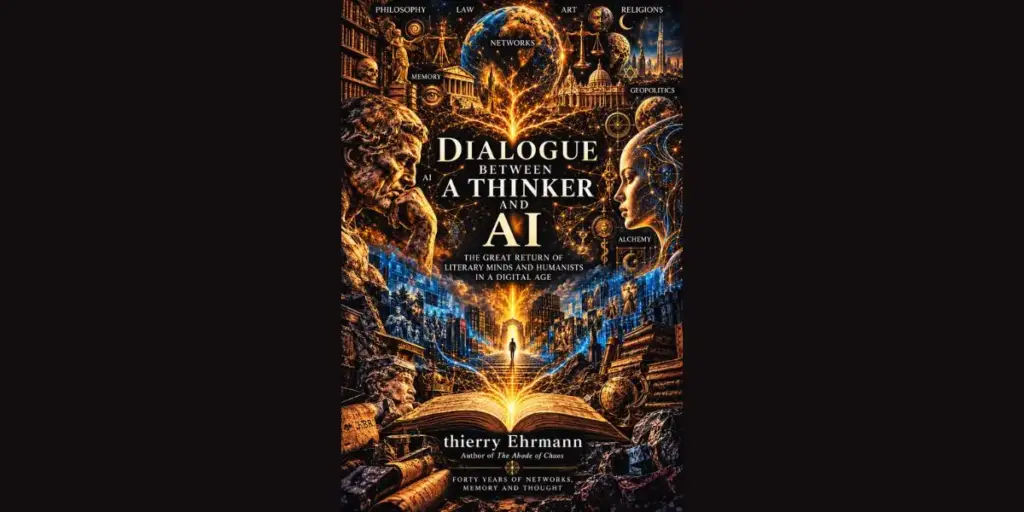
Amid the financial disclosures, the H1 2026 report devotes significant attention to an unusual project that has become central to Artprice’s AI strategy. “Dialogue Between a Thinker and AI,” an 1,800-page work by thierry Ehrmann, has reached 21.9 million English-language downloads across 123 countries in 16 languages and dialects. The work is freely accessible online under a CC BY-NC-ND 4.0 license.
What makes this more than a publishing event is its role as a foundational corpus for an experimental literary benchmark. Nine AI systems—ChatGPT 6, Gemini, Grok, DeepSeek, Perplexity, Mistral, Qwen, Copilot, and Meta—have produced comparative “meta-readings” of the work, available online. The initiative aims to develop nonbinary benchmarks for evaluating large language models on dimensions that binary success conditions cannot capture: continuity of voice, construction of coherent meaning, shifts in interpretation, and the reasoning behind each judgment.
For Artprice, the strategic value is threefold. First, it establishes the company at the center of contemporary AI discourse as a source of ground truth. Second, it demonstrates Ehrmann’s nearly four decades of AI expertise—he began designing algorithms for artist valuations in 1987, through Groupe Serveur, when personal computing was in its infancy. Third, it creates a reproducible framework for documenting AI progress, limitations, and divergences across successive model versions, with implications for Artprice’s core business of attribution tracking, source verification, and historical description comparison.
Download time is less than 10 seconds in any country, thanks to Gemini/Google, which keeps the work cached. The print edition will be released in late October in English and French through various bookstore networks around the world, with a Simplified Chinese edition expected through Artron, Artprice’s state-affiliated partner in China. Digital distribution through WeChat, with its 1.43 billion active users, has surged across the Chinese market.
The Artprice Odyssey Within the Work
The 1,800-page “Hyper Mundi” devotes nearly 30% of its length to Artprice’s extraordinary odyssey from 1991 to the present. Through an initiatory journey marked by major arcana—gathered in the seven arcana of Threshold V, “The Global Memory of the Art Market”—this odyssey retraces encounters and enduring relationships with the mentors and pioneers who shaped the modern history of art prices and art documentation.
The narrative moves from Enrique Mayer, the spiritual heir, to the archaeology of memory embodied in the Mireur, through the leading builders on the American continent, Thomas Bayer and Peter Hastings Falk, and on to the bridges forged with Asia through Wan Jie, sealing the mutual recognition of two civilizations. These essential figures, most of whom have since passed away, handed down their intellectual, documentary, and historical legacy by contributing manuscripts, auction catalogs, and notes from experts and auction houses, most of them now gone. In doing so, they definitively established Artprice as the true and ultimate guardian of the global memory of the art market.
Through this monumental work, thierry Ehrmann demonstrates that he has been working at the very genesis of AI architectures since 1987, drawing on nearly 40 years of pioneering immersion at the heart of networks and the algorithmic world of AI. This strategic head start, combined with worldwide distribution, enables Artprice to establish itself naturally at the heart of contemporary AI engines as the sector’s primary source of truth and essential reference.
The “Entrusted Pen” and Human Responsibility in AI-Assisted Creation
The H1 2026 report introduces a concept that extends beyond Artprice’s commercial operations into broader questions about AI and human creativity. The “entrusted pen” (la plume confiée) principle holds that assistance with wording takes place within a framework of intellectual direction, choices, and oversight assumed by the human author. In the benchmark program built around “Dialogue Between a Thinker and AI,” this responsibility extends to designing the tests, examining the evidence, and interpreting the results.
For thierry Ehrmann, AI’s involvement in literature touches on humanity’s understanding of its own singularity: expression, memory, intention, and responsibility for what it transmits. The project takes place at La Demeure du Chaos, Artprice’s global headquarters, where the convergence of creation, archives, and technology fosters exchanges with visitors and researchers.
The initiative belongs to a humanistic field. It takes as its starting point an extensive, multidisciplinary, and multidimensional work at the intersection of the hard sciences, philosophy, sociology, anthropology, art history, and documentary history, together with the successive readings it generates. Knowledge, mathematics, and programming tests play a major role in evaluating large language models, but almost all benchmarks rely on an expected answer or a verifiable success condition—simply reproducing a binary model. Literature also involves the continuity of a voice, the construction of a coherent whole, shifts in meaning, and the relevance of an interpretation. These dimensions require multiple evaluation criteria and an examination of the reasoning behind each judgment.
Benchmarking Beyond Binary: Tracking Versions and Renewing Corpora
The experimental literary benchmark built around “Dialogue Between a Thinker and AI” enables Artprice to develop nonbinary benchmarks fundamental to measuring progress in the human-machine voice interface. Successive model versions can be tested against an unchanged core set of tasks supplemented by new texts.
This traceability also applies to evaluator models. When an automated judge changes, its new assessments must be compared with its earlier ones on a common set of tasks. New, unpublished tests kept outside public distribution will supplement the open corpora to limit the risk of merely measuring familiarity with previously circulated texts or commentaries.
To expand this approach, Artprice has a documentary library containing hundreds of thousands of manuscripts, auction catalogs, and art books. This collection provides a vast field of study. Documented selections will make it possible to explore different forms of writing and historical periods while preserving the texts’ provenance and terms of use. This expansion will open up questions specific to Artprice’s business: tracking an attribution over time, distinguishing a source from a commentary, comparing historical descriptions, recognizing changes in vocabulary, or flagging an insufficiently supported connection. The transfer of results to these professional applications will need to be evaluated through domain-specific tests.
The Customer Profile: Serving the Intellectual Elite of the Art World
Artprice’s customers stand out for their exceptionally high level of expertise and their ongoing demand for deeper knowledge. They include fine art experts, auction house directors, private and institutional collectors, art historians, cultural institutions, international museum curators, researchers, and academics specializing in the art market. Together, they represent the intellectual elite of the global art sector.
Their advanced academic training and practical experience make them ideally positioned to benefit from AI’s advanced capabilities, provided they receive support in mastering the appropriate tools and methodologies. The art market has unique characteristics that make artificial intelligence particularly valuable to industry professionals. The complexity of the information to be processed—including artwork histories, market trends, auction data, critical analyses, artists’ biographical information, and socioeconomic contexts—requires research and analytical capabilities beyond traditional human capacity.
Recent developments in the market, marked by the emergence of new collectors (44% new buyers in 2025, according to gallery reports), the rise of AI-generated art, and the transformation of sales methods through growing digital integration, are creating new information needs that only a hybrid approach combining human expertise and artificial intelligence can effectively address.
This democratization is part of a broader shift toward a more accessible art market, illustrated by 17% sales growth among dealers with revenue below $250,000 and by the increase in auction sales of artworks priced below $5,000.
The Two-Act Transformation: From Internal Revolution to Platform Delivery
The H1 2026 report provides specific detail on how the AI-First transformation is being executed in two distinct acts:
Act I: The Revolution Within the Organization. The restructuring centers on Artprice’s unique heritage, comprising nearly 180 proprietary databases interconnected in a meta-database with no equivalent worldwide, together with its renowned documentary collection of manuscripts and auction catalogs dating from 1700 to the present, considered unique in the world by researchers and experts. The first phase of this transformation takes place internally. Every employee in the group, every department, and every production unit is being equipped directly with dedicated AI hardware and appliances. Before making these tools available to subscribers, Artprice is completely redesigning its workflows. Data collection, standardization, and enrichment pipelines are being fully rewritten to meet deep learning and proprietary algorithm standards.
Act II: Delivering a Database Platform Transformed at Its Core. The platform will be delivered to subscribers only once the internal value chain has been fully calibrated. Rather than a stack of evolving modules, the database platform will be a complete “AI-First” environment built on Artprice’s founding pillars: certified large-scale data (standardized big data), deep learning, and algorithmic security. By choosing this comprehensive, structured transformation, Artprice reaffirms its pioneering role: turning 30 years of global leadership in information into a sovereign decision intelligence engine for the entire global art market.
This commitment to rigor entails a marginal adjustment to Artprice’s public deployment timeline, with no impact on its financial trajectory. In a complex global economic environment marked by intense geopolitical tensions and highly volatile energy costs, Artprice by Artmarket’s revenue continues to grow steadily. This exceptional economic foundation gives the company the independence and confidence to prioritize operational perfection over haste. This is far removed from the situation of publicly traded companies that incorporate AI into their business models and are constantly seeking equity financing.
Strategic Synthesis: Perfect Encapsulation for the Premium Offering
With the enormous head start secured by Intuitive Artmarket® and Blind Spot®, Artprice has taken a necessary step back to make a very slight adjustment to its launch timeline. This strategic shift addresses a fundamental requirement: finalizing a premium subscription in which technological power disappears entirely behind absolute ease of use.
The overriding priority is to encapsulate algorithmic complexity completely between Artprice’s data production pipelines and the customer-facing experience. Subscribers should no longer have to manipulate complex filters or settings; dialogue between members and the sovereign AI systems must be natural and seamless.
In the art market’s specialized ecosystem, this fluidity demands extreme rigor: the AI must master industry terminology and operate in more than 40 languages while respecting art history’s golden rule, which strictly prohibits translating artwork titles. Preserving the original nomenclature and complying with long-established protocols remain nonnegotiable. This professionalization of AI use in art creates new career opportunities while preserving the importance of traditional art education.
La Demeure du Chaos: A “Total Work of Art” at the Heart of Sovereign AI
Artprice’s global headquarters, La Demeure du Chaos—dubbed “Abode of Chaos” by The New York Times—has received official recognition as a “total work of art” from Madame Rachida Dati, France’s Minister of Culture. This recognition is more than symbolic. It acknowledges the site as a singular architectural and artistic achievement, and it positions Artprice’s headquarters at the intersection of cultural heritage and technological innovation.
The headquarters symbolizes the convergence of creation, historical archives, and cutting-edge sovereign AI. The Ministry’s recognition, together with the site’s role in France’s strategy for developing sovereign AI, suggests potential government support for extending Artprice’s model of collaboration between cultural institutions and AI development.
Market Leadership and Unrivaled Industry Credentials
In the global art market, experience, expertise, authoritativeness, and trustworthiness are paramount. Artmarket.com‘s credentials are unmatched in the sector:
-
Top-of-Mind Awareness: An independent study at the International Committee of the History of Art congress revealed that 86% of 378 surveyed experts named Artprice first when asked about art market databases. The question was: “Which art market databases do you know?” Of the 378 people surveyed, 325 named Artprice first, making it the “top-of-mind” art market database.
-
Government Recognition: Artmarket has repeatedly received the “Innovative Company” designation from BPI (France’s public investment bank), devoting 80% of its resources annually to research and development. For fiscal 2026/2027, Artprice is seeking the designation for the third consecutive time.
-
Unprecedented Data Volume: The company adds over 1.2 million new data records yearly, enriched through 112 referential integrity fields and more than 3 million very-high-resolution photographs via Artprice Images®.
-
Thought Leadership: Thierry Ehrmann’s 1,800-page work, “Dialogue Between a Thinker and AI,” has become a foundational, open-source corpus for benchmarking and cross-critiquing major AI systems (including ChatGPT, Gemini, Grok, and Mistral), amassing over 21.9 million English-language downloads globally.
Strategic Outlook 2026–2030: Redefining the Global Art Ecosystem
The digital transformation of the art market is irreversible. Leading auction houses like Sotheby’s, Christie’s, and Bonhams are accelerating their online operations, targeting end-of-2030 goals by 2027. With over 180 million online art buyers globally, the demand for reliable, independent data is at an all-time high. In H1 2026 alone, Artprice recorded the highest number of lots sold in worldwide auction history.
The shift to online auctions and the substantial increase in time spent at home mean that internet users need reliable, independent data to participate securely in auctions as sellers or buyers and to stay informed about the art market. Since its inception in 1997, Artprice by Artmarket has anticipated the art market’s digital transformation. This transformation is now the only way forward for the art market’s influential players: auction houses, galleries, experts, museums, fairs, exhibitions, and others. There will be no turning back.
To serve this sophisticated clientele—which includes museum curators, fine art experts, and institutional collectors—Artprice is rolling out a premium subscription model priced between €1,600 and €2,500 annually. This model does not merely sell data access; it provides privileged access to an information asymmetry critical for high-stakes financial and operational decision-making.
The success of this approach opens opportunities to expand into other specialized fields of knowledge, broadening the company’s influence beyond the traditional art market. France’s Minister of Culture has officially recognized thierry Ehrmann’s La Demeure du Chaos as a total work of art. That recognition, together with its role in the strategy for developing sovereign AI, suggests potential government support for extending this model of collaboration.
Shareholder Confidence and Governance
The Ehrmann family and Groupe Serveur have demonstrated confidence in the AI-First transformation by increasing their holdings in Artmarket.com. Three disclosures were filed with the AMF:
-
First disclosure—No. 2026DD1133787 (published on August 17, 2026)
-
Second disclosure—No. 2026DD1134265 (published on August 20, 2026)
-
Third, supplementary disclosure—No. 2026DD1134267 (published on August 20, 2026)
In line with this commitment to increasing her stake in Artmarket.com, Ms. Nadège EHRMANN, a member of Artmarket.com‘s Board of Directors, sought to acquire additional Artmarket.com shares. As the aggregate value of her various purchases exceeded the regulatory threshold, she made the required disclosures to the issuer and the AMF in accordance with Article 19 of the Market Abuse Regulation (MAR).
Share purchases also normally follow movements in the share price. For the Ehrmann family, these movements in no way alter its determination to increase its stake in Artprice by Artmarket.com.
The company emphasizes that these transactions are not intended to result in a public takeover or buyout offer (OPA/OPR), contrary to speculation on certain forums. The suggestion that the Ehrmann family is failing to make required disclosures is described as incorrect, with all filings made through the AMF’s ONDE extranet platform within statutory deadlines. Groupe Serveur, the founding shareholder, remains by far the largest shareholder, holding 30.16% of the share capital and 45.78% of the voting rights, excluding the Ehrmann family’s holdings.
Follow all the Art Market news in real-time with Artmarket and its Artprice department on Facebook and Twitter:
www.facebook.com/artpricedotcom/ (more than 6.3 million subscribers)
Discover the alchemy and the universe of Artmarket and its Artprice department: https://www.artprice.com/video
Conclusion
Artmarket.com‘s H1 2026 Financial Report is not just a statement of fiscal health; it is a blueprint for the future of art market intelligence. By leveraging its €42 million appraised historical archive and deploying its proprietary Intuitive Artmarket® and Blind Spot® AI systems, the company is executing a flawless “AI-First” transformation.
With €30.826 million in shareholders’ equity, a 49-person workforce, and expense levels designed to remain flat up to €90 million in revenue, the company has the financial runway to execute a comprehensive AI transformation without external financing or shareholder dilution. With unwavering confidence from its founding shareholders, and an unassailable monopoly on ground-truth art market data, Artprice is uniquely positioned to dominate the global art information ecosystem through 2030 and beyond.
The strategic bet is clear: proprietary vertical AI, trained on a data moat that cannot be replicated, will command a premium in a market increasingly flooded with synthetic content. As generic AI struggles with synthetic data dilution, Artmarket.com stands as a sovereign citadel of cognitive reliability. Whether Intuitive Artmarket® and Blind Spot® deliver on their full promise will be determined over the next four years. What the H1 2026 report establishes is that Artprice has the assets, the discipline, and the conviction to make the attempt—on its own terms, at its own pace, and without compromising the independence that has defined its 29-year history.
Frequently Asked Questions (FAQs)
1. What are Intuitive Artmarket® and Blind Spot®?
Intuitive Artmarket® and Blind Spot® are Artprice’s proprietary, vertical AI systems. Unlike generic large language models, they are trained exclusively on Artprice’s sovereign, certified database of over 30 million auction results and historical records, providing deterministic, hallucination-free predictive analytics and decision intelligence for the art market. Intuitive Artmarket® transforms databases into active decision intelligence, while Blind Spot® identifies market anomalies and generates algorithmic hypotheses for predictive analysis.
2. What is Artmarket.com‘s financial position as of H1 2026?
Shareholders’ equity stood at €30.826 million as of June 30, 2026. The company has never undertaken a capital increase except for employee stock option exercises. Groupe Serveur and the Ehrmann family hold approximately 30% of share capital and 46% of voting rights. Q2 2026 revenue was €1,432K, up 7% year-over-year, and H1 revenue reached €4,362K, up 5%.
3. How is Artmarket.com managing AI energy consumption?
Artmarket.com has developed proprietary hardware, software, and clean-room architectures that ensure genuine energy efficiency. At equivalent computing power, the company’s AI infrastructure decreases its energy consumption by 18% each year, aligning with strict Corporate Social Responsibility (CSR) goals and the 39-year philosophy of its principal shareholder, Groupe Serveur.
4. Why did Artmarket.com reassess its relationship with Perplexity and other third-party AI aggregators?
The AI market is highly volatile, with frequent model updates and unstable token pricing. Artprice requires a stable technological environment to avoid passing unpredictable licensing costs onto its subscribers. Furthermore, as core search features become commoditized by major tech companies like Google and OpenAI, Artprice is prioritizing its own sovereign, closed-loop AI ecosystem to guarantee data integrity and service reliability.
5. What is the “ontological transformation” mentioned in the H1 2026 report?
Coined by CEO thierry Ehrmann, an ontological transformation refers to a fundamental change in the nature of the system itself, not just an incremental improvement. For Artprice, this means evolving from a static historical information repository into an autonomous, predictive cognitive organism that actively models market risks and trends in real time.
6. Is Artmarket.com planning a public takeover (OPA/OPR)?
No. Recent share purchases by the Ehrmann family and Groupe Serveur are explicitly intended to reaffirm their long-term confidence in Artmarket.com‘s future. The company has stated unequivocally that these transactions are not intended to result in a public takeover or buyout offer, and all holdings are transparently disclosed via the AMF’s ONDE extranet.
7. What is “Dialogue Between a Thinker and AI”?
It is an 1,800-page work by thierry Ehrmann, Artprice’s founder and CEO, that has reached 21.9 million English-language downloads across 123 countries. Beyond its editorial distribution, it serves as the foundational corpus for an experimental literary benchmark in which nine AI systems produce comparative readings. The project aims to develop nonbinary evaluation methods for large language models and is freely accessible online.
8. How does Artprice’s data compare to competitors?
Artprice maintains databases covering more than 918,800 artists and over 30 million auction results from 1700 to the present. Artprice Images® provides access to 181 million digital images. The company also owns the world’s largest physical collection of auction catalogs and manuscripts, appraised at €42 million in January 2025. No competitor matches this combination of digital depth and physical archive.
About Artmarket.com
Artmarket.com is listed on Eurolist by Euronext Paris. The latest TPI analysis includes more than 18,000 individual shareholders excluding foreign shareholders, companies, banks, FCPs, UCITS: Euroclear: 7478 – Bloomberg: PRC – Reuters: ARTF.
Artmarket and its Artprice department were founded in 1997 by thierry Ehrmann, the company’s CEO. They are controlled by Groupe Serveur (created in 1987).
Artmarket is a global player in the Art Market with, among other structures, its Artprice department, world leader in the accumulation, management and exploitation of historical and current art market information in databanks containing over 30 million indices and auction results, covering more than 918,800 artists.
Artprice Images® allows unlimited access to the largest art market image bank in the world with no less than 181 million digital images of photographs or engraved reproductions of artworks from 1700 to the present day, commented by our art historians.
Artmarket, with its Artprice department, constantly enriches its databases from 7,200 auction houses and continuously publishes art market trends for the main agencies and press titles in the world in 121 countries and 11 languages.
Artmarket.com makes available to its 9.3 million members the advertisements posted by its Members, who now constitute the first global Standardized Marketplace® for buying and selling artworks at fixed prices.
Artmarket, with its Artprice department, has twice been awarded the State label “Innovative Company” by the French Public Investment Bank (BPI).
For personalized statistics, econometric analyses, or a free demonstration of Artprice’s AI-driven services, visit artprice.com/demo or contact the econometrics department at econometrics@artprice.com.
Copyright 1987-2026 thierry Ehrmann www.artprice.com – www.artmarket.com
Recent Posts
- Artmarket.com H1 2026 Financial Report: How Intuitive Artmarket® and Blind Spot Will Drive the “AI-First” Transformation Through 2030
- USDT Gift Card: The Complete Guide to Digital Crypto Gifting with Free Redemption
- IronWallet Launches MCP Integration for AI-Powered Self-Custodial Crypto Wallet Management
- GoBTC Pay backs the Agnic.AI hackathon with a track for Bitcoin payments between AI agents
- How to Recognize a Crypto Scam Before Sending Money