
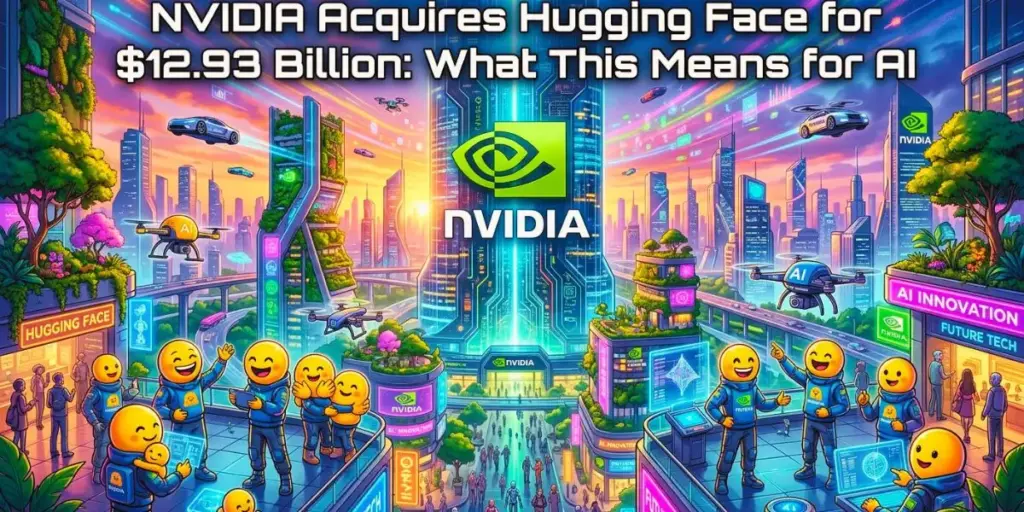

The tectonic plates of the artificial intelligence industry just shifted. On September 3, 2026, NVIDIA, the titan of AI hardware, announced a definitive agreement to acquire Hugging Face, the beloved “GitHub of AI,” for a staggering $12.93 billion.
For years, these two companies represented the two halves of the AI ecosystem: NVIDIA provided the physical “muscle” (GPUs) while Hugging Face provided the collaborative “brain” (models and code). The merger of these two worlds has sparked intense debate in developer forums, executive boardrooms, and regulatory bodies from Washington to Brussels.
Is this the beginning of a monopolistic stronghold on AI infrastructure, or is it a necessary consolidation that will usher in a new era of efficiency and innovation?
This article breaks down the complex financial transaction, analyzes the strategic motivations, and forecasts what this seismic shift means for the 18 million developers, 50,000 enterprises, and the future of open-source artificial intelligence.
Quick Answer: The $12.93 Billion Blockbuster
If you are looking for a summary without the deep dive, here is the bottom line:
-
The Deal: NVIDIA has agreed to pay $12.93 billion for Hugging Face.
-
Structure: The package consists of $11.9 billion in cash** plus approximately **$1 billion in equity retention to keep key Hugging Face talent on board.
-
The Promise: NVIDIA claims Hugging Face will remain an “open and neutral” platform.
-
The Concern: The acquisition combines the world’s most powerful AI chipmaker with the world’s largest model repository, raising serious questions about vendor neutrality.
-
The Timeline: The deal is expected to close in the first half of 2027, pending regulatory approval.
Bottom Line: This is not just a hardware company buying a software company. This is NVIDIA attempting to own the entire AI stack, from the silicon to the source code.
Deconstructing the Deal: The Financial Architecture
NVIDIA is known for its calculated aggression in the market, and this acquisition represents the largest purchase in the company’s storied history. Let’s look under the hood of the financial transaction.
The Numbers
According to NVIDIA’s 8-K filing with the SEC, the total transaction value is $12,930,300,000. The market has reacted favorably, with NVIDIA stock ticking up roughly 2% to hover around $230 per share, suggesting that shareholders believe the strategic value justifies the massive price tag.
The Rationale According to Jensen Huang
The standard corporate line for such acquisitions usually involves “synergy” and “optimization.” However, NVIDIA CEO Jensen Huang’s statement struck a different tone, designed to calm the nerves of the open-source community:
“Hugging Face will remain an open platform for the entire AI ecosystem. Developers will choose the models they want, the frameworks they want, the clouds and inference service providers they want and the computing platforms they want. NVIDIA compute will not be required to build on or deploy through Hugging Face.”
This statement is a clear attempt to preempt regulatory scrutiny (memories of the failed Arm acquisition are still fresh) and to prevent a developer exodus.
The Crown Jewels: What $13 Billion Buys
Why is a platform with relatively modest revenue worth one of the largest tech deals of the decade? The answer lies in the assets:
-
Scale: Over 3 million AI models and 500,000 datasets.
-
Community: 18 million developers and 50,000 organizations rely on the platform.
-
Influence: The open-source libraries (Transformers, Diffusers) have become the de facto standard for modern machine learning.
NVIDIA isn’t buying revenue; it is buying the distribution layer of the entire AI industry.
The Strategic Chess Game: Why NVIDIA Made the Move
To understand this acquisition, we must look at the competitive landscape of 2026. The AI “Gold Rush” is over; the “Infrastructure Building” phase has begun.
1. Moving Up the Stack
For years, industry analysts warned that GPU hardware was commoditizing. Competitors like AMD (with ROCm), Google (with TPUs), and Amazon (with custom chips) are nipping at NVIDIA’s heels. Hardware margins, while still high, will eventually erode.
By acquiring Hugging Face, NVIDIA secures the software layer. Software margins (80-90%) dwarf hardware margins (60-70%). More importantly, this creates “stickiness.” If the entire AI workflow—from dataset preparation to model deployment—lives on a platform you own, the customer is effectively locked in, regardless of who manufactured the chip underneath.
2. Neutralizing the Microsoft + OpenAI Threat
Microsoft currently holds the crown in the commercial AI application space, thanks to its deep investment in OpenAI and the ubiquity of GPT-4 and Copilot. NVIDIA cannot out-innovate OpenAI on the foundational model front quickly enough to win that war.
Instead, NVIDIA is adopting a “picks and shovels” strategy. By controlling Hugging Face, NVIDIA becomes the neutral territory where all models—including those from competitors like Meta (Llama) and Mistral—are trained, shared, and deployed. If you can’t own the product, own the marketplace.
3. The Data Insight Advantage
The most underrated aspect of this deal might be the data. Hugging Face holds immense metadata on which models are gaining traction, which frameworks are faltering, and what the developer community needs next. This is a goldmine for NVIDIA’s R&D department. It allows them to design the next generation of GPUs specifically optimized for the models that are actually being used, creating a feedback loop that competitors will find impossible to replicate.
4. Competing with Big Tech
The acquisition allows NVIDIA to offer an enterprise suite that rivals AWS SageMaker, Google Vertex AI, and Azure Machine Learning, but with one crucial difference: NVIDIA’s platform is perceived as more hardware-agnostic and community-driven. This is a unique selling proposition in a market wary of Big Tech monopolies.
Implications for the AI Ecosystem: Winners and Losers
This acquisition will have a ripple effect across the entire industry. Here is a breakdown of what it means for each stakeholder group.
For the Developers (The 18 Million)
The community is currently in a state of cautious optimism mixed with existential dread.
The Short-Term Reality (0-6 Months):
-
No Changes: The platform will operate independently. The free tier remains.
-
The NVIDIA Promise: You will not be forced to buy an NVIDIA GPU to use the platform.
The Medium-Term Shift (6-18 Months):
-
Enterprise Features Overload: Expect a pivot toward features that serve large corporate clients who pay for SLAs and compliance.
-
CUDA Optimization: While not mandated, you will likely see “recommended” optimizations that make models run incredibly fast on NVIDIA hardware (using TensorRT and NVLink), potentially making other hardware feel sluggish by comparison.
The Long-Term Uncertainty:
-
The Neutrality Question: Will Hugging Face eventually prioritize models built on NVIDIA’s NeMo framework over others?
-
Developer Advice: Diversify your infrastructure. Ensure you have backups of your critical model weights. Watch the Terms of Service closely.
For Enterprises (The 50,000)
For CTOs and data scientists at Fortune 500 companies, this deal presents a complex trade-off.
The Positives:
-
Integration: Expect seamless “one-click” deployment from the Hugging Face hub to NVIDIA-powered cloud instances. This reduces DevOps overhead significantly.
-
Bundling: Enterprises buying NVIDIA servers will likely be offered “Enterprise Hugging Face” licenses at discounted rates, potentially lowering the total cost of ownership.
The Negatives:
-
Price Creep: The days of free enterprise usage are numbered. NVIDIA paid $13 billion; they will need to monetize aggressively. Expect subscription costs to rise by 20% to 50% over the next two years.
-
Lock-in: By standardizing your MLOps on the NVIDIA-Hugging Face stack, you lose the leverage to negotiate with cloud providers like AWS or Google.
For Investors
For shareholders, the reaction is generally positive, but tempered by risk.
-
The Bull Case: NVIDIA is transitioning into a SaaS company. A recurring revenue model (subscriptions to Hugging Face) smooths out the cyclical nature of GPU hardware sales. It expands the moat significantly.
-
The Bear Case: Valuation. Paying roughly 40-50x revenue for a platform that is technically designed to be free is a risky bet on future monetization. If the developer community rebels and moves to a fork (like ModelScope or a new decentralized alternative), NVIDIA has bought a ghost town.
The Regulatory Hurdle: Will the Deal Close?
The specter of the failed Arm acquisition looms large over this transaction.
The Approval Timeline
The deal has been announced, but the ink is not dry. The rigorous process of securing global regulatory approvals will take the better part of a year.
-
September 2026: Filing with the FTC (US) and European Commission (EU).
-
January 2027: Expectation of “Second Requests” (deep dives) from regulators.
-
Q1-Q2 2027: The likely window for a decision.
The Antitrust Argument
The Federal Trade Commission (FTC) is currently hyper-vigilant about “vertical integration” in tech. The concern is straightforward:
-
NVIDIA holds an 80-90% market share in advanced AI GPUs.
-
Hugging Face holds a dominant position in AI model distribution.
-
If NVIDIA restricts access to the best models or optimizes them exclusively for NVIDIA hardware, it could stifle competition.
The Likely Outcome
Unlike the Arm deal, which was a “horizontal” merger of a critical supplier to all competitors, Hugging Face is a software layer. It is harder to argue that this is a monopoly on essential physical infrastructure.
The Prediction:
-
80% Probability: The deal closes in H1 2027, but with strict Behavioral Remedies. Regulators will likely require NVIDIA to sign a legally binding consent decree ensuring that non-NVIDIA hardware receives identical optimization and access on the Hugging Face platform for a period of 5-10 years.
-
15% Probability: The deal closes with minor divestitures (perhaps spinning off a specific part of the business).
-
5% Probability: The deal is blocked due to a “chilling effect” on open-source innovation.
The Historical Context: Can NVIDIA Integrate Successfully?
NVIDIA has a mixed track record with acquisitions of this magnitude.
-
Mellanox (2020, $7B): Widely considered a massive success. NVIDIA integrated the networking technology and now dominates the data center interconnect market, a key component of AI superclusters.
-
**Arm (2022, $40B):** A spectacular failure. NVIDIA was forced to walk away due to regulatory pressure, paying a $1.25 billion breakup fee.
The Hugging Face acquisition falls somewhere in the middle. It is larger than Mellanox but more palatable than Arm. The key risk here is cultural clash. NVIDIA is a top-down, engineering-driven, profit-focused machine. Hugging Face is a community-centric, bottom-up, open-source collective. If NVIDIA imposes too much corporate structure, the core of the Hugging Face talent base will simply leave (taking the $1 billion retention bonus and waiting for the vesting period to expire before starting a new competitor).
The Verdict: A Necessary Evolution or a Monopoly in the Making?
So, is this good for AI?
The Case for “It’s Good”:
The resources of NVIDIA will allow Hugging Face to fix its persistent infrastructure scaling issues. The platform often struggles with downtime. With NVIDIA’s backing, the platform becomes bulletproof. Furthermore, the deep integration could lead to a 10x increase in performance for inference, making AI applications cheaper and faster for everyone.
The Case for “It’s Bad”:
Monoculture is dangerous. When a single entity controls both the hardware and the software distribution, innovation becomes dictated by that entity’s financial interests. The open web thrived because it was neutral. The risk of “Hugging Face” becoming “NVIDIA Model Store” is real.
Our Final Take:
This is a net positive for the industry’s performance, but a net negative for the industry’s independence. The deal will likely go through, and in the short term, users will enjoy better service. The true test will come in 2028 and beyond, when we see if NVIDIA truly resists the temptation to tilt the playing field in its favor.
Frequently Asked Questions (FAQ)
1. Is the NVIDIA-Hugging Face deal finalized?
No. While announced, the acquisition is pending regulatory review. It is not expected to close until the first half of 2027.
2. Does this mean I need an NVIDIA GPU to use Hugging Face?
Not currently. NVIDIA has explicitly stated that “NVIDIA compute will not be required to build on or deploy through Hugging Face.” However, many are watching closely to see if this policy holds or if it becomes difficult to maintain.
3. What happens to my Hugging Face repositories?
In the immediate term, nothing. All models and datasets remain accessible. The platform continues to operate independently. However, it is prudent to ensure you have local backups of any critical assets.
4. Why was the Arm deal blocked but this might be approved?
The Arm deal was a horizontal acquisition of a chip designer that supplied competitors like Apple and Samsung—creating a direct conflict of interest. Hugging Face is a software platform, and NVIDIA can argue that keeping it open actually increases competition for cloud providers like Azure and AWS.
5. Will Hugging Face remain free to use?
NVIDIA has committed to maintaining the free tier for the community. The monetization strategy will likely target enterprise users who require dedicated support, higher rate limits, and private infrastructure.
6. Who are the main competitors to Hugging Face if I want to diversify?
If you are concerned about vendor lock-in, you should evaluate alternatives such as Replicate, GitHub ML, Modal, or ModelScope. These platforms offer varying degrees of model hosting and deployment capabilities.
7. How does this affect the price of AI chips?
The acquisition itself doesn’t directly change hardware prices, but it strengthens NVIDIA’s ecosystem lock-in. This could reduce the competitive pressure that might have otherwise forced NVIDIA to lower GPU prices in the face of AMD competition.
8. What is the “Entourage Effect” equivalent in this context?
In this context, we call it the “Full Stack Integration.” Just as full spectrum CBD works better together, NVIDIA believes that owning the hardware (GPUs) and the software (Hugging Face) will yield superior performance through optimization that third parties cannot match.