
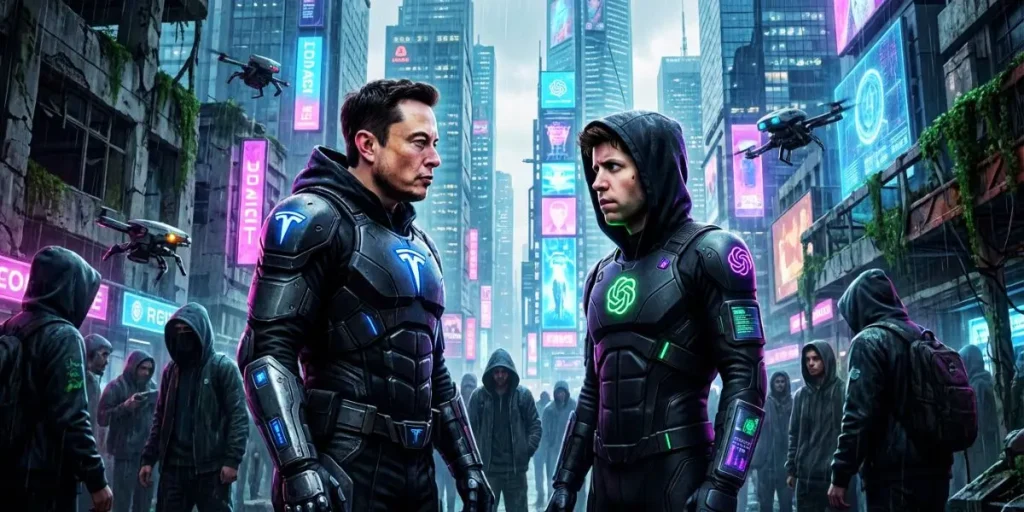

In a move that has stunned the business world and captured global attention, Elon Musk has pledged to donate $134 billion to charity—if he wins his April 2026 lawsuit against OpenAI. It is a high-stakes gamble that puts the very soul of artificial intelligence on trial. But how did we get here? How did two visionaries who once shared a mission to “benefit humanity” become locked in one of the most bitter and consequential legal battles in tech history?
To understand the present, we must go back to 2015, when Elon Musk and Sam Altman co-founded OpenAI as a non-profit organization. Their shared vision was noble: to develop artificial intelligence safely and openly, ensuring it would serve humanity rather than concentrate power in the hands of a few. Musk provided $38 million in initial funding—roughly 60% of the early capital—and the project was born with idealistic ambitions.
What began as a partnership to “benefit humanity” has now turned into one of the most closely watched rivalries, with massive implications for the future of technology, the structure of the AI industry, and the very question of whether artificial intelligence will remain a public good or become a corporate battlefield.
The Eye of the Storm: The $134 Billion Lawsuit
What is the Main Accusation?
At the heart of this legal firestorm is a fundamental question: Can an AI company betray its non-profit roots? Musk’s legal team is now alleging contract fraud, breach of fiduciary duty, and accusing OpenAI of becoming a “get-rich-quick scheme” disguised as a charity.
The central argument is that Altman and OpenAI strayed from their original mission to become a for-profit company, closely allied with Microsoft, creating what Musk claims is a de facto monopoly. With the company now valued at over $500 billion, Musk is demanding the return of “ill-gotten gains” —specifically, a payout representing 3,500 times his original investment as punitive damages.
The Figure and the Controversy
The staggering amount of $134 billion being claimed has raised eyebrows across the legal and financial world. Judge Yvonne Gonzalez Rogers, who is presiding over the case, initially expressed skepticism, reportedly calling some of the figures “made up.” However, in a significant ruling, she has decided that these questions are substantial enough to warrant a jury’s evaluation. This decision alone validates that the core issues—fraud, mission betrayal, and the nature of OpenAI’s transformation—are legitimate legal questions.
Musk’s Promise: PR Move or Genuine Act?
Perhaps the most dramatic twist came when Musk announced on X (formerly Twitter): “I will not enrich myself in any way.” His promise to donate the entire $134 billion to charity if he wins has sparked intense debate. Is this a genuine act of philanthropy, a brilliant public relations move, or a calculated legal strategy to gain public sympathy?
The possible interpretations are fascinating:
-
As a PR strategy, it positions Musk as the selfless defender of AI ethics against corporate greed.
-
As a legal tactic, it undermines claims that he is acting out of personal financial interest.
-
As a genuine act, it aligns with his long history of pledging his wealth to causes like renewable energy and space exploration.
Whatever the motivation, the promise has captured the public imagination and ensured that this trial will be watched far beyond the usual tech and legal circles.
The Court Calendar
Mark your calendars. After months of motions and legal skirmishes, Judge Yvonne Gonzalez Rogers has ruled that the case will proceed to a jury trial set for April 27-28, 2026, in a California federal court. Despite her skepticism regarding the viability of some of Musk’s damage claims, she has determined that the fundamental questions deserve a public airing before a jury of peers.
The Other Side of the Coin: Sam Altman and His Vision
Beyond OpenAI
While Musk dominates headlines with his legal offensive, Sam Altman has been quietly building a vision of the future that extends far beyond ChatGPT. To understand the stakes of this trial, we must understand the man at the center of the defense.
Altman’s worldview encompasses not just language models but the entire infrastructure of how humans will interact with AI in the coming decades. His projects reveal a consistent philosophy: AI will become so fundamental to society that it must be treated as a public utility, but one that requires robust commercial structures to develop and scale.
The “World” Project (Formerly Worldcoin)
One of Altman’s most ambitious ventures is World (formerly Worldcoin), a project that recently announced the launch of AgentKit. This technology allows AI agents to cryptographically prove they have “real human backing.” In an era where bots and automated accounts increasingly dominate online spaces, this capability is revolutionary.
Why is this important? As AI becomes more sophisticated, the ability to distinguish between human and automated interactions becomes critical for everything from social media integrity to financial transactions. World’s technology could become the verification layer for the entire AI-driven internet, ensuring that when you interact with an entity online, you know whether there’s a human behind it.
AI as a Public Utility
Altman has recently made statements comparing the future sale of AI computing power to basic services like water or electricity. This vision of a ubiquitous and commercialized AI reflects his belief that the technology will become so essential to daily life that it must be accessible to all—but developed through market mechanisms.
This philosophy stands in stark contrast to the pure non-profit idealism of OpenAI’s founding documents and helps explain why the company evolved the way it did. For Altman, serving humanity at scale requires the resources that only commercial success can provide.
The Context: From Partners to Rivals
Timeline of a Breakup
To understand the bitterness of this legal battle, let’s trace the path from partnership to rivalry:
2015: Musk and Altman co-found OpenAI as a non-profit organization dedicated to open-source, human-friendly AI. The founding board includes visionaries like Sam Altman, Elon Musk, Greg Brockman, and Ilya Sutskever.
2018: Musk resigns from the board, reportedly due to conflicts of interest with Tesla’s own AI development and disagreements over the company’s direction. The official statements mention amicable separation, but behind the scenes, tensions were brewing.
2019: OpenAI creates a “capped-profit” structure and receives a massive $1 billion investment from Microsoft. This pivot fundamentally changes the company’s character, transforming it from a pure research institution into a commercial entity with profit-seeking incentives.
2020-2023: OpenAI releases GPT-3, ChatGPT, and DALL-E, achieving mainstream breakthrough and commercial success. Microsoft deepens its partnership, integrating OpenAI’s technology across its product suite and reportedly investing over $10 billion.
2024: Musk files his initial lawsuit against OpenAI and Altman, alleging breach of contract and fraud. The legal battle begins in earnest.
Present: Musk founds his own AI company, xAI, and launches the chatbot Grok, directly competing with OpenAI in the consumer AI market. The legal and commercial tension is now at its absolute peak.
The Role of Microsoft
No analysis of this conflict is complete without examining the role of the tech giant that has become the “third party” in this drama. Microsoft’s investment and technological alliance have been the catalyst that, according to Musk, diverted OpenAI from its original path.
The partnership gave OpenAI access to massive computing resources, Azure cloud infrastructure, and distribution channels that pure research institutions could only dream of. In return, Microsoft gained a leading position in the AI race and integration of cutting-edge models into its products.
For Musk, this alliance represents exactly the kind of corporate concentration of power that OpenAI was founded to prevent. The fact that a trillion-dollar company now effectively controls the direction of an organization meant to benefit humanity is, in his view, the ultimate betrayal.
Defense and Counterclaims: What OpenAI and Altman Say
The “Frustrated Rival” Narrative
OpenAI and CEO Sam Altman have fired back with a vigorous defense that paints a very different picture. Their legal team has revealed that Musk himself pushed for total control in 2017 and was aware of—and agreed to—the hybrid non-profit/for-profit structure before his exit.
Court filings describe Musk as a “frustrated rival” whose claims are “outlandish” and designed solely for legal harassment and market disruption. They argue that Musk wanted OpenAI to merge with Tesla and have absolute authority over its direction, and when that didn’t happen, he walked away—only to return years later with lawsuits when his own AI venture needed attention.
The Hybrid Structure Defense
OpenAI’s defense rests heavily on the argument that their evolution was transparent and necessary. The “capped-profit” structure, they contend, was designed to attract the capital needed to compete with tech giants while maintaining a governance structure that prioritized safety. Without commercial partnerships, they argue, OpenAI would have been left in the dust by better-funded competitors, and the mission of safe AI development would have suffered.
Market Impact: How the Trial Is Reshaping AI
The Segmentation of the Market
Beyond the courtroom, this battle is actively reshaping the AI landscape. It is forcing a hard split in the market: non-profit safety vs. for-profit scale. Investors, developers, and users are being forced to choose sides, and the entire industry is polarizing around these competing visions.
Ironically, the legal turmoil is giving a massive boost to Musk’s own venture, xAI and its chatbot Grok. The controversy has elevated Grok’s profile, positioning it as the “anti-OpenAI” alternative for those skeptical of corporate AI dominance.
Historical Parallels: The Blockchain Wars
Industry analysts are increasingly comparing this moment to the early blockchain wars, when battles between Bitcoin purists and Ethereum innovators ultimately validated the technology and drove massive returns—such as the +500% surge in ETH that followed major regulatory clarity.
Just as those legal and philosophical battles established the rules for cryptocurrency, this trial could establish the ethical and commercial framework for AI development for decades to come. The uncertainty is painful in the short term, but the clarity that emerges could unleash the next wave of growth.
Public Perception and Prediction Markets
The case is being followed intensely on platforms like Polymarket, where prediction markets offer a window into public sentiment. Currently, only 31% of bettors think Musk will win, reflecting widespread skepticism about the viability of his legal claims. However, these same markets show high volatility, suggesting that new developments could rapidly shift opinions.
Implications and Future: What’s at Stake?
For OpenAI
If Musk wins, the consequences for OpenAI would be severe. The company could be forced to restructure its corporate form, potentially unwind its relationship with Microsoft, or pay damages that would dwarf most corporate settlements. A ruling against them would set a massive precedent for how AI companies can evolve from non-profit to for-profit status.
Even if Musk loses, the trial itself imposes costs. Discovery could reveal internal communications that embarrass executives, distract leadership, and create uncertainty that hampers recruitment and partnerships.
For the AI Industry
This trial addresses fundamental questions that will shape the entire sector:
-
Can an AI company maintain an altruistic mission while seeking to maximize profits? The tension between idealism and capitalism has never been more publicly examined.
-
How is the concentration of power regulated? The Microsoft-OpenAI alliance represents the kind of vertical integration that antitrust authorities are increasingly scrutinizing.
-
What governance models work for transformative technology? The trial is essentially a case study in how not to structure AI development, offering lessons for every startup in the space.
For Musk and Altman
Beyond the money, something more personal is at stake: their legacy as “fathers” of modern AI. History will judge who was right about how this technology should develop. Was Musk the visionary who saw the danger of corporate capture, or the sore loser who couldn’t handle not being in control? Was Altman the pragmatist who understood that idealism needs resources, or the opportunist who sold out the mission for Microsoft’s money?
These questions will be debated long after the verdict is read.
Conclusion
This case represents the peak of a battle for the narrative and economic control of artificial intelligence. It is not merely a dispute between wealthy men and their lawyers; it is a public reckoning with questions that will define our technological future.
The trial’s outcome will not only decide who wins financial compensation. It could establish the ethical and commercial rules that will govern the development of AI for decades to come. Will founders be held to their original mission statements? Can non-profit structures evolve without betraying their purpose? How much concentration of power is acceptable in industries that shape human cognition and communication?
The underlying question remains: Will AI be a common good or a corporate battlefield?
As we approach April 2026, the world will be watching. The jury’s verdict will echo far beyond the courtroom, influencing investment decisions, regulatory frameworks, and the very direction of technological progress. Whatever you think of the personalities involved, this trial matters—perhaps more than any tech lawsuit in a generation.
What do you think? Is Musk a defender of AI ethics or a frustrated competitor using the courts to attack a rival? Is Altman a pragmatist building the future or an idealist who sold out? The comments are open—we want to hear your perspective.
Frequently Asked Questions (FAQs)
Q: What is the Musk vs. OpenAI lawsuit about?
A: Elon Musk is suing OpenAI and its CEO Sam Altman for contract fraud and breach of fiduciary duty, alleging that the company abandoned its original non-profit mission to become a for-profit entity closely allied with Microsoft. Musk claims this betrayal violates the founding agreements of OpenAI from 2015.
Q: How much money is Musk demanding?
A: Musk is seeking $134 billion in damages, which represents approximately 3,500 times his original $38 million investment. He has pledged to donate the entire amount to charity if he wins.
Q: When will the trial take place?
A: The jury trial is scheduled for April 27-28, 2026, in a California federal court, presided over by Judge Yvonne Gonzalez Rogers.
Q: What is Judge Yvonne Gonzalez Rogers known for?
A: She previously presided over the high-profile Epic Games vs. Apple antitrust trial, demonstrating her experience with complex tech industry disputes.
Q: When was OpenAI founded, and who were the co-founders?
A: OpenAI was founded in December 2015 as a non-profit research organization. The co-founders included Elon Musk, Sam Altman, Greg Brockman, Ilya Sutskever, and several others. The founding mission was to develop artificial intelligence safely and ensure it benefits all of humanity.
Q: How much did Elon Musk initially invest in OpenAI?
A: Musk provided $38 million in initial funding, which represented approximately 60% of the early capital raised by the organization.
Q: Why did Elon Musk leave OpenAI in 2018?
A: Musk resigned from the board in 2018, citing potential conflicts of interest with Tesla’s AI development. However, court filings and statements suggest deeper disagreements about OpenAI’s direction, with Musk reportedly pushing for more control and a closer integration with Tesla.
Q: Did Musk agree to OpenAI’s for-profit transition?
A: This is a central point of dispute. OpenAI’s legal team claims Musk was aware of and agreed to the hybrid “capped-profit” structure before his departure. Musk’s team disputes this, arguing the transition violated the original non-profit charter.
Q: What are the main legal accusations Musk is making?
A: The lawsuit alleges:
-
Contract fraud: Breach of the original non-profit founding agreement
-
Breach of fiduciary duty: Violation of obligations to act in the organization’s best interest
-
Unfair business practices: Creating a de facto monopoly with Microsoft
-
Misappropriation of intellectual property: Using Musk’s early contributions for private gain
Q: How is OpenAI defending itself?
A: OpenAI’s defense argues that:
-
Musk pushed for total control in 2017 and wanted to merge OpenAI with Tesla
-
The hybrid structure was necessary to attract capital for competitive AI development
-
Musk’s claims are “outlandish” and represent a “frustrated rival” trying to harass a competitor
-
The non-profit parent company still exists and maintains governance oversight
Q: What did Judge Rogers say about the damage figures?
A: Judge Rogers expressed skepticism, reportedly calling some damage calculations “made up” or speculative. However, she determined that the questions were substantial enough to warrant a jury’s evaluation rather than dismissing the case entirely.
Q: What is the “ill-gotten gains” argument?
A: Musk’s team argues that OpenAI’s current $500 billion valuation was built on technology and mission that originated from the non-profit structure. Therefore, they claim, the profits derived from the for-profit transition rightfully belong to the public purpose originally intended.
Q: What is Microsoft’s involvement in this case?
A: Microsoft invested $1 billion in OpenAI in 2019, followed by subsequent investments reportedly totaling over $10 billion. The tech giant provides cloud computing infrastructure through Azure and has integrated OpenAI’s models across its product suite, including Bing, Office, and Windows.
Q: Is Microsoft being sued directly?
A: Currently, Microsoft is not a direct defendant in the lawsuit, though the company’s relationship with OpenAI is central to Musk’s argument about monopoly creation and mission betrayal.
Q: Could Microsoft be affected by the trial’s outcome?
A: Yes. If Musk wins and OpenAI is forced to restructure, Microsoft’s partnership and investment could be significantly impacted. A ruling against OpenAI might require unwinding or modifying the exclusive partnership.
Q: Did Elon Musk really promise to donate all the money to charity?
A: Yes. Musk announced on X (formerly Twitter) that “I will not enrich myself in any way” and pledged to donate the entire $134 billion to charitable causes if he wins the lawsuit.
Q: Is this legally binding?
A: The pledge itself is a public statement rather than a legally binding commitment in the lawsuit. However, if Musk wins and collects damages, he would face enormous public pressure to honor his word, and it could become part of a settlement agreement.
Q: Why would Musk make this promise?
A: Legal analysts suggest multiple motivations:
-
Public relations: Positioning himself as a defender of AI ethics against corporate greed
-
Legal strategy: Undermining claims that he is acting out of personal financial interest
-
Genuine philanthropy: Aligning with his history of pledging wealth to causes
-
Pressure tactic: Making OpenAI appear greedy by contrast if they fight the claim
Q: Which charities might receive the money?
A: Musk has not specified which charities would benefit, though his philanthropic history suggests causes related to renewable energy, space exploration, education, and AI safety research could be recipients.
Q: Who is Sam Altman beyond OpenAI?
A: Sam Altman is a tech entrepreneur and investor who previously served as president of startup accelerator Y Combinator. Beyond OpenAI, he is involved in projects like World (formerly Worldcoin) , which aims to create a global identity and financial network, and has invested in various energy and biotechnology companies.
Q: What is World (Worldcoin) and AgentKit?
A: World is a project co-founded by Altman that uses biometric verification (iris scans) to create unique digital identities. AgentKit is a recently launched tool that allows AI agents to cryptographically prove they have “real human backing,” helping distinguish between human and automated interactions online.
Q: What is Altman’s vision for AI’s future?
A: Altman has compared the future sale of AI computing power to basic utilities like water or electricity. He envisions AI becoming so fundamental to society that it must be accessible to all, but developed through market mechanisms that require commercial structures and investment.
Q: Does Altman still hold equity in OpenAI?
A: OpenAI’s structure is complex. As a capped-profit company, there are limits on returns for investors and employees. Altman’s compensation and potential equity are subject to these caps, though specific details are not fully public.
Q: What is xAI and how is it related to this case?
A: xAI is Elon Musk’s artificial intelligence company, founded in 2023 as a direct competitor to OpenAI. It launched Grok, a chatbot positioned as a more humorous and less “politically correct” alternative to ChatGPT.
Q: Is xAI involved in the lawsuit?
A: A separate suit involving xAI was dismissed, but the company benefits indirectly from the controversy. The legal battle has raised Grok’s profile and positioned it as the “anti-OpenAI” alternative for users skeptical of corporate AI dominance.
Q: How has the lawsuit affected xAI’s valuation?
A: While private company valuations are difficult to track, industry analysts suggest the controversy has increased interest in alternatives to OpenAI, potentially benefiting xAI’s fundraising and user acquisition efforts.
Q: How is this trial affecting the AI industry?
A: The trial is forcing a segmentation of the AI market between organizations emphasizing safety/non-profit governance and those pursuing aggressive commercial strategies. It has also intensified scrutiny of partnerships between AI startups and tech giants.
Q: What are the parallels to the blockchain wars?
A: Industry analysts compare this moment to early cryptocurrency battles between Bitcoin purists and Ethereum innovators. Those conflicts ultimately validated the technology and drove massive returns—such as the +500% surge in ETH following regulatory clarity. Similarly, this trial could establish frameworks that enable the next wave of AI growth.
Q: What do prediction markets say about the outcome?
A: On platforms like Polymarket, approximately 31% of bettors think Musk will win, reflecting general skepticism about his legal claims. However, these markets show high volatility, suggesting that new developments could shift sentiment.
Q: Could this trial lead to new AI regulations?
A: Yes. The case highlights gaps in how non-profit to for-profit transitions are governed and how AI monopolies are regulated. Lawmakers and regulators are watching closely, and the trial could inform future legislation.
Q: What is the complete timeline of this dispute?
-
December 2015: OpenAI founded as non-profit by Musk, Altman, and others
-
February 2018: Musk resigns from OpenAI board
-
March 2019: OpenAI creates “capped-profit” structure
-
July 2019: Microsoft invests $1 billion in OpenAI
-
November 2022: ChatGPT launches, achieving mainstream breakthrough
-
January 2023: Microsoft announces multi-billion dollar expanded partnership
-
July 2023: Musk launches xAI
-
February 2024: Musk files initial lawsuit against OpenAI and Altman
-
November 2024: Judge Rogers schedules trial for April 2026
-
January 2025: Musk announces $134 billion charity pledge
-
April 27-28, 2026: Scheduled jury trial
Q: How long is the trial expected to last?
A: While only two days are currently scheduled for the main arguments, complex cases of this magnitude often extend longer. The timeline could expand depending on witness testimony and evidence presentation.
Q: What happens if Musk wins the lawsuit?
A: Potential consequences include:
-
OpenAI being forced to restructure its corporate form
-
Damages paid to Musk (which he pledges to donate)
-
Potential unwinding of the Microsoft partnership
-
Precedent-setting for how AI companies can evolve from non-profit to for-profit
-
Increased scrutiny and regulation of AI governance
Q: What happens if OpenAI wins?
A: If the defense prevails:
-
OpenAI’s structure and Microsoft partnership would be validated
-
Musk would likely appeal, extending the legal battle
-
The “frustrated rival” narrative would be strengthened
-
Other AI companies would have clearer guidance on governance transitions
-
xAI might face increased pressure to compete without the “halo effect” of the lawsuit
Q: Could there be a settlement before trial?
A: Settlements are always possible in high-stakes litigation. However, the personal animosity between the parties, the principle-based nature of the claims, and Musk’s public charity pledge make settlement more complicated than typical commercial disputes.
Q: How might this affect the average person using AI tools?
A: In the short term, minimal impact. Long term, the outcome could influence:
-
How AI companies are governed and regulated
-
Whether AI development prioritizes safety or speed
-
How concentrated the AI industry becomes
-
What transparency requirements exist for AI training and deployment
Q: What do legal experts say about Musk’s chances?
A: Opinions are divided, but most legal analysts suggest Musk faces an uphill battle. Proving contract fraud requires showing specific, binding agreements were violated. The fact that Musk left the board in 2018 while the transformation happened afterward complicates his claims.
Q: What do tech industry analysts predict?
A: Many tech observers believe the case is as much about narrative and positioning as legal victory. Even if Musk loses in court, he may win in the court of public opinion by raising questions about AI governance and corporate concentration.
Q: How is the venture capital community viewing this?
A: VCs are watching closely because the outcome could affect investment structures for AI startups. Clear rules about governance transitions could reduce uncertainty and unlock more funding, while ambiguous outcomes might chill investment.
Q: Where can I find official court documents?
A: The case is filed in the U.S. District Court for the Northern District of California. Documents can be accessed through PACER (Public Access to Court Electronic Records) or followed through legal news outlets that cover tech litigation.
Q: Will the trial be public or televised?
A: Federal trials are generally open to the public, though cameras are typically not permitted in courtrooms. Major news organizations will likely have reporters covering the proceedings and providing updates.
Q: Are there any documentaries or books about this case?
A: Given that the trial hasn’t happened yet, definitive accounts are still to come. However, several books about OpenAI’s history and the broader AI race provide context, including accounts of the founding and early years.
Q: Why is Elon Musk suing OpenAI?
A: Elon Musk is suing OpenAI and its CEO Sam Altman for contract fraud and breach of fiduciary duty, alleging that the company abandoned its original non-profit mission. The lawsuit centers on OpenAI’s 2019 transition from a non-profit to a “capped profit” structure, followed by a multi-billion dollar investment and partnership with Microsoft . Musk claims this constitutes a “bait-and-switch scheme,” arguing that his early contributions—including $38 million in seed funding (roughly 60% of the early capital), recruiting top talent, and lending his credibility—were used to build an organization that ultimately enriched corporate partners rather than benefiting humanity as promised . He is seeking as much as $134 billion in damages, alleging that OpenAI and Microsoft obtained “wrongful gains” from his foundational contributions .
Q: How many lawsuits has Musk filed?
A: Musk has engaged in a multi-front legal war against OpenAI, with at least six different legal actions spanning federal and state courts. These include:
-
Main Fraud Lawsuit: Filed in 2024 against OpenAI and Microsoft, alleging breach of the non-profit mission. This is the largest case, with a jury trial scheduled for April 27-28, 2026, in Oakland, California .
-
xAI Trade Secrets Lawsuit: Filed in September 2025 by Musk’s AI company xAI, accusing OpenAI of stealing trade secrets related to the Grok chatbot. This lawsuit was dismissed in February 2026 by US District Judge Rita F. Lin for insufficient evidence, though xAI was granted leave to amend the complaint by March 17, 2026 .
-
Individual Employee Lawsuit: xAI separately sued former engineer Xuechen Li, accusing him of being an “insider” who took core secrets to the ChatGPT team .
-
Antitrust Claims: Musk has alleged that OpenAI’s partnership with Microsoft creates a monopoly that “actively tries to eliminate xAI and other competitors by obtaining commitments from investors not to fund them” .
-
State Court Action: Musk initially filed in California state court before moving to federal court .
-
Requests for Injunctions: Musk has sought court orders to block OpenAI’s conversion to a for-profit company .
Q: Did Elon Musk lead a $97.4 billion bid to buy the non profit that controls ChatGPT?
A: Yes. In February 2026, a group of investors led by Elon Musk offered approximately $97.4 billion to acquire the nonprofit organization that controls OpenAI . The consortium included Musk’s AI company xAI, along with Valor Equity Partners, Baron Capital, Atreides Management, Vy Capital, Joe Lonsdale’s 8VC, and Ari Emanuel’s investment fund . Musk stated his goal was to revert OpenAI to its original charitable mission as an “open-source, safety-focused force for good” . His attorney, Marc Toberoff, argued that if OpenAI’s leadership is “intent on becoming a fully for-profit corporation, it is vital that the charity be fairly compensated for what its leadership is taking away from it: control over the most transformative technology of our time” .
Q: Did Elon Musk offer to buy OpenAI for $97.4 B and Sam Altman decline with a counteroffer to buy Twitter?
A: Yes, exactly. When Musk’s consortium made the $97.4 billion offer, OpenAI CEO Sam Altman quickly and publicly rejected the unsolicited bid on Musk’s own social media platform, X. Altman posted: “no thank you but we will buy Twitter for $9.74 billion if you want” . The counter-offer was a sarcastic jab, referencing Musk’s $44 billion acquisition of Twitter (now X) in 2022. The $9.74 billion figure was a deliberate joke—approximately one-tenth of Musk’s bid, mirroring how Musk’s bid was a fraction of OpenAI’s valuation. Altman also stated definitively that “the company isn’t for sale” and has made it clear his commitment to OpenAI is driven by passion for the work, not money .