

Imagine this: You wake up one morning, and your house is perfectly fine. There was no break-in, no malware on your computer, and no suspicious transactions on your exchange accounts. Yet, your crypto wallet is empty. How? It wasn’t your device that was hacked—it was your brain. Well, specifically, the piece of paper where you wrote down your seed phrase.
Let’s face it: seed phrases are the Achilles‘ heel of crypto. You’ve probably felt that knot in your stomach when you misplace a piece of paper or worry that the “24 words” you scribbled down years ago might be faded, damaged, or—worse—compromised. In 2023 alone, hackers made off with $1.7 billion from crypto platforms . While most of those funds were taken from centralized exchanges, the reality is that even self-custody solutions fail when humans make mistakes.
What if you could eliminate that single point of failure entirely? What if you could secure crypto without a seed phrase?
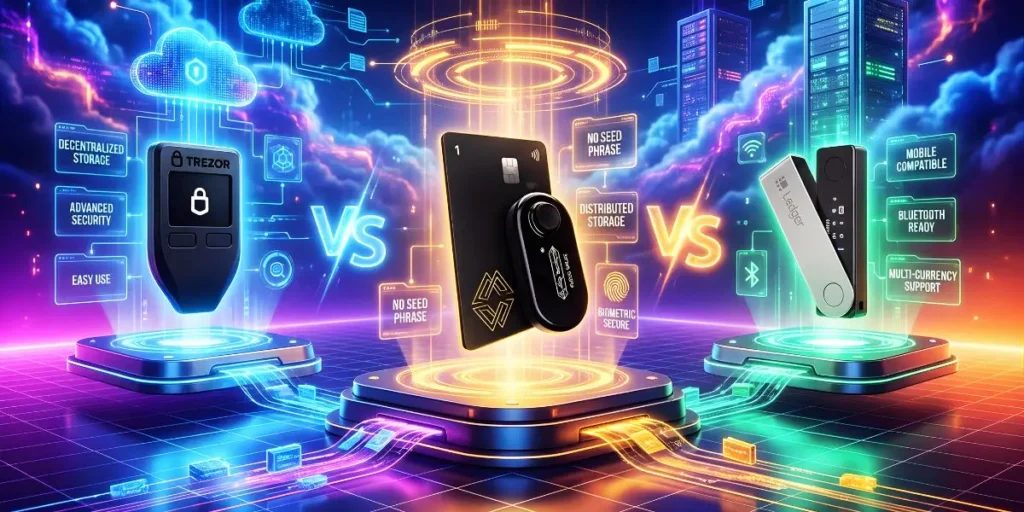
We are witnessing a paradigm shift in digital asset security. The old guard (Ledger and Trezor) is being challenged by innovators like Cypherock, who ask a simple question: why do we still use a piece of paper from the 15th century to protect 21st-century wealth?
In this deep dive, we are going to tear down the walls of traditional crypto storage. We will compare the titans—Cypherock vs Ledger vs Trezor—to determine which hardware wallet deserves a spot in your portfolio. By the end, you’ll know exactly what is the most secure way to hold crypto and whether a cold wallet without seed phrase is the right upgrade for you.
Why the Seed Phrase is Crypto’s Biggest UX Problem
When Bitcoin was young, writing down 24 words on paper was revolutionary. Today, it’s archaic. The seed phrase backup creates a massive single point of failure. If a thief finds your words, your funds are gone. If you store them in a safe, they might burn. If you hide them, you might forget where.
Modern security isn’t about hiding a secret; it’s about distributing trust. The concept of how to secure crypto without a seed phrase is gaining traction because it removes the human error element from the equation. You wouldn’t put all your gold in one lockbox with a single key made of paper, so why do it with your digital assets?
The Problem with the Paper Trail: Do You Need a Seed Phrase?
Before we compare devices, we have to address the elephant in the room: Do you need a seed phrase? Traditionally, yes. If you’ve ever used a Trezor or Ledger, you know the drill: initialize the device, watch it generate 12 to 24 words, and frantically search for a pen.
However, the seed phrase is a vector for attack. It can be photographed by a hidden camera, stolen by a roommate, or lost in a fire. According to the SEC’s Office of Investor Education, if you lose your private keys or seed phrase, you permanently lose access to your crypto assets .
This is where the market is splitting. While Ledger and Trezor still rely on this model (albeit with improvements like Shamir Backup), Cypherock is pioneering a seedless future.
Let’s be honest for a second. When was the last time you looked at your seed phrase backup? Is it in a sock drawer? A safe? Buried in the backyard? The very nature of a seed phrase creates a “single point of failure.”
The market has responded to this irony. The concept of a cold wallet without seed phrase is gaining massive traction because it removes the human error element. You can’t lose what you never had. You can’t have your seed phrase stolen via phishing if it doesn’t exist.
Cypherock X1: The Seedless Revolution
If you are looking for the most untraceable crypto wallet or the highest level of fault tolerance, the Cypherock X1 is currently the gold standard. Cypherok’s philosophy is simple: “Don’t store keys, distribute them.”
How Cypherock Eliminates the Seed Phrase
The Cypherock X1 uses a decentralized key storage system. Instead of a seed phrase, your private key is split into five parts using Shamir Secret Sharing:
-
The X1 Vault: The main device (with a secure display and joystick).
-
Four NFC Cards: Durable, credit-card-sized pieces that hold “shards” of your key.
To sign a transaction, you need the vault and any two of the four cards. To recover your wallet, you don’t need a phrase; you just need the vault and one card, or two cards together . This means that Cypherock does not use a seed phrase—it uses a “shard” system.
Security Benefits
-
Tamper Resistance: Independently audited by Keldlabs (a firm known for finding flaws in Trezor and Ledger) .
-
No Single Point of Failure: Even if someone steals three of your cards, they cannot access your funds.
-
Inheritance Planning: You can give one card to a family member and keep the vault; they cannot access funds without you, but they can assist in recovery if something happens to you.
How It Works: The 2-of-3 (or 5) Principle
The Cypherock X1 kit comes with one “Vault” (the main device with a screen and joystick) and four NFC-enabled “Cards.” Here is the magic: Your private key is never assembled in one place.
-
The key is cryptographically sharded into five parts.
-
The Vault stores one shard.
-
Each of the four cards stores one shard.
-
To sign a transaction, you need the Vault + any one of the four cards.
This means that even if someone steals your Vault and two of the cards, your crypto is still safe. They don’t have enough shards to reconstruct the key . This is the ultimate answer to the question, “Do you need a seed phrase?” With Cypherock, the answer is a definitive no.
Real-World Application: Inheritance and Disaster Recovery
One of the most stressful aspects of crypto is inheritance. How do you pass assets on without handing over a seed phrase? Cypherock solves this with “Cypherock Cover.” You can assign guardians or store cards in different geographic locations. Since you only need 2-out-of-5 shards to recover, you can lose multiple cards to fire, flood, or theft and still recover your assets . This level of redundancy is unmatched.
Independent Validation
Security isn’t just about claiming to be secure; it’s about proving it. Cypherock has undergone independent audits by firms like Keldlabs—the same researchers who have found flaws in Trezor and Ledger devices . This level of transparency builds the “Trustworthiness” that modern users demand.
Trezor Safe 5: The Open-Source Veteran
When discussing Trezor vs Ledger, Trezor has always been the champion of open-source maximalists. The Trezor Safe 5 is their latest flagship, and it is a beautiful piece of kit.
Does Trezor use a seed phrase?
Yes. Trezor uses a seed phrase, but the Safe 5 allows for advanced options like Shamir Backup (SLIP39) . This lets you split your 20-word recovery backup into multiple shares (e.g., give 3 shares to 5 different people, requiring 3 to recover).
The Safe 5 features a vibrant color touchscreen with haptic feedback and an EAL 6+ Secure Element chip—the same security level found in high-end passports .
The Open-Source Advantage
Trezor’s firmware is 100% open-source. For the paranoid (we prefer the term “security-conscious”), this is huge. You can verify the code yourself (or trust that the community has). It also supports Tor integration and CoinJoin, making it a strong contender for privacy-focused users .
However, even with Shamir Backup, you are still dealing with words. You are responsible for ensuring those shares are stored in physically secure, geographically separate locations.
The Vulnerability of the Seed
Despite its strengths, the Trezor ecosystem still revolves around the seed phrase. If you are asking, “Does Trezor use a seed phrase?” —yes, absolutely. It is the core of its recovery model.
This reliance has led to attack vectors. Researchers have demonstrated “voltage glitching” attacks on Trezor’s hardware to extract the seed . While these attacks require physical possession of the device, they prove that if an adversary has your hardware and enough time, the seed can be compromised.
What is the difference between Cypherock and Trezor wallet?
The fundamental difference lies in the attack surface.
-
Trezor is a single-point-of-failure device. Secure the device, secure the seed. Lose the seed, lose the coins.
-
Cypherock distributes the trust. Even if a hacker physically possesses your Trezor and cracks your PIN, they have the keys. If a hacker possesses your Cypherock Vault, they have nothing but a useless piece of metal because they lack the card shards.
Side-by-Side: Cypherock X1 vs Ledger Nano X vs Trezor Safe 5
To visualize how to secure crypto without a seed phrase, let’s look at how these contenders stack up against the most critical security features.
| Feature | Cypherock X1 | Ledger Nano X | Trezor Safe 5 |
|---|---|---|---|
| Seed Phrase Requirement | None (Key Sharding) | Yes (12/24-word) | Yes (12/24-word or SLIP39) |
| Secure Element | EAL6+ (in Cards) | EAL5+/EAL6+ | EAL6+ |
| Single Point of Failure? | No (2-of-4 system) | Yes (Device + Seed) | Yes (Device + Seed) |
| Open Source | Hybrid (Vault open, Cards closed) | No (Firmware closed) | Yes (Fully) |
| Recovery Method | Any 2 of 5 shards | Seed Phrase or Ledger Recover | Seed Phrase or Shamir Backup |
| Asset Support | 18,000+ | 5,500+ | 1,000+ |
The Quest for Anonymity: What is the most untraceable crypto wallet?
While security and anonymity are cousins, they are not the same thing. A common query among privacy advocates is, “What is the most untraceable crypto wallet?”
If “untraceable” means no KYC, no data leaks, and no connection to your identity, then hardware wallets that require verified shipping addresses (all of them, to some extent) fall short of true anonymity. However, if we are talking about transactional privacy and self-custody:
-
Zengo offers keyless MPC security and doesn’t require a seed phrase, but it’s a hot wallet .
-
Trezor, being fully open-source, allows tech-savvy users to run their own nodes and use CoinJoin features (in partnership with Wasabi Wallet) to obfuscate transaction history. This makes it a strong contender for privacy.
-
Cypherock focuses on the security of the key itself, not the privacy of the transaction. However, by eliminating the seed phrase, it eliminates the risk of a metadata leak (like a photo of your seed ending up in cloud backup).
If you want to minimize your digital footprint, pairing a Cypherock X1 (for key custody) with a privacy-focused hot wallet interface might be the ultimate setup.
Ledger Nano X: The Feature-Rich Market Leader
Ledger dominates the market for a reason: ease of use and asset support. The Ledger Nano X supports over 5,500 cryptocurrencies and connects via Bluetooth to your phone, making it the most convenient option for active traders .
The Recover Controversy
Recently, Ledger introduced “Ledger Recover,” a service that allows users to backup their seed phrase via encrypted shards sent to three different entities (identities verified via ID). While technically secure, this caused an uproar in the community because it introduced a potential KYC link to the hardware wallet.
Is Trezor better than Ledger? It depends on your threat model.
-
Choose Ledger if you need maximum coin support and mobile convenience.
-
Choose Trezor if you prioritize open-source transparency and privacy features.
But both still leave you with the burden of the seed phrase.
Is Trezor better than Ledger?
This is a classic debate. Trezor is fully open-source, which is a huge win for transparency. However, Ledger has historically had the edge in physical security due to its Secure Element. But in 2025, the gap is closing.
-
Ledger still relies on the seed phrase for the primary backup. If you write that 24-word phrase on a piece of paper and someone finds it, your funds are gone—Secure Element or not.
-
Trezor also relies on a seed phrase, but they offer Shamir Backup (SLIP39) where you can split the seed into multiple shares. This is similar to Cypherock’s concept, but it’s a feature on top of a seed, not a replacement for it .
Head-to-Head: Cypherock vs Trezor Wallet
So, in the battle of Cypherock vs Trezor wallet, how do they stack up?
Usability
-
Trezor: The touchscreen on the Safe 5 makes it incredibly intuitive. If you are a beginner familiar with the concept of “seed phrases,” Trezor feels natural.
-
Cypherock: There is a slight learning curve with the multi-card system. However, the payoff is massive. Imagine never having to hide a piece of paper again.
Asset Support
-
Trezor: Supports thousands of coins.
-
Cypherock: Supports over 19,000 cryptocurrencies, integrating with major wallets like MetaMask .
The “Untraceable” Factor
Many users ask, “What is the most untraceable crypto wallet?” While no wallet is truly “untraceable” on a public blockchain, the hardware itself can be designed for privacy.
-
Trezor: Offers Tor and CoinJoin to obfuscate transactions.
-
Cypherock: By eliminating the seed phrase, you eliminate the risk of a physical backup being discovered and linked to your identity. Furthermore, its architecture ensures that if a customs agent or thief seizes one card, they find nothing of value.
Security Architecture
-
Cypherock X1: Shamir Secret Sharing (2-of-5). No single point of failure. Private key never assembled on a single device .
-
Ledger: Single private key stored on a secure element. Backed up by a 24-word seed phrase.
-
Trezor: Single private key. Backed up by a seed phrase (option to split via SLIP39).
Physical Backup Method
-
Cypherock X1: No seed phrase backup required. Recovery via X1 Cards and Vault.
-
Ledger: Physical paper/metal backup of 24 words, or optional Ledger Recovery Key (paid/subscription).
-
Trezor: Physical paper/metal backup of 12, 18, or 24 words.
Transparency
-
Cypherock X1: Open-source firmware; proprietary card code (for secure element integrity) .
-
Ledger: Partially open-source (OS and apps), hardware closed.
-
Trezor: Fully open-source.
Screen & Interface
-
Cypherock X1: 0.96″ OLED with a unique mini-joystick for navigation .
-
Ledger: Varies from button-based (Nano) to touchscreen E-Ink (Stax).
-
Trezor: Touchscreen on Model T; button-based on Safe models.
Best For…
-
Cypherock X1: Users who want to secure crypto without a seed phrase and want military-grade key distribution.
-
Ledger: Users who want a sleek app (Ledger Live) and a wide range of models.
-
Trezor: Purists who demand fully open-source code and community-driven development.
Real-World Scenarios: Why Seedless Matters
Let’s look at two real-world scenarios to understand why this comparison matters.
Scenario A: The Coffee Shop Disaster
You have a Trezor. You write your seed phrase on a piece of paper and hide it in your home office. Six months later, you have guests, or a cleaner, or a repairman. Your seed phrase is photographed in 2 seconds. Weeks later, your funds are gone. Is Trezor better than Ledger in this situation? No—both fail because the backup was compromised.
Scenario B: The Cypherock Advantage
You have a Cypherock X1. You carry the Vault in your bag and keep two cards at home, one in a safety deposit box, and one with a trusted relative. If your bag is stolen, the thief has a useless piece of hardware. They have one shard. They cannot move your funds. You simply buy a new Vault, grab your backup card from home, and recover everything—without a phrase .
Recovery: What Happens When Things Go Wrong?
A common panic point is losing access. Let’s address the FAQs directly.
How to recover Trust Wallet without phrase?
If you are using a software wallet like Trust Wallet and you lose your phrase, you are likely out of luck. Trust Wallet is non-custodial; the phrase is the wallet . However, if you connected Trust Wallet to a hardware wallet like Cypherock or Trezor, you don’t need the Trust Wallet phrase—you need the hardware to sign. This highlights why hardware wallets are superior: they abstract away the vulnerability of software-only storage.
Recovery with Cypherock
If you lose your Cypherock Vault, you simply buy a new one. Using the CySync app, you tap two of your backup cards to the new Vault, and your wallet is restored. No hunting for a scrap of paper.
Recovery with Trezor/Ledger
If you lose your Trezor, you must buy a new one and input your 20-word recovery backup into the new device. This process exposes your seed phrase to the environment (you are typing it into a computer or the device). If that computer is compromised by malware, your seed is gone.
What is a cold wallet without seed phrase?
A cold wallet without seed phrase is a hardware device that does not generate or rely on a human-readable list of words for recovery. Instead, it uses cryptographic methods like Multi-Party Computation (MPC) or Key Sharding. The Cypherock X1 is a prime example, where the private key is split into shards and stored across multiple physical cards and the vault. Recovery requires gathering a threshold of these physical shards, not reciting words.
How to recover Trust Wallet without phrase?
This is a critical question for many users. Trust Wallet is a non-custodial software wallet. According to industry standards, if you lose your recovery phrase for a non-custodial wallet like Trust Wallet, there is no way to recover the account . The developers do not store your information on a central server. This highlights exactly why hardware wallets like Cypherock are superior: they replace that fragile phrase with durable, recoverable hardware shards.
What is the most secure way to hold crypto?
The most secure way is a multi-layered approach:
-
Eliminate the Seed: Use a device like the Cypherock X1 to remove the risk of phrase theft.
-
Use a Secure Element: Ensure your device has an EAL6+ certified chip to protect against physical side-channel attacks .
-
Transaction Verification: Always use a device with a physical screen (like the Cypherock Vault or Trezor touchscreen) to verify the exact details of the transaction. Never “blind sign” on a PC.
How to Choose the Best Hardware Wallet for Your Portfolio
So, which one wins the Cypherock vs Ledger vs Trezor battle? The answer depends on your threat model.
-
For the Long-Term Hodler: If you are a “whale” or someone holding significant life-changing wealth, the Cypherock X1 is the safest bet. The ability to secure crypto without a seed phrase eliminates the risk of the “paper in the safe” getting destroyed. The distributed nature of the X1 Cards means you can store them in different geographic locations, making you immune to house fires, floods, or local theft.
-
For the Active DeFi User: If you are constantly swapping, staking, and connecting to dApps, Ledger’s extensive Ledger Live integration and WalletConnect support might be more convenient. The Cypherock CySync app is catching up fast with support for over 15 networks and 1000+ cryptocurrencies for swapping , but Ledger’s ecosystem is currently broader.
-
For the Privacy Maximalist: Trezor remains the king of transparency. If you want to ensure no corporation can ever push a malicious update that extracts your keys, Trezor’s fully open-source nature is reassuring.
Case Study: Consider a crypto fund manager who lost a Trezor in a boating accident (a classic tale). Despite having the seed phrase backed up, the backup was in a safe that also went underwater, rendering the paper illegible. If they had used a Cypherock X1, they would have simply grabbed two of the four X1 Cards from separate locations (e.g., home safe and office safe) and a new Vault to restore everything. No seed phrase, no problem.
Future-Proofing Your Crypto: Inheritance and Disaster Recovery
One of the most overlooked aspects of crypto security is inheritance. What happens to your Bitcoin when you’re gone?
-
Cypherock X1 allows you to distribute the four cards to different lawyers, family members, or trusted friends. By setting up a recovery threshold (2-of-4 cards + vault), you can create a decentralized inheritance plan.
-
Ledger offers a “Ledger Recover” service that uses ID verification, but this requires trusting a third party.
-
Trezor leaves it entirely up to you to ensure your heirs find and understand your seed phrase.
If you are planning for the long term, learning how to secure crypto without a seed phrase simplifies inheritance. You don’t have to teach your non-tech-savvy spouse what a BIP39 seed is; you just hand them a card and tell them to tap it if something happens to you.
The Verdict: Which Should You Buy?
We’ve looked at the data, the security audits, and the user experiences. Here is the bottom line.
Choose the Trezor Safe 5 if:
-
You are a Bitcoiner who values open-source ethos.
-
You want privacy tools like CoinJoin out of the box.
-
You are comfortable with the responsibility of storing a seed phrase (or Shamir shares) in a fireproof, waterproof safe.
Choose the Ledger Nano X if:
-
You trade shitcoins and NFTs on various networks.
-
You need Bluetooth connectivity for mobile transactions.
-
You trust the company’s secure element and don’t mind the closed-source firmware or the Recover feature.
Choose the Cypherock X1 if:
-
You want the most secure way to hold crypto available today.
-
You are terrified of losing or exposing a seed phrase.
-
You want a cold wallet without seed phrase friction.
-
You are holding for the long term and want inheritance-ready security.
Disclaimer: This article is for informational purposes only and does not constitute financial advice. Cryptocurrency investments are volatile and involve significant risk. Always do your own research (DYOR) before purchasing hardware or digital assets. The security features mentioned are based on manufacturer specifications and independent audits available at the time of writing.
Frequently Asked Questions (FAQs)
What is the difference between Cypherock and Trezor wallet?
The main difference is the backup mechanism. Trezor uses a seed phrase (a list of words) to back up the wallet. Cypherock eliminates the seed phrase entirely, instead splitting the private key into encrypted shards stored across the main vault and four NFC cards. This makes Cypherock resistant to single points of failure like a stolen piece of paper.
Is Trezor better than Ledger?
Is Trezor better than Ledger? It depends on your priorities. Trezor offers fully open-source firmware and stronger privacy integrations (Tor/CoinJoin), which appeals to Bitcoin purists. Ledger offers broader asset support (15,000+ coins) and Bluetooth convenience, appealing to DeFi users and traders .
What is the most untraceable crypto wallet?
What is the most untraceable crypto wallet? For hardware, Trezor offers strong privacy features like CoinJoin to mix coins. However, Cypherock offers a different kind of privacy by ensuring that even if a single hardware component is discovered, it holds no identifiable key material, making physical surveillance less effective.
Does Trezor use a seed phrase?
Yes, Trezor uses a seed phrase (usually 12, 18, or 20 words). Newer models like the Trezor Safe 5 support Shamir Backup, which allows you to split that phrase into multiple shares, but the underlying principle still relies on the security of those words.
What is the most secure way to hold crypto?
Currently, what is the most secure way to hold crypto involves a combination of hardware isolation and distributed risk. The Cypherock X1 currently leads in this area because it removes the seed phrase vulnerability. For large sums, combining a Cypherock for primary storage with a multi-signature setup is considered best practice.
Do you need a seed phrase?
Do you need a seed phrase? With legacy wallets (Ledger, Trezor), yes. However, with next-gen wallets like Cypherock and the new CoolWallet Go , the answer is no. These devices use backup cards or sharding to recover access without forcing you to manage a human-readable list of words.
What is a cold wallet without seed phrase?
A cold wallet without seed phrase is a hardware device that does not generate or require a mnemonic phrase for recovery. The Cypherock X1 is the prime example, using a multi-card system. The CoolWallet Go also offers a “seedless backup system” using a backup card .
How to recover Trust Wallet without phrase?
How to recover Trust Wallet without phrase? If you are using only the Trust Wallet app and you have lost the phrase, it is generally impossible to recover the funds, as the wallet is non-custodial . However, if your Trust Wallet was linked to a hardware wallet (like Cypherock or Trezor), you do not need the Trust Wallet phrase. You simply reconnect the hardware device to recover access to those addresses.
Is it really possible to secure crypto without a seed phrase?
Yes. Wallets like the Cypherock X1 use Shamir’s Secret Sharing to split your private key into cryptographic shards. These shards are stored on different hardware components. When you need to sign a transaction, the shards are combined mathematically. The full private key is never stored on or transmitted by a single device, thus eliminating the need for a textual seed phrase backup.
Can I import my old seed phrase into Cypherock?
Absolutely. The Cypherock X1 can function as a seed phrase vault. You can securely import the seed phrases from your old Ledger or Trezor wallets into the Cypherock ecosystem, bringing them under the protection of the X1’s multi-card security model .
What happens if Cypherock goes out of business?
This is a crucial question for any hardware wallet. Cypherock allows you to export the standard BIP39 seed derived from your shards if you ever need to. This ensures you are never locked into their ecosystem. You can always take your seed and restore it in a Ledger or Trezor if necessary, maintaining self-custody at all times .
How many coins does each wallet support?
-
Cypherock X1: Over 18,000 assets .
-
Ledger: Over 5,000+ via Ledger Live and third-party wallets.
-
Trezor: Supports most major coins and a wide selection of altcoins.