
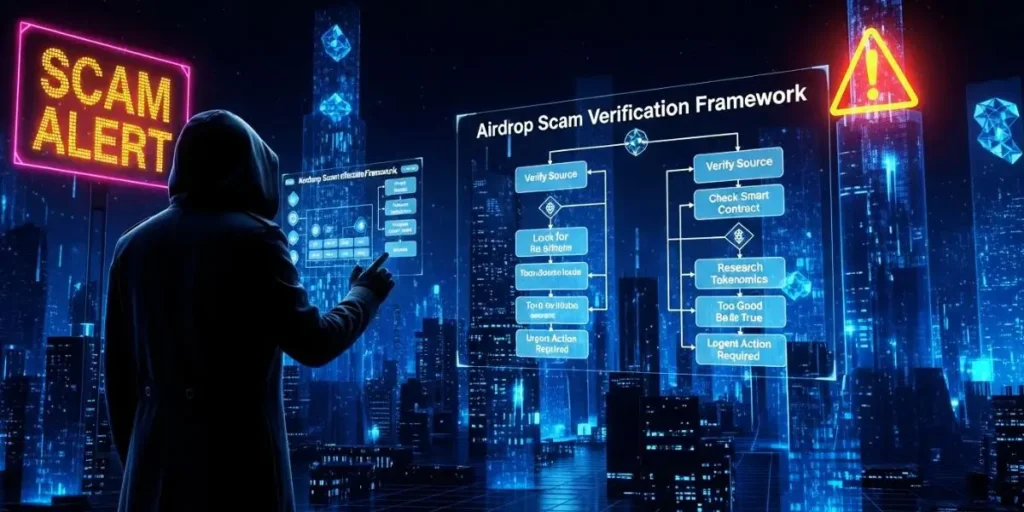

Have you ever felt that mix of excitement and suspicion when you hear about a new crypto airdrop? That feeling is your best defense. In the wild west of Web3, airdrop scams have evolved from clumsy cons into sophisticated psychological operations designed to drain your wallet in seconds. The promise of “free money” is a powerful lure, and scammers know it.
But what if you could build an unbreakable shield? This isn’t just about caution; it’s about installing a verification operating system in your mind. By the end of this guide, you won’t just randomly wonder, “how to know if an airdrop is legit?”—you’ll have a battle-tested, step-by-step framework to separate genuine opportunities from devastating traps. Let’s turn your paranoia into protocol.
In the high-stakes world of Web3, where major airdrops like Uniswap and Arbitrum have created millionaires overnight, scammers are conducting parallel, fraudulent operations to exploit that very hype. The promise of “free money” is an irresistible lure, making crypto airdrops a prime target for sophisticated fraud.
This guide moves beyond basic warnings. It provides a professional, actionable verification framework—a step-by-step system you can apply to any airdrop opportunity to distinguish legitimate gold from fool’s gold. Your journey to secure, profitable participation starts here.
Understanding the Enemy: Why Airdrop Scams Are So Effective
Before we build our defenses, we must understand the attack vectors. An airdrop scam isn’t a single tool; it’s a full-funnel deception strategy.
-
The Psychological Hook: Scammers exploit FOMO (Fear Of Missing Out) and greed. They create urgency (“Claim within 24 hours!”) and mimic social proof (fake Reddit threads, Telegram groups filled with bots).
-
The Technological Bait: These scams often involve fake websites that are clones of legitimate projects, phishing emails pretending to be from wallets like MetaMask, or malicious smart contracts that look like standard airdrop claim pages.
-
The Endgame: The goal is rarely just to get your email. It’s to trick you into connecting your wallet to a malicious dApp, approving a transaction that drains your tokens, or entering your secret recovery phrase on a fake site.
A common question on forums like airdrop scams Reddit threads is, “Are crypto airdrops a scam?” The answer is nuanced. Legitimate airdrops are a powerful marketing and community-building tool used by real projects. The fake ones are 100% a scam. The trick is telling them apart, which is exactly what our framework solves.
The Anatomy of an Airdrop Scam: Understanding the Attack Vectors
Before building defenses, you must understand the enemy’s playbook. Modern crypto airdrop scams are rarely crude. They are psychological operations (social engineering) that manipulate your trust, greed, or fear. Here are the most common and dangerous schemes:
-
The Phishing Lure: Scammers create flawless clones of legitimate project websites or announce fake airdrops through hijacked social media accounts. The goal is to trick you into connecting your wallet to a malicious site, where a single signature can grant unlimited access to your funds.
-
The Poisoned Token (or NFT): You receive unsolicited tokens in your wallet. Exploring this token on a block explorer reveals a website URL, enticing you to “claim” or “sell” it. Interacting with this site triggers a malicious smart contract designed to drain your wallet.
-
The Rug Pull in Disguise: A seemingly legitimate new project launches with an airdrop to build a community. After generating hype and liquidity, the anonymous developers disappear with all the funds, leaving the airdropped tokens worthless.
-
Social Engineering & Deepfakes: This is the fastest-growing threat. Scammers use AI to clone voices of CEOs or create deepfake videos of influencers promoting a fraudulent airdrop. They infiltrate Discord and Telegram groups, posing as friendly community members or support staff to offer “exclusive” access.
The Common Hook: Urgency. All these scams weaponize FOMO (Fear Of Missing Out) with phrases like “Claim ends in 24 hours!” or “Exclusive access for early users.” A legitimate project has no need for such high-pressure tactics.
Understanding the Airdrop Landscape: Legitimacy vs. Fraud
A crypto airdrop is a marketing strategy where blockchain projects distribute free tokens or coins to wallet addresses. Legitimate projects use them to reward early adopters, decentralize governance, and incentivize ecosystem participation. The allure is undeniable: Uniswap’s 2020 airdrop turned 400 UNI tokens (worth ~$1,200 at launch) into over $16,800 at its peak.
However, where there is value, scammers follow. Airdrop scams exploit this excitement to steal funds or sensitive data. They typically promise free digital assets in exchange for tasks like sharing personal information, connecting a wallet, or paying a small “activation fee”. The scammer’s goal is always the same: to gain access to your wallet or trick you into divulging your private keys.
Table: Common Types of Airdrop Scams and Their Mechanisms
| Scam Type | How It Works | Primary Goal | Example |
|---|---|---|---|
| Phishing Attacks | Fake websites/DMs impersonating real projects. | Steal seed phrases or wallet login info. | Fake “Arbitrum claim” sites post-airdrop. |
| Malicious Smart Contracts | Tokens requiring contract interaction to “claim” or “swap”. | Gain unlimited token spending approvals. | Fake token airdrops with embedded malicious URLs. |
| Pump and Dump Schemes | Widespread distribution of worthless tokens to create hype. | Dump developer holdings on retail buyers. | Anonymous teams with no product but heavy marketing. |
| Dust Attacks | Sending tiny amounts of unknown tokens to track wallets. | Track activity or lure to malicious sites. | Unsolicited, worthless tokens appearing in wallet. |
What Makes an Airdrop Truly “High-Potential”?
Not all free tokens are equal. The most valuable airdrops in crypto history share distinct, verifiable characteristics that separate them from scams or worthless token dumps.
1. Projects with Real Traction and Utility
The fundamental rule is simple: no product, no value. High-potential airdrops come from projects with:
-
A working, usable product (e.g., a live DEX, lending protocol, or blockchain).
-
Substantial Total Value Locked (TVL), indicating real user trust and capital.
-
Genuine user adoption and organic growth, not just social media hype.
2. Transparent, Credible Teams and Backers
Anonymity is a major red flag in 2026. Legitimate projects typically feature:
-
Publicly known founders and developers with verifiable reputations.
-
Backing from top-tier venture capital firms like a16z, Paradigm, or Sequoia, who conduct rigorous due diligence.
-
Regular, transparent communication via official blogs, GitHub repositories, and community calls.
3. Fair, Merit-Based Distribution Models
Scams often promise equal, huge rewards for minimal effort. Legitimate distributions carefully reward genuine contributors:
-
They use sophisticated points systems based on transaction history, bridge activity, and network engagement (like Arbitrum did).
-
They often penalize Sybil farmers (users creating multiple fake wallets) and prioritize real, long-term users.
-
Allocations are proportional to meaningful contribution, not just wallet registration.
The Step-by-Step Verification Framework: Your Actionable Checklist
Before clicking any “Claim” button, run through this four-step verification protocol. This systematic approach is your primary defense.
Step 1: Source Verification – Confirming Authenticity
The first and most critical step is verifying the announcement’s origin.
-
Cross-Check Official Channels: Never trust a single source. Go directly to the project’s verified Twitter account, official Discord server, and blog. Compare the announcement word-for-word.
-
Scrutinize URLs Character-by-Character: Scammers use lookalike domains (e.g., “arnbitrum.com” instead of “arbitrum.foundation”). Always check for HTTPS and correct spelling.
-
Beware of Unsolicited Contact: No legitimate airdrop is announced solely via direct message (DM) on Twitter, Telegram, or Discord. If you receive a DM about an airdrop you didn’t apply for, it’s almost certainly a scam.
Step 2: Project Due Diligence – Researching Fundamentals
If the source checks out, investigate the project itself.
-
Analyze Financial and Usage Metrics: Use DeFiLlama to check the project’s TVL growth trend. Is it organic and sustained? Check trading volume and unique user counts.
-
Verify Funding and Team: Search Crunchbase or RootData for confirmed funding rounds and investor names. Look up team members on LinkedIn to confirm their identities and experience.
-
Check Audit Reports: Any project handling user funds must have public smart contract audits from reputable firms like Trail of Bits, OpenZeppelin, or CertiK. No audit is a severe warning sign.
Step 3: Smart Contract and Wallet Safety – The Technical Check
Before connecting your wallet, perform these technical verifications.
-
Inspect the Smart Contract: Find the official contract address from the project’s documentation. Paste it into Etherscan or the relevant block explorer. Verify that the code is “Verified” and check for any suspicious functions.
-
Use a Dedicated “Burner” Wallet: Never claim an airdrop with your main wallet. Use a separate wallet containing only the minimal funds needed for gas fees. This limits potential losses if the claim is malicious.
-
Review Token Approvals: If the claim process asks for a token approval, read the prompt meticulously. Does it request “unlimited” spending approval? If yes, cancel immediately. Use tools like Revoke.cash to periodically review and revoke old approvals.
Step 4: The Final Common-Sense Gut Check
Apply basic critical thinking before the final click.
-
Beware of Upfront Payments: It is 100% a scam if you are asked to send cryptocurrency to “verify,” “activate,” or “unlock” your airdrop. Legitimate distributions are free to claim.
-
Ignore Unrealistic Promises: Be extremely skeptical of phrases like “guaranteed returns,” “100x potential,” or “limited time offer.” These are emotional triggers, not investment fundamentals.
-
Ask the Community: Visit trusted crypto forums (like specific subreddits or Discord communities) and ask if others are evaluating the same airdrop. Collective scrutiny is powerful.
Real-World Tools & Tactics: Your Practical Arsenal
Let’s translate the framework into tools you can use today.
-
CoinMarketCap/Alerts: Set up alerts for projects you follow. Get news from the source.
-
Etherscan & BscScan: The blockchain explorers are your truth machine. Verify token contract addresses here.
-
Pocket-Sized Checklist: Bookmark this. Before any claim, ask:
-
✅ Source verified officially?
-
✅ Project has audit/doxxed team?
-
✅ URL is perfect?
-
✅ Offer seems logical?
-
✅ Never sharing seed phrase?
-
Common Airdrop Scam Mechanics: Know Your Enemy
Understanding the specific tactics scammers use will help you recognize them instantly.
The Phishing Playbook
After major legitimate airdrops, scammers launch coordinated phishing campaigns. They create hundreds of fake “claim” sites that are visual clones of the official page. These are promoted via:
-
Fake Twitter accounts impersonating team members or influencers.
-
Compromised Discord or Telegram accounts in community servers.
-
Promoted search ads that appear above official links in Google results.
Always navigate directly to a project’s official link from their verified Twitter bio.
Malicious Token Approvals and “Honeypot” Tokens
This is a more technical and devastating scam. You might receive unsolicited tokens or go to claim your “reward.” The process involves signing a smart contract transaction.
-
The malicious contract doesn’t send you tokens; instead, it asks you to approve it to spend your existing tokens (like your ETH or USDC).
-
If you sign, you’ve given the scammer permission to drain that specific token from your wallet. They often request “unlimited” approval, giving them carte blanche.
Always read what a transaction is asking for. If it says “Approve” for spending, not “Receive,” be on high alert.
The “Free NFT” Airdrop Trap
An emerging tactic is the fraudulent NFT airdrop. You may find an NFT you didn’t purchase in your wallet. The image or description contains a link to a “claiming” website. This site will almost certainly phish for your secret recovery phrase or trick you into a malicious approval.
The safe practice is to ignore unsolicited NFTs completely. Most wallets allow you to hide them from view.
Essential Tools for the Airdrop Hunter’s Security Toolkit
Equip yourself with these non-negotiable tools for verification and protection.
Table: Essential Security and Verification Tools
| Tool Category | Tool Name | Primary Use | Why It’s Essential |
|---|---|---|---|
| Analytics & Verification | DeFiLlama | Checking a project’s TVL and growth metrics. | Provides objective data on real usage and capital. |
| Analytics & Verification | Etherscan / Block Explorer | Inspecting smart contract code and transactions. | Lets you verify contract legitimacy and audit status. |
| Analytics & Verification | Revoke.cash | Reviewing and revoking token approvals. | Critical for removing dangerous permissions. |
| Wallet Safety | Dedicated “Burner” Wallet | Isolating risk during airdrop claims. | Limits maximum possible loss to a small, separate wallet. |
| Wallet Safety | Hardware Wallet (e.g., OneKey) | Securing primary assets offline. | Private keys never touch the internet, blocking remote phishing. |
| Community Intelligence | Project’s Official Discord/Twitter | Getting announcements from the true source. | The single source of truth for any project update. |
Why a Hardware Wallet is a Game-Changer: A hardware wallet like OneKey or Tangem keeps your private keys in an offline, secure chip. This makes you immune to remote phishing attacks—a scammer cannot steal what isn’t connected to the internet. However, remember: even a hardware wallet cannot save you from signing a malicious smart contract approval. You must still verify every transaction on the device’s screen.
What to Do If You’ve Been Scammed: Damage Control Steps
If you suspect you’ve fallen victim, act with speed and precision to mitigate losses.
-
Immediate Isolation: Disconnect your wallet from all websites immediately using your wallet extension’s “Connected Sites” menu. If you used a software wallet, transfer all remaining funds to a brand-new, secure wallet with a newly generated seed phrase.
-
Review and Revoke: Go to Revoke.cash and connect the compromised wallet. You will see a list of all token approvals. Revoke every approval you don’t 100% recognize and trust.
-
Report and Alert: Report the scam to the real project’s official support or security channel. They can warn their community. You can also report phishing websites to Google Safe Browsing.
-
Strengthen Security Posture: Enable all available security features—two-factor authentication (2FA) on exchanges, transaction signing on wallets. Treat this as a costly lesson and commit to the verification framework moving forward.
Building Long-Term Safe Habits: Beyond a Single Airdrop
Crypto security is a lifestyle, not a one-time action. Integrate these habits:
-
Practice “Wallet Hygiene”: Regularly (monthly) review and clean your token approvals on Revoke.cash. Use different wallets for different purposes: one for holding, one for DeFi interactions, one for airdrop experiments.
-
Cultivate Healthy Skepticism: In crypto, if something seems too good to be true, it is. Your default stance should be “guilty until proven innocent” for every new offer.
-
Commit to Continuous Learning: Scam tactics evolve. Follow trusted security-focused blogs and researchers in the crypto space to stay updated on new threats.
-
Prioritize Security Over FOMO (Fear of Missing Out): Missing a legitimate airdrop is a minor opportunity cost. Losing your life savings to a scam is catastrophic. Patience and caution always win.
Future-Proofing Against Next-Gen Scams: AI, Deepfakes, and Beyond
The threat landscape is evolving. By 2026, cybersecurity experts predict that AI-generated deepfake videos and audio will become nearly indistinguishable from reality, making traditional verification harder.
-
The Deepfake CEO: Imagine a video of a well-known crypto founder announcing an airdrop on a cloned YouTube channel. The voice, mannerisms, and background are perfect.
-
Your Defense: Multi-channel verification. If you see an unexpected announcement, verify it through a second, independent official channel. Did the founder also post it on their official Twitter? Is it in the project’s Discord announcement channel? If something feels off, trust your gut and wait for community confirmation.
Your Action Plan: The Airdrop Security Checklist
Print this out or save it. Use it for every single airdrop.
-
SOURCE: I found this airdrop announcement on the project’s verified website or social media channel.
-
PROJECT: The team is public/doxxed, the whitepaper is logical, and the community sentiment is neutral or positive.
-
CONTRACT: The smart contract address is verified on a block explorer and has a public audit from a known firm.
-
WALLET: I am using a dedicated burner wallet with minimal funds for this interaction.
-
CONNECTION: I am NOT connecting my main hardware wallet to this site.
-
APPROVAL: I will carefully check any transaction pop-up for unlimited spending approvals and reject it if found.
-
CLEANUP: After claiming, I will revoke token approvals and transfer gains to my secure wallet.
By institutionalizing this framework, you transform from a potential target into a vigilant participant. You’ll not only avoid airdrop scams but also develop the discerning eye needed to identify truly valuable opportunities in the Web3 space.
Conclusion
How to avoid airdrop scams is not about luck; it’s about disciplined process. The excitement of Web3 shouldn’t be dampened by fear, but guided by a structured, skeptical mindset. By implementing this 6-step verification framework, you transform from a potential victim into a savvy participant.
You are now the gatekeeper of your own digital assets. Share this guide with your community. The more informed we all are, the harder we make it for scammers to operate.
Ready to audit your current airdrop opportunities? Go back to your open tabs and run them through the framework now. What did you find? Share your experiences in the comments below to help others learn.
Frequently Asked Questions (FAQs)
What is the #1 red flag for an airdrop scam?
The number one red flag is any request for your private key, seed phrase, or a request to “validate” your wallet by sending crypto first. Legitimate airdrops never require this. A close second is being contacted out of the blue via direct message with an “exclusive” offer.
I received unsolicited tokens in my wallet. What should I do?
Do not interact with them. The safest course of action is to ignore them completely. Do not attempt to sell, transfer, or “claim” them, as this interaction can trigger a malicious contract. Most reputable wallets allow you to hide these tokens from your view.
Are hardware wallets completely safe from airdrop scams?
Hardware wallets provide excellent security by keeping your private keys offline, making them immune to remote phishing attacks. However, they cannot protect you from signing a malicious transaction yourself. If you connect your hardware wallet to a scam site and approve a fraudulent contract, your funds can still be stolen. Always use a burner wallet first.
How can I check if I’ve granted dangerous token approvals?
Use decentralized approval management tools like Revoke.cash. Connect your burner wallet (never your main wallet first) to these sites to see a list of all contracts you’ve granted spending allowances to. You can revoke any that look suspicious or that you no longer use.
What’s the next big trend in crypto scams I should be aware of?
AI-powered social engineering. Scammers are using artificial intelligence to create convincing deepfake videos and clone voices of executives or influencers to promote fraudulent airdrops and projects. Always verify major announcements through multiple official channels and be skeptical of anything that creates a strong, urgent emotional reaction.
How to avoid airdrop scams in 2026?
Use a strict verification framework: always confirm news from official project channels, scrutinize website URLs for misspellings, never share your private keys or seed phrase, and use tools like CoinMarketCap and Etherscan to independently verify project and token details before connecting your wallet.
Are fake airdrops a scam?
Yes, 100%. Fake airdrops are a pervasive type of crypto scam designed solely to steal your assets or personal information. They mimic legitimate crypto distribution events to lure victims into connecting their wallets to malicious sites or approving draining transactions.
Are crypto airdrops a scam?
Not inherently. Legitimate crypto airdrops are a common marketing strategy for real projects. However, the space is rife with airdrop scams. The key is rigorous due diligence to distinguish the real, community-building distributions from the fraudulent ones.
How do I know if an airdrop is legit?
You verify it. Check the project’s official social media and website. Search for community discussions on Reddit about potential scams. Use a trusted aggregator like CoinMarketCap. If the offer requires an upfront payment, seems too good to be true, or asks for your seed phrase, it is definitively not legit.
How do I prevent unwanted AirDrop requests? (For Apple Users)
This refers to Apple’s AirDrop feature, not crypto. To prevent unwanted file-sharing requests on iOS/macOS, go to Settings > General > AirDrop and set it to “Contacts Only” or “Receiving Off.” This prevents strangers from seeing your device.
Can someone steal your information from AirDrop (Apple)?
While designed to be secure between Apple devices, accepting files from unknown senders via Apple AirDrop can potentially expose you to malicious files (like malware-disguised documents). It’s best to only accept from known contacts.
Is it safe to accept AirDrop from strangers?
No. For Apple AirDrop, you should not accept files from strangers, as they could contain harmful content. For crypto airdrops, you should never interact with or claim an airdrop from an unverified, stranger-led source, as it is almost certainly a scam.
How do I report a MetaMask phishing email?
Do not click any links. Forward the entire suspicious email to phishing@metamask.io. This helps their security team track and dismantle phishing campaigns. You can also report the phishing site to Google Safe Browsing.
What is a MetaMask airdrop checker?
A tool, ideally accessed only through the official MetaMask portfolio interface or website, that allows users to check their eligibility for official token distributions related to the MetaMask ecosystem. Be extremely cautious of third-party sites posing as MetaMask airdrop checkers, as these are common phishing traps.
Disclaimer: This article is for informational and educational purposes only. It does not constitute financial, investment, or security advice. The cryptocurrency market is highly volatile and risky. You are solely responsible for conducting your own due diligence and for securing your own assets. The author and publisher are not liable for any financial losses resulting from actions taken based on the information provided herein.