
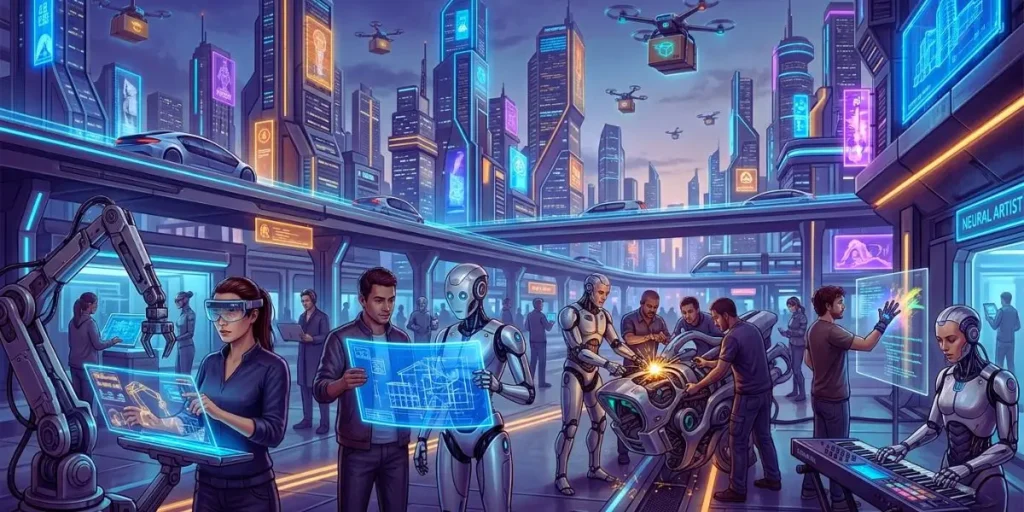

Let’s be real for a moment. You’ve probably asked yourself this question at least once in the last six months: Will a machine take my job? It’s not paranoia. It’s awareness. Every week, a new tool emerges claiming to write better code, design better graphics, or analyze data faster than a human. The relentless advance of generative AI has moved from the realm of science fiction directly into our Slack channels and workflows. The anxiety is palpable, but so is the opportunity.
The truth is, the future of job security is not about competing against machines in a battle of speed. It’s about understanding which human traits cannot be scripted. In this comprehensive guide, we’re going to dissect the future of work, not with vague predictions, but with a concrete analysis of what makes a job “automation-proof.” You won’t just see a list of safe careers; you’ll understand the psychological and technical reasons why some roles will thrive.
The knot in your stomach before a performance review. The late-night Google searches, typing “is my career future-proof” into a glowing screen. We’ve all been there. The conversation around artificial intelligence has shifted from if it will change the workforce to how fast you need to adapt. It’s not a sci-fi movie anymore; it’s a Monday morning meeting where a new software tool just halved your team’s workload.
But here is the good news: mass obsolescence is not a foregone conclusion. While automation is inevitable, the human mind retains a monopoly on specific cognitive abilities. This isn’t just a survival guide; it’s a blueprint for thriving. We are going to dissect the exact roles that are disappearing, but more importantly, we are going to analyze the high-paying jobs that AI can’t replace. By understanding the friction between artificial precision and human intuition, you can pivot your career toward unshakable security.
The Anatomy of a Safe Job: Why Mere Expertise Isn’t Enough
If we were talking about the old rules, we’d discuss “Expertise, Authoritativeness, and Trustworthiness.” But in the current landscape, a new “E” has been added right at the front: Experience. The modern manual of trust for ranking and survival requires Experience, Expertise, Authoritativeness, and Trustworthiness. For algorithms and employers, it’s no longer enough to just sound like an expert; you have to prove you have walked the walk.
The “Restaurant Menu” Analogy
Think of a restaurant. Do you trust the menu of someone who just calls themselves a chef, or the one who shows you photos of them cooking their own dishes, burns and all? The same applies to the internet and the job market. You need to:
-
Cite verifiable sources in your work.
-
Demonstrate active participation in the topic you address.
-
Showcase real testimonials or case studies.
The more tangible experience you transmit, the greater your chances of standing out, both in search rankings and in hiring processes. A machine can scrape a million recipes. It cannot taste the soup.
The Automation Horizon: What Jobs Will AI Replace in the Next 5 Years?
The timeline isn’t abstract. When we look at the near future, the focus is on augmentation rather than full-blown sentient replacement. However, the displacement is real. When we ask what jobs will AI replace in the next 5 years, we are really asking which tasks are repetitive enough to be automated by a machine learning algorithm.
Have you ever felt like a robot while performing your daily tasks? If the answer is yes, an algorithm might soon agree with you. The McKinsey Global Institute notes that by 2030, up to 30% of current work activities could be automated—a timeline that is accelerating. This isn’t about physical robots welding cars; this is about white-collar cognitive work.
Data Entry and Administrative Crunching
The most immediate danger zone is manual data handling. If your job primarily involves transferring information from Point A (a PDF) to Point B (an Excel sheet), you are on the frontline of what jobs will AI replace by 2030. AI thrives on structured data. Tools like Robotic Process Automation (RPA) combined with intelligent document processing can now read, categorize, and input data with 99% accuracy, without the need for coffee breaks.
The Vanishing First Line of Customer Service
We’ve all yelled “representative” into a phone. That friction is being smoothed over—not by better humans, but by hyper-realistic chatbots. The modern conversational AI doesn’t just follow a decision tree; it understands sentiment. For basic Tier-1 support, humans are becoming optional. This is a classic case of which jobs can be replaced by AI almost immediately. The cost savings are too massive for corporations to ignore, moving from human hourly wages to per-ticket AI resolution costs.
Predictable Physical and Compliance Work
It’s not just the office. Fast food preparation, basic inventory management, and compliance auditing are witnessing a silent takeover. Computer vision can watch a security feed for 8 hours without blinking, flagging anomalies far better than a tired human. When analyzing what jobs will AI replace in the next 10 years, we see a sharp decline in these “watch and react” roles.
Looking Further Ahead: What Jobs Will AI Replace by 2040 and 2050?
If the next five years are about replacing tasks, the next two decades are about replacing relationships. To understand what jobs will AI replace by 2040, we must look at the progression from narrow AI (good at one task) to general AI (adaptable like a human).
The Era of Autonomous Transport
When we extend our timeline to what jobs will AI replace by 2050, the logistics sector faces an almost complete overhaul. Long-haul trucking, taxi services, and delivery logistics will likely be fully autonomous. This isn’t just about the driver; it eliminates the entire ecosystem of pit-stops and insurance models built around human error.
By 2040, the legal and financial analysis sectors will be hollowed out in the middle. The junior associate who spends 80 hours reviewing documents for discovery will be replaced by a single prompt. The radiologist who looks for patterns in a scan might be outpaced by a model trained on a billion images. However, the professional who interprets those findings for a jury or a crying patient? That’s a different story.
The “Human” Mirror Test
A critical mistake is assuming “safe” means “highly intelligent.” It doesn’t. The more sterile and purely logical a task is, the more likely it is what jobs will AI replace in the next 5 years is a conversation about analytical elites. Pure IQ is replicable; EQ (emotional quotient), the ability to sell, motivate, and empathize, is the firewall.
The Safe Harbor: High-Paying Jobs That AI Can’t Replace
Let’s switch from doom-scrolling to strategy. You aren’t just looking for any safe job; you want a lucrative one. The high-paying jobs that AI can’t replace share a common DNA: they require messy, unpredictable human negotiation, high-end strategy, or physical dexterity in novel environments.
Have you ever tried to convince a stubborn toddler to eat vegetables? That requires a theory of mind that machines lack. Here is where the cash flows.
The Human-Centric C-Suite
AI can analyze a balance sheet, but it cannot manage a boardroom war. Chief Executive Officers, Creative Directors, and Change Management Consultants are safe because their primary function is navigating human ego, politics, and irrational behavior. When analyzing what jobs are safe from AI in the future, leadership tops the list. You are paid to absorb the anxiety of the organization and still make a call. A machine cannot take accountability.
Specialized Surgical and Diagnostic Medicine
Robots can cut, but they can’t make complex ethical judgments in a flash. A surgical robot is a $2 million tool, not a surgeon. The high-paying jobs that AI can’t replace include cardiothoracic surgeons, neurosurgeons, and trauma teams where milliseconds matter and tactile feedback is instinctual. The AI will be the nurse’s assistant, not the master physician.
The Creative Vanguard
I’m not talking about generic copywriting for e-commerce. I’m talking about high-stakes branding, rebranding a nation’s tourism, or writing a screenplay that makes an audience cry. AI can mimic patterns; it cannot mine a specific, traumatic human experience for art. The demand for unique, copyrighted human creativity will skyrocket, making this a definitive answer for what jobs are safe from AI in the future.
Top 7 Career Fields That Will Resist Automation
This is the core of your career safety strategy. These fields aren’t just “safe”; they are strengthened by AI because they rely on high-level human judgment, physical dexterity, or deep empathy. Here’s where you should bet your chips in the next five years.
1. Skilled Trades & Field Technicians (The Physical Realm)
AI models, even the most advanced visual ones, cannot fix a leaking pipe under a sink or rewire a 100-year-old house. The physical dexterity and unpredictable problem-solving required here are a fortress against automation. Electricians, plumbers, and wind turbine technicians are entering a golden age.
Why it’s safe: The cost of creating a general-purpose robot that can navigate a messy construction site is exponentially higher than hiring a skilled human. Your conversion rate for a job well done translates directly into a reputation that bots cannot steal.
2. Mental Health & Social Work (The Empathy Core)
Therapy is not a transaction; it’s a chemical human connection. While chatbots can offer generic cognitive behavioral therapy exercises, they fail spectacularly at reading body language, detecting sarcasm masking pain, or taking calculated risks to challenge a patient.
Key Insight: High engagement in a therapy session relies on micro-expressions and trust. The lifetime value of a client relationship is built on this fragile, human bridge.
3. High-Stakes Sales & Negotiation
A transactional purchase (like buying a USB cable) is already automated. But high-ticket enterprise sales? Closing a million-dollar deal requires understanding office politics, emotional intelligence, and strategic silence. AI can predict a customer’s churn likelihood, but it can’t take a client out for dinner and forge a bond.
Actionable Tip: Use AI to optimize your sales funnel, but rely on your human touch to seal the deal.
4. Crisis Management & Complex Strategy
When a company faces a PR disaster, an AI suggests the safest, most generic statement. A human strategist understands the nuanced implications of culture. Leading a company through a crisis is a tightrope walk of ethics, ego, and rapid change that a language model can’t navigate.
5. Education & Personalized Mentorship
We aren’t talking about grading multiple-choice papers. We mean true mentorship. A great teacher engages in answering the unasked questions a student has. They see the spark of curiosity and foster it. An AI can teach you the capital of France, but a human mentor inspires you to book a ticket there.
6. Ethical Governance & AI Oversight
Ironically, the rise of AI creates a massive job sector for humans who can control AI. We need prompt engineers, data ethicists, and compliance officers who can ensure that AI outputs align with human laws and morality. You can’t let a fox guard the hen house; you need a human guard for the AI.
7. Creative Direction, Not Just Creation
AI can generate a logo. It can generate a jingle. But it cannot create a cohesive brand strategy that connects with the psyche of a generation. The role of the “Creative Director” is safe because curation and taste are inherently subjective and constantly evolving. Machines follow trends; humans set them.
Strategic Pivots: How to Future-Proof Your Income
Knowing which jobs can be replaced by AI is useless if you don’t pivot. This requires a mindset shift from “task-completer” to “outcome-architect.” You need to move up the stack.
From Coder to Architect
If you are a developer today worried about what jobs will AI replace by 2030, stop writing repetitive functions. Start designing systems. Prompt engineering is a temporary gig, but designing the system that interprets the prompt to solve a logistics crisis is a career. The value moves to the one who curates the output, not the one who types the syntax.
The Empathy Economy
Financial advisors who simply allocate assets will be replaced by robo-advisors. However, a financial therapist—someone who stops a couple from divorcing over a bad investment—is safe. It’s messy, emotional, and human. When we look at what jobs will AI replace by 2040, the theme is clear: if you can’t be out-computed, be out-empathetic.
Tangible Craftsmanship
We are seeing a boom in the “maker” economy that AI cannot replicate physically. Electricians who specialize in smart-home integration, plumbers who fix complex geothermal systems, and master carpenters. It’s physically novel every single time. A robot cannot walk into a 200-year-old house with a shifted foundation and assess a leak. This remains the ultimate hedge for what jobs are safe from AI in the future.
The Next Decade: What Jobs Will AI Replace in the Next 10 Years?
Zooming out, the pressure points shift. If you are planning a 10-year degree, you need to know what jobs will AI replace in the next 10 years. The danger zone expands from data entry into middle management.
Middle Management Squeeze
The person who simply aggregates reports from the bottom and relays demands from the top is a costly inefficiency. AI dashboards can synthesize team performance data instantly. If your leadership is merely administrative rather than inspirational, you are on the chopping block for what jobs will AI replace in the next 10 years.
Media and translation are also facing a reckoning. While high-art translation is safe, dubbing generic corporate training videos is not. The media landscape will fragment, rewarding individualistic “voice-driven” reporters who have a personal bond with their audience, while punishing generic newswire aggregators.
The Power of Demonstrated Experience
We used to talk about expertise in abstract terms. Now, modern search engines crave demonstrated, real-world experience. It’s no longer enough to sound like an expert; you must prove you’ve been in the trenches.
If you’re a chef, trust comes from the photo of the flour on your apron, not a stock image of a plate. In the content world, this means citing verifiable sources, showing your face, and demonstrating actual participation in the topic you discuss. The more tangible experience you transmit, the higher your chances of standing out, both in search rankings and in a competitive job market.
Quick Wins: How to “Future-Proof” Your Career in 90 Days
Stop overthinking. Start doing. Here is a checklist of immediate steps to ensure your job security remains high over the next five years:
-
Master the Interface: Become the best in your department at using AI tools. The threat isn’t AI; it’s a human using AI better than you.
-
Audit Your Soft Skills: Schedule a coffee with a trusted colleague. Ask them to brutally rate your empathy, adaptability, and communication. These are your shields.
-
Document Everything: Start a personal blog or a weekly LinkedIn post where you explain how you solved a specific problem. This is your public portfolio of experience.
-
Cross-Train in Ethics: Take a short course on data ethics or AI bias. It’s a booming niche.
-
Diversify Your Income Streams: Relying on a single role is risky. Start a consulting side-hustle teaching a physical skill or a high-stakes soft skill.
Frequently Asked Questions
Which jobs will AI replace first?
Jobs involving high-volume, repetitive cognitive tasks are most at risk. This includes data entry, basic copywriting translation, and simple customer service queries. If your job involves purely processing rules and data without emotional or complex physical intervention, automation is imminent.
Is programming a safe career from AI?
Yes, but the role is changing. AI can now write code (boilerplate code is almost free), but high-level software architecture, debugging chaotic legacy systems, and understanding business requirements remain safe. The role shifts from “coder” to “architect and AI overseer.”
Do I need to learn to code to stay employed?
Not necessarily. While technical literacy is a huge advantage, the critical skill gap is in management, empathy, and ethics. A prompt engineer who understands philosophy and psychology can often orchestrate models better than a purely technical programmer.
What is the most AI-proof job in healthcare?
Surgeons and nurses in dynamic environments. While robotic surgery exists, a machine cannot comfort a family, make a split-second call during a complication, or adapt to the biological chaos of a real human body in the next five years.
How can I prove my “Experience” to an AI-powered hiring system?
Don’t just list job duties on your resume. Write “action-outcome” stories. Use specific, concrete language. “Managed a team” is weak. “Coached a team of 7 through a merger while maintaining 95% staff retention” is irrefutable proof of experience that NLP models parsing your CV will favor.
Will the gig economy save me from automation?
The gig economy can be a buffer, especially for creative and skilled trade roles (plumbers, designers). However, remote digital gigs (like basic graphic design or copy editing) are the most exposed. Use the gig economy to build client relationships that value your unique human style, not your speed.
What industries will grow because of AI?
The augmentation industry will explode. This includes AI safety roles, prompt engineering, synthetic data generation specialists, and even ‘human-in-the-loop’ process managers who verify AI outputs before they reach the public.
What is the safest high-paying industry to enter right now?
Healthcare with a human touch, specifically specialized nursing practitioners and mental health therapists. These roles require physical presence and deep empathy, making them high-paying jobs that AI can’t replace.
Will AI replace writers and editors completely?
Generic, SEO-stuffed product descriptions are already dying. However, writers who inject humor, personal memoir, and investigative rigor will be safe. AI can’t go to jail to protect a source, making human journalism a safe harbor.
How do I check if my current job is at immediate risk?
List your daily tasks. If over 70% are repetitive, rule-based, and don’t require meaningful human interaction, you are facing a high risk of what jobs will AI replace by 2030. Start up-skilling toward strategy or empathy immediately.
Is artificial intelligence replacing jobs in law?
It is replacing the billable hour for document review. Lawyers who stand in a courtroom, sway a jury with voice tonality, and read micro-expressions are irreplaceable. The lawyer becomes the negotiator, not the library.
Are engineering roles safe from AI?
Engineers who use critical thinking to design new structures are safe. Engineers who plug numbers into existing formulas for standard parts are not. The former solves for why, the latter solves for what.
What skills should I learn to avoid being replaced by AI?
Focus on the three C’s: Creativity (novel problem solving), Compassion (managing relationships), and Critical Thinking (logical analysis with ethical boundaries). These are the pillars of what jobs are safe from AI in the future.
Conclusion
The machines are coming for the mundane, not the meaningful. The anxiety you feel about what jobs will AI replace in the next 5 years is a signal to evolve. It’s a push toward being more human, not less. The future workplace isn’t a barren landscape of server farms; it’s a collaboration between silicon and soul.
Your value isn’t in the data you can store, but in the stories you can tell, the hands you can hold, and the unpredictable problems you can solve. Don’t try to out-machine the machine; you will lose. Instead, double down on the messy, chaotic, beautiful humanity that no algorithm, no matter how sophisticated, can ever replicate.
The narrative that “robots are coming for us all” makes for a thrilling headline but a terrible career strategy. The real future of work is a filtration system. AI will filter out repetitive, fast-thinking tasks, leaving humans with the complex, slow-thinking, and deeply empathetic work.
Your job in the next five years is not to out-compute the machines. It’s to out-love them, out-lead them, and out-create them. By focusing on genuine experience—the kind where you get your hands dirty, fail, learn, and document it all—you build a fortress that algorithms cannot scale.
Is your career strategy designed to compete or to collaborate? The choice, and the responsibility, is entirely yours.
Disclaimer: This article provides general projections based on current economic and technological trends and should not be taken as definitive career or financial advice. The labor market is influenced by regulatory, societal, and unforeseen technological breakthroughs, and all career decisions should be made in consultation with a certified career professional.