
















Bitcoin is a decentralized digital currency with a capped issuance schedule, public transactions, proof-of-work mining and no central customer-service authority. Many of its most surprising features come from giving users direct control over funds while making transactions difficult to reverse.
Bitcoin started as an experiment in digital money, but it has become one of the most discussed technologies in modern finance.
Behind the price charts and market headlines is a system with unusual rules: its supply is limited by code, transactions are visible on a public ledger, lost private keys can make coins permanently inaccessible and a pizza purchase helped create one of the most famous stories in cryptocurrency history.
Here are 25 Bitcoin facts that sound impossible—but are true.
Financial disclaimer: This article is for educational purposes only and is not financial, investment, tax or legal advice. Bitcoin is a high-risk asset, and you may lose some or all of your money. Historical facts do not predict future prices or performance.
1. Bitcoin was created by someone whose identity is still unknown
Bitcoin was introduced in 2008 by a person or group using the name Satoshi Nakamoto.
The Bitcoin white paper described a peer-to-peer electronic cash system that could operate without relying on a traditional financial intermediary.
Satoshi later disappeared from the public Bitcoin development community. No universally accepted evidence has conclusively established the real-world identity of Satoshi Nakamoto.
The name may refer to one person or a group.
2. Bitcoin’s first block contains a newspaper headline
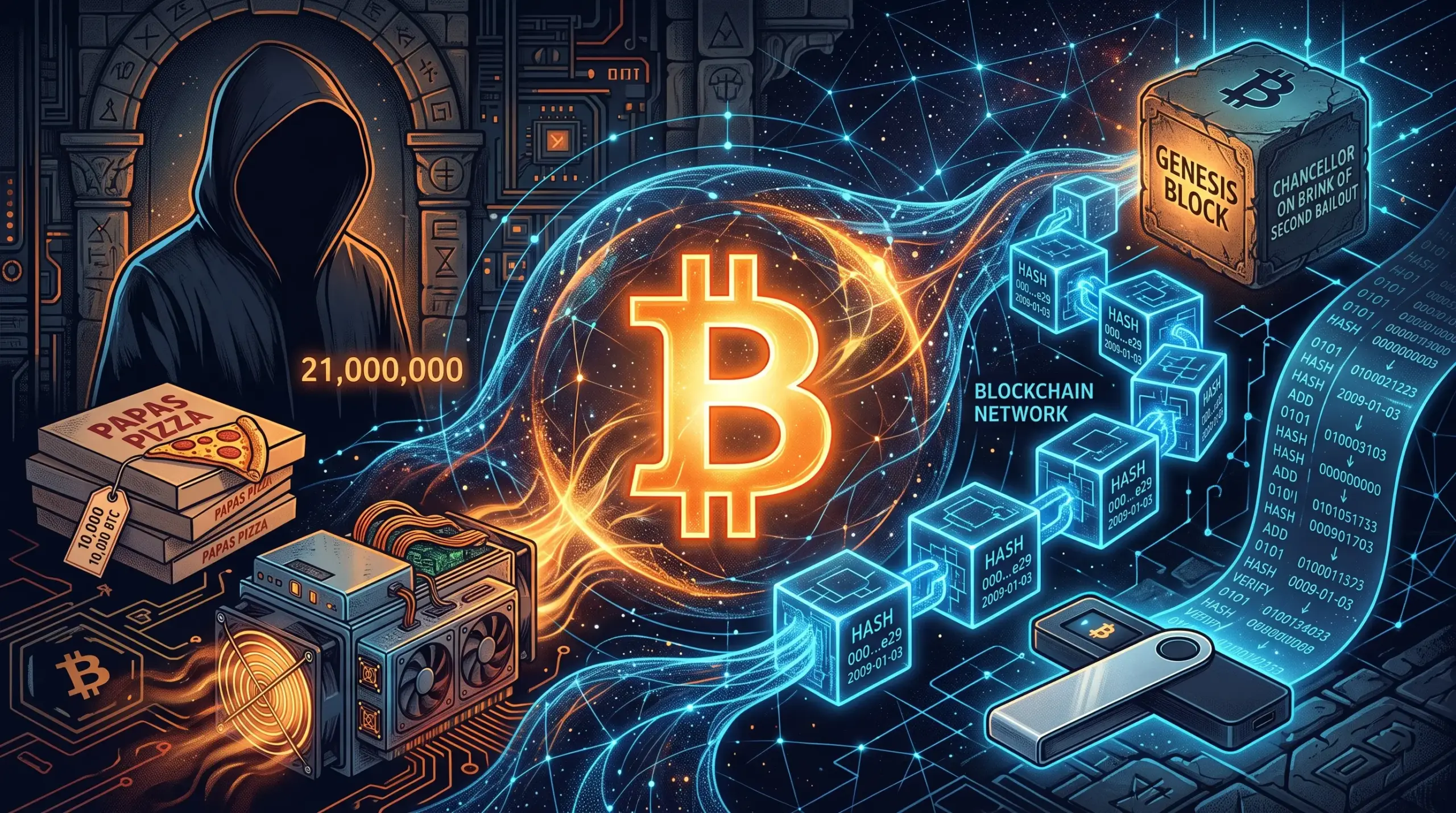
The first Bitcoin block is known as the Genesis Block or Block 0.
Its embedded data included the headline:
“The Times 03/Jan/2009 Chancellor on brink of second bailout for banks”
This message is widely interpreted as a timestamp and a statement about the financial environment in which Bitcoin was created.
The Genesis Block was mined on January 3, 2009, marking the beginning of the Bitcoin blockchain.
3. Bitcoin has a maximum supply of approximately 21 million coins
Bitcoin’s issuance schedule is designed to approach a maximum supply of approximately 21 million BTC.
New bitcoins are created as part of the block reward paid to miners. That reward is reduced over time through scheduled halvings.
The 21-million limit is one of Bitcoin’s most important monetary properties, but the exact final total is slightly below 21 million because of how the issuance schedule and integer rounding work.
4. Bitcoin is divisible into 100 million units
One bitcoin can be divided into 100 million smaller units called satoshis or ** sats**.
That means someone does not need to buy a whole Bitcoin to participate in the network.
For example:
1 BTC = 100,000,000 satoshisThis divisibility allows Bitcoin to be used for amounts much smaller than one coin, although network fees and platform minimums may affect whether small transactions are practical.
5. The first block reward was 50 BTC
When Bitcoin mining began, the block subsidy was 50 BTC per block.
The reward has been reduced through periodic halvings. The 2012 halving reduced it to 25 BTC, the 2016 halving reduced it to 12.5 BTC, the 2020 halving reduced it to 6.25 BTC and the 2024 halving reduced it to 3.125 BTC.
The reward will continue to decline until new issuance approaches zero.
6. Bitcoin’s mining reward is cut roughly every four years
The Bitcoin subsidy is reduced every 210,000 blocks, which works out to approximately four years because the protocol targets an average block interval of about ten minutes.
The exact calendar date of each halving cannot be known far in advance because blocks are not mined at perfectly regular intervals.
This is why “every four years” is an approximation, not a fixed date on a calendar.
7. Bitcoin does not produce a block exactly every ten minutes
Bitcoin targets an average block interval of about ten minutes, but actual blocks can arrive seconds apart or take much longer.
The protocol adjusts mining difficulty approximately every 2,016 blocks, or roughly two weeks, to help maintain that long-term average.metamask
This means ten minutes is a network target over time, not a timer that forces every block to appear precisely ten minutes after the previous one.
8. Bitcoin’s mining difficulty changes automatically
Mining difficulty is adjusted by the protocol rather than manually changed by a central bank or company.
If blocks were produced too quickly during the previous adjustment period, mining becomes more difficult. If blocks were produced too slowly, the difficulty can decrease.
The purpose is to keep the network’s average block production close to its target even when the total computing power dedicated to mining changes.
9. A Bitcoin transaction can be visible forever
Bitcoin transactions are recorded on a public blockchain.
That does not necessarily mean every transaction is immediately linked to a person’s legal identity. Bitcoin addresses are generally pseudonymous rather than fully anonymous.
However, blockchain analysis, exchange records, IP data, reused addresses and other information can sometimes connect addresses with real-world entities.
Once a transaction is confirmed and remains part of the chain, the record is designed to be extremely difficult to remove.
10. Bitcoin is pseudonymous, not anonymous
A Bitcoin address does not automatically display your name.
But the address, transaction history and movement of funds can be publicly inspected. If an address is connected to a verified exchange account, donation page, merchant or other identity-linked service, the activity may become easier to attribute.
This is why people should avoid describing Bitcoin as an anonymous payment system.
A more accurate description is pseudonymous public accounting.
11. Losing a private key can mean losing access permanently
Bitcoin ownership is controlled through private keys.
If someone loses the recovery phrase or private key controlling a wallet, there may be no central company that can reset access.
This is different from a traditional online account where a bank or platform can often reset a password after identity verification.
The situation makes backups essential—but backups must also be protected from theft, damage, fire, unauthorized access and accidental disclosure.
12. Some Bitcoin may be permanently inaccessible
Bitcoin can become inaccessible when private keys are lost, destroyed or forgotten.
The network does not have a complete official list of “lost coins,” so estimates vary widely. Some coins may be inactive for years but still recoverable, while others may be permanently inaccessible.
This is why claims such as “X million Bitcoin are definitely lost” should be treated carefully.
Dormant coins are not automatically lost coins.
13. The Genesis Block’s reward is unusual
The Genesis Block contains a 50 BTC block reward, but those coins are not spendable in the same ordinary way as later coinbase rewards.
The reason relates to how the original Bitcoin software treated the first block and its coinbase transaction.
This is one of the technical details that makes the Genesis Block different from standard mined blocks.
14. Bitcoin’s first known payment between users was 10 BTC
In the early days of the network, Satoshi Nakamoto sent 10 BTC to Hal Finney, an early cryptographer and Bitcoin software participant.
This is commonly described as the first known Bitcoin transaction between two people, separate from mining rewards. Historical accounts place it shortly after the Genesis Block.
The event demonstrated that Bitcoin could move from one user to another across the network.
15. Two pizzas were bought for 10,000 BTC
On May 22, 2010, Laszlo Hanyecz paid 10,000 BTC for two pizzas in what is widely considered the first known commercial Bitcoin purchase.
The event is commemorated as Bitcoin Pizza Day.
The story is often used to illustrate Bitcoin’s extreme historical price changes, but comparisons with today’s price can oversimplify the context. In 2010, Bitcoin had a tiny market, limited liquidity and almost no established pricing infrastructure.
16. Bitcoin mining is a competition, not a lottery with guaranteed winners
Mining uses proof of work.
Miners compete to find a valid block hash that satisfies the network’s current difficulty target. A miner may spend significant computing power without winning the next block.
Mining revenue depends on factors such as:
Hardware efficiency.
Electricity cost.
Network difficulty.
Block subsidy.
Transaction fees.
Pool arrangements.
Operational costs.
Owning mining hardware does not guarantee profitable results.
17. Bitcoin mining difficulty is independent of Bitcoin’s price
Bitcoin’s mining difficulty responds primarily to the network’s block-production performance and total mining competition.
A higher Bitcoin price may attract more miners, but the protocol does not directly adjust difficulty because the price moved up or down.
Difficulty and price can influence each other indirectly through miner economics, but they are not the same variable.
18. Bitcoin can be sent without a bank approving each transaction
Bitcoin transactions are validated by the network according to protocol rules.
Users do not need a traditional bank to approve a transfer between Bitcoin addresses. However, users do need access to their private keys, sufficient network fees and a valid transaction.
This does not mean Bitcoin has no intermediaries at all. Exchanges, payment processors, wallet providers and custodians may still participate in the user experience.
19. Bitcoin is not controlled by one company
Bitcoin does not have a corporate headquarters, CEO or central administrator who can unilaterally change the rules for everyone.
The network is maintained by a combination of:
Full-node operators.
Developers.
Miners.
Wallet providers.
Exchanges.
Users.
Businesses.
However, “decentralized” does not mean every participant has equal influence or that the system is immune to concentration. Mining pools, large holders, developers and service providers can have different forms of influence.
20. Running a node and mining are different
A Bitcoin full node verifies transactions and blocks according to the network’s rules.
A miner performs proof-of-work calculations and competes to add a new block.
You can run a full node without mining, and mining does not automatically mean that a miner can change the rules accepted by properly configured nodes.
This distinction is important when discussing who “controls” Bitcoin.
21. Confirming a Bitcoin transaction is not always immediate
A transaction may appear in a wallet before it has received a block confirmation.
A confirmation means that a miner has included the transaction in a block. Additional confirmations place more blocks on top of that block and generally increase confidence that reversing the transaction would require significant proof-of-work.
The number of confirmations required depends on the merchant, exchange, transaction size, risk tolerance and operational policy.
There is no universal number that is always correct for every situation.
22. Bitcoin transactions generally cannot be reversed
Once a Bitcoin transaction is confirmed, it usually cannot be reversed by calling customer support.
If you send Bitcoin to the wrong address, use the wrong network or fall for a scam, the funds may be permanently unrecoverable.
Some platforms may be able to help before a withdrawal is broadcast, but users should never assume that a blockchain transaction can be cancelled.
Always verify:
Recipient address.
Network.
Amount.
Memo or tag, where applicable.
Destination platform.
Fees.
23. Bitcoin has no built-in customer service department
There is no official Bitcoin company that can reset your wallet, reverse a confirmed transfer or recover a stolen recovery phrase.
Users interact with separate services such as:
Exchanges.
Wallet providers.
Hardware-wallet manufacturers.
Payment processors.
Developers.
Community forums.
A person claiming to be “Bitcoin support” and asking for your private key or recovery phrase is attempting to obtain control of your funds.
24. Bitcoin can be used without downloading the entire blockchain
Running a full Bitcoin node requires storing and validating blockchain data.
But many users interact with Bitcoin through lightweight wallets, mobile apps, exchanges or other services that do not store a complete copy of the blockchain on the user’s device.
The trade-off is that lightweight solutions may require users to trust a service or rely on simplified verification rather than independently validating every part of the network.
25. Bitcoin’s supply is transparent, but its future price is not
Anyone can inspect Bitcoin’s issuance rules, block history and transaction activity using blockchain tools.
That transparency does not make Bitcoin’s market value predictable.
A fixed supply does not guarantee a rising price. Bitcoin’s price can be affected by demand, liquidity, regulation, macroeconomic conditions, market structure, investor sentiment, technological developments and other factors.
The supply schedule is a protocol property—not a promise of investment returns.
The most important lesson
The most surprising thing about Bitcoin may be that its unusual features create both control and responsibility.
You can hold Bitcoin without a bank. You can verify transactions on a public network. You can send value across borders. You can also lose access through one forgotten recovery phrase or send funds to the wrong address with no guaranteed way to undo the mistake.
Bitcoin is not just digital money. It is a system that gives users more direct control while removing some traditional safety nets.
Frequently asked questions
Is Bitcoin really limited to 21 million?
Bitcoin’s issuance schedule is designed to approach approximately 21 million BTC. The exact final amount is slightly below 21 million due to protocol rounding and the way block rewards are calculated.
Who created Bitcoin?
Bitcoin was created under the pseudonym Satoshi Nakamoto. The person or group behind the name has not been conclusively identified.
Is Bitcoin anonymous?
No. Bitcoin is generally pseudonymous. Transactions are public, although addresses are not automatically labelled with legal names.
What is the smallest unit of Bitcoin?
The smallest standard unit is one satoshi, equal to 0.00000001 BTC.
What was Bitcoin Pizza Day?
Bitcoin Pizza Day commemorates the May 22, 2010 purchase of two pizzas for 10,000 BTC.
Can lost Bitcoin be recovered?
Usually not without the private key or recovery phrase. Some situations may involve a recoverable backup, but there is no central Bitcoin authority that can reset access.
Does Bitcoin create a block every ten minutes?
Ten minutes is the target average interval. Individual blocks can arrive faster or slower.
Can Bitcoin transactions be reversed?
Confirmed Bitcoin transactions generally cannot be reversed. Users must verify addresses, amounts and networks before sending.
Does Bitcoin have a CEO?
No. Bitcoin is maintained by a distributed ecosystem of users, developers, miners, nodes, businesses and service providers.
Is Bitcoin a good investment?
This article does not provide investment advice. Bitcoin is a high-risk asset, and historical facts do not predict future returns.